The Quality Standards Resource Centre helps extend understanding of the strengthened Aged Care Quality Standards, which took effect from 1 November 2025. You can search for resources by using keywords, or filtering by standard, outcome and audience. Before using the Resource Centre, please read the terms of use.
Falls Guidelines for Community Care
The Preventing Falls and Harm from Falls in Older People: Best Practice Guidelines for Community Care in Australia (Falls Guidelines for Community Care) has been developed for use by health professionals, primary care providers, the aged care workforce and other community care staff.
This resource may refer to information that will be updated from 1 November 2025 to align with the new Aged Care Act and Quality Standards.
Case study - Safe and Appropriate use of Psychotropic Medicines - Residential Aged Care
This resource is a fictional scenario that follows an older person’s care pathway with a residential aged care provider. The resource focuses on the systems and processes to support high-quality care of older people living with cognitive impairment. It includes 4 key priority areas: person-centred care, medication management, managing changed behaviours and transitions of care.
This resource may refer to information that will be updated from 1 November 2025 to align with the new Aged Care Act and Quality Standards.
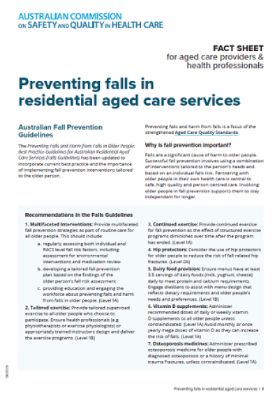
Preventing falls in residential aged care services - Fact sheet
This fact sheet supports the Falls Guidelines for Australian Residential Aged Care Services. It includes recommendations from the falls guidelines about multifaceted interventions, exercise, hip protectors, dairy food provision, vitamin D supplements, and osteoporosis medicines.
This resource may refer to information that will be updated from 1 November 2025 to align with the new Aged Care Act and Quality Standards.
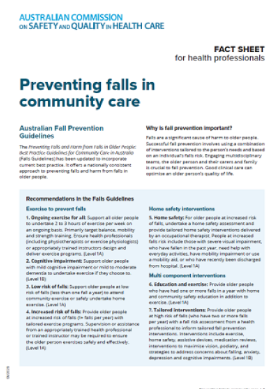
Preventing falls in community care - Fact sheet
This fact sheet supports the Falls Guidelines for Community Care. It includes recommendations from the falls guidelines including exercise to prevent falls, home safety interventions, multi component interventions, and single interventions for specific risk factors.
This resource may refer to information that will be updated from 1 November 2025 to align with the new Aged Care Act and Quality Standards.
Falls Guidelines for Australian Residential Aged Care Services
The Preventing Falls and Harm from Falls in Older People: Best Practice Guidelines for Australian Residential Aged Care Services has been developed for use by health professionals and the aged care workforce.
This resource may refer to information that will be updated from 1 November 2025 to align with the new Aged Care Act and Quality Standards.
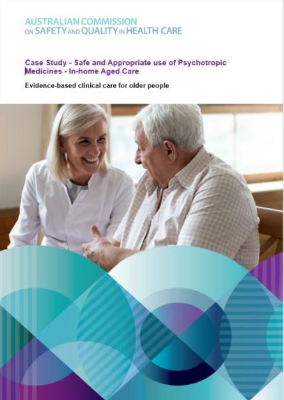
Case study - Safe and Appropriate use of Psychotropic Medicines - In-home Aged Care
This resource is a fictional scenario that follows an older person’s care pathway with an in-home aged care provider. The resource focuses on the systems and processes to support high-quality care of older people living with dementia. It includes 4 key priority areas: person-centred care, medication management, managing changed behaviours and transitions of care.
This resource may refer to information that will be updated from 1 November 2025 to align with the new Aged Care Act and Quality Standards.
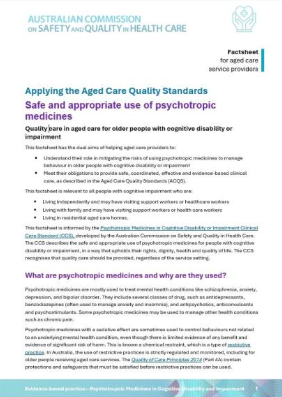
Safe and appropriate use of psychotropic medicines for aged care - Fact sheet
This fact sheet is informed by the Psychotropic Medicines in Cognitive Disability or Impairment Clinical Care Standard (CCS), developed by the Australian Commission on Safety and Quality in Health Care. The CCS describes the safe and appropriate use of psychotropic medicines for people with cognitive disability or impairment, in a way that upholds their rights, dignity, health and quality of life.
This resource may refer to information that will be updated from 1 November 2025 to align with the new Aged Care Act and Quality Standards.
Food focus group resources
This resource is a collection of resources about food focus groups. It includes a fact sheet about setting up a food focus group and a checklist for an effective food focus group. It also contains associated templates, including agenda, minutes, terms of reference and feedback form.
This resource may refer to information that will be updated from 1 November 2025 to align with the new Aged Care Act and Quality Standards.
National Model Clinical Governance Framework
This framework provides a consistent national approach to clinical governance in healthcare, focusing on governance structures, leadership, culture, safety and quality improvement systems, clinical performance, care environment, and consumer partnerships. It supports healthcare organisations in developing systems to ensure accountability, safety, quality of care, and continuous improvement, following the NSQHS Standards.
This resource may refer to information that will be updated from 1 November 2025 to align with the new Aged Care Act and Quality Standards.
Clinical governance and quality improvement to support medication management
This resource outlines clinical governance and quality improvement systems to support safe medication management. It requires health service organisations to implement systems for procuring, prescribing, dispensing, and monitoring medicines.
This resource may refer to information that will be updated from 1 November 2025 to align with the new Aged Care Act and Quality Standards.
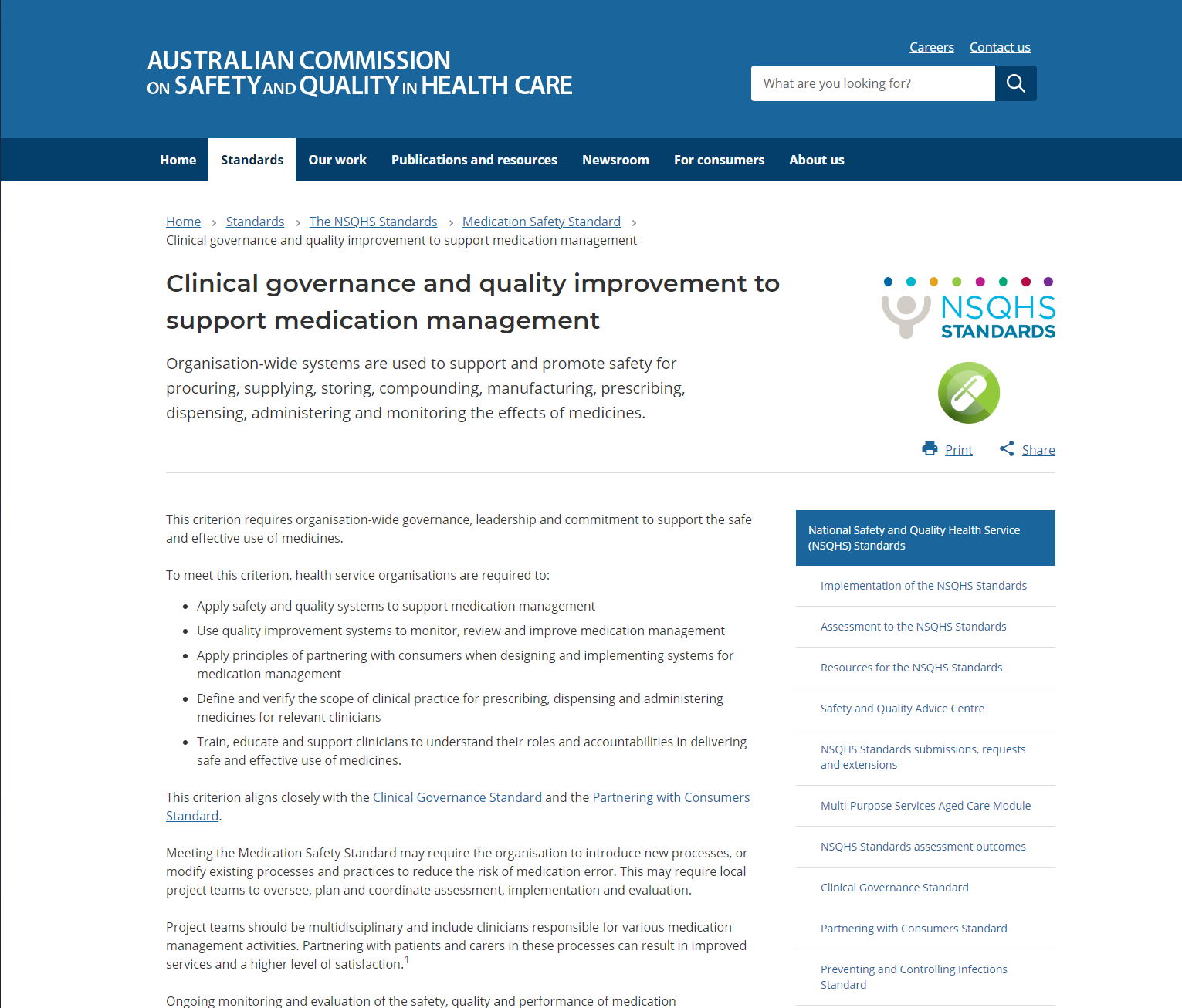
Fact sheet - Improving antimicrobial prescribing through selective reporting of antimicrobials
This fact sheet provides guidance on improving antimicrobial prescribing through selective reporting of antimicrobials for health service organisations and primary care providers. It includes information on diagnostic stewardship, definitions and the importance of selective reporting and other relevant information to support organisations and providers.
This resource may refer to information that will be updated from 1 November 2025 to align with the new Aged Care Act and Quality Standards.
Incontinence associated dermatitis and pressure injury
This resource provides guidance on managing incontinence-associated dermatitis (IAD) and pressure injuries (PI) in aged care. It highlights the differences between IAD and PI, emphasises the need for timely assessment and monitoring, and outlines strategies for prevention, including proper skin care, repositioning, and using appropriate continence products to prevent skin damage.
This resource may refer to information that will be updated from 1 November 2025 to align with the new Aged Care Act and Quality Standards.
Infection prevention & control resources
This resource provides guidance on infection prevention and control for aged care providers, outlining responsibilities to make sure safety and minimise infection risks. It covers the development of infection control programs, training requirements, governance, and compliance with national standards, supporting the delivery of safe, high-quality care in residential aged care settings.
This resource may refer to information that will be updated from 1 July 2025 to align with the new Aged Care Act and Quality Standards.
How to support everyday decision-making for people living with dementia in residential aged care: A guide for care workers
This guide offers practical strategies for care workers to support people with dementia in making everyday decisions within residential aged care settings. It covers communication techniques, promoting choice in personal care and daily activities, understanding body language, and emphasises person-centred care while respecting residents' preferences, dignity, and rights.
Preventing falls at home
This resource provides information on preventing falls at home for older people. It explains common causes of falls, such as poor lighting and slippery surfaces, and offers practical solutions like home modifications, exercise, and footwear adjustments. The document emphasises maintaining safety in and around the home to reduce the risk of falls.
This resource was developed by a state/territory government or organisation and therefore its applicability and usefulness may be limited.
RACGP aged care clinical guide (Silver Book) - Part A - Multimorbidity
This resource provides guidelines for managing patients with multimorbidity in aged care settings. It includes frameworks for assessing treatment burden, identifying patients at risk, and developing individualised care plans. It recommends validated tools for screening, a focus on quality of life, and strategies for medication review and care coordination.
RACGP aged care clinical guide (Silver Book) - Part B - Physiology of ageing
This guide reviews the physiological changes associated with ageing across multiple body systems, including cardiovascular, nervous, renal, respiratory, gastrointestinal, immune, skin, haematological, endocrine, and musculoskeletal systems. It also discusses clinical manifestations of these changes, implications for care, and provides recommendations for adjusting clinical practice to meet the needs of older adults, including medication reviews, hydration, mobility support, and preventive health strategies.
RACGP aged care clinical guide (Silver Book) - Part B - Geriatric syndromes
This guide outlines the challenges of diagnosing and managing geriatric syndromes, describing clusters like immobility, instability, incontinence, frailty, sarcopenia, and cognitive impairment. It introduces the 'Geriatric 5Ms' framework: Mind, Mobility, Medications, Mult complexity, and Matters Most, which assists in comprehensive assessment and care planning for older adults, focusing on mental health, physical function, medication review, complex health needs, and care goals.
RACGP aged care clinical guide (Silver Book) - Part A - Behavioural and psychological symptoms of dementia
This guide offers principles and practice points for assessing and managing behavioural and psychological symptoms of dementia (BPSD) in aged care. It includes frameworks for comprehensive patient assessment, non-pharmacological and pharmacological interventions, medication review, and personalised care plans to improve care outcomes for dementia patients.
RACGP aged care clinical guide (Silver Book) - Part A - Dementia
This resource offers guidance on diagnosing and managing dementia, covering its impact on cognitive and physical functions, screening methods, and differential diagnoses. It discusses appropriate use of medications, non-pharmacological approaches, and ongoing care plans for supporting those with dementia. It includes practical recommendations on cognitive assessments, functional reviews, and medication management.