The Quality Standards Resource Centre helps extend understanding of the strengthened Aged Care Quality Standards, which took effect from 1 November 2025. You can search for resources by using keywords, or filtering by standard, outcome and audience. Before using the Resource Centre, please read the terms of use.
Colouring, conversation, creativity and care
These colouring resources have been designed specifically for the Aged Care Quality and Safety Commission with the intention of providing a multifaceted creative experience for older Australians living in residential or home aged care settings, and for the people who care for them.
 fnd-colouring-resources-engagement-pages.pdf (PDF 1.72 MB)
fnd-colouring-resources-instructions.pdf (PDF 3.86 MB)
fnd-colouring-resources-engagement-pages.pdf (PDF 1.72 MB)
fnd-colouring-resources-instructions.pdf (PDF 3.86 MB)

Tips for engaging with Elders
This resource provides tips for engaging with Elders from Aboriginal communities. It includes practical advice for communicating and engaging in a respectful way, with a focus on awareness and understanding of the person and their community.
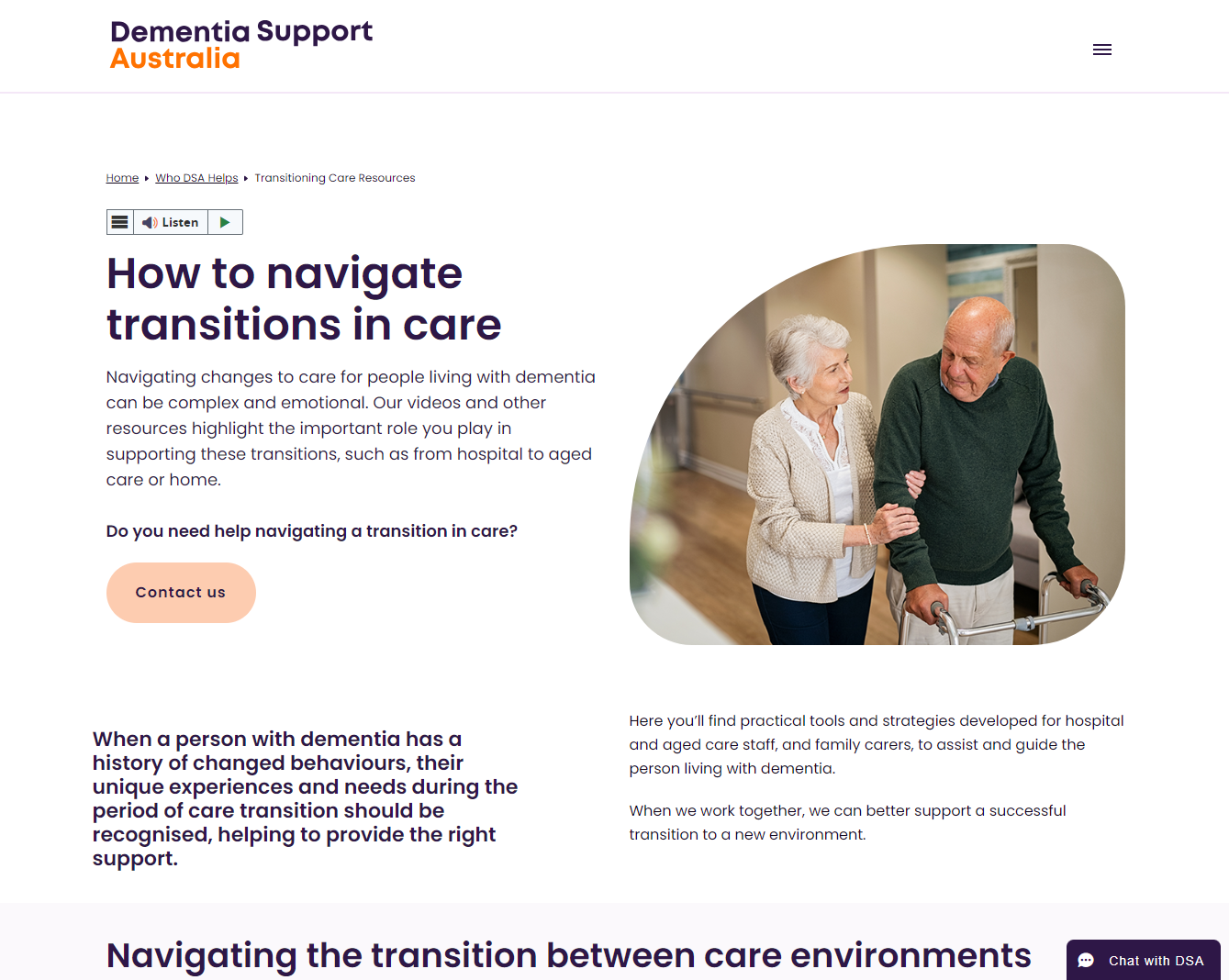
How to navigate transitions in care
This resource offers tools and strategies for navigating care transitions for people living with dementia. It provides support to hospital, aged care staff, and family carers, ensuring that the unique needs of those with dementia are met during transitions, such as moving from hospital to aged care or home.
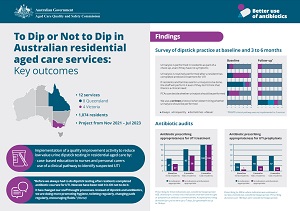
To Dip or Not to Dip in Australian residential aged care services - project findings
This visual abstract presents outcomes from a quality improvement project aimed at reducing low-value urine dipstick testing in aged care services. It included nurse education, implementing clinical pathways for UTI identification, and evaluating urinalysis practices and antibiotic prescribing. The findings demonstrate improved antibiotic prescribing appropriateness for UTIs over a 6-month follow-up period.
This resource may refer to information that will be updated from 1 November 2025 to align with the new Aged Care Act and Quality Standards.
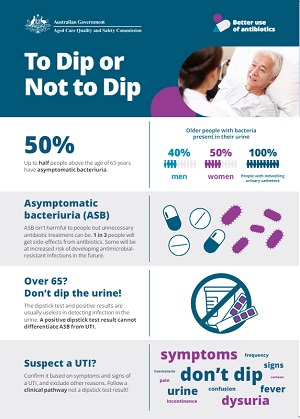
To Dip or Not to Dip - huddle tool A3 poster
This huddle tool poster provides guidance on appropriate use of urine dipstick tests in older adults. It explains that asymptomatic bacteriuria (ASB) is common and not harmful, but that unnecessary antibiotic treatment can be. It suggests confirming urinary tract infections (UTIs) through clinical symptoms rather than dipstick results.
This resource may refer to information that will be updated from 1 November 2025 to align with the new Aged Care Act and Quality Standards.
To Dip or Not to Dip - huddle tool A3 poster (PDF 393.96 KB)
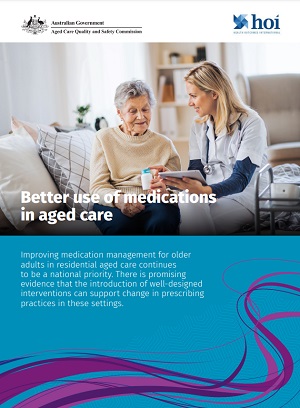
Better use of medications in aged care
This discussion paper explores strategies to improve medication management in aged care, including reducing inappropriate prescriptions and promoting non-pharmacological interventions. It reviews current interventions' effectiveness, highlights the use of psychotropic medications, and identifies areas for improving practices through multifaceted and multidisciplinary approaches for better resident outcomes and healthcare quality.
This resource may refer to information that will be updated from 1 November 2025 to align with the new Aged Care Act and Quality Standards.
About health data in Australia
This resource explains the collection, use, and regulation of health data in Australia. It highlights the importance of health data in improving healthcare, policy-making, and research. The document details various data sources, including the National Health Data Hub, ensuring data privacy and security while maximising the benefits of health information for research and service improvement. This resource may refer to information that will be updated from 1 November 2025 to align with the new Aged Care Act and Quality Standards.
Aged Care Financial Report
This resource outlines the mandatory Aged Care Financial Report (ACFR) for approved aged care providers. It details reporting requirements for residential care, home care, multi-purpose services, and short-term restorative care. Providers must submit financial data on income, expenses, and compliance statements to receive government funding. This resource may refer to information that will be updated from 1 November 2025 to align with the new Aged Care Act and Quality Standards.
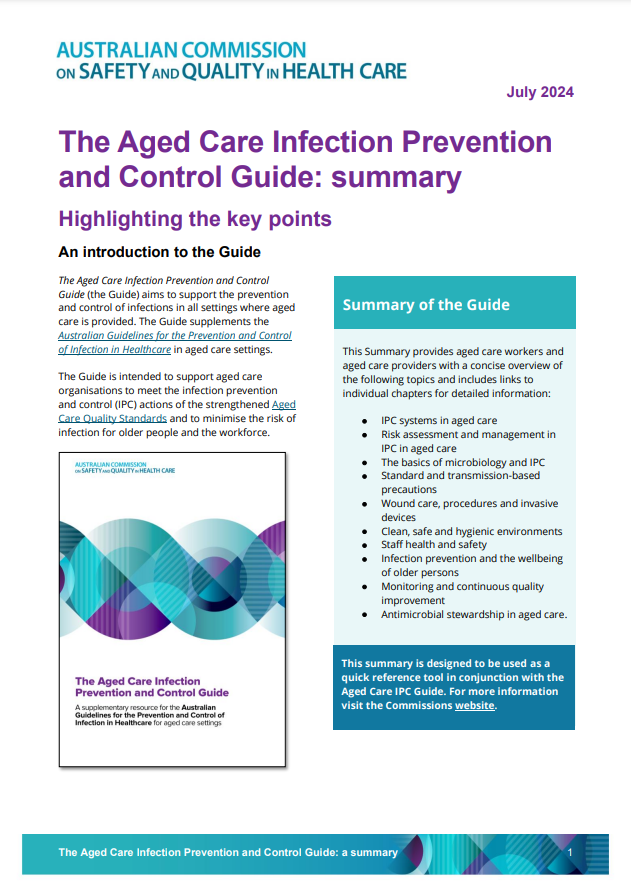
The Aged Care Infection Prevention and Control Guide: summary resource
This summary provides an overview of the Aged Care Infection Prevention and Control (IPC) Guide. It includes key topics such as IPC systems, risk assessment, standard and transmission-based precautions, staff health and safety, antimicrobial stewardship, and continuous quality improvement. It supports aged care providers in maintaining infection control standards.
This resource may refer to information that will be updated from 1 November 2025 to align with the new Aged Care Act and Quality Standards.
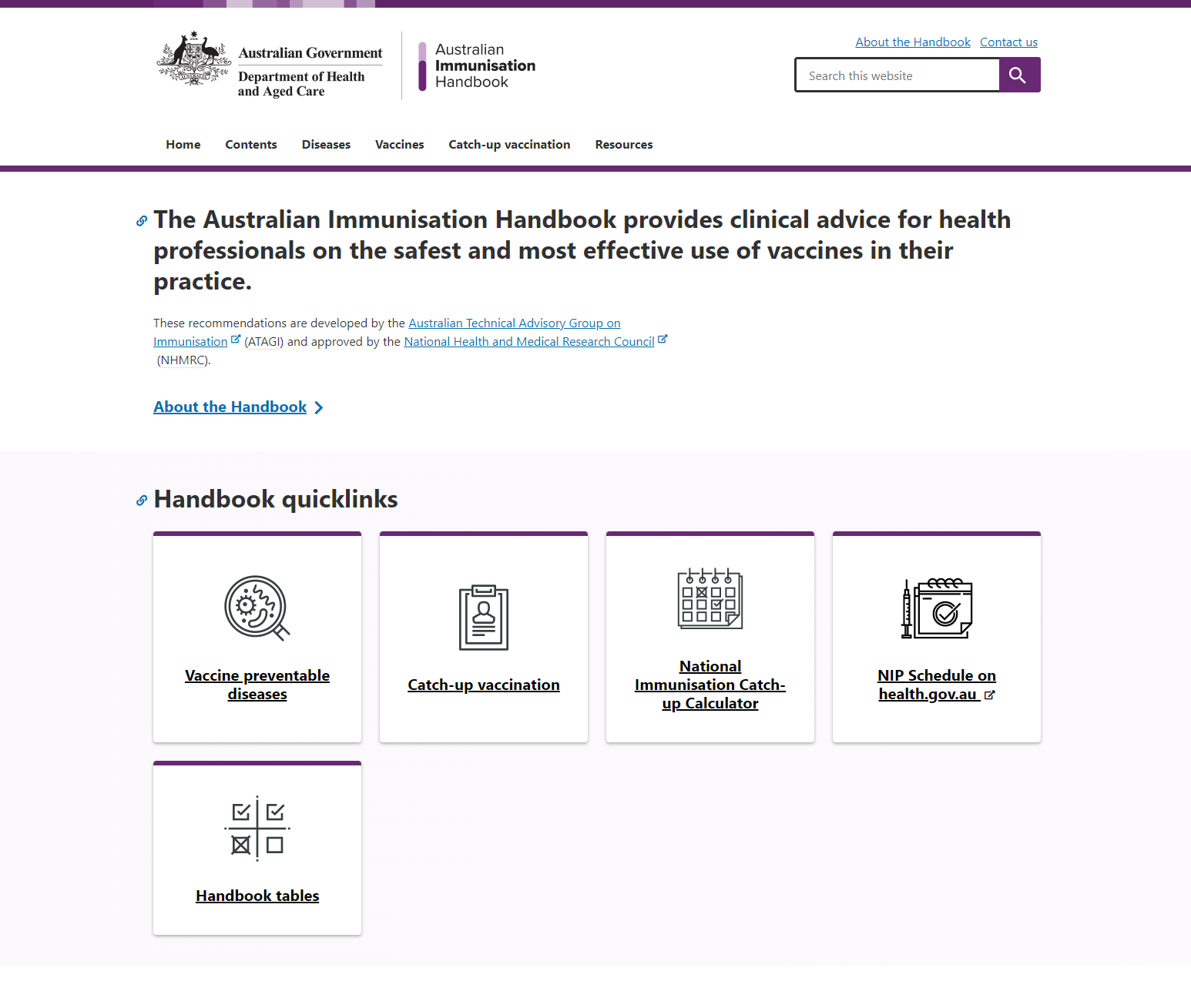
The Australian Immunisation Handbook
This resource provides clinical advice for health professionals on the safe and effective use of vaccines. It includes guidelines for vaccine administration, special risk groups, and updates on vaccine-preventable diseases. The handbook is a comprehensive reference for ensuring the best immunisation practices, particularly important in protecting vulnerable populations, including those in aged care.
This resource may refer to information that will be updated from 1 November 2025 to align with the new Aged Care Act and Quality Standards.
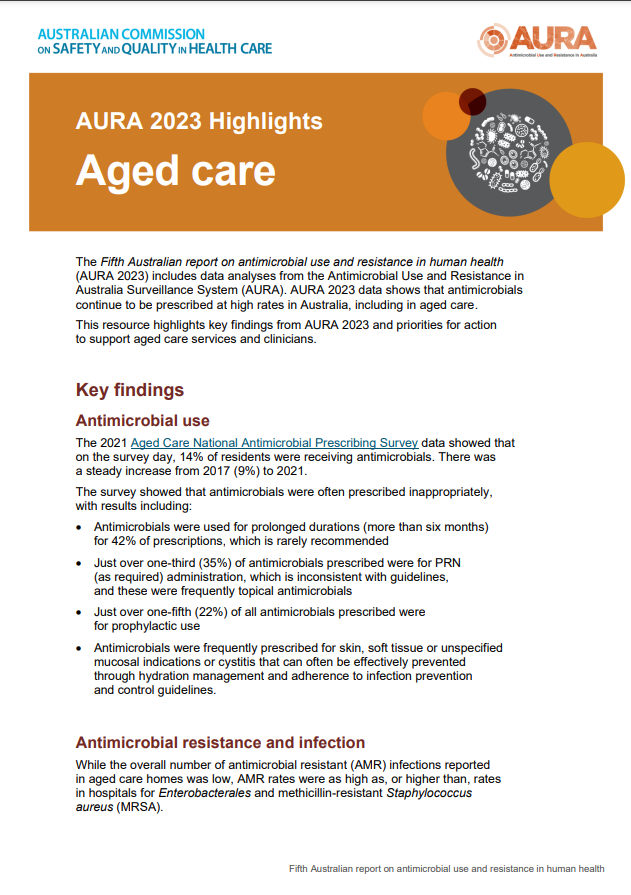
AURA 2023 Highlights for Aged care
This resource summarises key findings from the AURA 2023 report, focusing on antimicrobial use and resistance in aged care. It provides priorities for action to reduce inappropriate prescriptions, promote antimicrobial stewardship, and improve infection prevention and control in aged care settings, aligning with quality standards to enhance care for older people.
This resource may refer to information that will be updated from 1 November 2025 to align with the new Aged Care Act and Quality Standards.
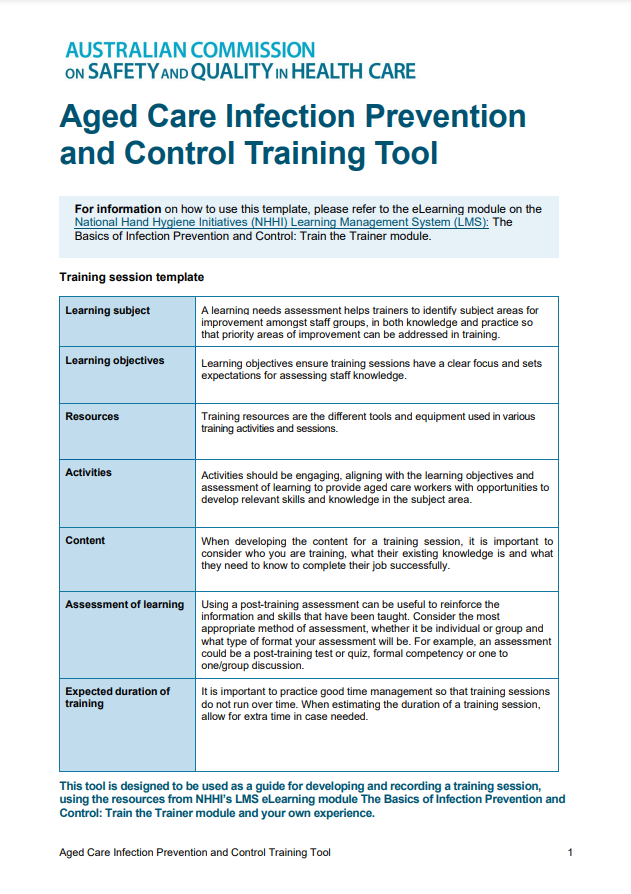
Aged Care Infection Prevention and Control Training Tool
This resource is a training tool designed to help develop and record infection prevention and control training sessions in aged care. It includes templates for learning objectives, content development, and assessment methods, ensuring effective delivery of key infection control practices using structured guidance and eLearning resources.
This resource may refer to information that will be updated from 1 November 2025 to align with the new Aged Care Act and Quality Standards.
The Aged Care Infection Prevention and Control Guide
This resource outlines the basic principles of infection prevention and control and explains how to apply these principles using a risk-based approach. The guide supports implementation of the strengthened Aged Care Quality Standards. It is a supplementary resource for the Australian Guidelines for the Prevention and Control of Infection in Healthcare for aged care settings.
This resource may refer to information that will be updated from 1 November 2025.
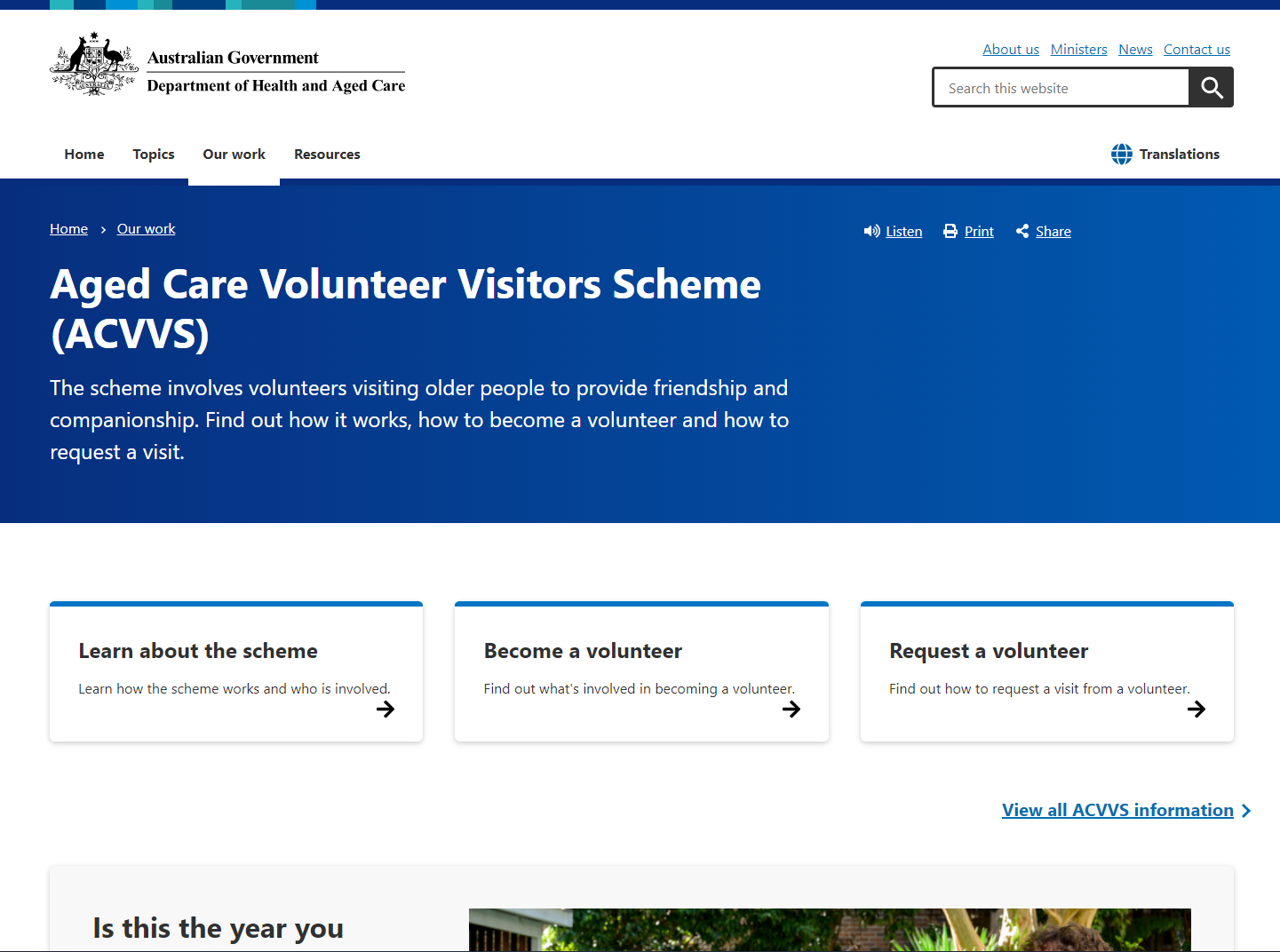
Aged Care Volunteer Visitors Scheme (ACVVS)
This resource explains the Aged Care Volunteer Visitors Scheme (ACVVS), which connects volunteers with older people to provide companionship and reduce social isolation. It details how to become a volunteer, request a visitor, and outlines the scheme's benefits for both recipients and volunteers in aged care settings.
This resource may refer to information that will be updated from 1 November 2025 to align with the new Aged Care Act and Quality Standards.
ARIIA Knowledge and Implementation Hub - Resources
The ARIIA Resources Hub is an evidence-based guide that supports innovation across the aged care sector. It provides a comprehensive collection of tools, guidelines, and frameworks for aged care providers, focusing on technology adoption, clinical standards, and care improvement strategies. The hub offers resources to enhance service quality and support the digital transformation of aged care.
This resource may refer to information that will be updated from 1 November 2025 to align with the new Aged Care Act and Quality Standards.

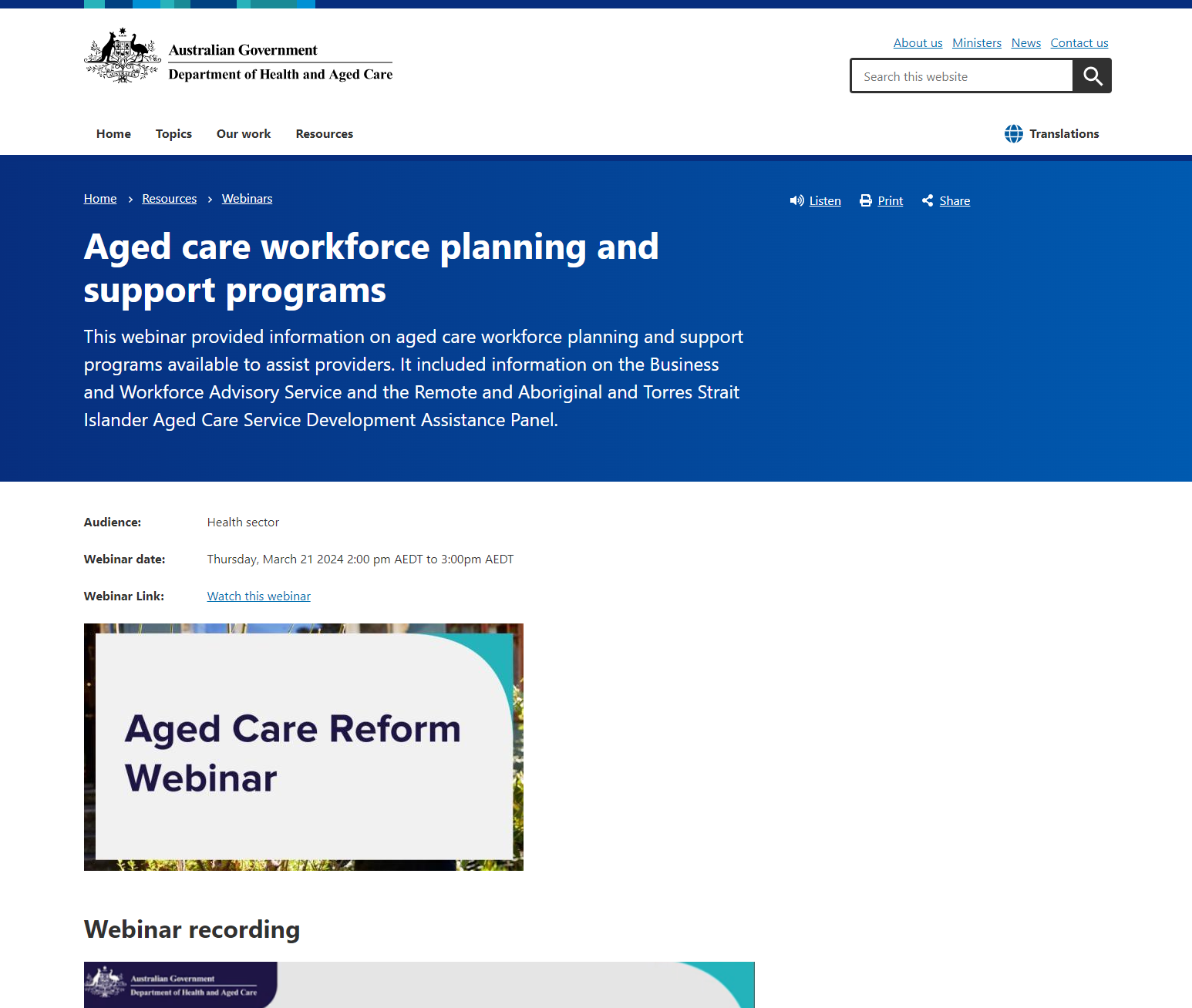
Aged care workforce planning and support programs
This resource provides information about aged care workforce planning and support programs available to help providers. It covers initiatives such as the Business and Workforce Advisory Service and the Remote and Aboriginal and Torres Strait Islander Aged Care Service Development Assistance Panel.
This resource may refer to information that will be updated from 1 November 2025 to align with the new Aged Care Act and Quality Standards.
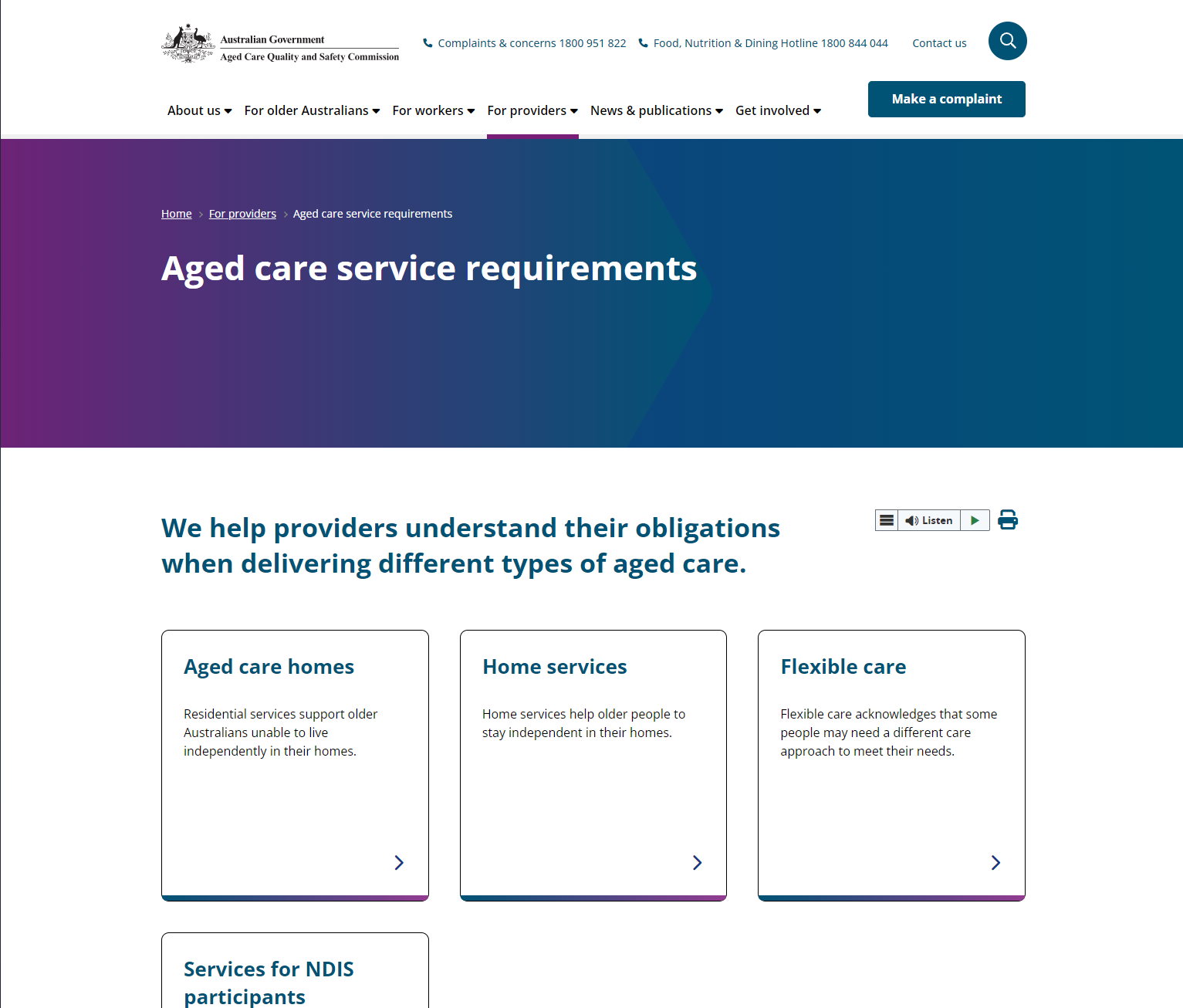
Aged care service requirements
This resource provides information on aged care service requirements, helping providers understand their obligations for delivering various types of care, including residential, home, and flexible care. It outlines the essential responsibilities for ensuring quality care and compliance with aged care standards, supporting independent living and tailored care approaches.
This resource may refer to information that will be updated from 1 November 2025 to align with the new Aged Care Act and Quality Standards.
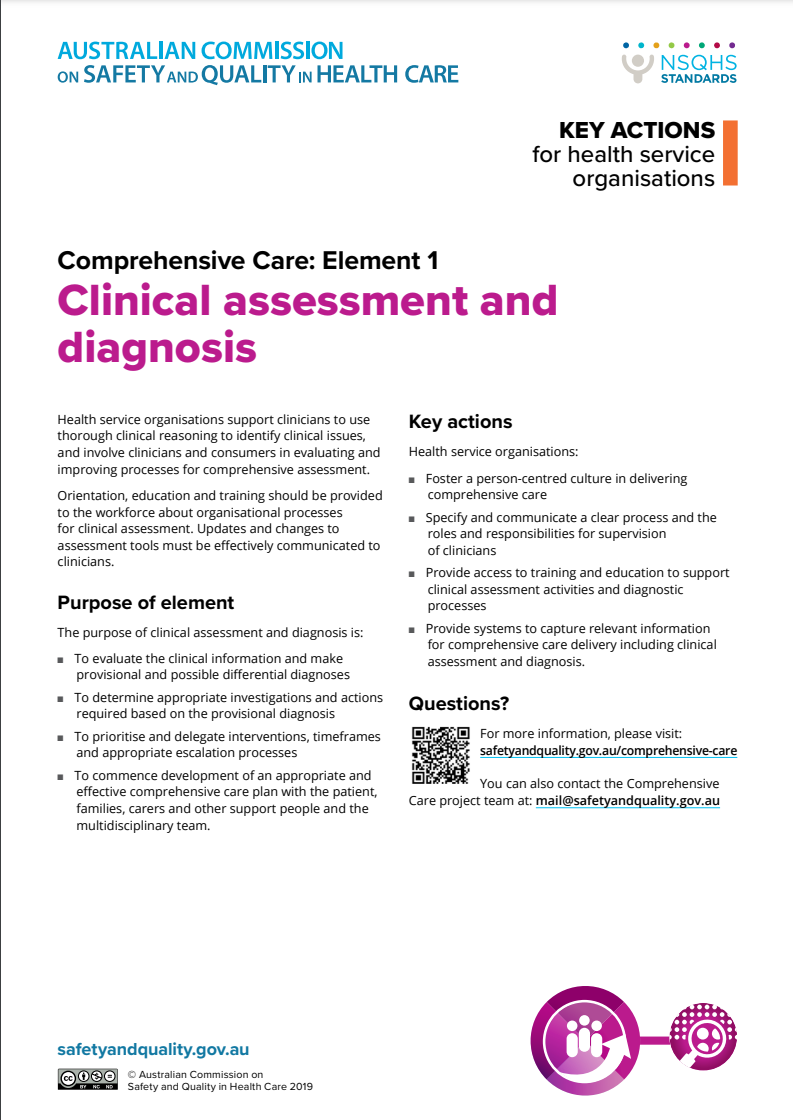
Comprehensive Care - Clinical assessment and diagnosis - Key actions for health service organisations
This resource provides actions for health service organisations to support clinical assessment and diagnosis, promoting a person-centred approach and comprehensive care planning. It highlights training, clear communication of roles, and systems for documenting diagnoses and care plans.
This resource may apply to healthcare contexts outside of aged care. Please consider the applicability of this resource to your care setting. This resource may refer to information that will be updated from 1 November 2025 to align with the new Aged Care Act and Quality Standards.
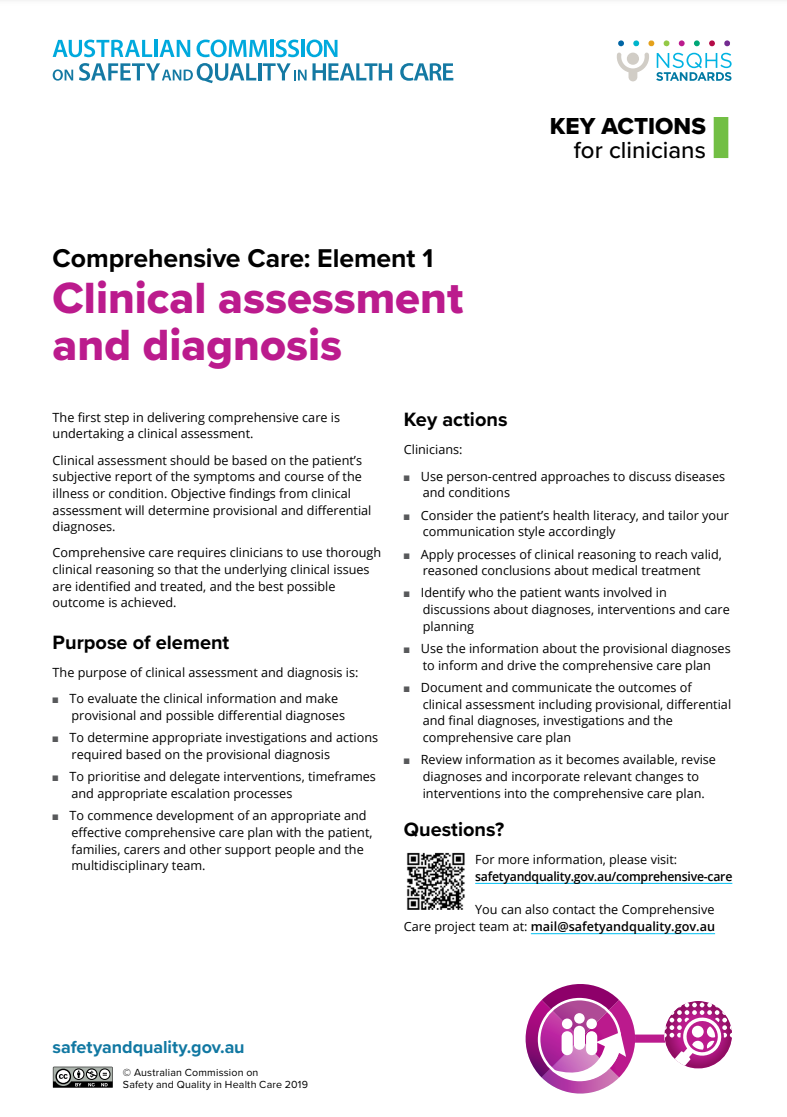
Comprehensive Care - Clinical assessment and diagnosis - Key actions for clinicians
This resource provides actions for health service organisations to support clinical assessment and diagnosis, promoting a person-centred approach and comprehensive care planning. It highlights training, clear communication of roles, and systems for documenting diagnoses and care plans.
This resource may apply to healthcare contexts outside of aged care. Please consider the applicability of this resource to your care setting. This resource may refer to information that will be updated from 1 November 2025 to align with the new Aged Care Act and Quality Standards.
COVID-19 resources for health professionals, including aged care providers, pathology providers and health care managers
This resource offers COVID-19 guidance for health professionals and aged care providers. It includes information on managing outbreaks, infection control, PPE use, and telehealth services. These resources support safe and effective care delivery while ensuring compliance with guidelines during the pandemic in aged care settings.
This resource may refer to information that will be updated from 1 November 2025 to align with the new Aged Care Act and Quality Standards.