The Quality Standards Resource Centre helps extend understanding of the strengthened Aged Care Quality Standards, which took effect from 1 November 2025. You can search for resources by using keywords, or filtering by standard, outcome and audience. Before using the Resource Centre, please read the terms of use.
Essential element 2: Identifying goals of care
This resource guides providers in identifying and setting goals of care with patients through shared decision-making. It fosters collaboration between patients, family, and healthcare teams to clarify expectations and establish personalised clinical and personal care objectives.
This resource may apply to healthcare contexts outside of aged care. Please consider the applicability of this resource to your care setting. This resource may refer to information that will be updated from 1 November 2025 to align with the new Aged Care Act and Quality Standards.
Environmental cleaning and infection prevention and control resources
This resource offers a range of environmental cleaning and infection prevention tools for healthcare settings, including guidelines for small organisations, cleaning audits, product selection, and emerging cleaning technologies. It supports aged care providers in maintaining clean, hygienic environments, helping them comply with infection control standards and ensure safety.
This resource may refer to information that will be updated from 1 November 2025 to align with the new Aged Care Act and Quality Standards.
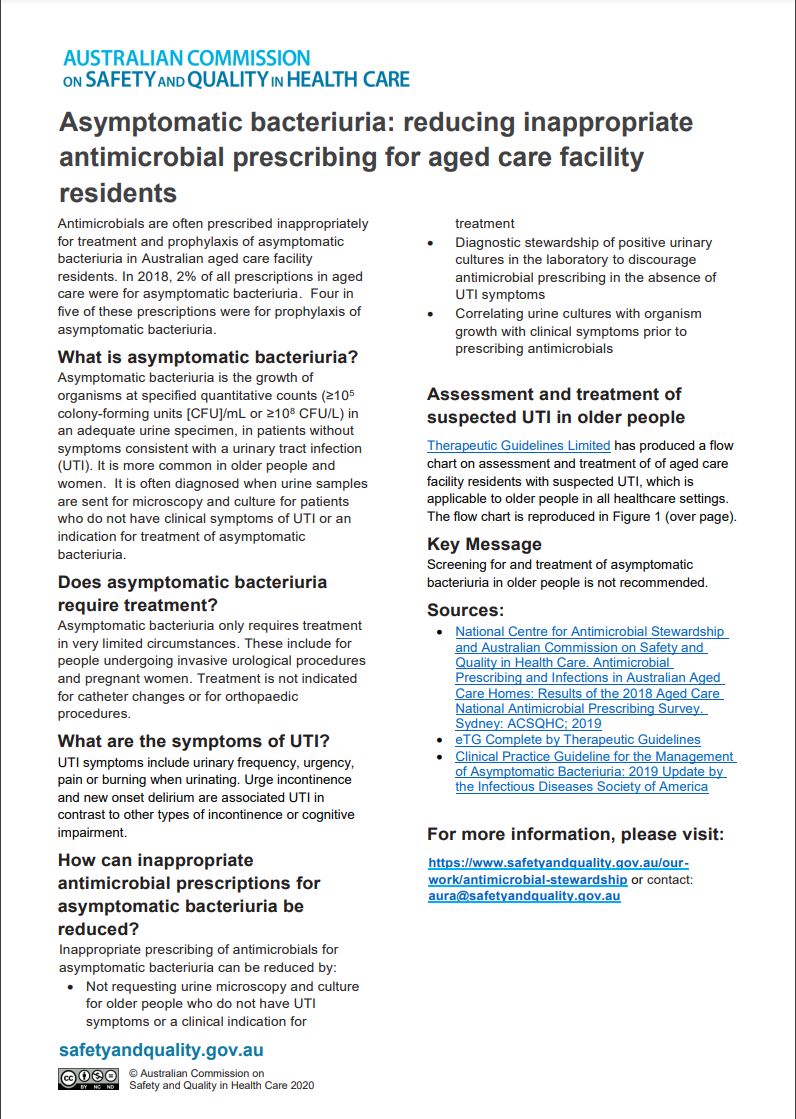
Fact sheet - Asymptomatic bacteriuria
This fact sheet offers guidance on managing asymptomatic bacteriuria and reducing inappropriate antimicrobial prescribing for residents of aged care facilities. It details symptoms, strategies to decrease unwarranted antimicrobial prescriptions for asymptomatic bacteriuria, and an assessment and treatment framework for residents suspected of urinary tract infections.
This resource may refer to information that will be updated from 1 November 2025 to align with the new Aged Care Act and Quality Standards.
Environmental design resources handbook
This resource supports improvements to environments for people living with dementia. The resource includes information and background on the key design principles and environmental assessment tools. It also includes the Indigenous Aged Care Design Guide. The handbook can be accessed in full, or individually as 7 separate resources.
This resource may refer to information that will be updated from 1 November 2025 to align with the new Aged Care Act and Quality Standards.
Falls prevention
This resource provides guidance for preventing falls and harm from falls in older people in healthcare settings. This resource may refer to information that will be updated from 1 November 2025 to align with the new Aged Care Act and Quality Standards.
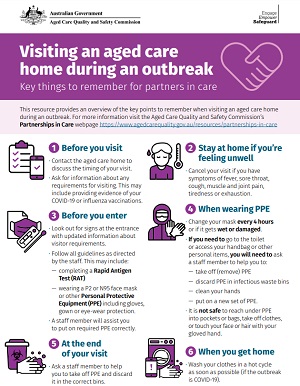
Visiting an aged care home during an outbreak - A3 poster
This A3 poster can be used by aged care facilities during an outbreak. It explains the key things for partners in care to remember when visiting an aged care home during an outbreak.
This resource may refer to information that will be updated from 1 November 2025 to align with the new Aged Care Act and Quality Standards.
 Visiting an aged care home during an outbreak poster (PDF 323.5 KB)
What we’re doing about palliative care
This resource outlines the Australian Government’s strategies, initiatives, and research for improving palliative care. It details the National Palliative Care Strategy, workforce training, and key programs such as at-home and aged care measures. It also highlights the National Framework for Advance Care Planning, ensuring access to quality palliative care across Australia.
This resource may refer to information that will be updated from 1 November 2025 to align with the new Aged Care Act and Quality Standards.
What is hand hygiene?
This resource provides guidance on proper hand hygiene practices in healthcare settings. It covers key topics such as the correct use of alcohol-based hand rubs, when to wash hands with soap and water, and appropriate glove use. It also addresses common hand care issues and strategies for preventing dermatitis in healthcare workers.
This resource may refer to information that will be updated from 1 November 2025 to align with the new Aged Care Act and Quality Standards.
Hand Hygiene presentation
This presentation is designed for healthcare workers to introduce the basics of hand hygiene, its significance in preventing infections, and ensuring both patient and healthcare worker safety. It outlines when and how to perform hand hygiene, its role in infection control, and the importance of compliance monitoring in healthcare settings.
This resource may refer to information that will be updated from 1 November 2025 to align with the new Aged Care Act and Quality Standards.
Visitor restrictions
This resource provides guidelines on visitor restrictions for aged care services during infectious outbreaks, such as COVID-19. It includes information on managing the impact of restrictions, ensuring the safety and wellbeing of care recipients, and balancing health risks with the need for social connection to prevent negative physical and psychological effects.
This resource may refer to information that will be updated from 1 November 2025 to align with the new Aged Care Act and Quality Standards.
Workforce responsibilities
This resource outlines the workforce responsibilities of aged care providers, including the legal obligation to provide skilled staff and support their workforce. It details mandatory requirements such as 24/7 registered nurse coverage and care minutes for residential aged care services.
This resource may refer to information that will be updated from 1 November 2025 to align with the new Aged Care Act and Quality Standards.
Your aged care rights
This resource offers tools for self-advocacy in aged care, helping people understand their rights and what to expect from providers. It includes resources on the Charter of Aged Care Rights, care planning, and maintaining connections, supporting people in navigating and maximising their aged care experience.
This resource may refer to information that will be updated from 1 November 2025 to align with the new Aged Care Act and Quality Standards.
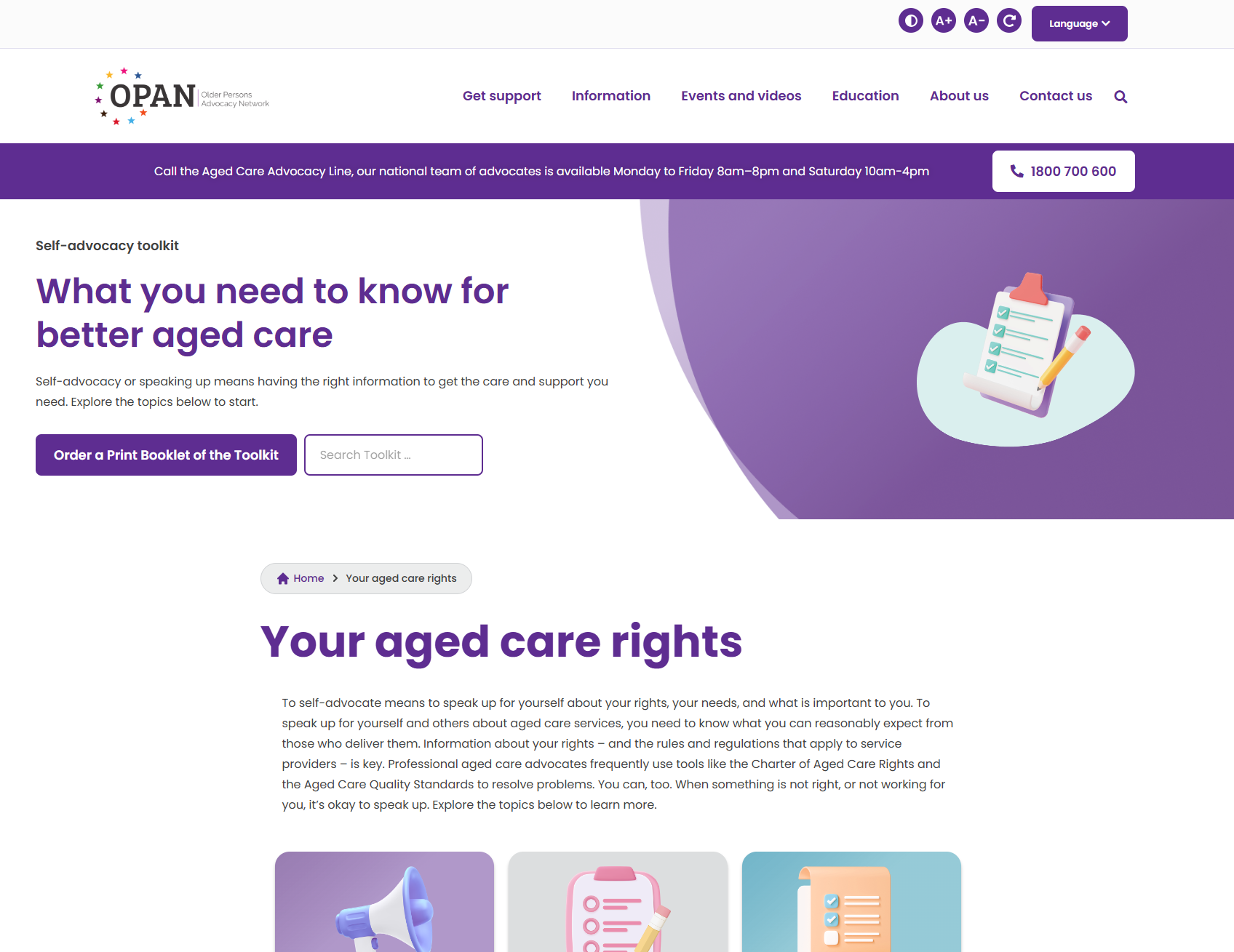
Residential aged care food services discussion paper
This paper presents a high-level overview of contemporary evidence regarding food services in residential aged care settings.
Residential aged care food services discussion paper (PDF 536.47 KB)
Benefits of effective incident management video
In this short video, we provide an overview of the benefits of effective incident management in residential aged care settings under the Serious Incident Response Scheme (SIRS), which commenced on 1 April 2021.
Frequently asked questions about consent
This fact sheet covers the frequently asked questions about consent in aged care.
Frequently asked questions about consent (PDF 433.26 KB)
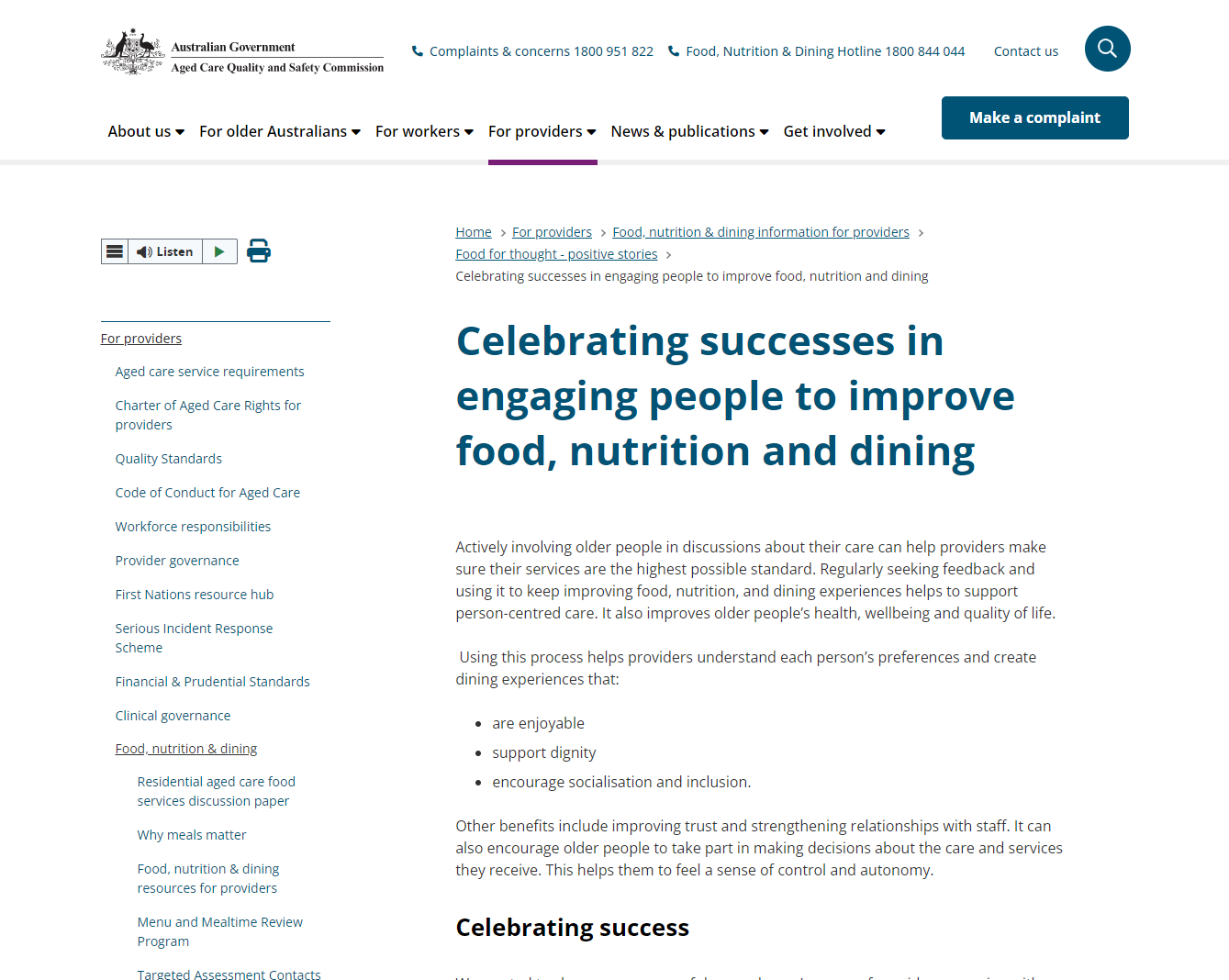
Celebrating successes in engaging people to improve food, nutrition and dining
This resource highlights successful practices in engaging older people to improve food, nutrition, and dining experiences. Providers can use examples like food focus groups, family involvement in recipe changes, and resident-led dining committees to promote enjoyable, dignified, and inclusive dining. It fosters better health, wellbeing, and relationships with staff.
This resource may refer to information that will be updated from 1 November 2025 to align with the new Aged Care Act and Quality Standards.
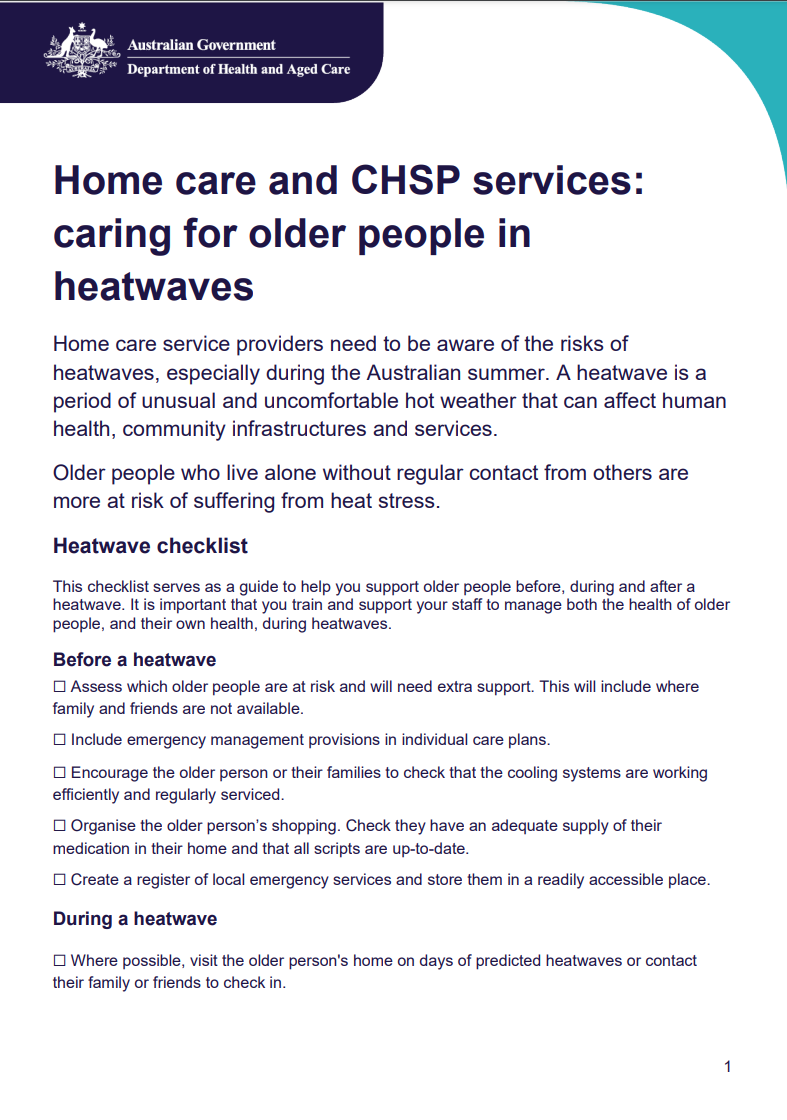
Caring for older people in heatwaves – Home Care and CHSP
This resource provides a checklist for home care and Commonwealth Home Support Programme (CHSP) providers to help them prepare for and manage the care of older people during heatwaves. It outlines steps to take before, during, and after heatwaves, ensuring the health and safety of those under their care.
This resource may refer to information that will be updated from 1 November 2025 to align with the new Aged Care Act and Quality Standards.
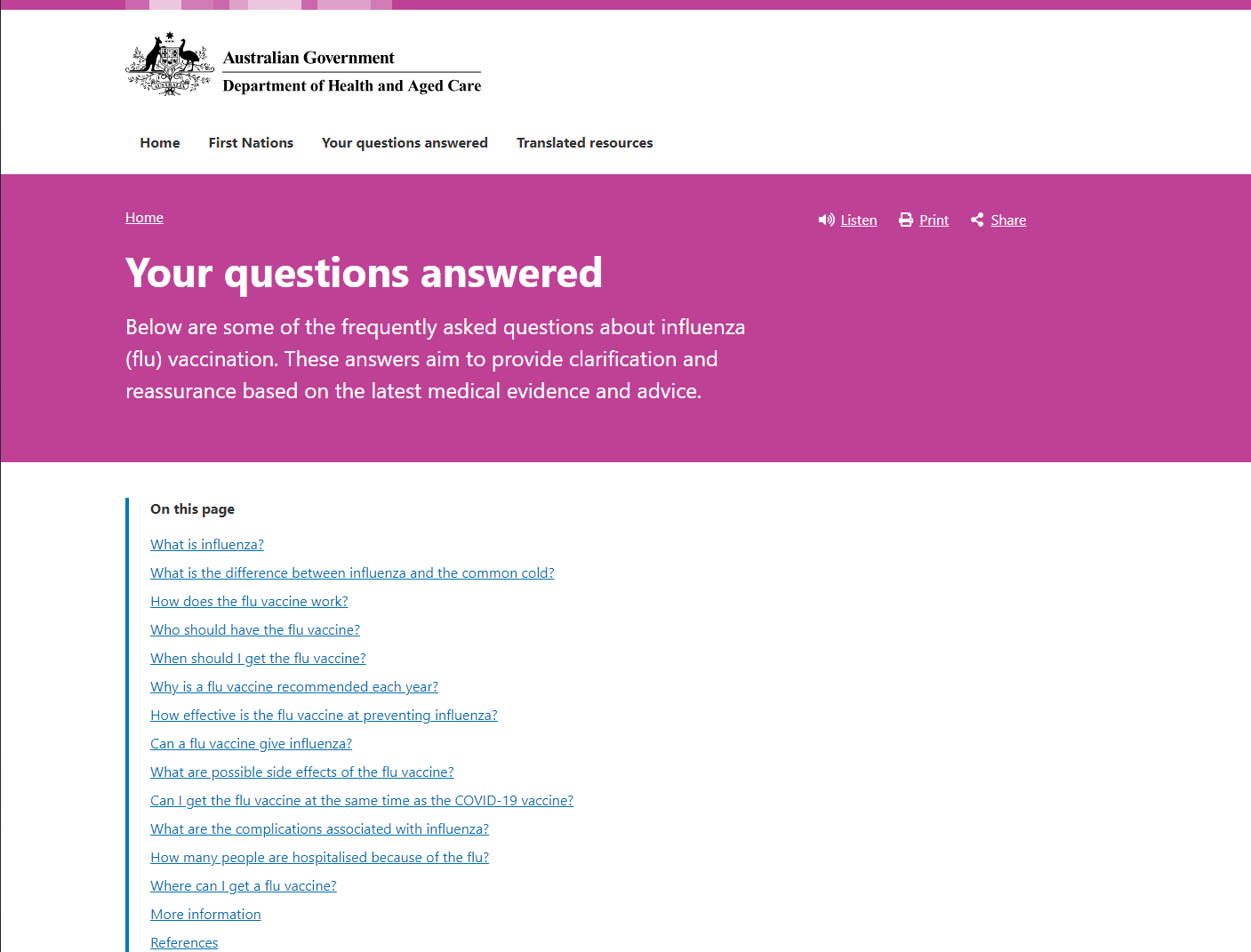
Your questions answered - Influenza
This resource answers common questions about influenza vaccination. It explains the importance of annual flu vaccines, who should get vaccinated, and how the vaccine works. It highlights the vaccine's role in preventing serious complications, particularly for older adults, children, pregnant people, and those with chronic health conditions.
This resource may refer to information that will be updated from 1 November 2025 to align with the new Aged Care Act and Quality Standards.
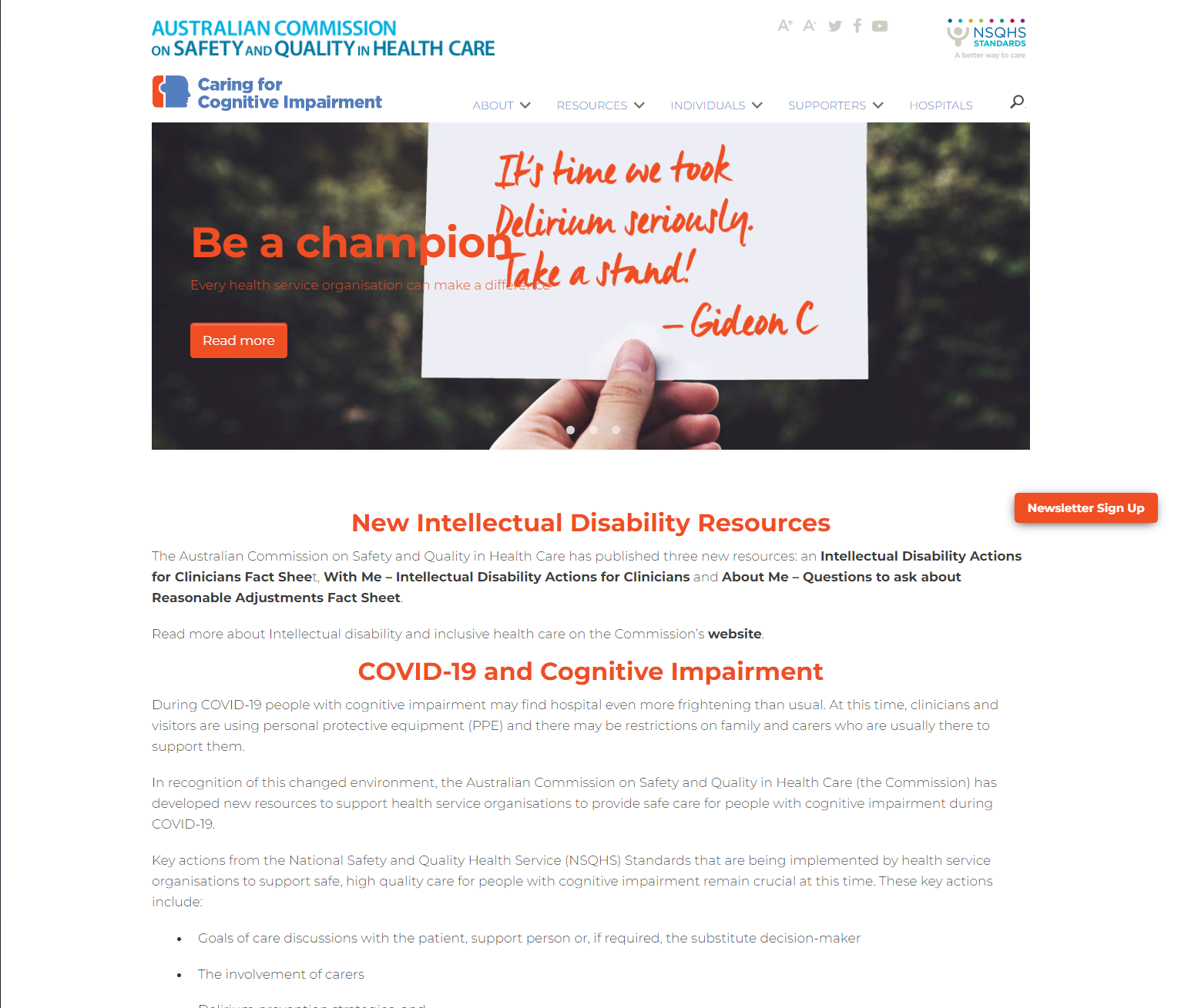
Caring for Cognitive Impairment
This resource outlines support for health service organisations to provide safe, high-quality care for people with cognitive impairment, especially during COVID-19. It includes new intellectual disability resources, fact sheets, posters, and guidance aligned with the National Safety and Quality Health Service (NSQHS) Standards to improve patient outcomes and care experiences.
This resource may refer to information that will be updated from 1 November 2025 to align with the new Aged Care Act and Quality Standards.
Caring for Older People in heatwaves – Residential Aged Care
This resource provides guidance to care for older people living in residential aged care services during a heatwave. The resource includes checklists to guide providers to support older people before, during and after a heatwave. It includes clinical assessment guidance and where to find more information about heatwaves.
This resource may refer to information that will be updated from 1 November 2025 to align with the new Aged Care Act and Quality Standards.