The Quality Standards Resource Centre helps extend understanding of the strengthened Aged Care Quality Standards, which took effect from 1 November 2025. You can search for resources by using keywords, or filtering by standard, outcome and audience. Before using the Resource Centre, please read the terms of use.
Overview of Voluntary Assisted Dying
This resource provides an overview of voluntary assisted dying (VAD) in Australia, detailing eligibility criteria, procedures, and legal requirements. It covers how VAD laws vary across jurisdictions, safeguards in place, and responsibilities for health professionals and institutions. Health professionals can conscientiously object but may still have legal responsibilities.
National Palliative Care Standards for All Health Professionals and Aged Care Services
The National Palliative Care Standards provide guidance for all health professionals and aged care services to deliver high-quality generalist palliative care. They support improved experiences and outcomes for people receiving care, and are intended for use across diverse care settings. Resources like audit tools and fact sheets are available to aid self-assessment and adherence to these standards.
What we’re doing about palliative care
This resource outlines the Australian Government’s strategies, initiatives, and research for improving palliative care. It details the National Palliative Care Strategy, workforce training, and key programs such as at-home and aged care measures. It also highlights the National Framework for Advance Care Planning, ensuring access to quality palliative care across Australia.
This resource may refer to information that will be updated from 1 November 2025 to align with the new Aged Care Act and Quality Standards.
Benefits of effective incident management video
In this short video, we provide an overview of the benefits of effective incident management in residential aged care settings under the Serious Incident Response Scheme (SIRS), which commenced on 1 April 2021.
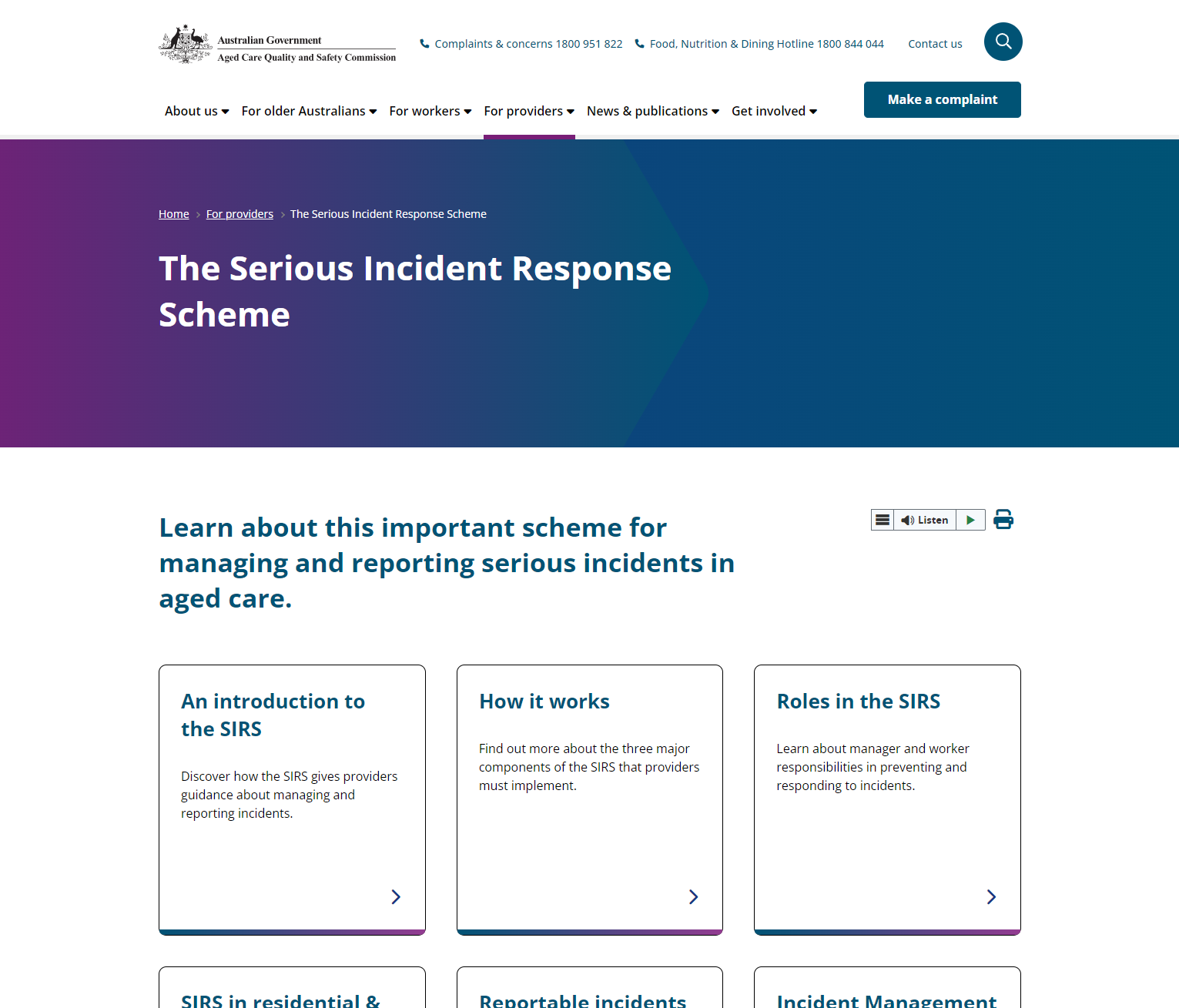
The Serious Incident Response Scheme
This resource provides an introduction to the Serious Incident Response Scheme (SIRS), outlining its role in managing and reporting serious incidents in aged care. It includes guidance on incident management systems, the responsibilities of managers and workers, and reporting requirements for residential and home services.
This resource may refer to information that will be updated from 1 November 2025 to align with the new Aged Care Act and Quality Standards.
Governing for Reform in Aged Care Program
This resource outlines the Governing for Reform in Aged Care Program, designed to strengthen corporate and clinical governance capabilities for aged care leaders. It provides tools, online learning modules, webinars, and podcasts to support governance improvement and help leaders engage in reform efforts.
This resource may refer to information that will be updated from 1 November 2025 to align with the new Aged Care Act and Quality Standards.