Aged care laws in Australia have now changed. The new Aged Care Act 2024 and Aged Care Rules 2025 now apply. While we complete updating of our website, including draft guidance and other materials, to align with the new laws, providers are advised to refer to the new Act and Rules for any required clarification of their obligations and legal responsibilities. Thank you for your patience.

Quality Standards Resource Centre

The Quality Standards Resource Centre helps extend understanding of the strengthened Aged Care Quality Standards, which take effect from 1 November 2025. The Resource Centre will be updated to reflect key changes made to the draft strengthened Standards. You can search for resources by using keywords, or filtering by standard, outcome, audience and theme. Before using the Resource Centre, please read the terms of use.

Displaying 1 to 5 of 5 result(s)
/quality-standards/participating-consumers

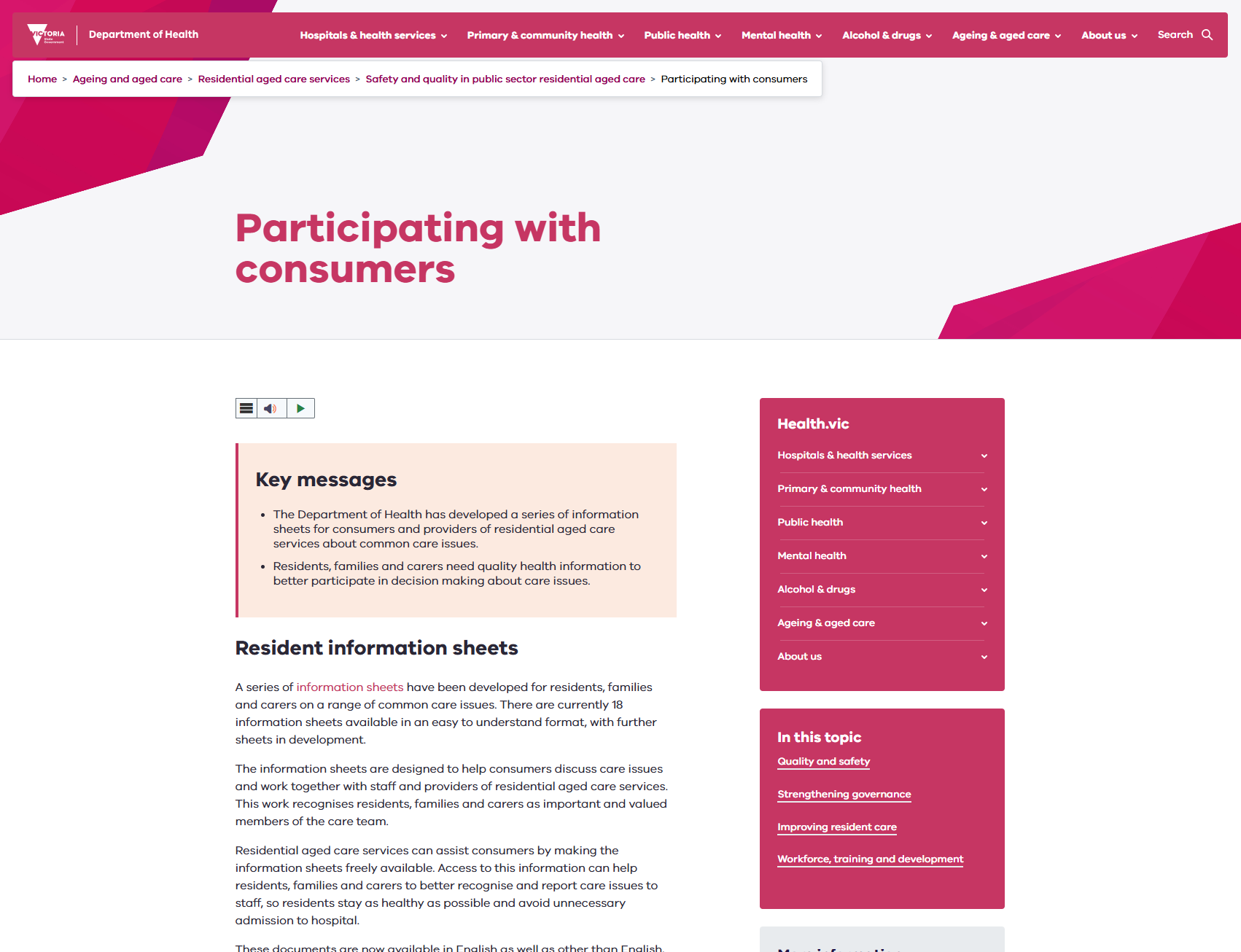
Participating with consumers

Fact sheet
Last Updated

This resource provides information sheets for residents, families, and carers to support decision-making in residential aged care. Covering topics such as pain management, falls, and medicines, it promotes health literacy, enabling consumers to engage in discussions and report care issues effectively.

This resource was developed by a state/territory government or organisation and therefore its applicability and usefulness may be limited.
Author
External resource
Key Theme
Assessment and planning, Care coordination and transitions, Medication management, Clinical safety, Delivering comprehensive care and services, Palliative and end of life care
Standard
3: The Care and Services, 5: Clinical Care
Outcomes
3.1 Assessment and planning, 3.4: Planning and coordination of funded aged care services, 5.3: Safe and quality use of medicines, 5.5: Safety of clinical care services, 5.6 Cognitive impairment  , 5.7: Palliative care and end-of-life care
Participating with consumers
/quality-standards/communication-clinical-handover

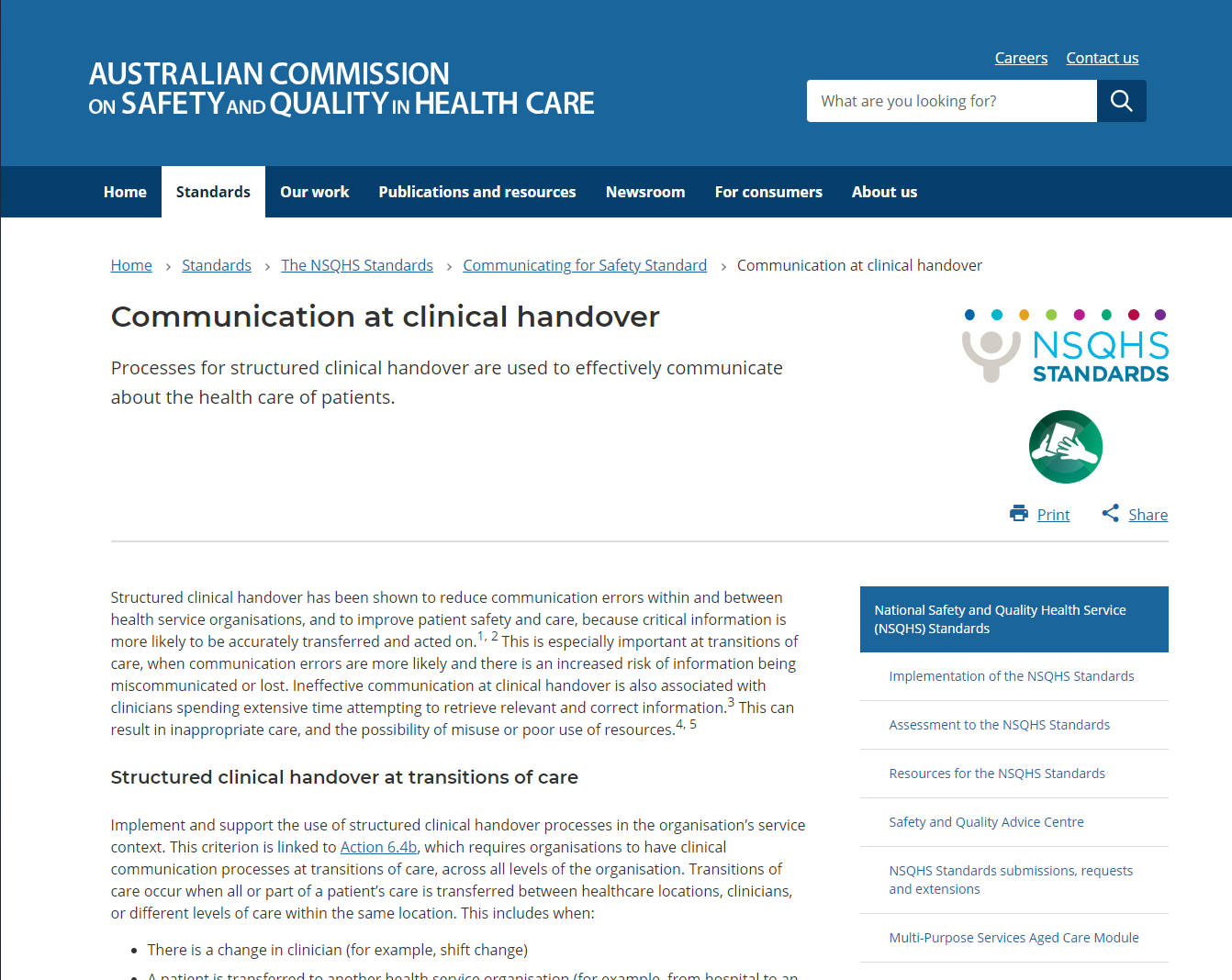
Communication at clinical handover

Guidance
Last Updated

This resource focuses on structured clinical handover processes to improve communication during patient care transitions. It highlights the importance of standardising handover procedures to make sure relevant information is effectively communicated, reducing errors and enhancing patient safety, especially during care transfers in healthcare settings, including aged care. 

This resource may refer to information that will be updated from 1 November 2025 to align with the new Aged Care Act and Quality Standards.
Author
Australian Commission On Safety And Quality In Health Care
Key Theme
Delivering comprehensive care and services, Care coordination and transitions, Assessment and planning
Standard
3: The Care and Services, 5: Clinical Care, 7: The Residential Community
Outcomes
3.3: Communicating for safety and quality, 3.4: Planning and coordination of funded aged care services, 5.4: Comprehensive care, 7.2: Transitions
Communication at clinical handover
/quality-standards/communicating-safety

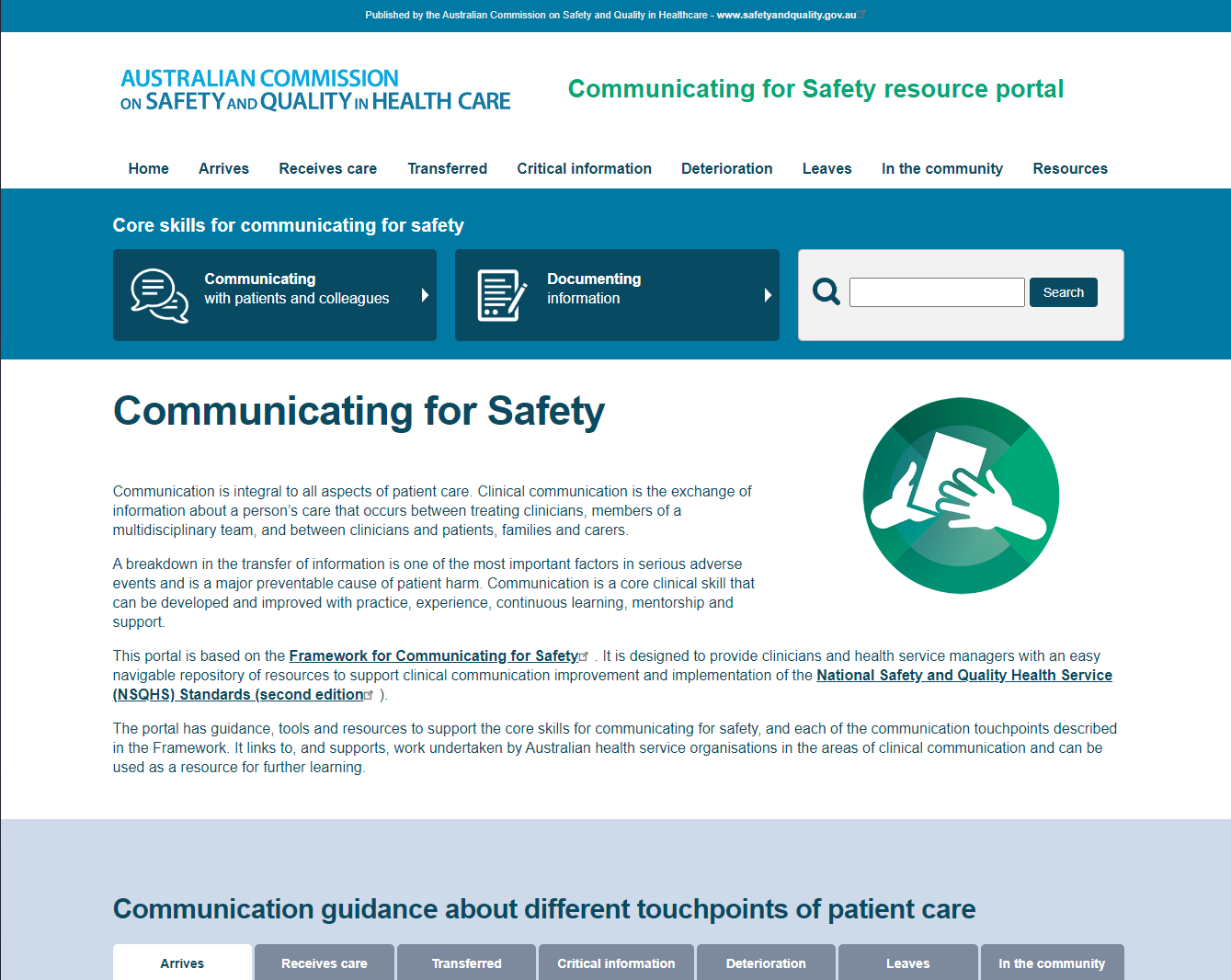
Communicating for Safety

Guidance

This resource provides tools and guidance on improving clinical communication to enhance patient safety. It focuses on key communication touchpoints, such as handovers, decision-making, and care transitions. Designed to support healthcare providers, it offers practical strategies to reduce errors and improve outcomes in aged care and other healthcare settings. 

This resource may refer to information that will be updated from 1 November 2025 to align with the new Aged Care Act and Quality Standards.
Author
Australian Commission On Safety And Quality In Health Care
Key Theme
Delivering comprehensive care and services, Care coordination and transitions, Assessment and planning
Standard
3: The Care and Services, 5: Clinical Care, 7: The Residential Community
Outcomes
3.3: Communicating for safety and quality, 3.4: Planning and coordination of funded aged care services, 5.4: Comprehensive care, 7.2: Transitions
Communicating for Safety
/quality-standards/national-aged-care-mandatory-quality-indicator-program

National Aged Care Mandatory Quality Indicator Program

Guidance

The National Aged Care Mandatory Quality Indicator Program aids residential aged care providers in enhancing their services by allowing them to benchmark their performance against national outcomes. The program resource provides guidance on data submission frequency, explains the program's role, and provides more information on open hours and contact details. 

This resource may refer to information that will be updated from 1 November 2025 to align with the new Aged Care Act and Quality Standards. 

Author
Aged Care Quality & Safety Commission
Key Theme
Accountability and quality system
Standard
5: Clinical Care
Outcomes
2.3: Accountability, quality system and policies and procedures, 2.2a: Quality, safety and inclusion culture to support aged care workers to deliver quality care, 2.2b: Quality, safety and inclusion culture to support individuals
National Aged Care Mandatory Quality Indicator Program
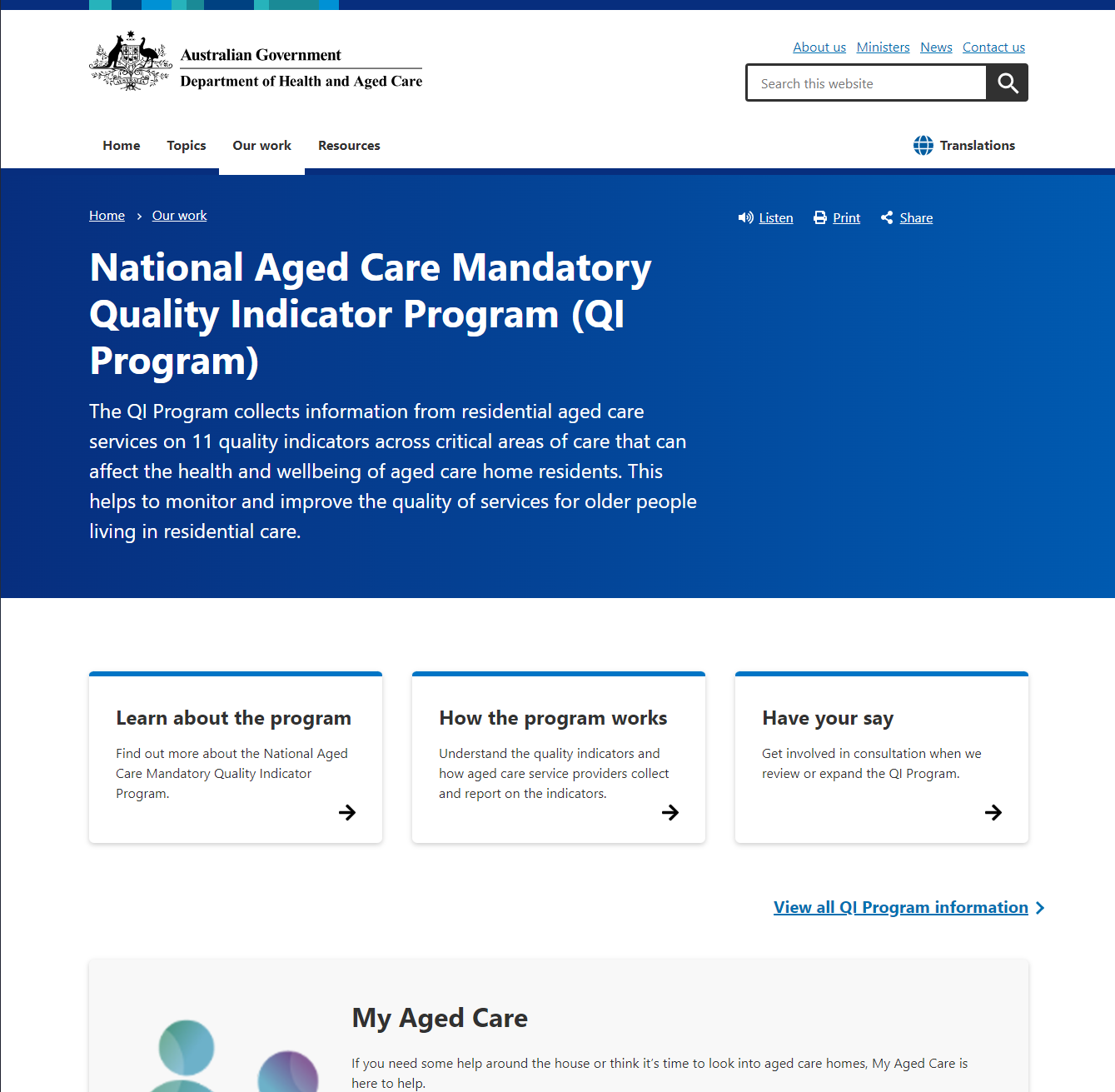
/quality-standards/national-aged-care-mandatory-quality-indicator-program-qi-program

National Aged Care Mandatory Quality Indicator Program (QI Program)

Guidance
Published date

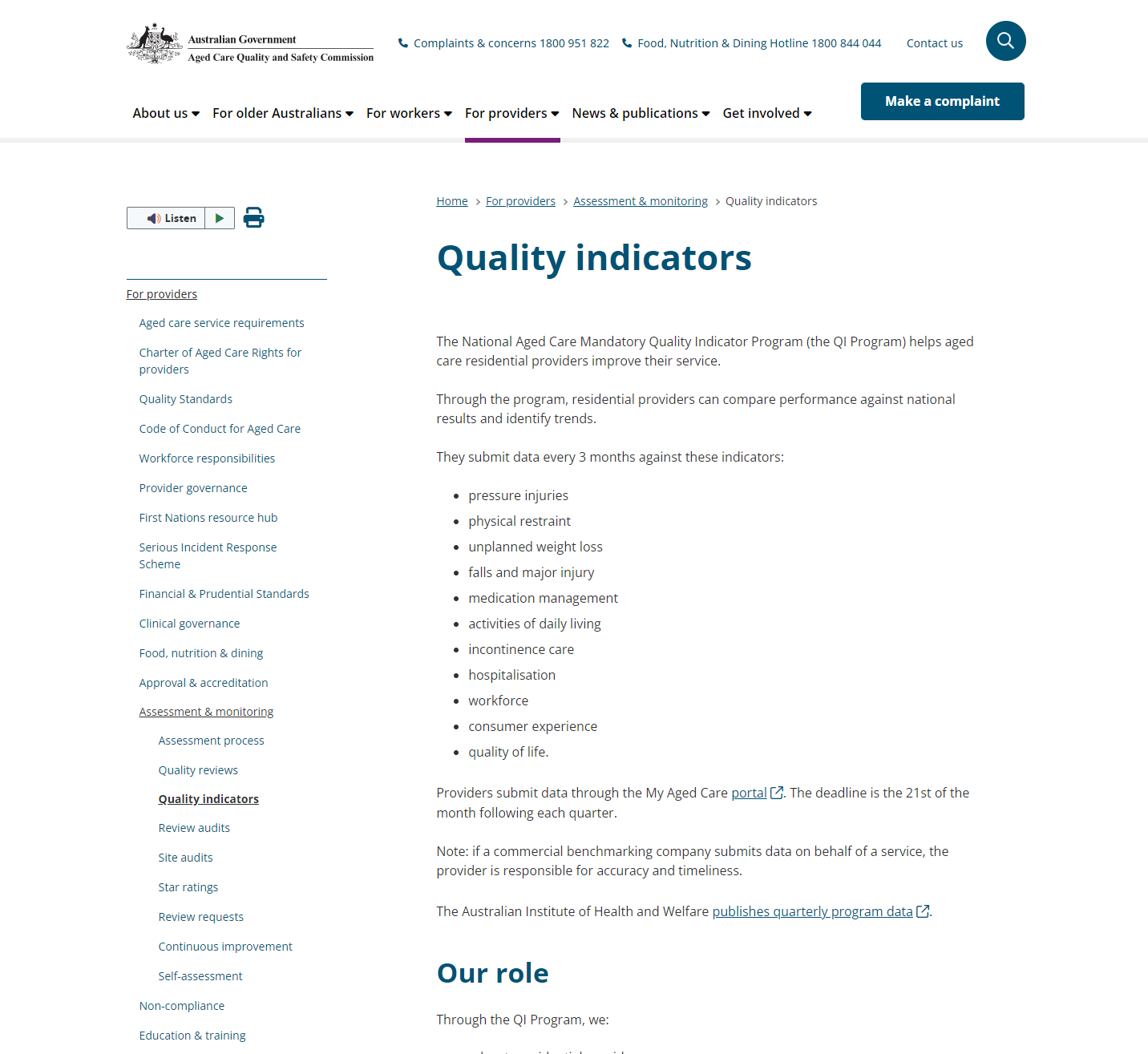
This resource provides information on the National Aged Care Mandatory Quality Indicator Program (QI Program). The program gathers data on 11 quality indicators from residential aged care services to enhance care standards and outcomes for residents. It includes resources, quick guides, consultation papers, and surveys for improving quality indicators in both residential and in-home aged care services. 

This resource may refer to information that will be updated from 1 November 2025 to align with the new Aged Care Act and Quality Standards.

Author
Department of Health, Disability and Ageing
Key Theme
Accountability and quality system, Corporate and clinical governance, Information management system, Workforce and human resources management
Standard
5: Clinical Care, 2: The Organisation
Outcomes
2.2a: Quality, safety and inclusion culture to support aged care workers to deliver quality care, 2.2b: Quality, safety and inclusion culture to support individuals, 2.3: Accountability, quality system and policies and procedures, 5.1: Clinical governance, 5.5: Safety of clinical care services
National Aged Care Mandatory Quality Indicator Program (QI Program)