
The Quality Standards Resource Centre helps extend understanding of the strengthened Aged Care Quality Standards, which took effect from 1 November 2025. You can search for resources by using keywords, or filtering by standard, outcome and audience. Before using the Resource Centre, please read the terms of use.
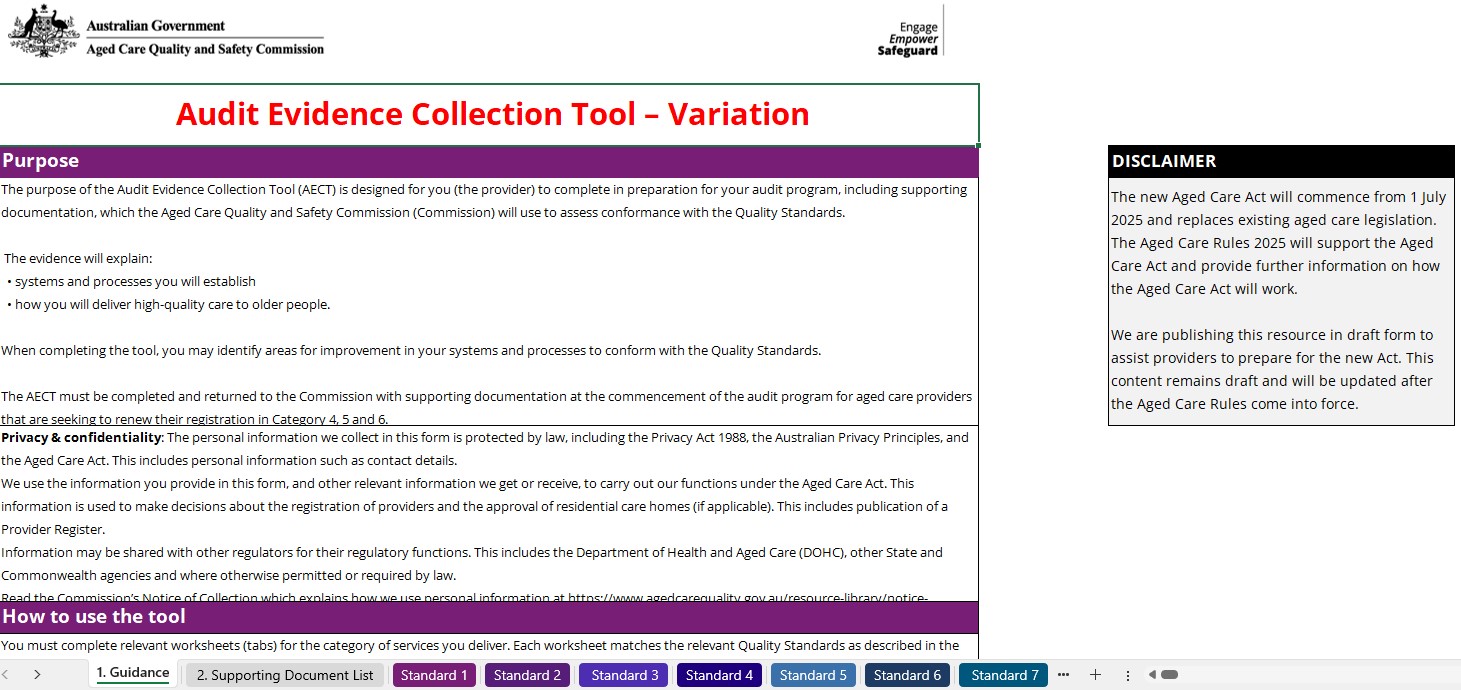
Care Delivery Evidence Collection Tool (CDECT) – Care delivery location (Category 4 & 5)
Providers must complete this tool as part of a renewal audit in registration categories 4 and 5.
We will identify a targeted sample of care delivery locations (Category 4 & 5). You will be notified of this sample and the CDECT – Care delivery location must only be completed for these targeted sample locations.
We use this tool to collect evidence about care and services delivered in a home or community setting.

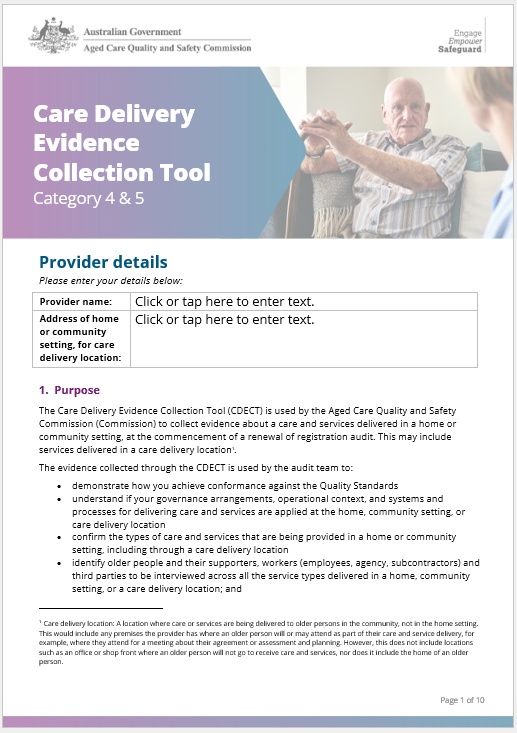
Audit Evidence Collection Tool (AECT) – Registration
Organisations or persons must complete the Audit Evidence Collection Tool (AECT) – Registration as part of the initial registration audit. This is compulsory for organisations or persons applying for registration in categories 4, 5 and 6 from 1 November 2025.
The registration audit helps us to understand if the organisation or person can conform with the related strengthened Aged Care Quality Standards.
We use this tool to collect evidence about:
 Audit Evidence Collection Tool (AECT) – Registration (XLSX 444.19 KB)
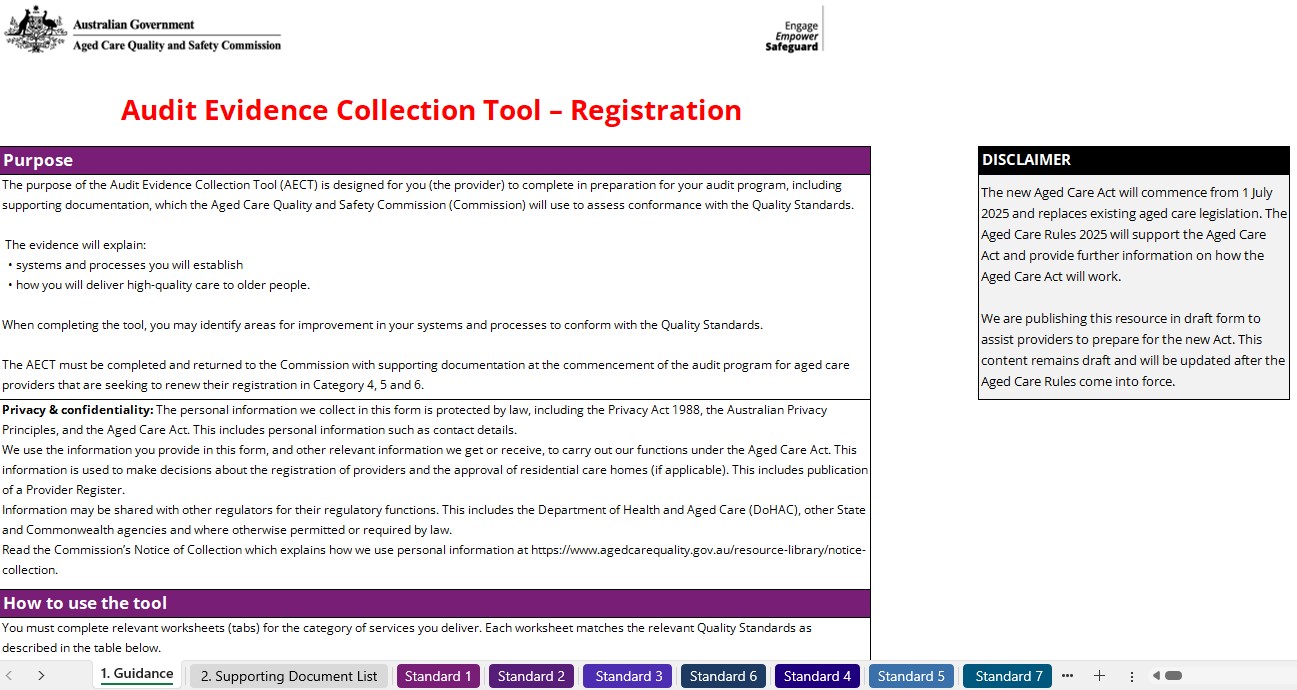
Audit Evidence Collection Tool (AECT) – Renewal
Providers must complete the Audit Evidence Collection Tool (AECT) – Renewal as part of a renewal audit in registration categories 4, 5 and 6. This is compulsory for providers from 1 November 2025.
Providers only need to complete this tool once as part of the audit program.
The renewal audit helps us to understand if the provider can conform with the related strengthened Aged Care Quality Standards.
We use this tool to collect evidence about:
- your systems and processes
- how you deliver safe and quality care to older people.
Audit Evidence Collection Tool (AECT) – Renewal (XLSX 405.09 KB)
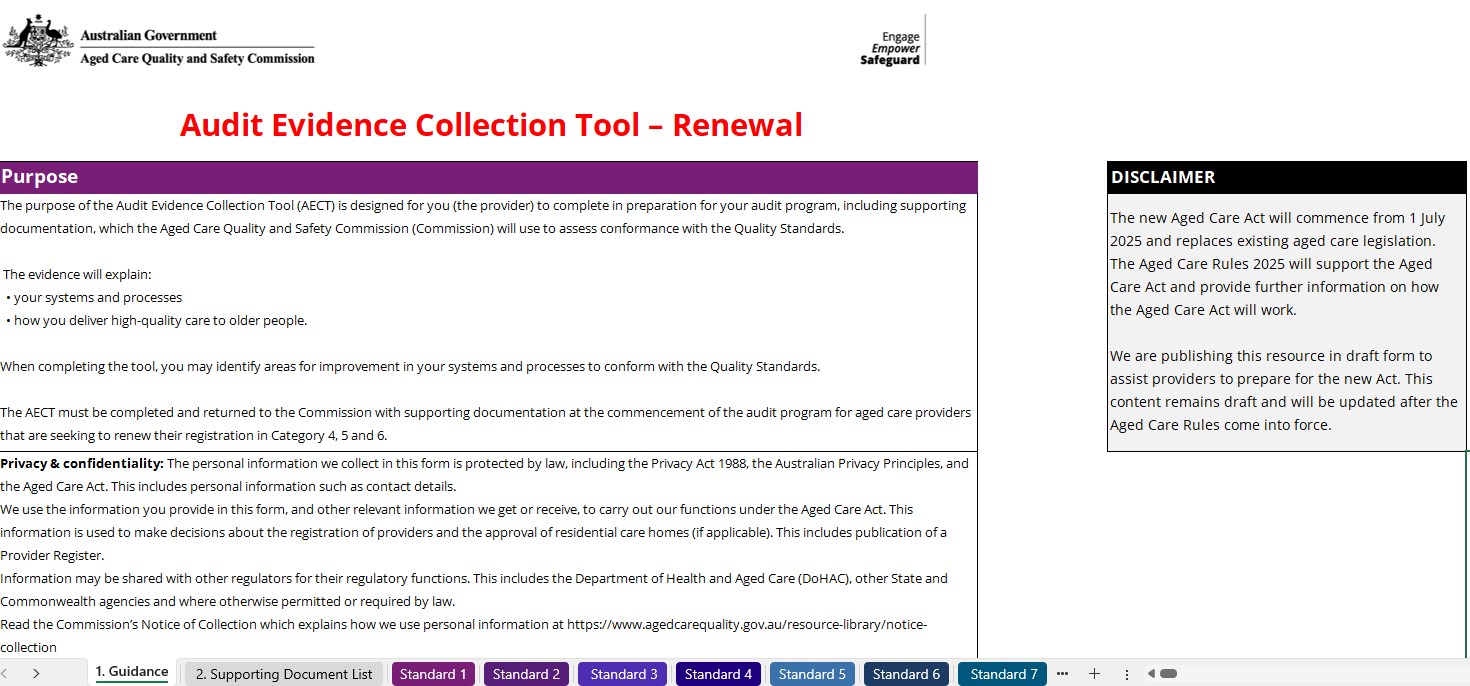
Audit Evidence Collection Tool (AECT) – Variation
Providers must complete the Audit Evidence Collection Tool (AECT) – Variation as part of a variation audit, where they are asking to add categories 4, 5 or 6 to their registration. This is compulsory for providers from 1 November 2025.
The variation audit helps us to understand if the provider can conform with the related strengthened Aged Care Quality Standards.
We use this tool to collect evidence about:
- the systems and processes you will establish
- how you will deliver safe and quality care to older people.
Audit Evidence Collection Tool (AECT) – Variation (XLSX 438.55 KB)
Cultural safety in health care for Indigenous Australians: monitoring framework
This resource uses available data to measure progress in achieving cultural safety in the health system for Aboriginal and Torres Strait Islander people. The monitoring framework covers 3 modules: Module 1 – Culturally respectful health care services; Module 2 – Patient experience of health care; and Module 3 – Access to health care services.
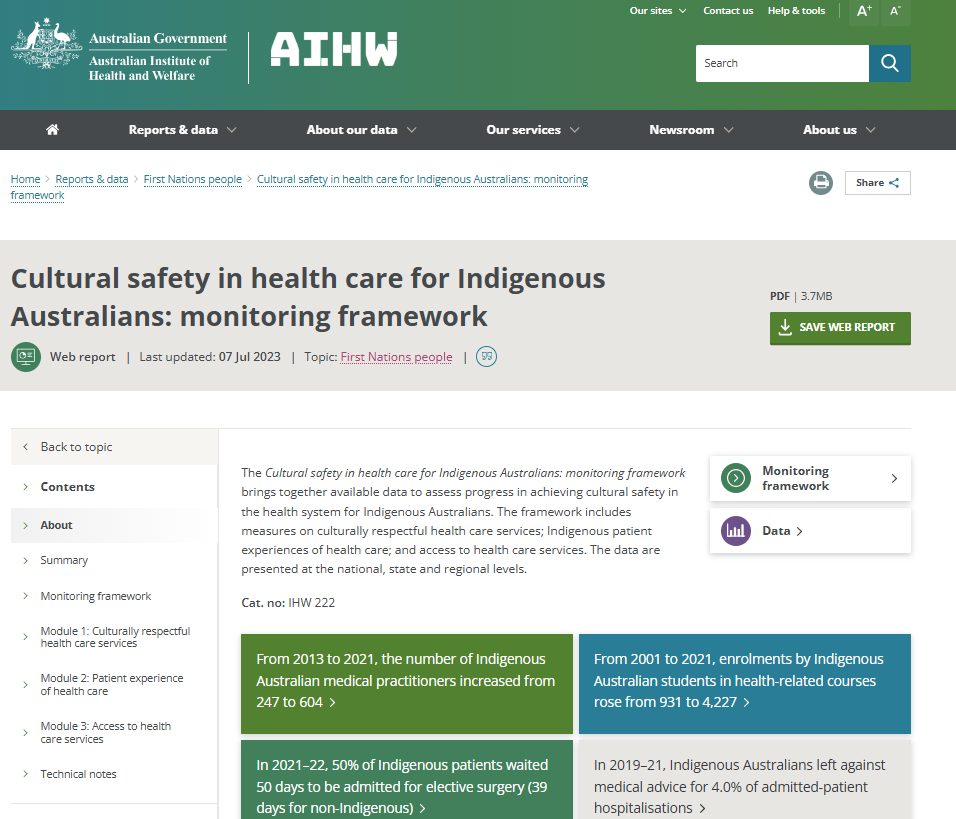
Liquidity calculator for registered providers in the aged care sector
This calculator informs registered providers of the minimum level of liquid assets they are required to hold calculated based on Quarterly Financial Report (QFR) financial statements.
 Liquidity calculator instructions (PDF 1.26 MB)
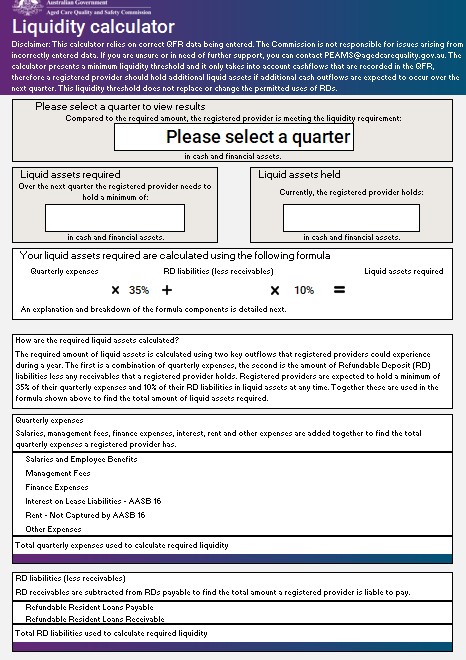
National Aged Care Mandatory Quality Indicator Program (QI Program)
This resource provides information on the National Aged Care Mandatory Quality Indicator Program (QI Program). The program gathers data on 11 quality indicators from residential aged care services to enhance care standards and outcomes for residents. It includes resources, quick guides, consultation papers, and surveys for improving quality indicators in both residential and in-home aged care services.
This resource may refer to information that will be updated from 1 November 2025 to align with the new Aged Care Act and Quality Standards.
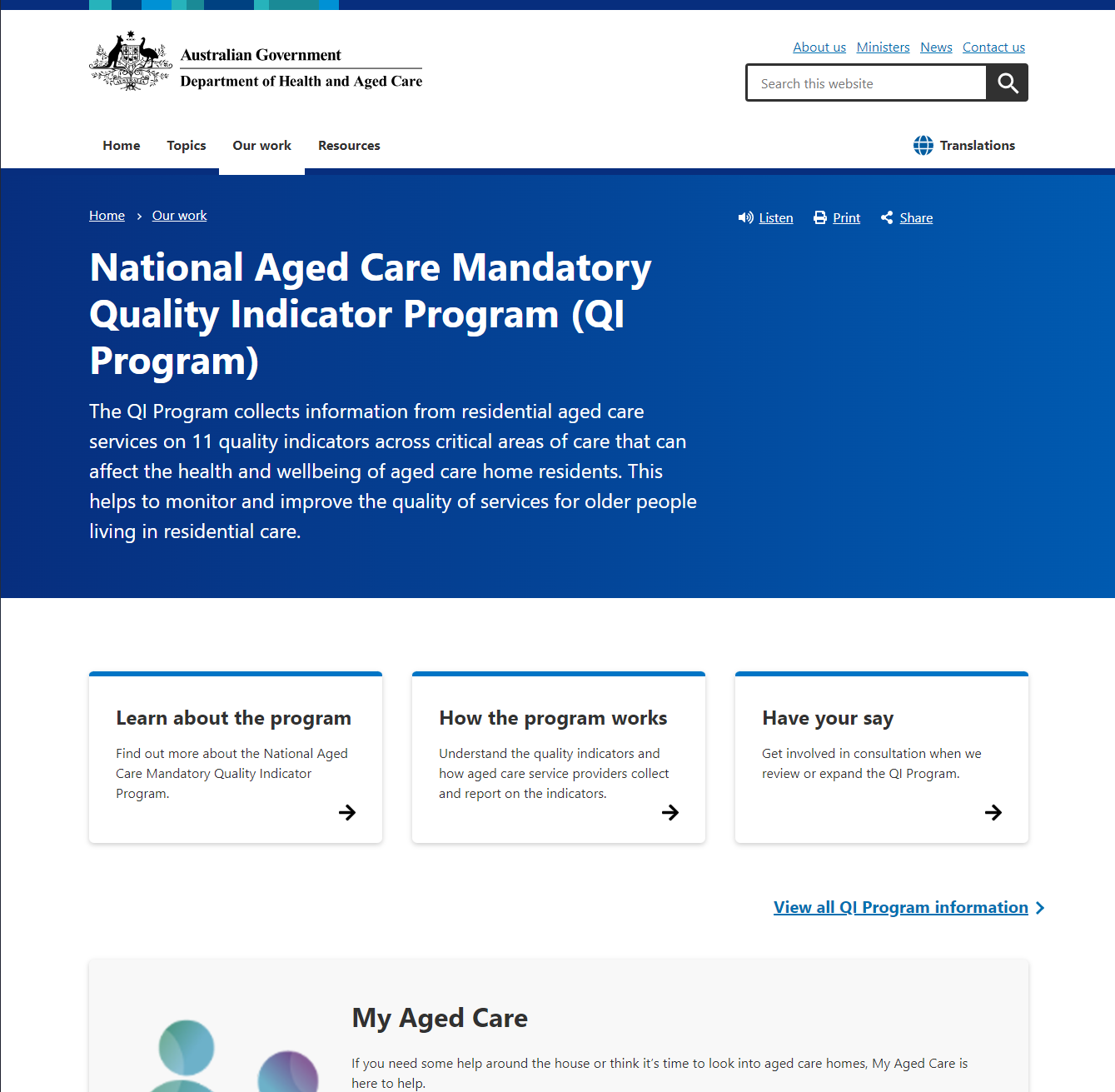
Delirium Clinical Care Standard
This resource outlines the Australian Commission on Safety and Quality in Health Care's Delirium Clinical Care Standard, which aims to improve the prevention, early diagnosis, and treatment of delirium. It includes 8 evidence-based quality statements and indicators for safe care. The standard helps clinicians and healthcare organisations manage cognitive impairment, with relevance to both hospital and aged care settings.
This resource may refer to information that will be updated from 1 November 2025 to align with the new Aged Care Act and Quality Standards.
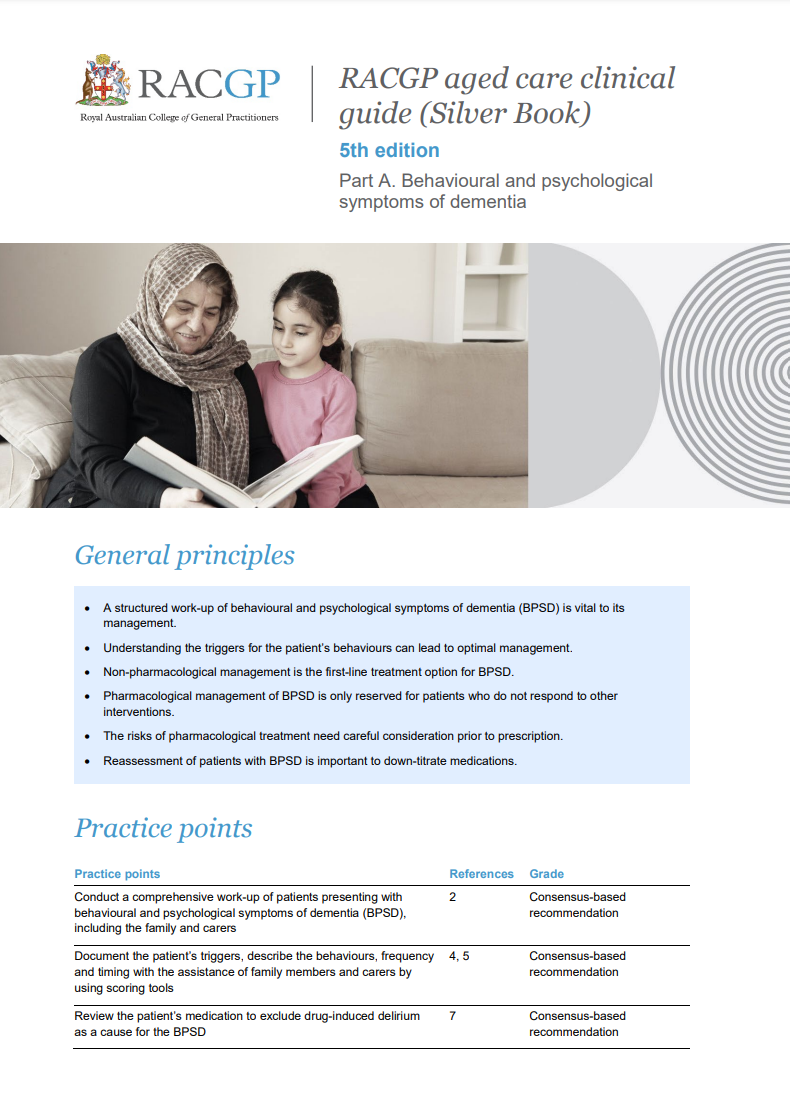
RACGP aged care clinical guide (Silver Book) - Part A - Behavioural and psychological symptoms of dementia
This guide offers principles and practice points for assessing and managing behavioural and psychological symptoms of dementia (BPSD) in aged care. It includes frameworks for comprehensive patient assessment, non-pharmacological and pharmacological interventions, medication review, and personalised care plans to improve care outcomes for dementia patients.
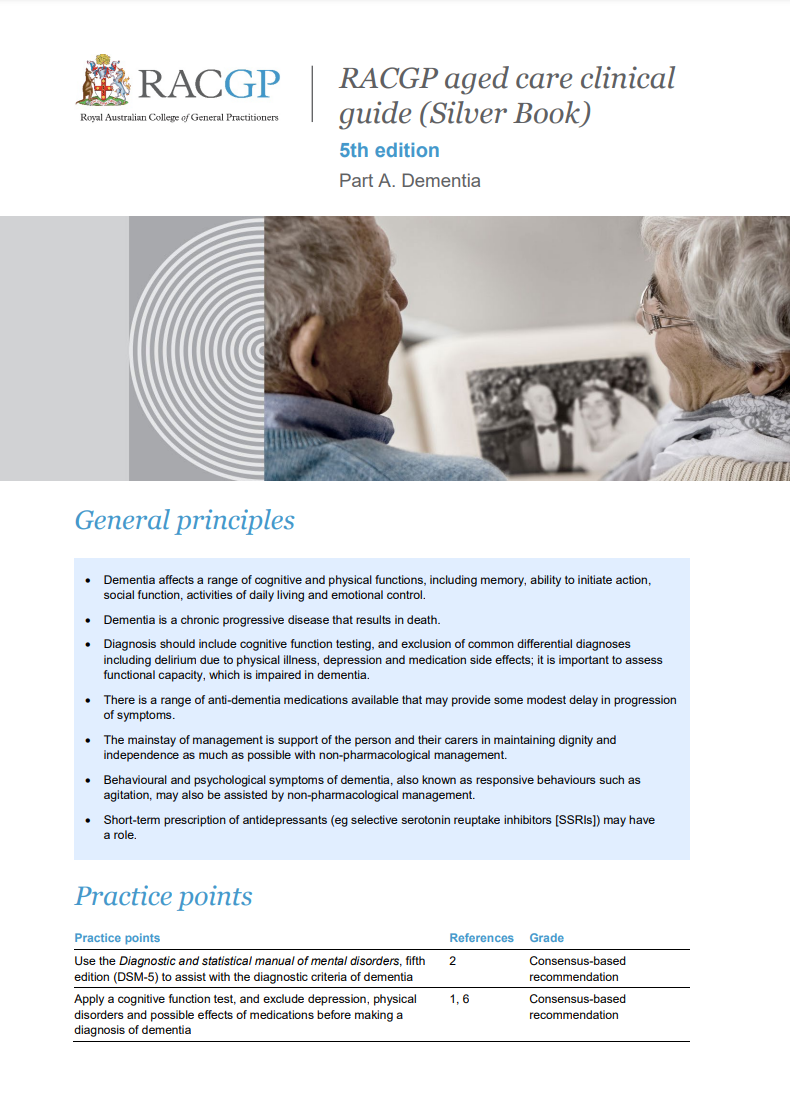
RACGP aged care clinical guide (Silver Book) - Part A - Dementia
This resource offers guidance on diagnosing and managing dementia, covering its impact on cognitive and physical functions, screening methods, and differential diagnoses. It discusses appropriate use of medications, non-pharmacological approaches, and ongoing care plans for supporting those with dementia. It includes practical recommendations on cognitive assessments, functional reviews, and medication management.
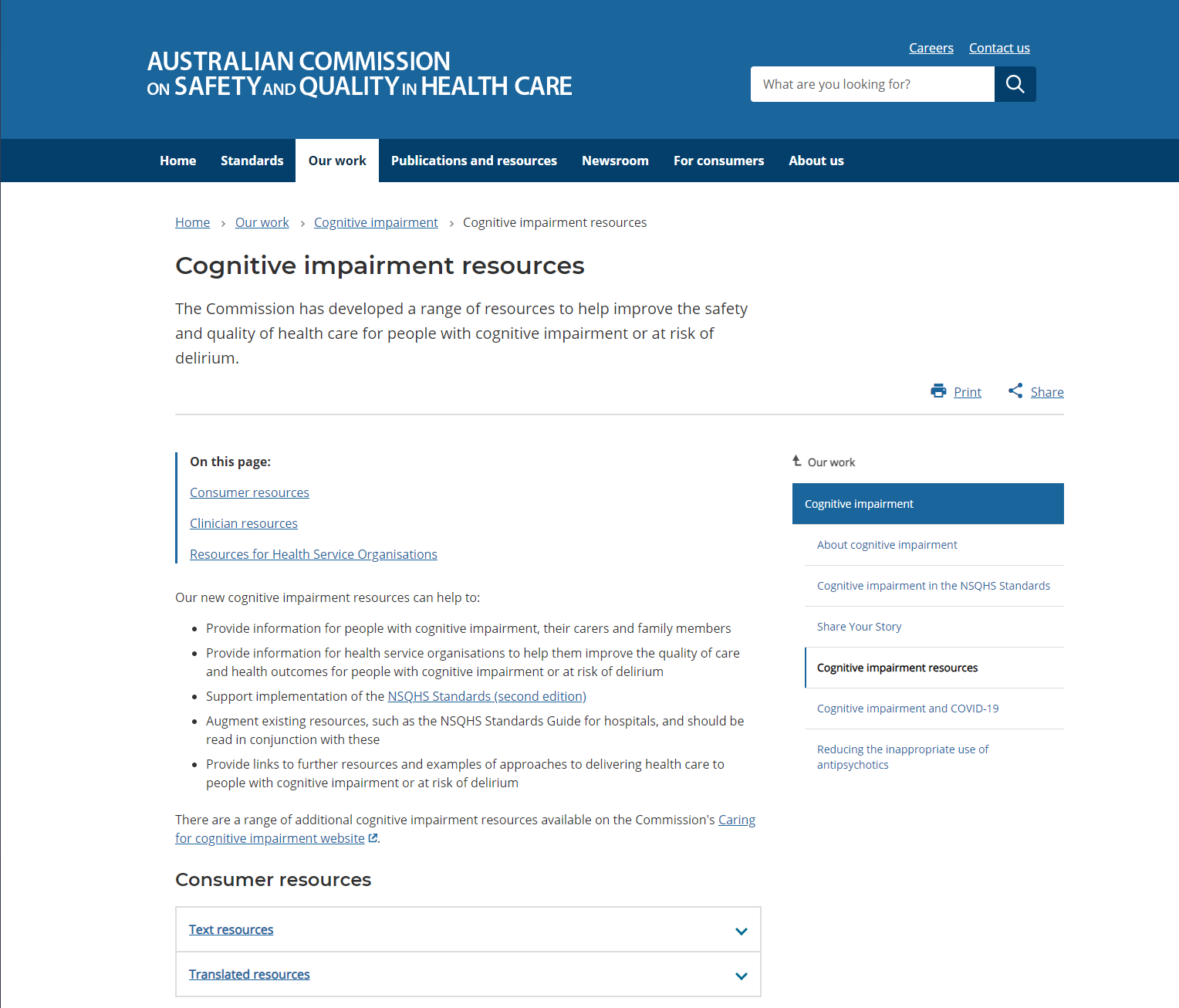
Cognitive impairment resources
This resource provides a range of materials developed to improve the safety and quality of healthcare for people with cognitive impairment or at risk of delirium. It includes guides, fact sheets, and standards for consumers, clinicians, and health service organisations, supporting the implementation of best practice and quality care.
This resource may refer to information that will be updated from 1 November 2025 to align with the new Aged Care Act and Quality Standards.
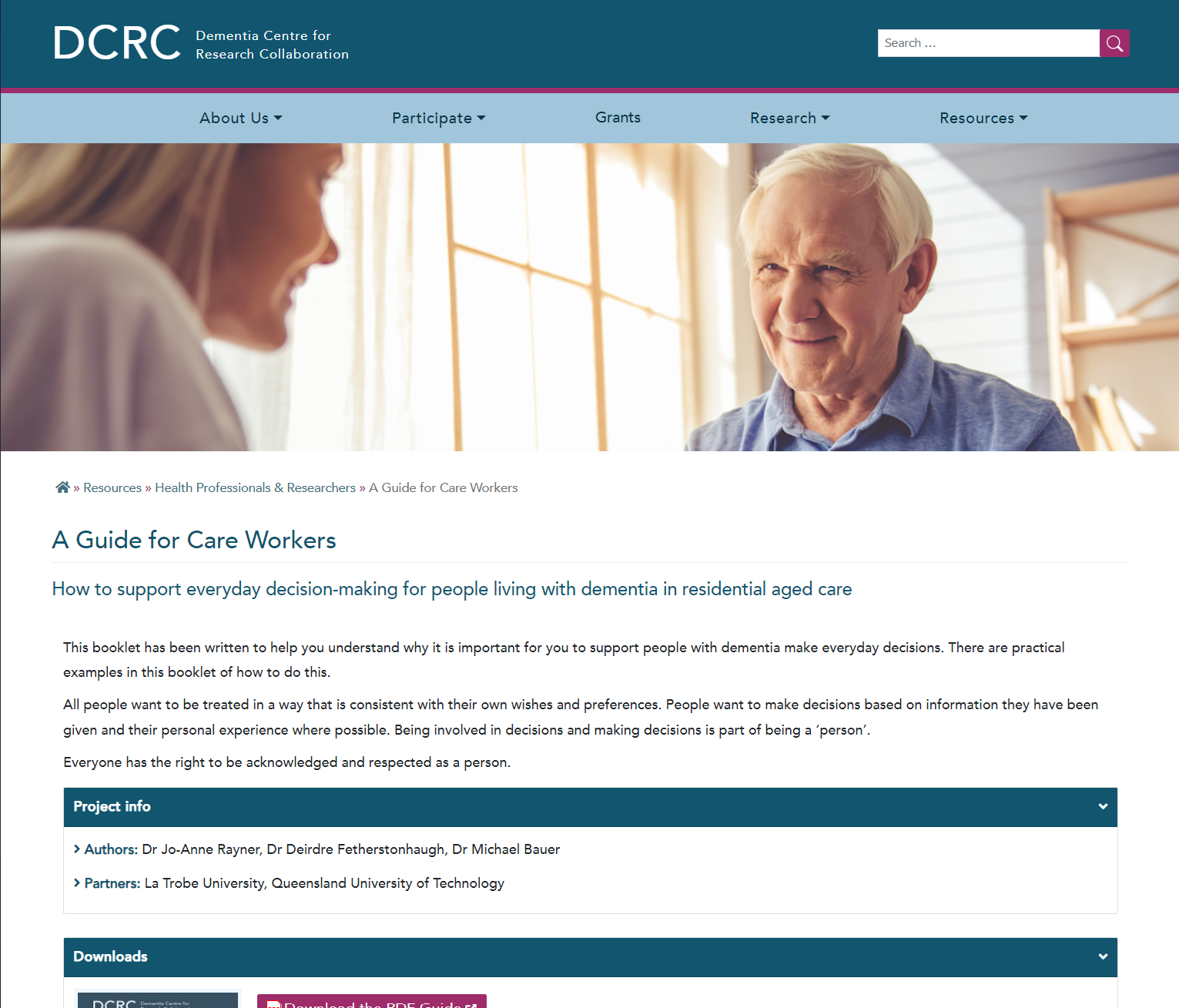
How to support everyday decision-making for people living with dementia in residential aged care: A guide for care workers
This guide offers practical strategies for care workers to support people with dementia in making everyday decisions within residential aged care settings. It covers communication techniques, promoting choice in personal care and daily activities, understanding body language, and emphasises person-centred care while respecting residents' preferences, dignity, and rights.
Cognitive impairment and dementia care for Aboriginal and Torres Strait Islander people
This resource is a best-practice guide to cognitive impairment and dementia care for Aboriginal and Torres Strait Islander people attending primary health care. It combines clinical evidence with cultural principles, addressing health promotion, prevention, detection, and management of dementia, while also providing culturally informed recommendations on end-of-life care and support for carers within the context of primary care services.
Caring for Cognitive Impairment
This resource outlines support for health service organisations to provide safe, high-quality care for people with cognitive impairment, especially during COVID-19. It includes new intellectual disability resources, fact sheets, posters, and guidance aligned with the National Safety and Quality Health Service (NSQHS) Standards to improve patient outcomes and care experiences.
This resource may refer to information that will be updated from 1 November 2025 to align with the new Aged Care Act and Quality Standards.
Health care for people with cognitive disability
This resource addresses the challenges people with cognitive disabilities face when accessing healthcare, such as communication barriers, limited access to quality services, over-prescription, and restrictive practices. It invites feedback on how to improve care quality and ensure the human rights of those with disabilities are upheld, incorporating considerations for different cultural and demographic groups.
Dementia & Our Mob
This resource provides information about dementia in Aboriginal and Torres Strait Islander communities. It covers the effects on mind, body, and spirit, the prevalence among older and younger people, risk factors like genetics and lifestyle, and the types of dementia most common in these communities. It emphasises the importance of cultural understanding in dementia care.
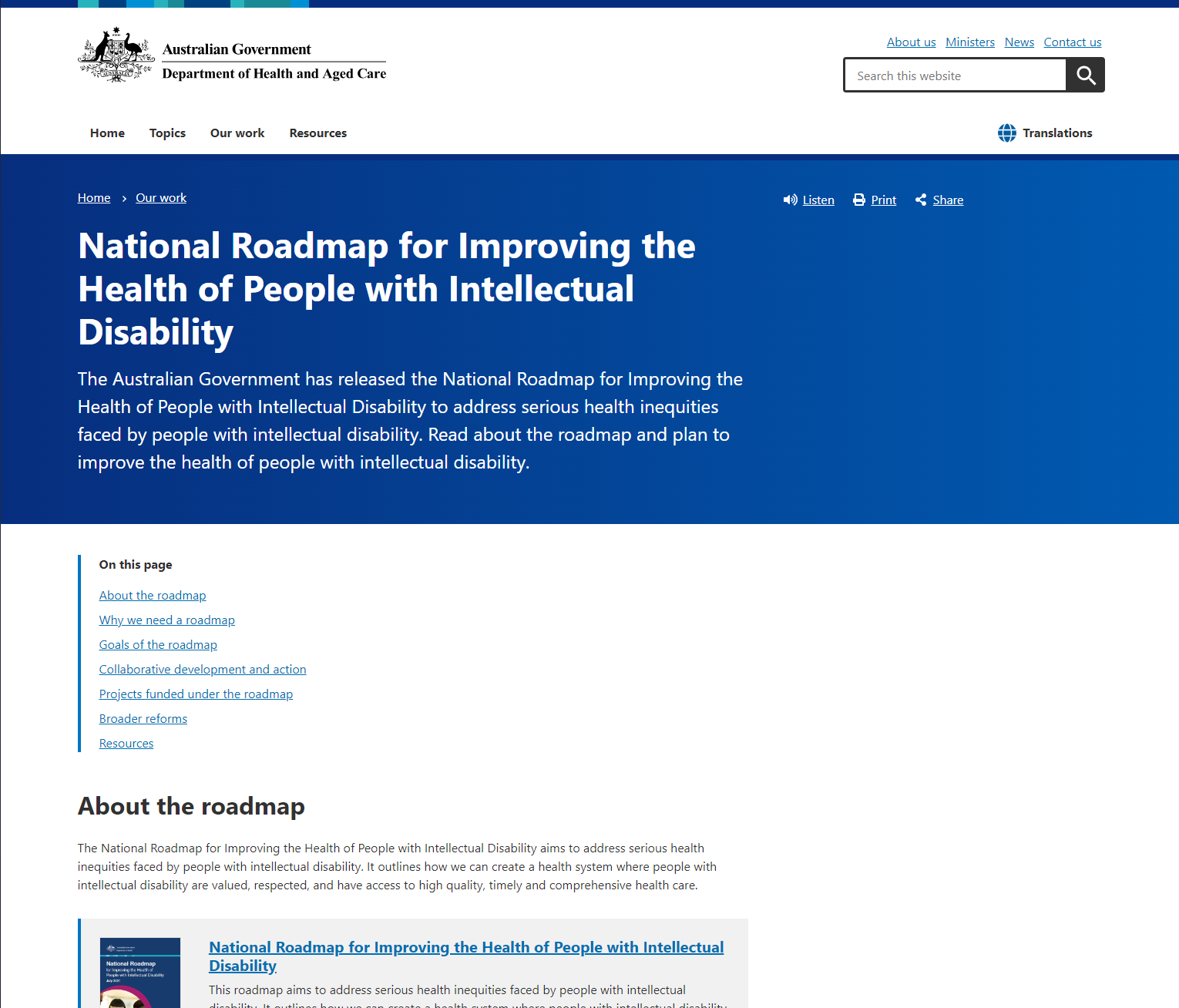
National Roadmap for Improving the Health of People with Intellectual Disability
This resource outlines the National Roadmap for Improving the Health of People with Intellectual Disability, aiming to address health inequities. It focuses on enhancing care support, developing better models of care, improving oral health, and supporting health professionals. The roadmap includes projects on primary care, health assessments, curriculum development, and more.
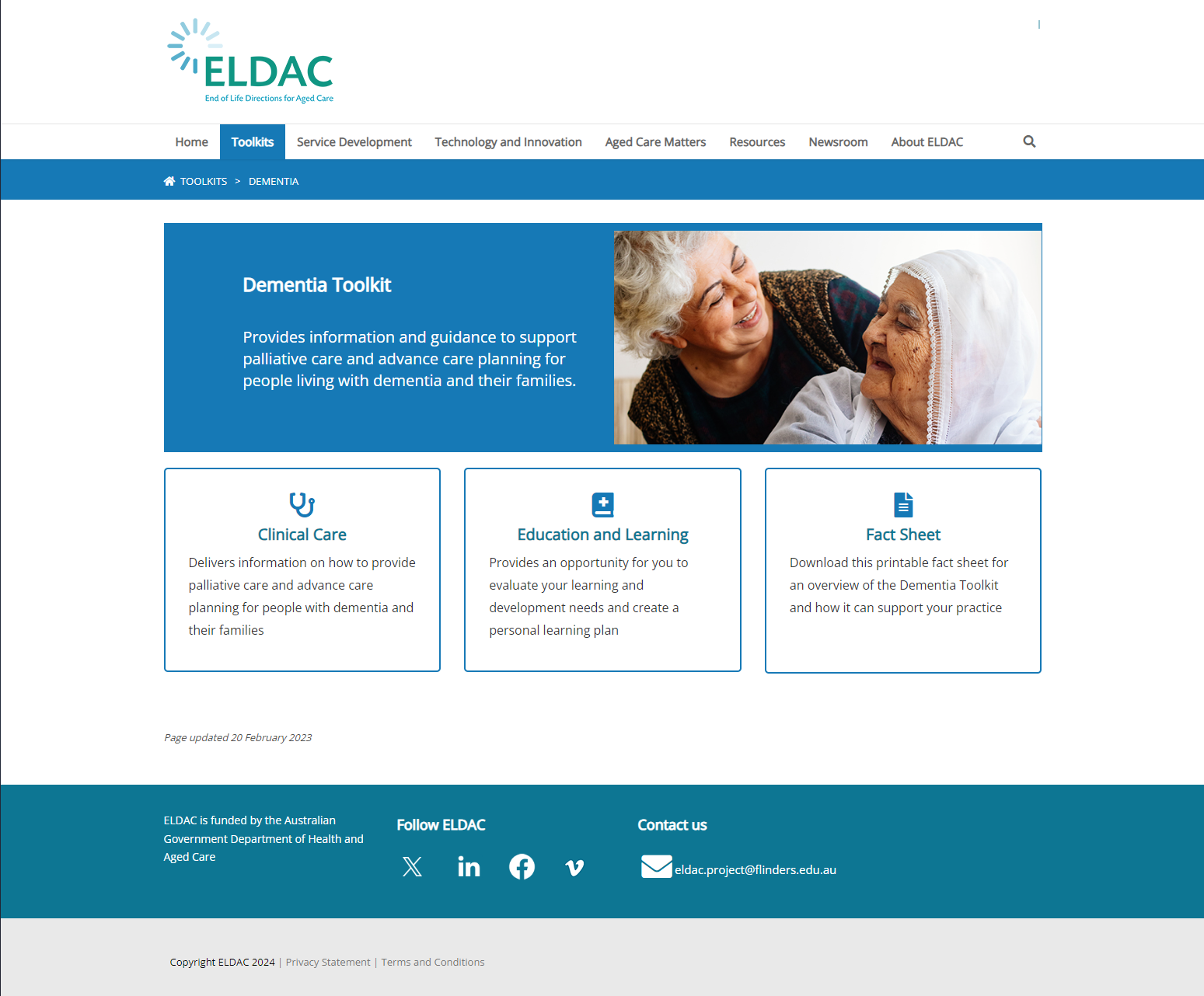
ELDAC Dementia Toolkit
This resource provides a toolkit for palliative care and end-of-life planning for people with dementia. It includes practical advice, resources, and evidence-based guidance to support health and aged care workers in delivering quality care. The toolkit covers assessment, care planning, symptom management, and communication with patients and families.
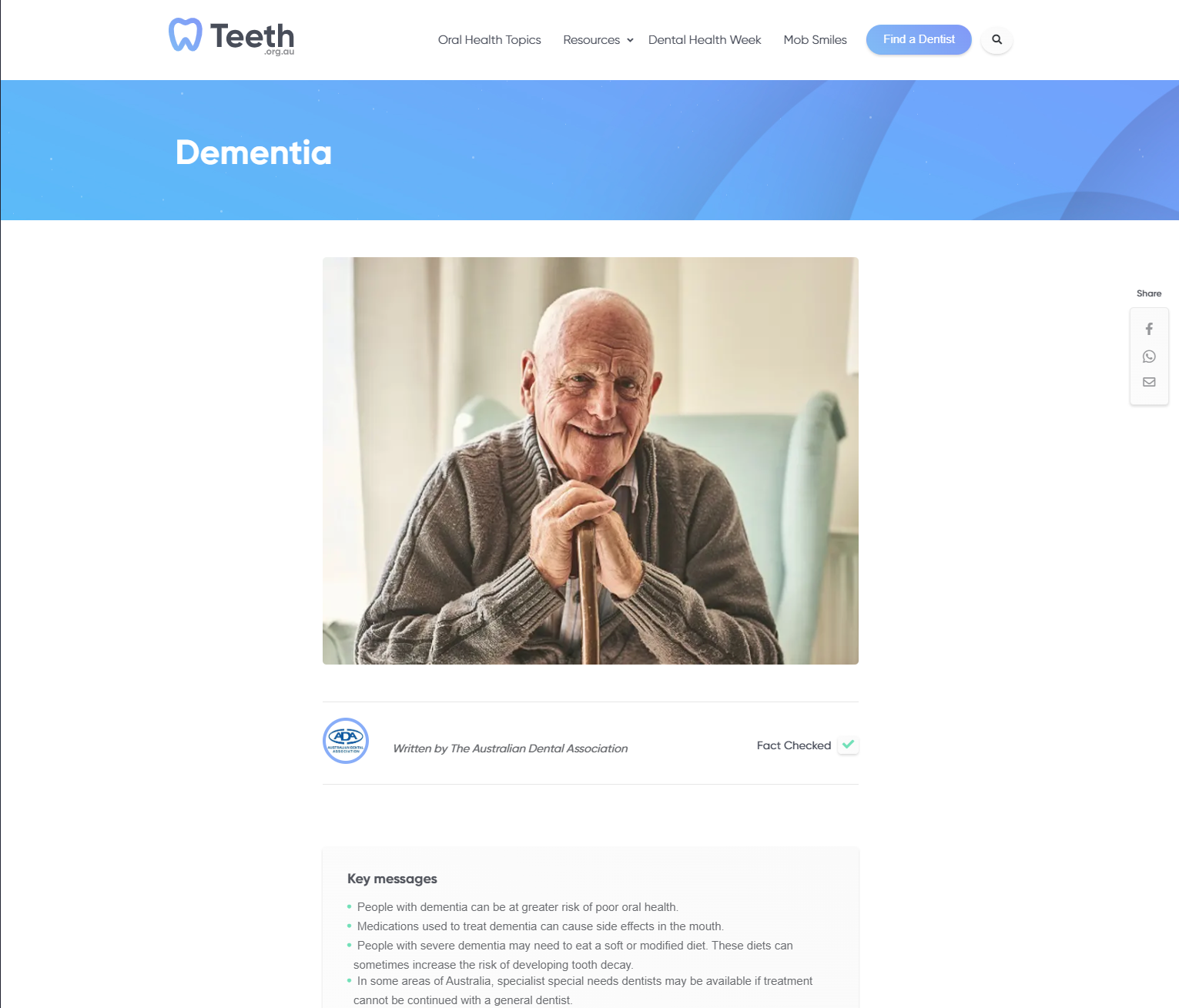
Dementia and oral health
This resource provides information on the impact of dementia on oral health, outlining key issues such as increased risk of poor oral health, the effects of medications, and the importance of maintaining dental care routines. It offers practical tips for toothbrushing, denture care, and dental visits to support those living with dementia.
Quality improvement guidance for aged care providers
This resource offers guidance for aged care providers on implementing continuous quality improvement processes. It explains the ‘Plan, Do, Check, Act’ model to monitor and enhance care quality, using data and feedback to address issues. It also provides practical examples and tools to support providers in improving care and meeting regulatory requirements. This resource may refer to information that will be updated from 1 November 2025 to align with the new Aged Care Act and Quality Standards.





