Aged care laws in Australia have now changed. The new Aged Care Act 2024 and Aged Care Rules 2025 now apply. While we complete updating of our website, including draft guidance and other materials, to align with the new laws, providers are advised to refer to the new Act and Rules for any required clarification of their obligations and legal responsibilities. Thank you for your patience.

Quality Standards Resource Centre

The Quality Standards Resource Centre helps extend understanding of the strengthened Aged Care Quality Standards, which take effect from 1 November 2025. The Resource Centre will be updated to reflect key changes made to the draft strengthened Standards. You can search for resources by using keywords, or filtering by standard, outcome, audience and theme. Before using the Resource Centre, please read the terms of use.

Displaying 1 to 10 of 10 result(s)
/quality-standards/participating-consumers

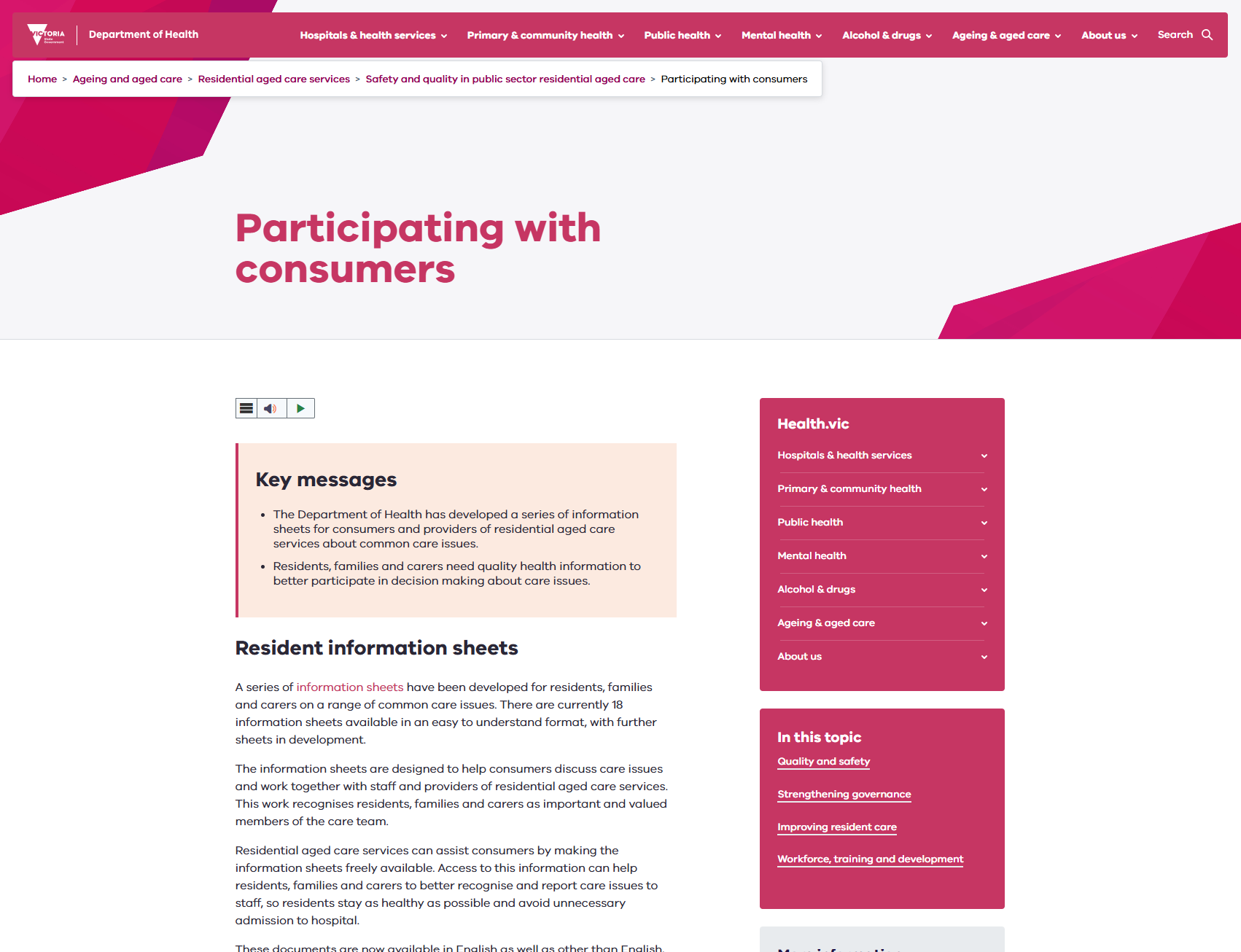
Participating with consumers

Fact sheet
Last Updated

This resource provides information sheets for residents, families, and carers to support decision-making in residential aged care. Covering topics such as pain management, falls, and medicines, it promotes health literacy, enabling consumers to engage in discussions and report care issues effectively.

This resource was developed by a state/territory government or organisation and therefore its applicability and usefulness may be limited.
Author
External resource
Key Theme
Assessment and planning, Care coordination and transitions, Medication management, Clinical safety, Delivering comprehensive care and services, Palliative and end of life care
Standard
3: The Care and Services, 5: Clinical Care
Outcomes
3.1 Assessment and planning, 3.4: Planning and coordination of funded aged care services, 5.3: Safe and quality use of medicines, 5.5: Safety of clinical care services, 5.6 Cognitive impairment  , 5.7: Palliative care and end-of-life care
Participating with consumers
/quality-standards/informed-consent-health-direct

Informed consent - Health Direct

Guidance
Last Updated

This resource explains the legal requirements and processes for obtaining informed consent for medical treatments, procedures, and care. It is relevant to aged care by ensuring that people understand their healthcare options, risks, and benefits, supporting their ability to make informed decisions about their health and wellbeing.

Author
External resource
Key Theme
Choice, independence and quality of life, Assessment and planning, Care coordination and transitions
Standard
1: The Individual, 3: The Care and Services, 7: The Residential Community
Outcomes
1.3: Choice, independence and quality of life, 3.1 Assessment and planning, 7.2: Transitions
Informed consent
/quality-standards/informed-consent

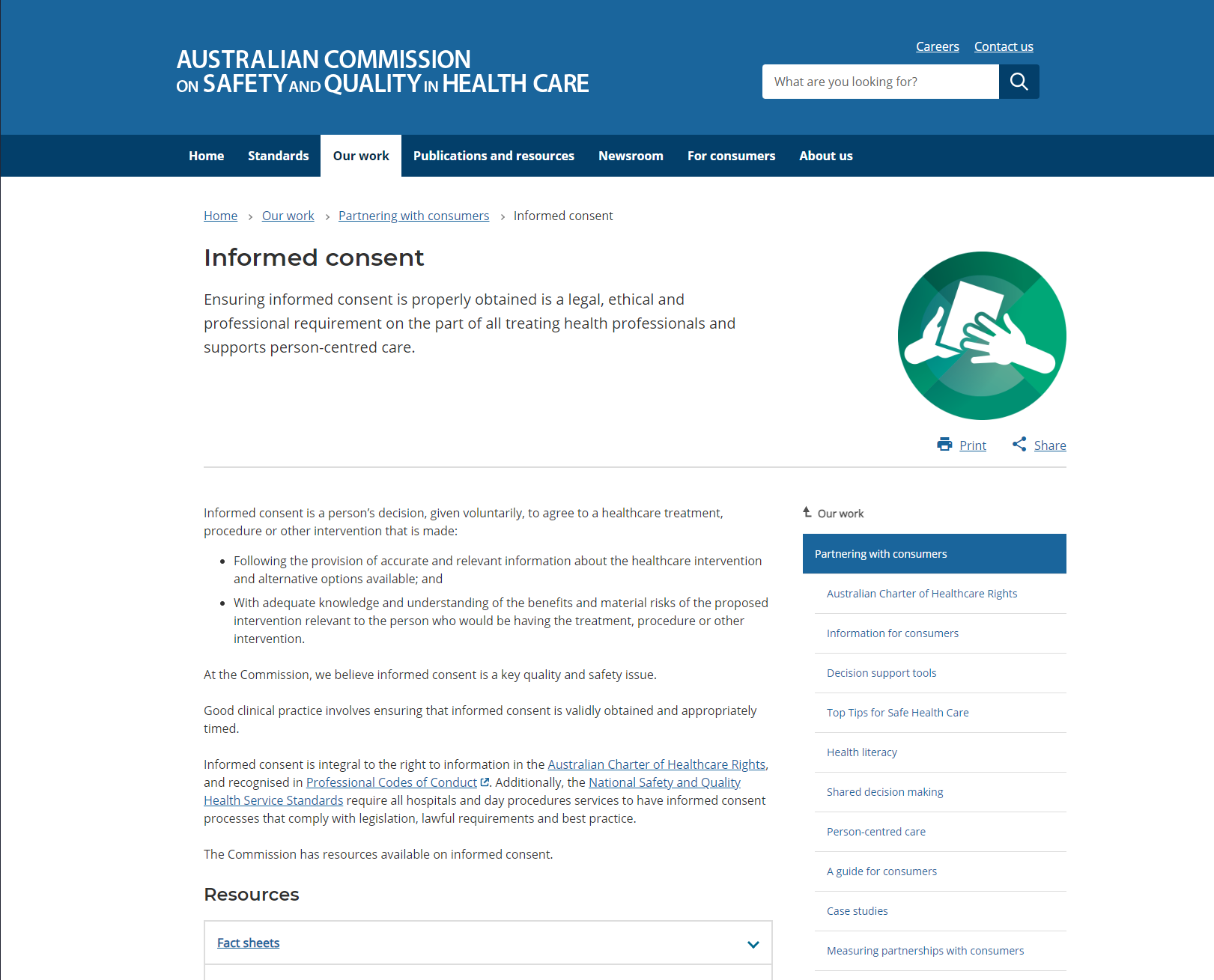
Informed consent

Guidance
Last Updated

This resource provides guidance on ensuring informed consent in healthcare settings. It outlines legal, ethical, and professional requirements for obtaining consent, supports person-centred care, and ensures compliance with Australian healthcare standards. It highlights the importance of providing accurate information about interventions and alternatives, ensuring people have sufficient knowledge of potential risks and benefits. 
Author
Australian Commission On Safety And Quality In Health Care
Key Theme
Choice, independence and quality of life, Assessment and planning, Care coordination and transitions
Standard
1: The Individual, 3: The Care and Services, 7: The Residential Community
Outcomes
1.3: Choice, independence and quality of life, 3.1 Assessment and planning, 7.2: Transitions
Informed consent
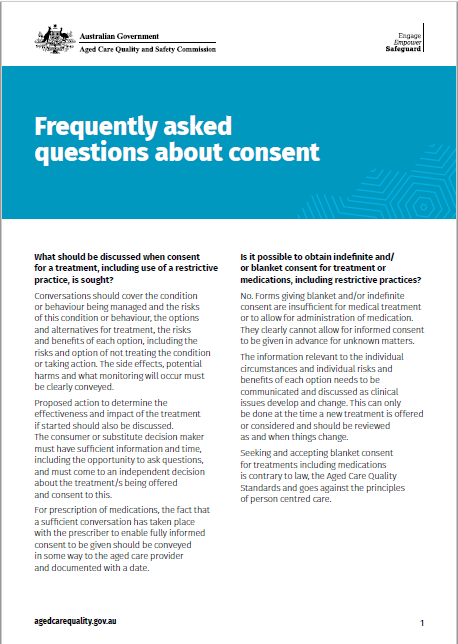
/quality-standards/frequently-asked-questions-about-consent

Frequently asked questions about consent

Fact sheet
Published date

This fact sheet covers the frequently asked questions about consent in aged care.

Author
Aged Care Quality & Safety Commission
Key Theme
Choice, independence and quality of life, Assessment and planning, Care coordination and transitions
Standard
1: The Individual, 3: The Care and Services, 7: The Residential Community
Outcomes
1.3: Choice, independence and quality of life, 3.1 Assessment and planning, 7.2: Transitions
Cover of Frequently asked questions about consent
/quality-standards/national-consensus-statement-essential-elements-recognising-and-responding-acute-physical-deterioration

National Consensus Statement - Essential elements for recognising and responding to acute physical deterioration

Guidance
Published date

This consensus statement outlines essential elements for recognising and responding to acute physiological deterioration in healthcare settings. It covers clinical processes like vital signs monitoring, diagnosis, and rapid response systems, as well as organisational aspects such as leadership, education, and evaluation. It provides generic information that can be applied to the aged care setting.

This resource may refer to information that will be updated from 1 November 2025 to align with the new Aged Care Act and Quality Standards.
Author
Australian Commission On Safety And Quality In Health Care
Key Theme
Care coordination and transitions, Delivering comprehensive care and services, Assessment and planning
Standard
5: Clinical Care, 3: The Care and Services
Outcomes
5.4: Comprehensive care, 3.1 Assessment and planning
National Consensus Statement - Essential elements for recognising and responding to acute physical deterioration
/quality-standards/draft-national-consumer-engagement-strategy-health-and-wellbeing

Draft National Consumer Engagement Strategy for Health and Wellbeing

Guidance
Published date

This resource presents the Draft National Consumer Engagement Strategy for Health and Wellbeing, which aims to foster partnerships between health policymakers and communities. It is designed to involve people and communities in the development and implementation of preventive health policies. The strategy supports policymakers and program developers in engaging effectively with consumers to achieve improved health outcomes across Australia. 

Author
Department of Health, Disability and Ageing
Key Theme
Person-centred care, Corporate and clinical governance, Assessment and planning, Care coordination and transitions
Standard
1: The Individual, 2: The Organisation, 3: The Care and Services
Outcomes
1.1: Person-centred care, 2.1: Partnering with individuals, 3.1 Assessment and planning, 3.4: Planning and coordination of funded aged care services
Draft National Consumer Engagement Strategy for Health and Wellbeing
/quality-standards/consumer-and-carer-engagement-practical-guide

Consumer and carer engagement: A practical guide

Guidance
Last Updated

This resource provides a guide for engaging consumers and carers in mental health services. It outlines steps for involving people in decision-making, service design, and evaluation. The guide emphasises co-design, leadership, and dedicated resources to create a person-centred approach that improves care and service outcomes.

Author
External resource
Key Theme
Person-centred care, Care coordination and transitions, Assessment and planning, Corporate and clinical governance
Standard
1: The Individual, 2: The Organisation, 3: The Care and Services
Outcomes
1.1: Person-centred care, 2.1: Partnering with individuals, 3.1 Assessment and planning, 3.4: Planning and coordination of funded aged care services
Consumer and carer engagement: A practical guide
/quality-standards/implementing-comprehensive-care-standard-clinical-assessment-and-diagnosis

Implementing the Comprehensive Care Standard - Clinical assessment and diagnosis

Guidance
Published date

This document provides guidance on implementing the clinical assessment and diagnosis element of the Comprehensive Care Standard (National Safety and Quality Health Service Standards). It helps clinicians identify a person’s conditions or needs through examination and investigation. The resource supports safe, patient-centred care, improving diagnostic accuracy and promoting teamwork in healthcare settings, including aged care. 

This resource may refer to information that will be updated from 1 November 2025 to align with the new Aged Care Act and Quality Standards.

Author
Australian Commission On Safety And Quality In Health Care
Key Theme
Care coordination and transitions, Assessment and planning, Delivering comprehensive care and services
Standard
5: Clinical Care, 3: The Care and Services
Outcomes
5.4: Comprehensive care, 3.1 Assessment and planning
Implementing the Comprehensive Care Standard - Clinical assessment and diagnosis
/quality-standards/racgp-aged-care-clinical-guide-silver-book-part-b-anticipatory-care

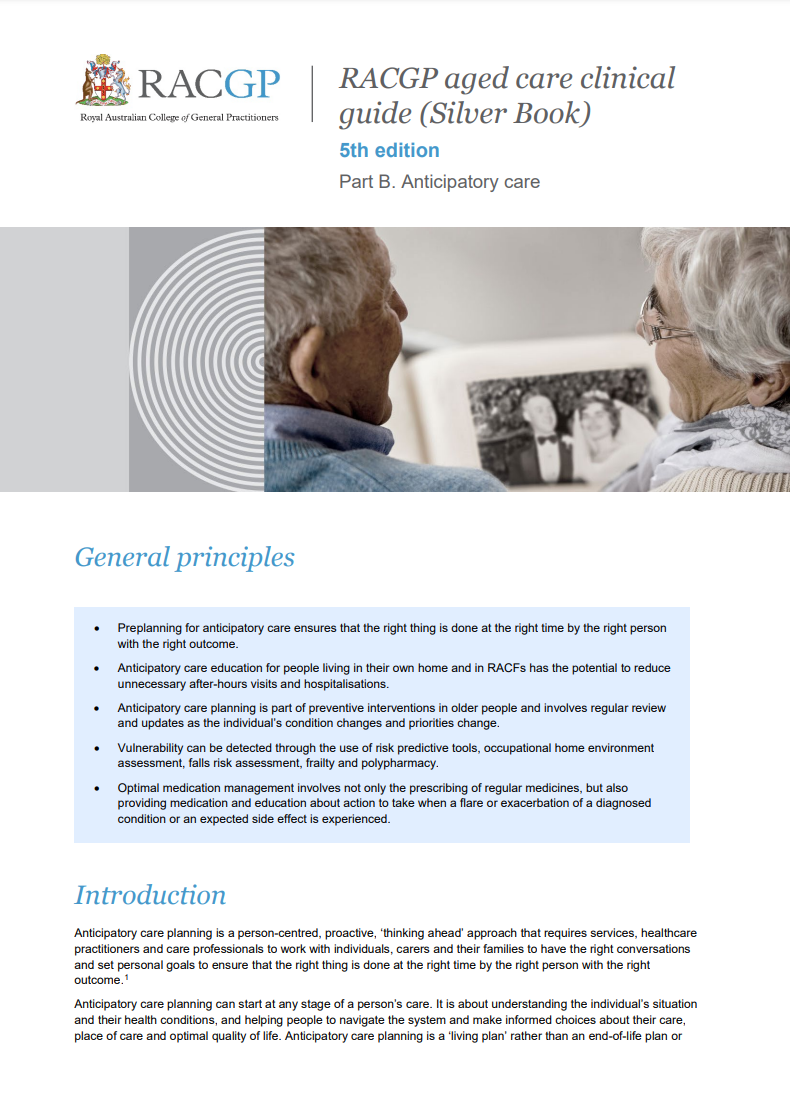
RACGP aged care clinical guide (Silver Book) - Part B - Anticipatory care

Guidance
Last Updated

This guide outlines anticipatory care planning for older adults, focusing on proactive and person-centred approaches. It details triggers for care planning, identifying vulnerability, medication management, and the use of 'as needed' (PRN) medicines for various conditions like allergic reactions, asthma, diabetes, falls, and palliative care. It includes specific recommendations for developing individualised care plans and appropriate interventions for maintaining health and quality of life.
Author
External resource
Key Theme
Environment, Delivering comprehensive care and services, Assessment and planning, Care coordination and transitions, Delivering comprehensive care and services
Standard
5: Clinical Care, 3: The Care and Services, 4: The Environment
Outcomes
4.1a: Environment – services delivered in the individual’s home, 3.2: Delivery of funded aged care services, 5.4: Comprehensive care
RACGP aged care clinical guide (Silver Book) - Part B - Anticipatory care
/quality-standards/creating-behaviour-support-plans-better-support-residents

Creating behaviour support plans that better support residents 

Guidance
Published date

This document outlines the development of behaviour support plans (BSPs) in aged care, focusing on person-centred assessments, identification of triggers, tailored strategies, and regular reviews. It highlights the involvement of healthcare professionals and adherence to care principles to effectively manage residents’ behavioural changes and improve their quality of life. 

This resource may refer to information that will be updated from 1 November 2025 to align with the new Aged Care Act and Quality Standards. 
Author
Aged Care Quality & Safety Commission
Key Theme
Assessment and planning, Delivering comprehensive care and services, Care coordination and transitions
Standard
5: Clinical Care, 3: The Care and Services
Outcomes
5.6 Cognitive impairment  , 3.1 Assessment and planning, 3.2: Delivery of funded aged care services
Creating behaviour support plans that better support residents