The Quality Standards Resource Centre helps extend understanding of the strengthened Aged Care Quality Standards, which took effect from 1 November 2025. You can search for resources by using keywords, or filtering by standard, outcome and audience. Before using the Resource Centre, please read the terms of use.
Infection prevention & control resources
This resource provides guidance on infection prevention and control for aged care providers, outlining responsibilities to make sure safety and minimise infection risks. It covers the development of infection control programs, training requirements, governance, and compliance with national standards, supporting the delivery of safe, high-quality care in residential aged care settings.
This resource may refer to information that will be updated from 1 July 2025 to align with the new Aged Care Act and Quality Standards.
Effective incident management education pack
The Effective incident management education pack is designed for providers to deliver to their own staff. It can be delivered in full or delivered as a series of shorter sessions where you can focus on the sections that are most relevant to your setting or the time you have available.
This pack will support your staff to understand the role they play in effectively managing incidents at your aged care service and help them understand what an incident management system is and its key elements.

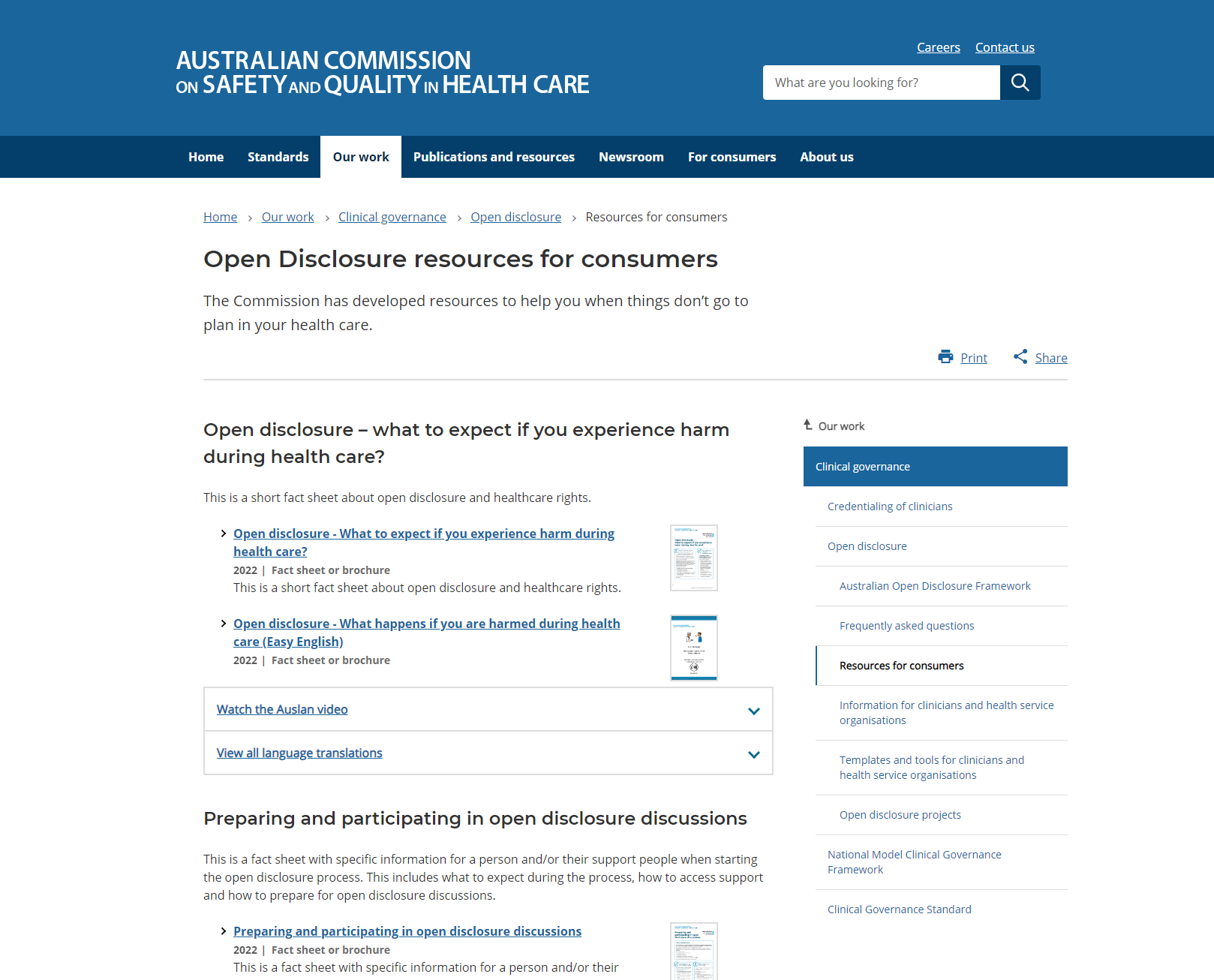
Open Disclosure resources for consumers
This resource provides information on open disclosure in healthcare, explaining what people should expect if harm occurs during care. It includes fact sheets in various languages and outlines how to prepare for open disclosure discussions. The resource aims to support transparent communication and improve care safety across healthcare settings, including aged care. This resource may refer to information that will be updated from 1 November 2025 to align with the new Aged Care Act and Quality Standards.
Financial and Prudential Monitoring, Compliance and Intervention Framework
This resource outlines the Financial and Prudential Monitoring, Compliance and Intervention Framework for aged care providers. It aims to enhance financial transparency, requiring stricter reporting, oversight, and adherence to prudential standards. The framework helps ensure financial stability, protects refundable accommodation deposits, and supports the continuity of care in residential aged care. It includes phased implementation and future regulatory changes.

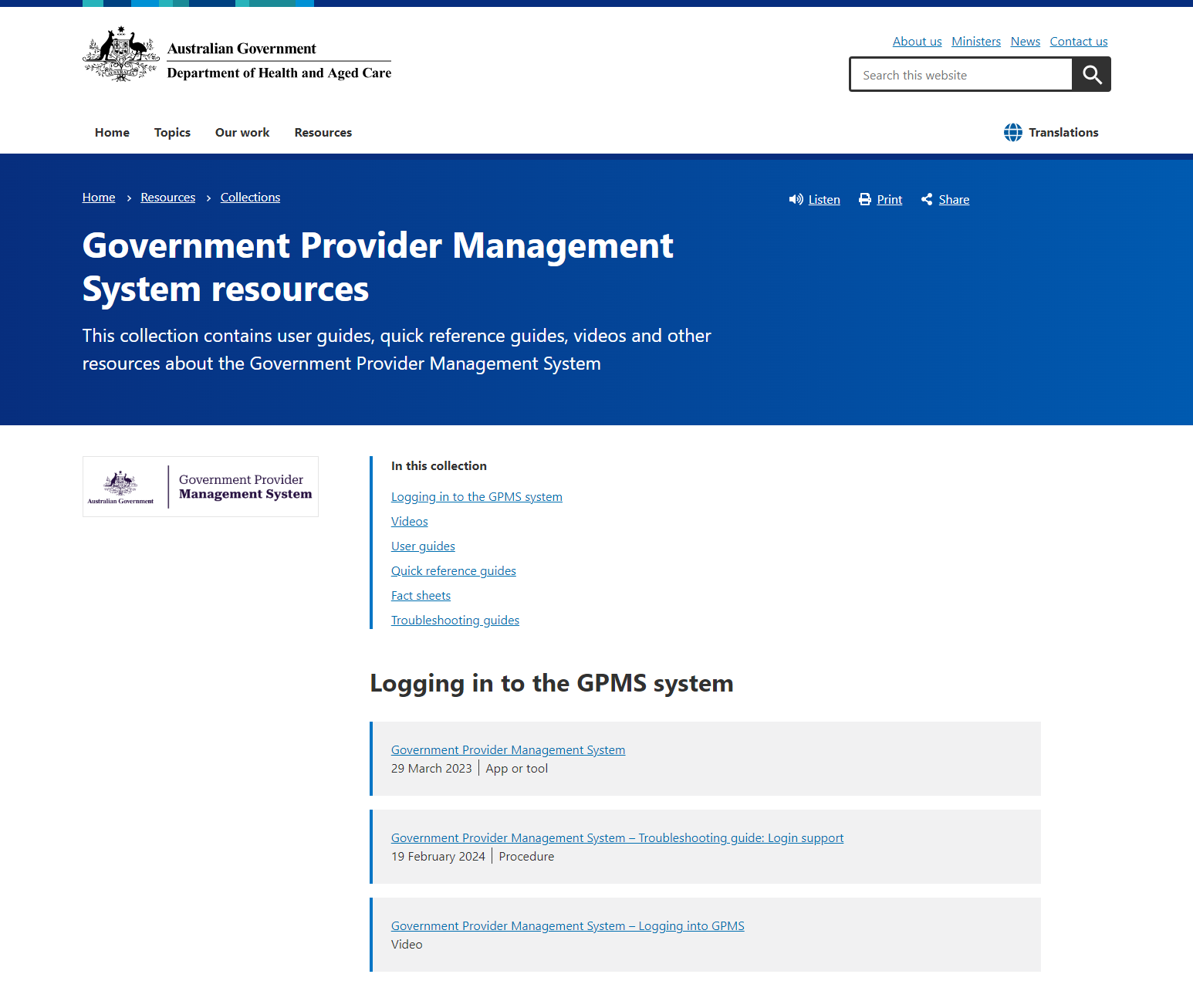
Government Provider Management System resources
This resource provides user guides, quick reference materials, and videos to support aged care providers in using the Government Provider Management System (GPMS). It covers essential tasks such as managing user details, financial reporting, and service information. The GPMS ensures accurate and efficient data management for regulatory compliance and operational oversight in aged care services.
This resource may refer to information that will be updated from 1 November 2025 to align with the new Aged Care Act and Quality Standards.
Government Provider Management System (GPMS)
This resource provides an overview of the Government Provider Management System (GPMS), designed to simplify access to and reporting of information by aged care providers to the government. It includes user guides, fact sheets, and troubleshooting support for managing organisational details, notifications, and financial reporting in compliance with aged care requirements.
This resource may refer to information that will be updated from 1 November 2025 to align with the new Aged Care Act and Quality Standards.
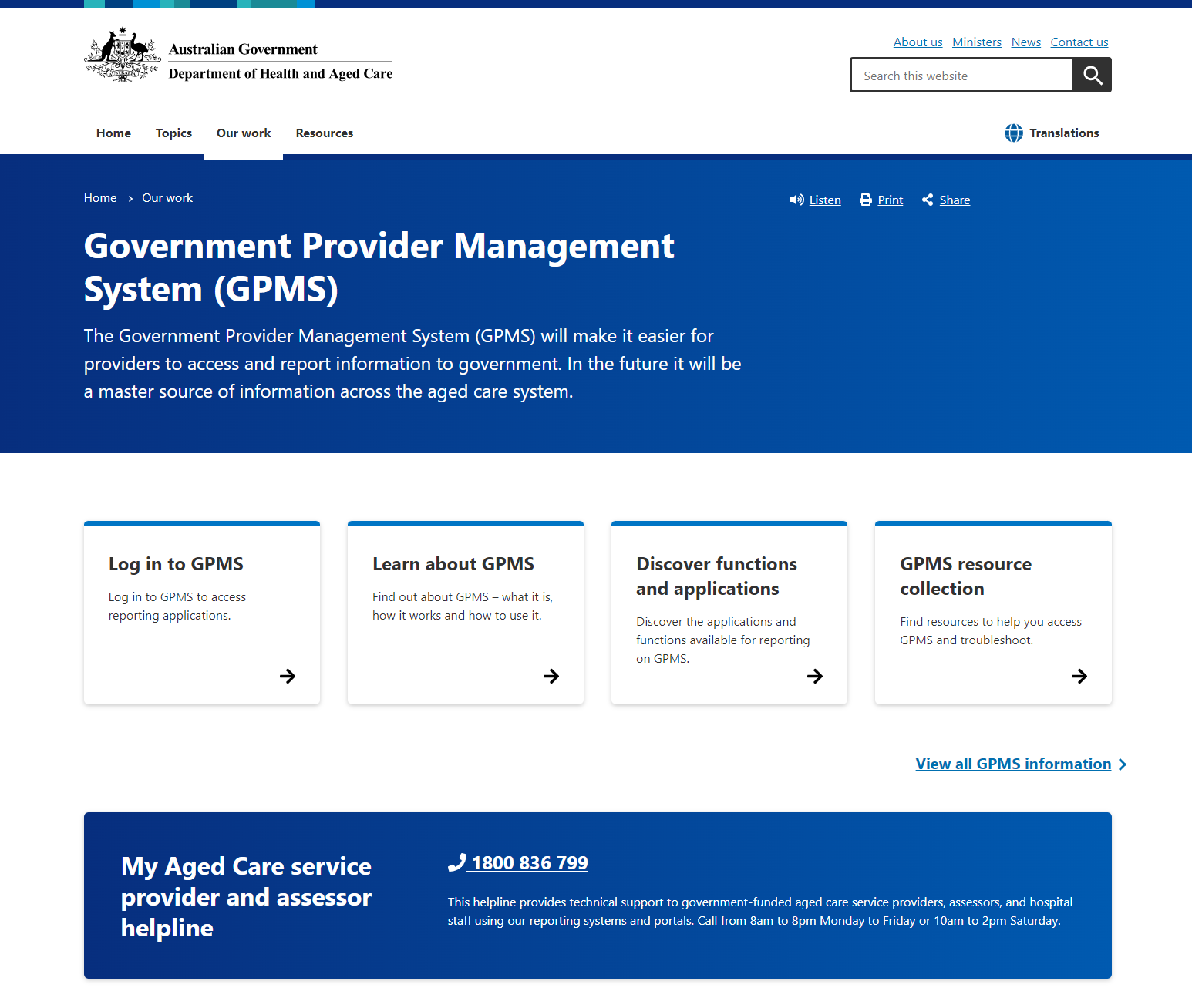
Quarterly Financial Report resources
This resource provides information and templates for the Quarterly Financial Report (QFR), required for approved aged care providers. It includes data definitions, templates, frequently asked questions, and guidance for reporting on finances, labour costs, and other operational data. This resource may refer to information that will be updated from 1 November 2025 to align with the new Aged Care Act and Quality Standards.
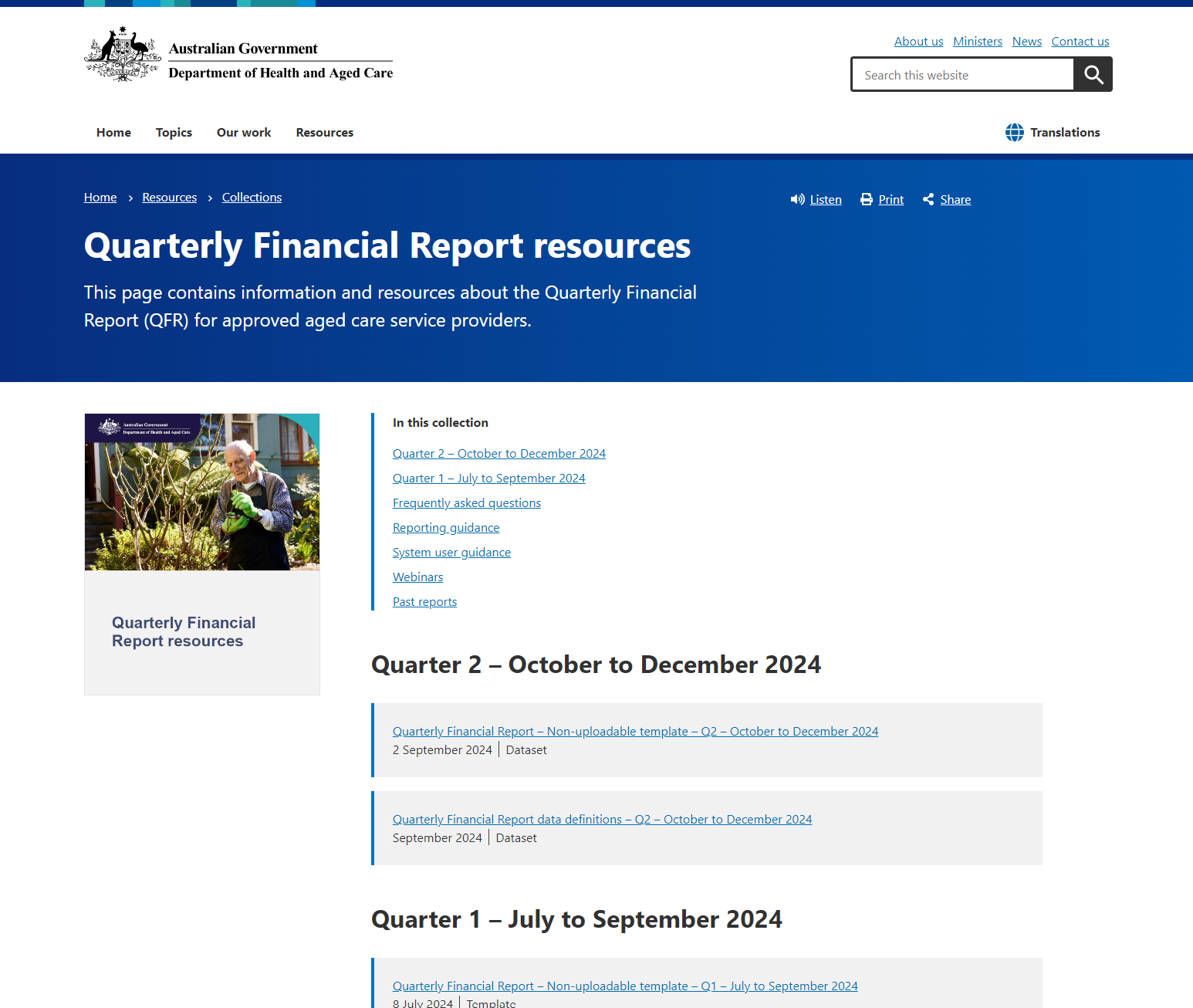
RACGP aged care clinical guide (Silver Book) - Part A - Infection and sepsis
This guide provides information on preventing and managing infections and sepsis in aged care settings. It includes recommendations on vaccination, antibiotic stewardship, recognising symptoms, and managing conditions such as respiratory, urinary tract, skin, and gastrointestinal infections. It also covers risk assessment, treatment considerations, and the role of general practitioners in infection control.
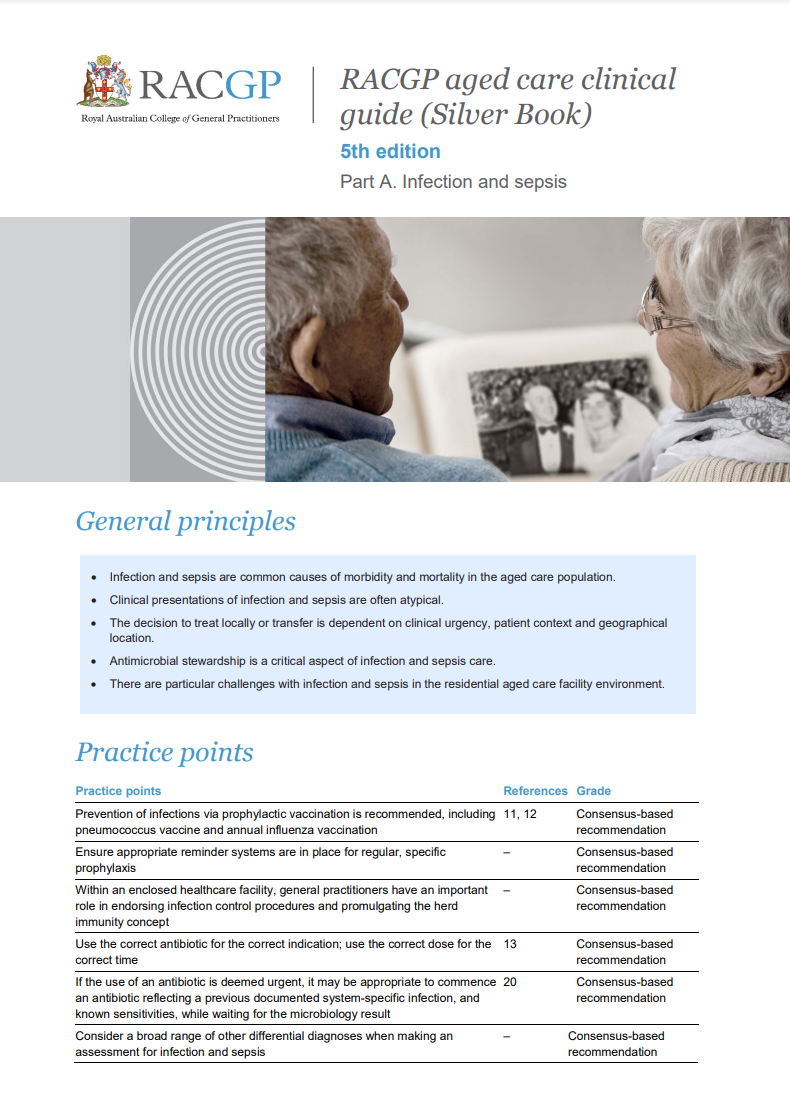
Aseptic technique
This resource provides information on aseptic techniques to support service provides adapt practices to protect patients from healthcare-associated infections and healthcare workers from contact with blood, body fluid and body tissue. It provides guides for implementation, principles of aseptic technique and safe use of chlorhexidine.
This resource may refer to information that will be updated from 1 July 2025 to align with the new Aged Care Act and Quality Standards.
AMR - Antimicrobial resistance
The AMR provides information on antimicrobial resistance and it's threats to human and animal health. It contains information on how to reduce it's spread, news, AMR resources and other resources on antimicrobial resistance.
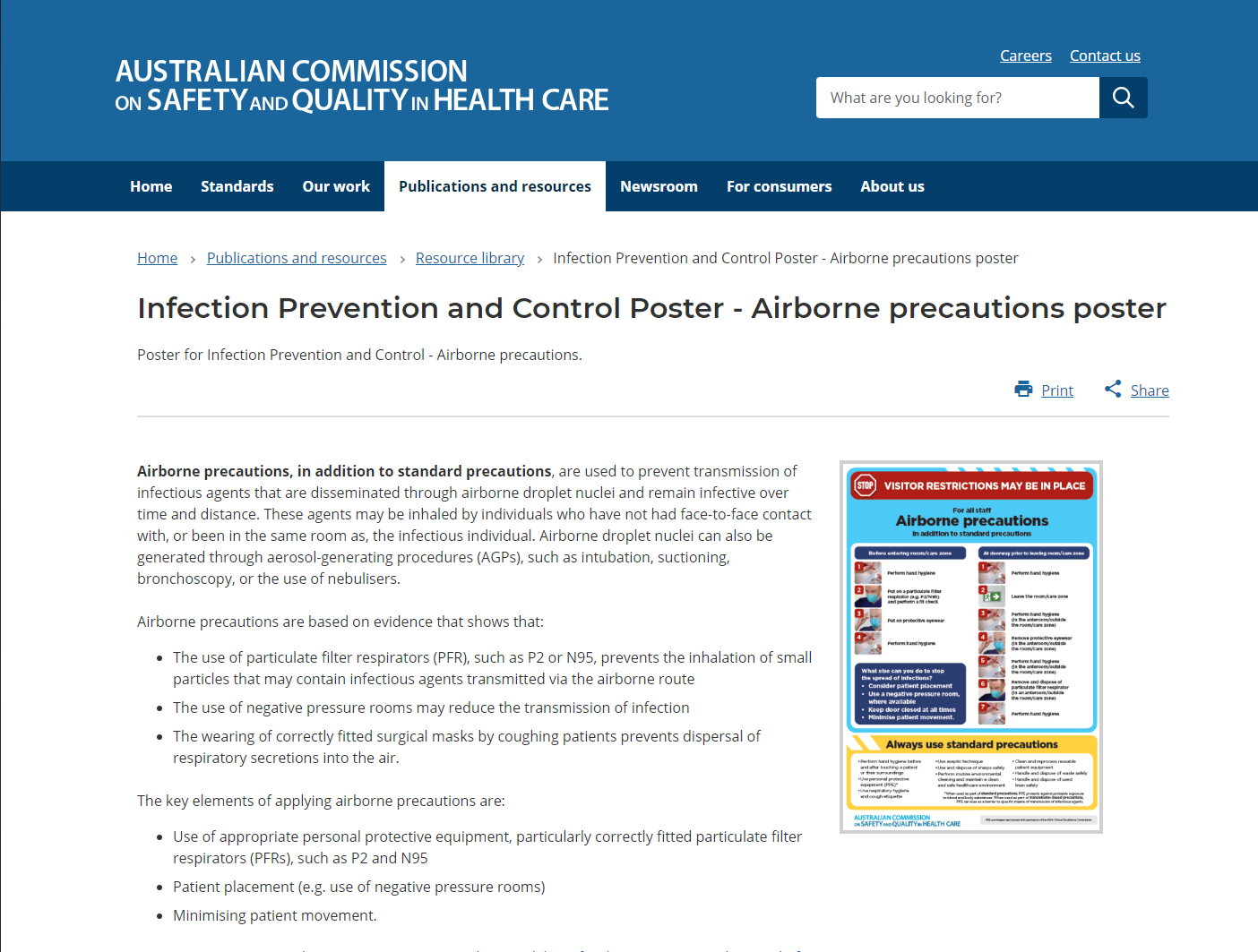
Infection Prevention and Control Poster - Airborne precautions poster
This poster outlines airborne precautions, in addition to standard precautions, for infection prevention and control. It provides guidance on preventing transmission of infectious agents through airborne droplet nuclei using personal protective equipment (PPE), negative pressure rooms, and limiting patient movement to reduce infection risks.
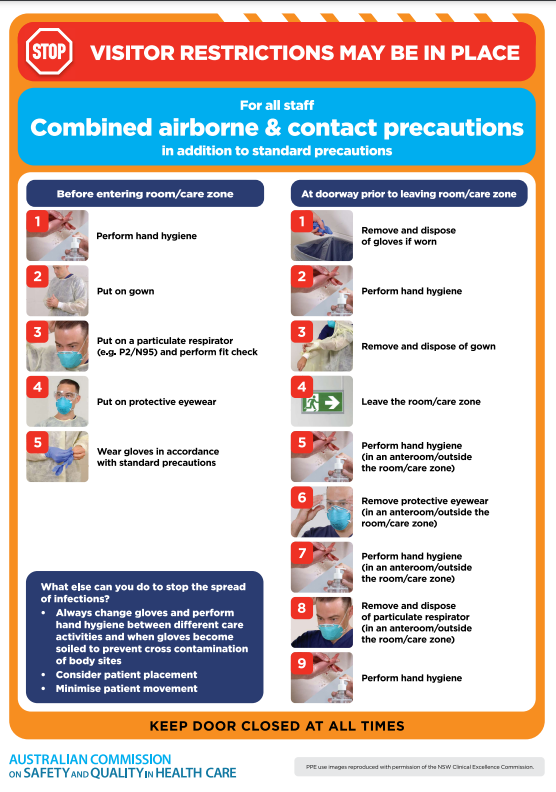
Infection Prevention and Control Poster – Combined airborne and contact precautions
This poster provides guidance on combined airborne and contact precautions for infection prevention and control. It includes information on using personal protective equipment (PPE) and other measures to minimise the spread of infectious agents transmitted through both airborne particles and direct contact.
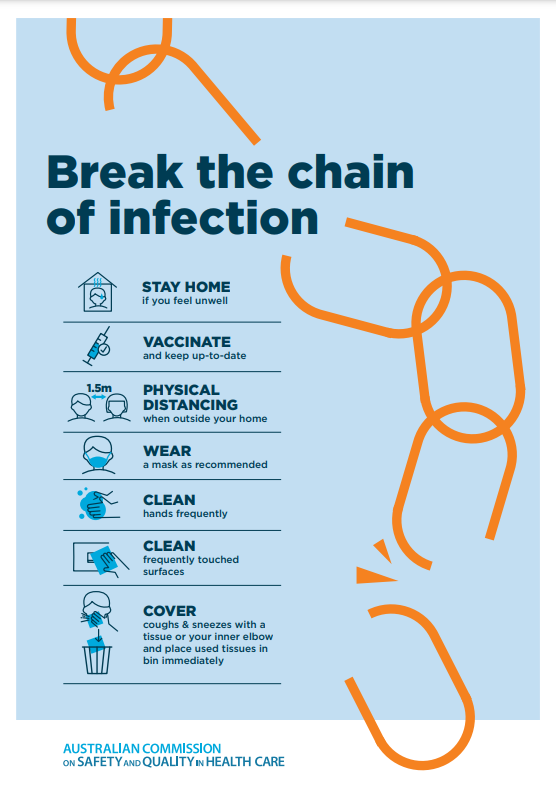
Break The Chain of Infection Poster
This poster outlines key steps to break the chain of infection, including staying home if unwell, physical distancing, frequent handwashing, cleaning surfaces, and covering coughs or sneezes. It aims to prevent the spread of respiratory infections and supports infection prevention practices in healthcare settings.
National Infection Control Guidance Non-tuberculous Mycobacterium infections associated with heater-cooler devices
This guidance addresses the infection risks associated with heater-cooler devices, particularly Non-tuberculous Mycobacterium infections. It provides recommendations for Australian healthcare organisations on managing these risks, including using safety notices and infection control guidelines. It should be used alongside state and territory health advice. This resource may apply to healthcare contexts outside of aged care and please consider the applicability of this resource to your care setting.
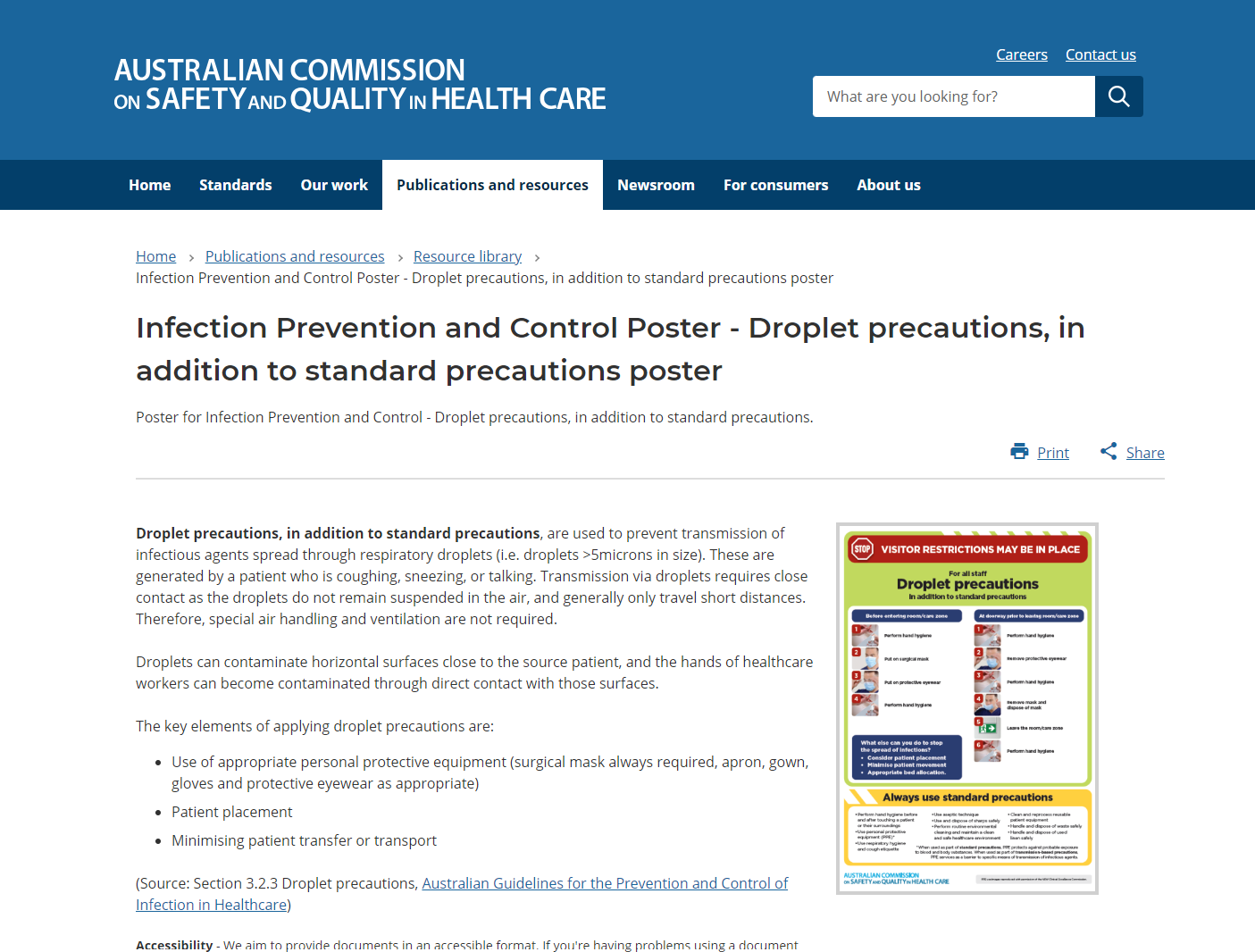
Infection Prevention and Control Poster - Droplet precautions, in addition to standard precautions poster
This resource is a poster on droplet precautions, in addition to standard precautions, for infection prevention. It outlines measures to prevent the transmission of infectious agents spread through respiratory droplets, such as using appropriate personal protective equipment (PPE), patient placement, and minimising patient transport. This resource may apply to healthcare contexts outside of aged care. Please consider the applicability of this resource to your care setting.
Preventing and Controlling Infections Standard
The Preventing and Controlling Infections Standard (National Safety and Quality Health Service Standards) outlines infection prevention and control strategies, antimicrobial stewardship, the safe use of resources, and evidence-based practices. It aims to minimise infection risks and ensure the safety of people receiving care and workforce members. It also supports compliance with infection control standards in healthcare and aged care settings. This resource may apply to healthcare contexts outside of aged care and please consider the applicability of this resource to your care setting.
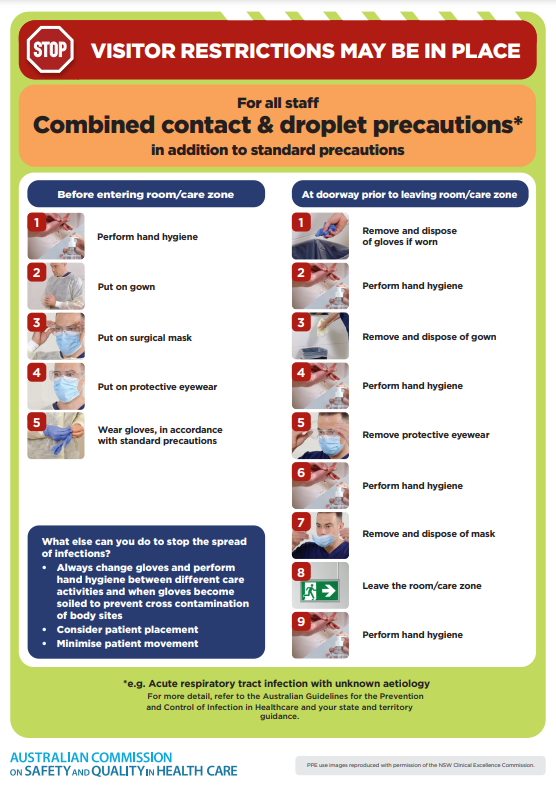
Infection Prevention and Control Poster – Combined contact and droplet precautions
This poster outlines combined contact and droplet precautions for infection prevention and control, in addition to standard precautions. It provides guidance on the use of personal protective equipment (PPE) and other measures to reduce the transmission of infectious agents through direct contact and respiratory droplets.
Infection Prevention and Control Poster - Contact precautions poster
This poster outlines contact precautions for infection prevention and control, in addition to standard precautions. It provides guidance on preventing the transmission of infectious agents through direct or indirect contact. Key elements include using personal protective equipment, proper patient placement, and minimising patient movement. This resource may apply to healthcare contexts outside of aged care. Please consider the applicability of this resource to your care setting.
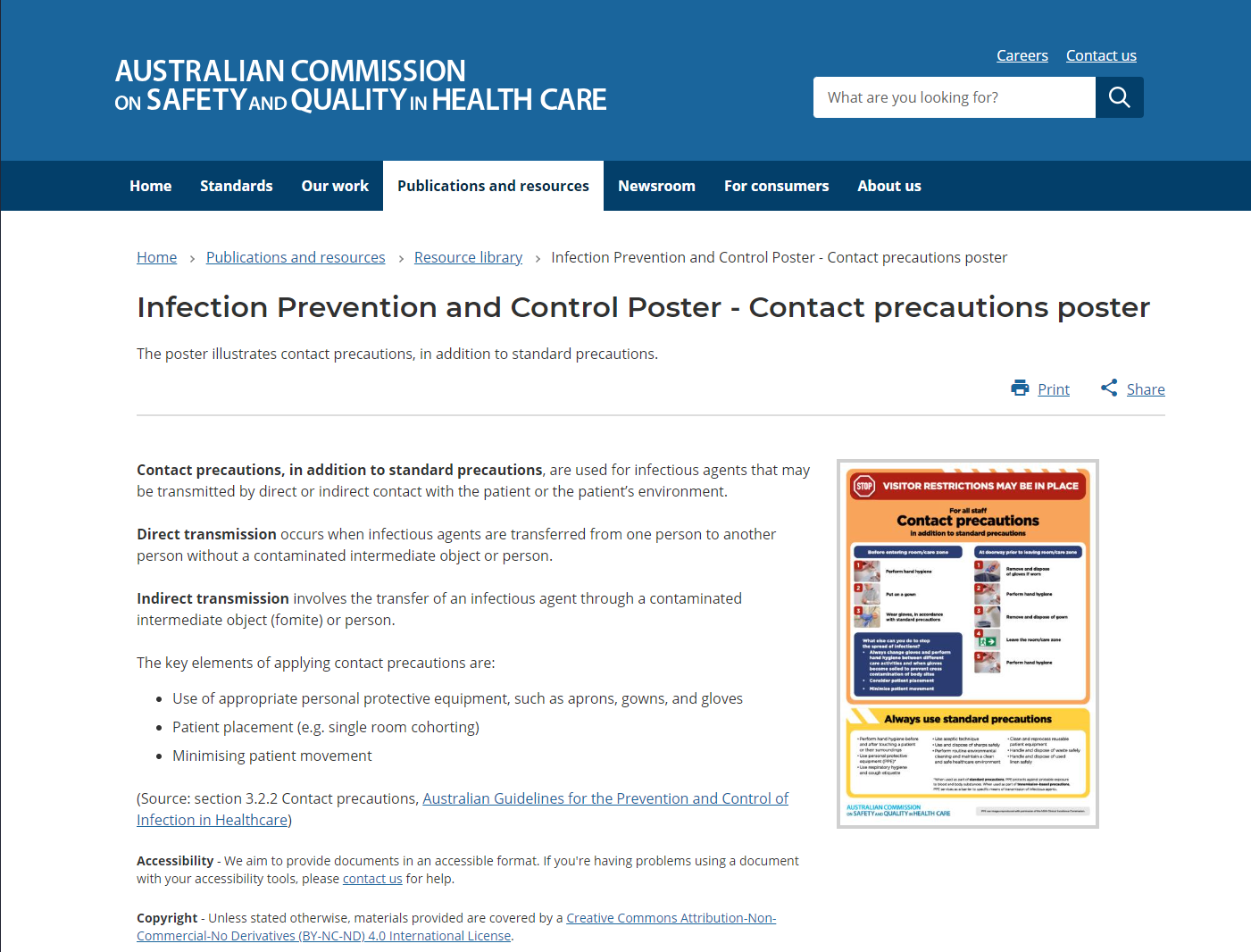
Infection Prevention and Control Poster - Standard precautions poster
This resource is a poster on standard precautions for infection prevention and control in healthcare. It outlines essential practices such as hand hygiene, personal protective equipment use, environmental cleaning, and waste management. The poster helps healthcare workers minimise infection risks and maintain safe care environments. This resource may apply to healthcare contexts outside of aged care. Please consider the applicability of this resource to your care setting.
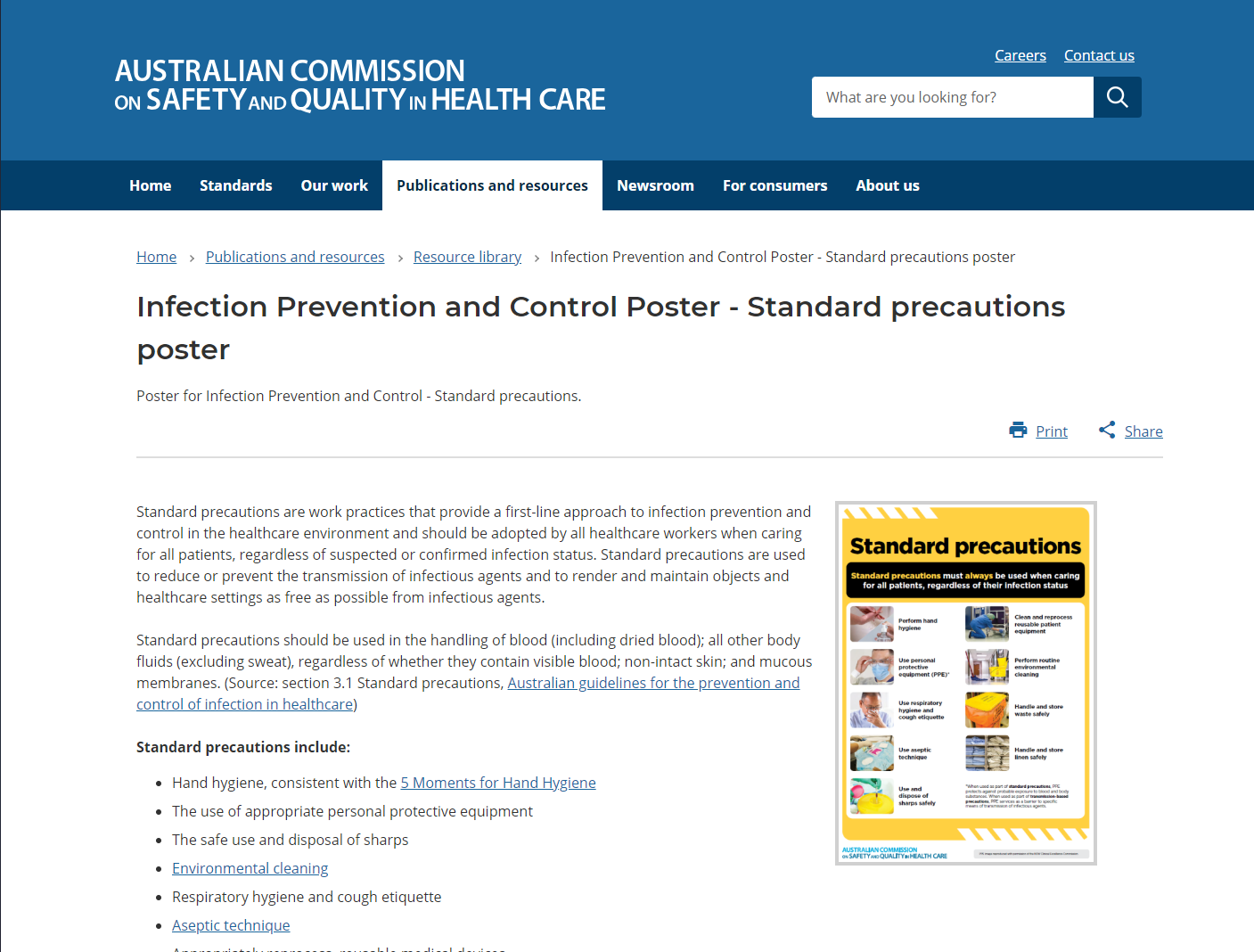
Recommendations for the control of carbapenemase-producing Enterobacterales
This resource provides guidance on preventing and managing carbapenemase-producing Enterobacterales (CPE) in healthcare. It covers screening, outbreak control, and environmental cleaning, helping to reduce antimicrobial resistance. The resource supports infection control policies and aims to enhance safety in aged care and health service organisations.
This resource may refer to information that will be updated from 1 November 2025 to align with the new Aged Care Act and Quality Standards.