The Quality Standards Resource Centre helps extend understanding of the strengthened Aged Care Quality Standards, which took effect from 1 November 2025. You can search for resources by using keywords, or filtering by standard, outcome and audience. Before using the Resource Centre, please read the terms of use.
Food, nutrition & dining: resources for providers
This resource provides tools and guidance for aged care providers to ensure quality food, nutrition, and dining experiences. It includes hotlines, resources for dining, choice, swallowing, and oral health, as well as webinars, research findings, and practical tips to support older adults' wellbeing and meet care standards.
This resource may refer to information that will be updated from 1 November 2025 to align with the new Aged Care Act and Quality Standards.
Using technology to improve the dining experience
This resource provides guidance on how technology, such as virtual reality (VR) and mobile applications, can enhance the dining experience in aged care settings. These tools are designed to increase engagement, support meal choices, improve communication with families, and contribute to overall wellbeing by making mealtimes more enjoyable.
This resource may refer to information that will be updated from 1 November 2025 to align with the new Aged Care Act and Quality Standards.
Heaters and burns - Reducing heater burn risks in residential aged care services
This resource provides guidance for aged care providers on managing risks related to hydronic heaters. It advises regular maintenance, accurate temperature checks, and positioning of beds away from heaters. Installing guards and monitoring heat settings are also recommended to prevent burns and ensure the safety of older people in cooler months.
This resource may refer to information that will be updated from 1 November 2025 to align with the new Aged Care Act and Quality Standards.
Hot water scalding
This page provides guidance for aged care providers on preventing and responding to hot water scalding incidents. It highlights the importance of staff oversight, proper training, and temperature checks when providing care. It also includes immediate first aid steps for burns, helping to reduce risks for vulnerable people, especially older people.
This resource may refer to information that will be updated from 1 November 2025 to align with the new Aged Care Act and Quality Standards.
Keeping residents safe this summer
This resource offers guidance to aged care providers on keeping older people safe during summer. It includes strategies for managing heat exposure, hydration, and sun protection. It helps providers monitor vulnerable people, recognise signs of overheating, and implement preventative measures to ensure safety during hot weather.
This resource may refer to information that will be updated from 1 November 2025 to align with the new Aged Care Act and Quality Standards.
Preventing equipment failures
This resource highlights the importance of preventing equipment failures in aged care settings. It outlines the need for regular maintenance checks, adherence to manufacturer guidelines, and proper record-keeping to ensure safety. The document also provides recommendations for improving the safety and reliability of critical devices, such as mobility hoists and medical equipment.
This resource may refer to information that will be updated from 1 November 2025 to align with the new Aged Care Act and Quality Standards.
Incontinence associated dermatitis and pressure injury
This resource provides guidance on managing incontinence-associated dermatitis (IAD) and pressure injuries (PI) in aged care. It highlights the differences between IAD and PI, emphasises the need for timely assessment and monitoring, and outlines strategies for prevention, including proper skin care, repositioning, and using appropriate continence products to prevent skin damage.
This resource may refer to information that will be updated from 1 November 2025 to align with the new Aged Care Act and Quality Standards.
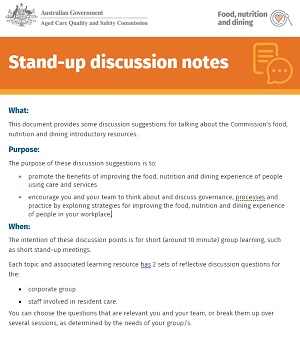
Food, nutrition and dining stand-up discussion notes
This resource provides discussion notes to improve the food, nutrition, and dining experience in aged care settings. It includes reflective questions for corporate teams and care staff, focusing on governance, resident choice, oral health, and support for those with swallowing difficulties. The resource promotes continuous improvement and quality care through group discussions. This resource may refer to information that will be updated from 1 November 2025 to align with the new Aged Care Act and Quality Standards.
 Stand-up discussion notes (DOCX 6.68 MB)
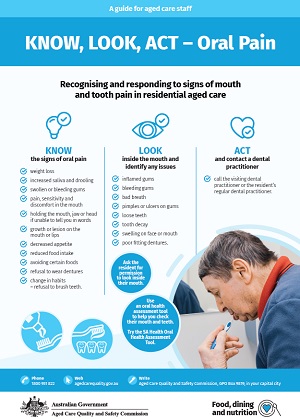
KNOW, LOOK, ACT - Oral Pain aged care staff poster
This poster serves as a resource for aged care staff to recognise and respond to signs of oral pain in residents. It provides guidance on identifying mouth and tooth pain and taking appropriate action to address these issues. The poster is available for download and use in residential aged care settings. This resource may refer to information that will be updated from 1 November 2025 to align with the new Aged Care Act and Quality Standards.

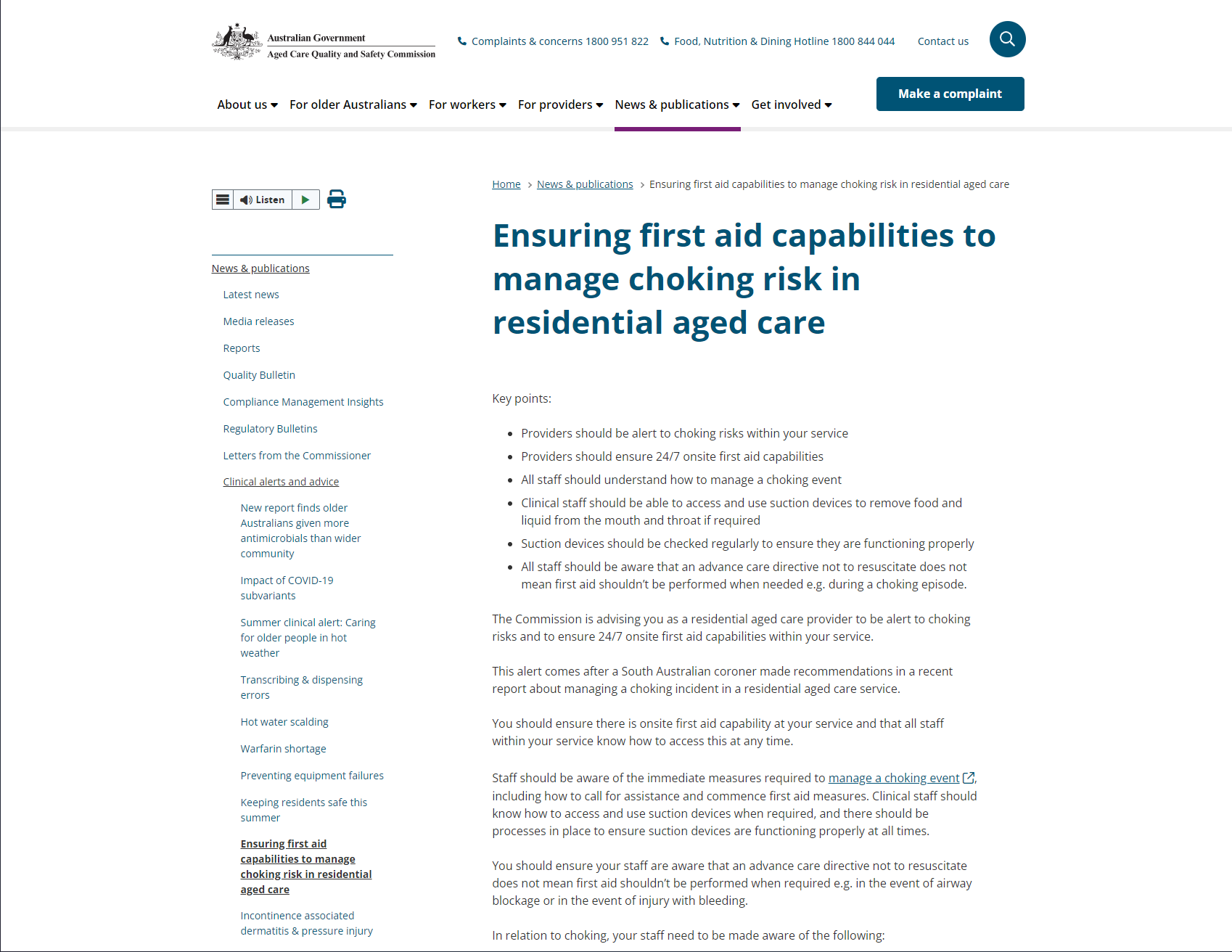
Ensuring first aid capabilities to manage choking risk in residential aged care
This page provides guidance for residential aged care services on managing choking risks. It advises 24/7 first aid capabilities, staff training on choking incidents, the use of suction devices, and understanding that advance care directives do not prevent the administering of first aid. The alert also recommends collaborating with speech pathologists, documenting discussions, and managing choking events through incident review and support.
Food, nutrition and dining: a reflection on practice
This training PowerPoint is a presentation that trainers/managers can download, customise and use to promote discussion and educate their staff to support and improve the food, nutrition and dining experience of consumers in their care.
The resource is designed to support reflective discussions about what ‘best practice’ looks like and a reflection on how it applies in practice. This resource may refer to information that will be updated from 1 November 2025 to align with the new Aged Care Act and Quality Standards.
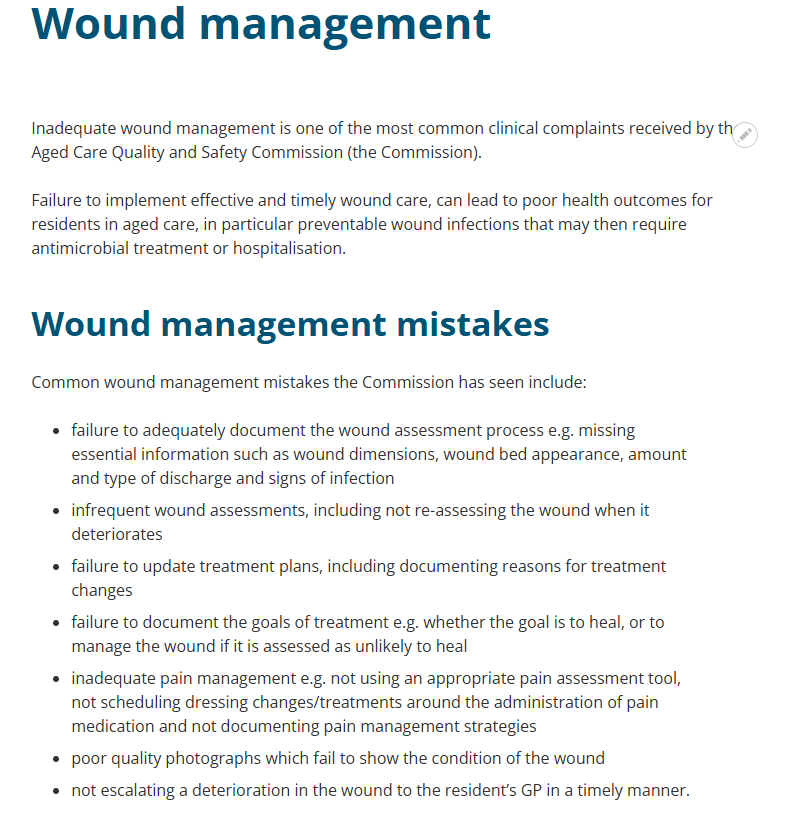
Wound management
This resource provides information about wound management, including wound management mistakes. It contains treatment plan information and highlights the importance of monitoring and analysing data under the National Mandatory Quality Indicator Program.
This resource may refer to information that will be updated from 1 November 2025 to align with the new Aged Care Act and Quality Standards.