
Aged care laws in Australia have now changed. The new Aged Care Act 2024 and Aged Care Rules 2025 now apply. While we complete updating of our website, including draft guidance and other materials, to align with the new laws, providers are advised to refer to the new Act and Rules for any required clarification of their obligations and legal responsibilities. Thank you for your patience.

Quality Standards Resource Centre

The Quality Standards Resource Centre helps extend understanding of the strengthened Aged Care Quality Standards, which take effect from 1 November 2025. The Resource Centre will be updated to reflect key changes made to the draft strengthened Standards. You can search for resources by using keywords, or filtering by standard, outcome, audience and theme. Before using the Resource Centre, please read the terms of use.

Displaying 1 to 13 of 13 result(s)
/quality-standards/recognising-signs-deterioration-persons-mental-state

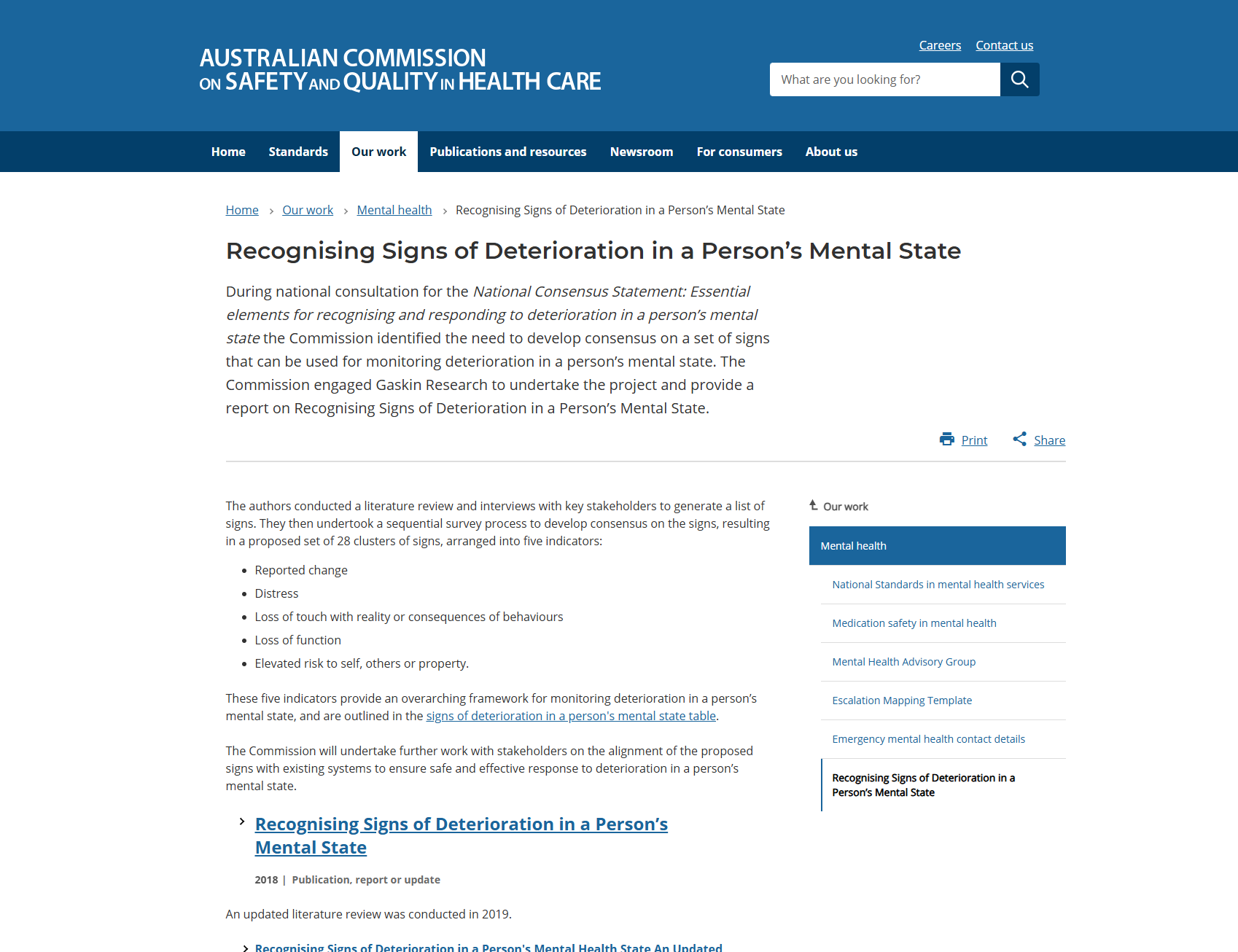
Recognising Signs of Deterioration in a Person’s Mental State

Paper, Report
Last Updated

This resource provides a framework for recognising signs of mental state deterioration, organised into 5 key indicators: reported change, distress, loss of reality, loss of function, and elevated risk. It supports healthcare providers in monitoring mental health changes to enable timely and effective responses across care settings. This resource may apply to healthcare contexts outside of aged care. Please consider the applicability of this resource to your care setting. 
Author
Australian Commission On Safety And Quality In Health Care
Key Theme
Assessment and planning, Clinical safety
Standard
5: Clinical Care, 3: The Care and Services
Outcomes
3.1 Assessment and planning, 5.5: Safety of clinical care services
Recognising Signs of Deterioration in a Person’s Mental State
/quality-standards/advance-care-planning-information-health-service-organisations

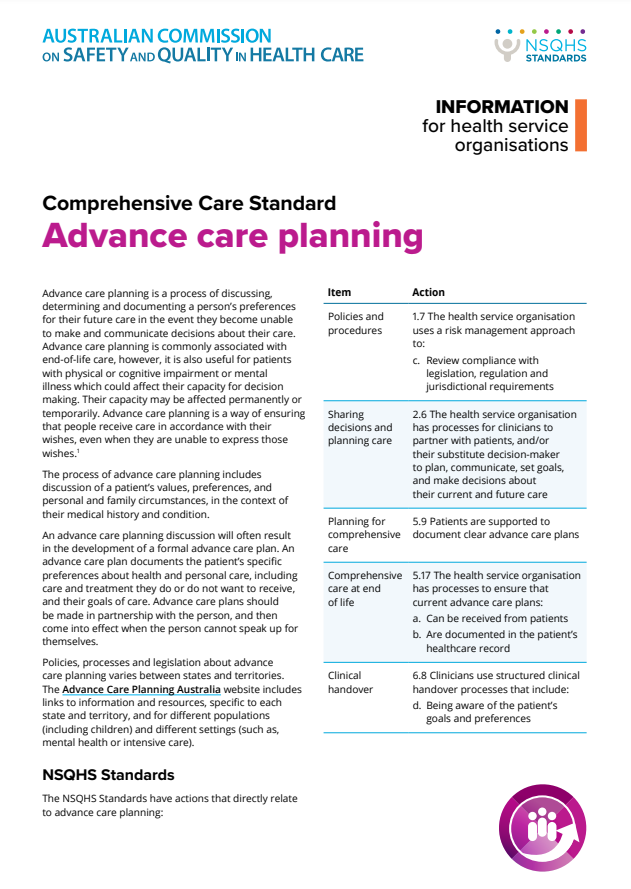
Advance care planning - Information for health service organisations

Guidance
Published date

This resource outlines how health service organisations can support advance care planning within the Comprehensive Care Standard (National Safety and Quality Health Service Standards). It highlights the importance of documenting a patient’s preferences for future care and ensuring systems are in place to act on these plans. It also provides actions related to policies, sharing decisions, comprehensive care, and clinical handover. 
Author
Australian Commission On Safety And Quality In Health Care
Key Theme
Palliative and end of life care, Assessment and planning
Standard
5: Clinical Care, 3: The Care and Services
Outcomes
5.7: Palliative care and end-of-life care, 3.1 Assessment and planning
Advance care planning - Information for health service organisations
/quality-standards/informed-consent

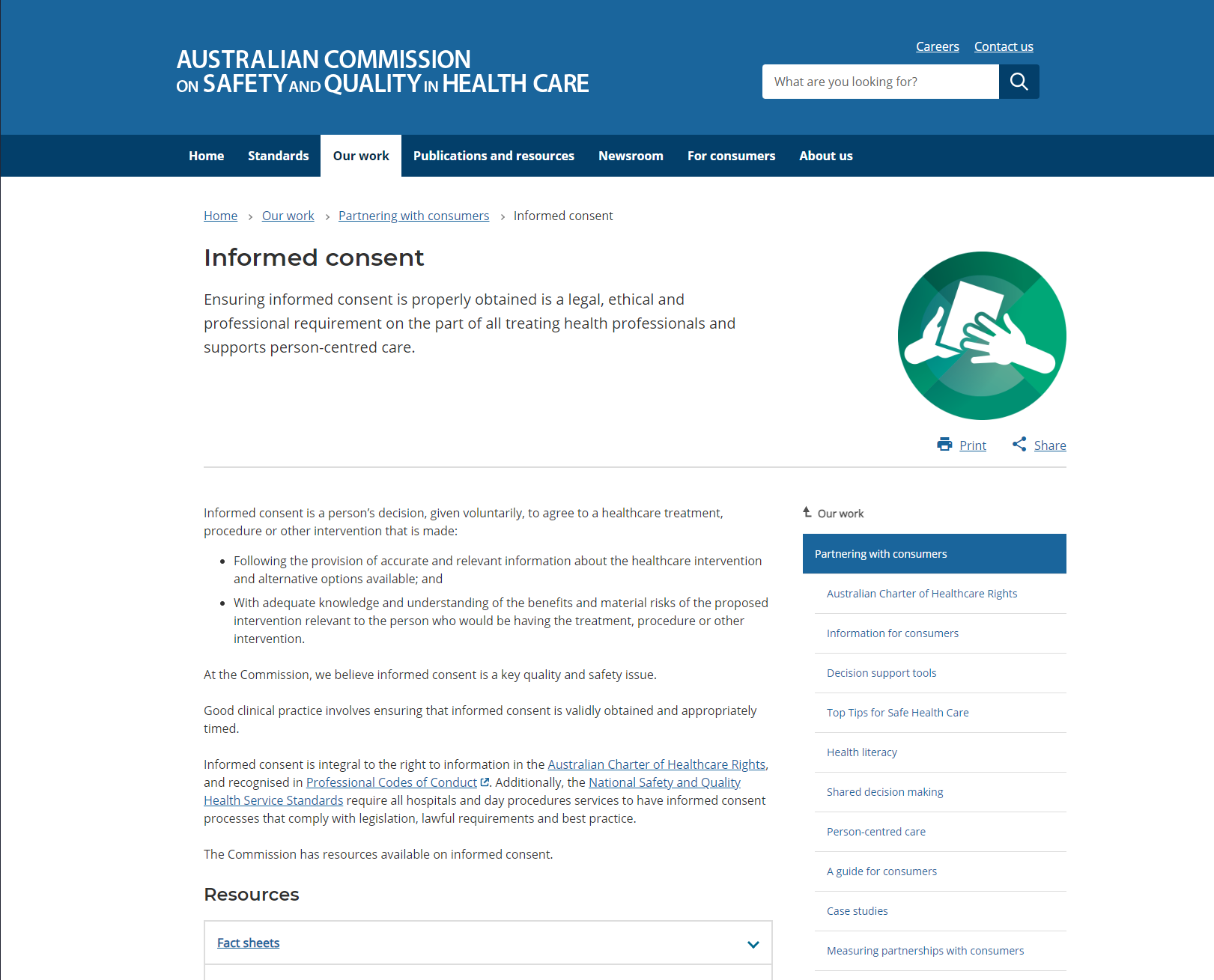
Informed consent

Guidance
Last Updated

This resource provides guidance on ensuring informed consent in healthcare settings. It outlines legal, ethical, and professional requirements for obtaining consent, supports person-centred care, and ensures compliance with Australian healthcare standards. It highlights the importance of providing accurate information about interventions and alternatives, ensuring people have sufficient knowledge of potential risks and benefits. 
Author
Australian Commission On Safety And Quality In Health Care
Key Theme
Choice, independence and quality of life, Assessment and planning, Care coordination and transitions
Standard
1: The Individual, 3: The Care and Services, 7: The Residential Community
Outcomes
1.3: Choice, independence and quality of life, 3.1 Assessment and planning, 7.2: Transitions
Informed consent
/quality-standards/advance-care-planning-information-clinicians

Advance care planning - Information for clinicians

Fact sheet
Published date

This resource guides clinicians on the importance of advance care planning, particularly for those with life-limiting illnesses, chronic conditions, or cognitive impairment. It outlines the need for early conversations about patient preferences and comprehensive care, ensuring decisions are documented, shared, and align with clinical handover processes to respect patient autonomy and improve care outcomes. 

This resource may refer to information that will be updated from 1 November 2025 to align with the new Aged Care Act and Quality Standards.
Author
Australian Commission On Safety And Quality In Health Care
Key Theme
Palliative and end of life care, Assessment and planning
Standard
5: Clinical Care, 3: The Care and Services
Outcomes
5.7: Palliative care and end-of-life care, 3.1 Assessment and planning
Advance care planning - Information for clinicians
/quality-standards/comprehensive-care-clinical-assessment-and-diagnosis-key-actions-health-service-organisations

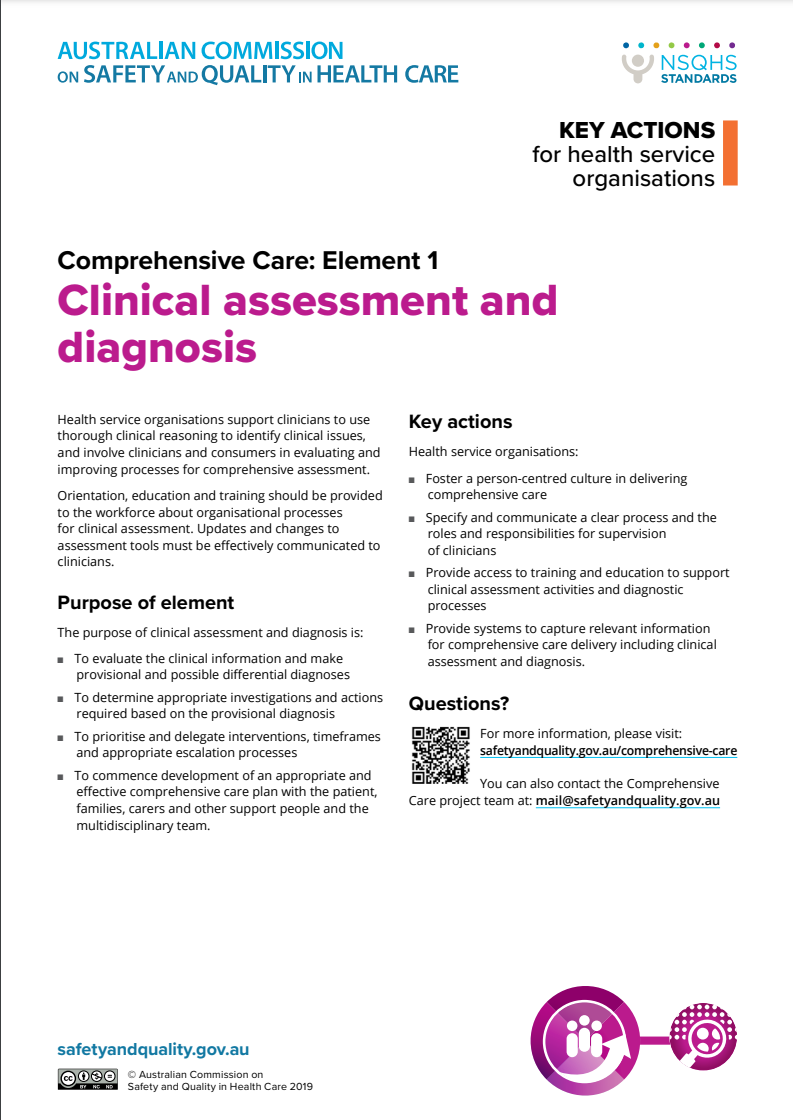
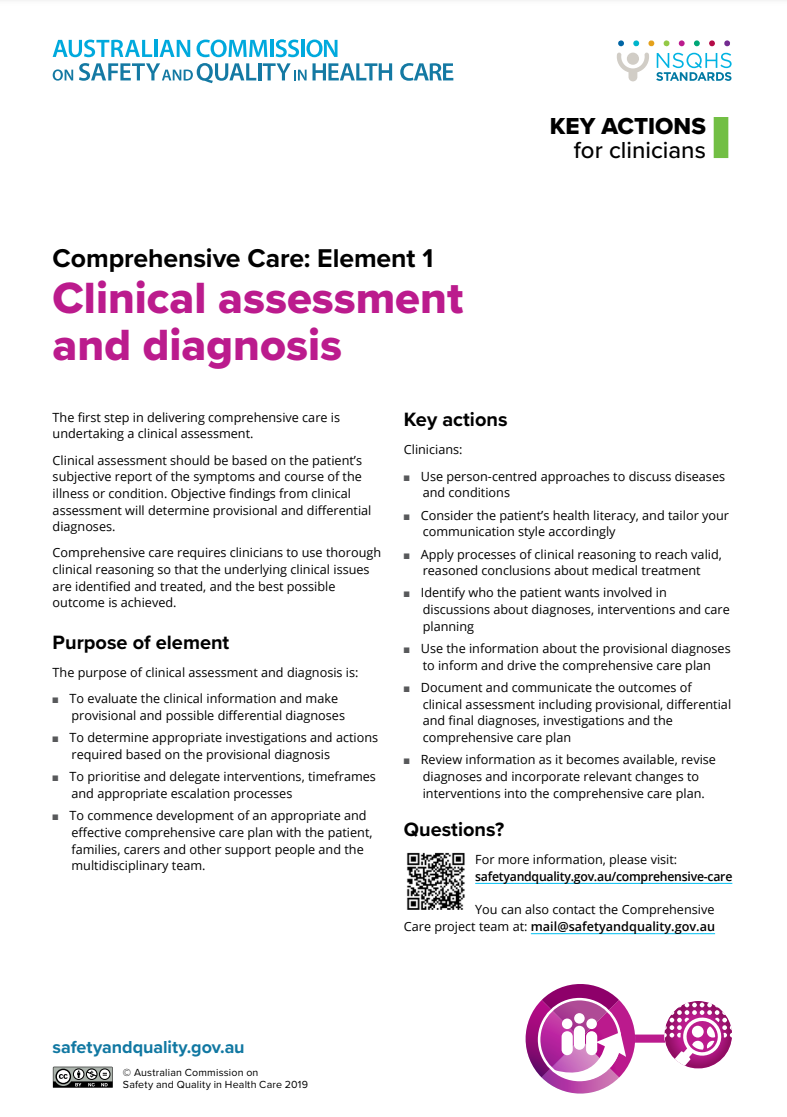
Comprehensive Care - Clinical assessment and diagnosis - Key actions for health service organisations

Fact sheet
Published date

This resource provides actions for health service organisations to support clinical assessment and diagnosis, promoting a person-centred approach and comprehensive care planning. It highlights training, clear communication of roles, and systems for documenting diagnoses and care plans. 

This resource may apply to healthcare contexts outside of aged care. Please consider the applicability of this resource to your care setting. This resource may refer to information that will be updated from 1 November 2025 to align with the new Aged Care Act and Quality Standards.
Author
Australian Commission On Safety And Quality In Health Care
Key Theme
Assessment and planning, Delivering comprehensive care and services
Standard
3: The Care and Services, 5: Clinical Care
Outcomes
3.1 Assessment and planning, 5.4: Comprehensive care
Comprehensive Care - Clinical assessment and diagnosis - Key actions for health service organisations
/quality-standards/comprehensive-care-clinical-assessment-and-diagnosis-key-actions-clinicians

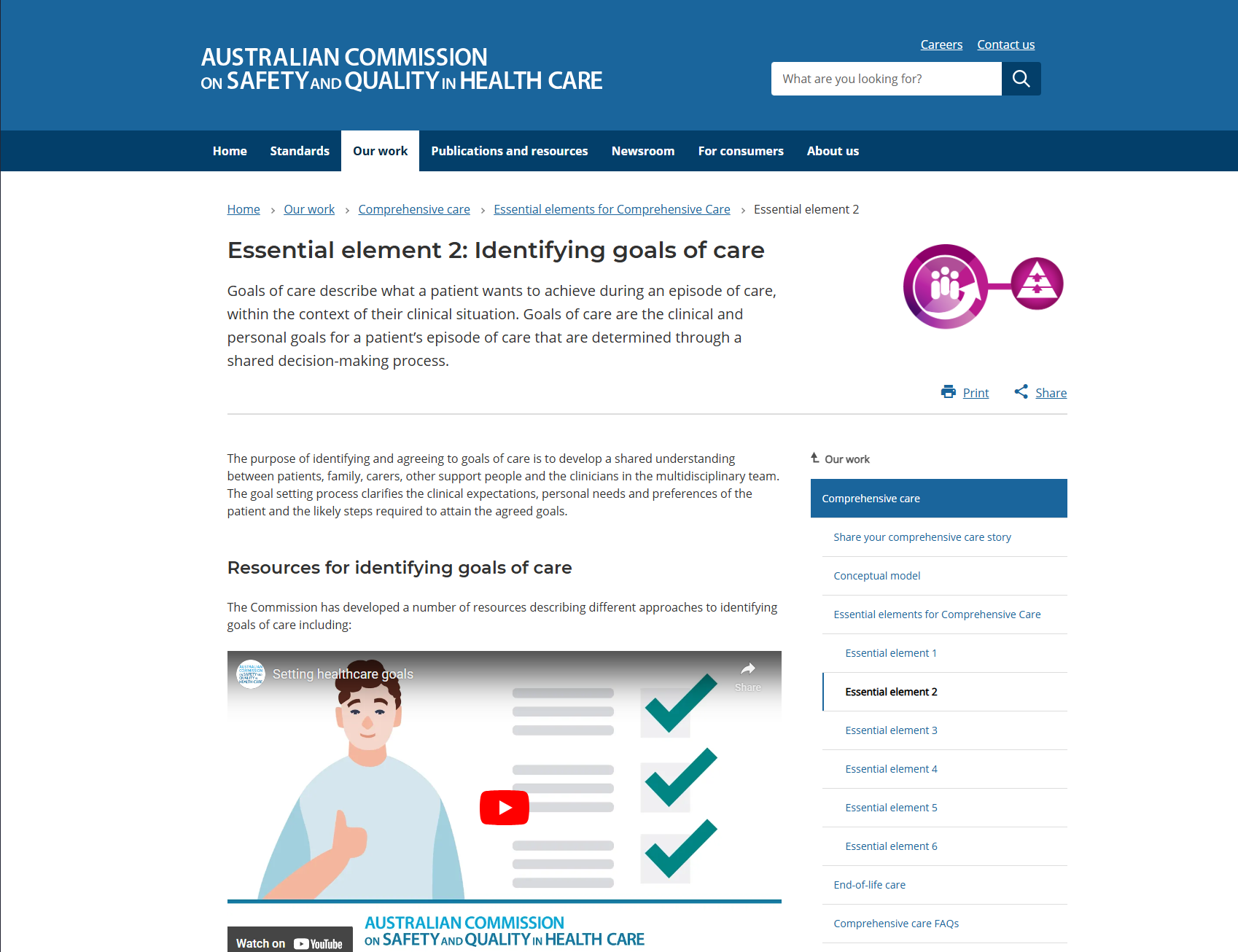
Comprehensive Care - Clinical assessment and diagnosis - Key actions for clinicians

Fact sheet
Published date

This resource provides actions for health service organisations to support clinical assessment and diagnosis, promoting a person-centred approach and comprehensive care planning. It highlights training, clear communication of roles, and systems for documenting diagnoses and care plans. 

This resource may apply to healthcare contexts outside of aged care. Please consider the applicability of this resource to your care setting. This resource may refer to information that will be updated from 1 November 2025 to align with the new Aged Care Act and Quality Standards.
Author
Australian Commission On Safety And Quality In Health Care
Key Theme
Assessment and planning, Delivering comprehensive care and services
Standard
3: The Care and Services, 5: Clinical Care
Outcomes
3.1 Assessment and planning, 5.4: Comprehensive care
Comprehensive Care - Clinical assessment and diagnosis - Key actions for clinicians
/quality-standards/essential-element-2-identifying-goals-care

Essential element 2: Identifying goals of care

Guidance
Last Updated

This resource guides providers in identifying and setting goals of care with patients through shared decision-making. It fosters collaboration between patients, family, and healthcare teams to clarify expectations and establish personalised clinical and personal care objectives.

This resource may apply to healthcare contexts outside of aged care. Please consider the applicability of this resource to your care setting. This resource may refer to information that will be updated from 1 November 2025 to align with the new Aged Care Act and Quality Standards.

Author
Australian Commission On Safety And Quality In Health Care
Key Theme
Choice, independence and quality of life, Delivering comprehensive care and services, Assessment and planning, Care coordination and transitions
Standard
1: The Individual, 3: The Care and Services, 5: Clinical Care
Outcomes
1.3: Choice, independence and quality of life, 3.2: Delivery of funded aged care services, 5.4: Comprehensive care
Essential element 2: Identifying goals of care
/quality-standards/comprehensive-care-review-and-improve-comprehensive-care-delivery-key-actions-health-service-organisations

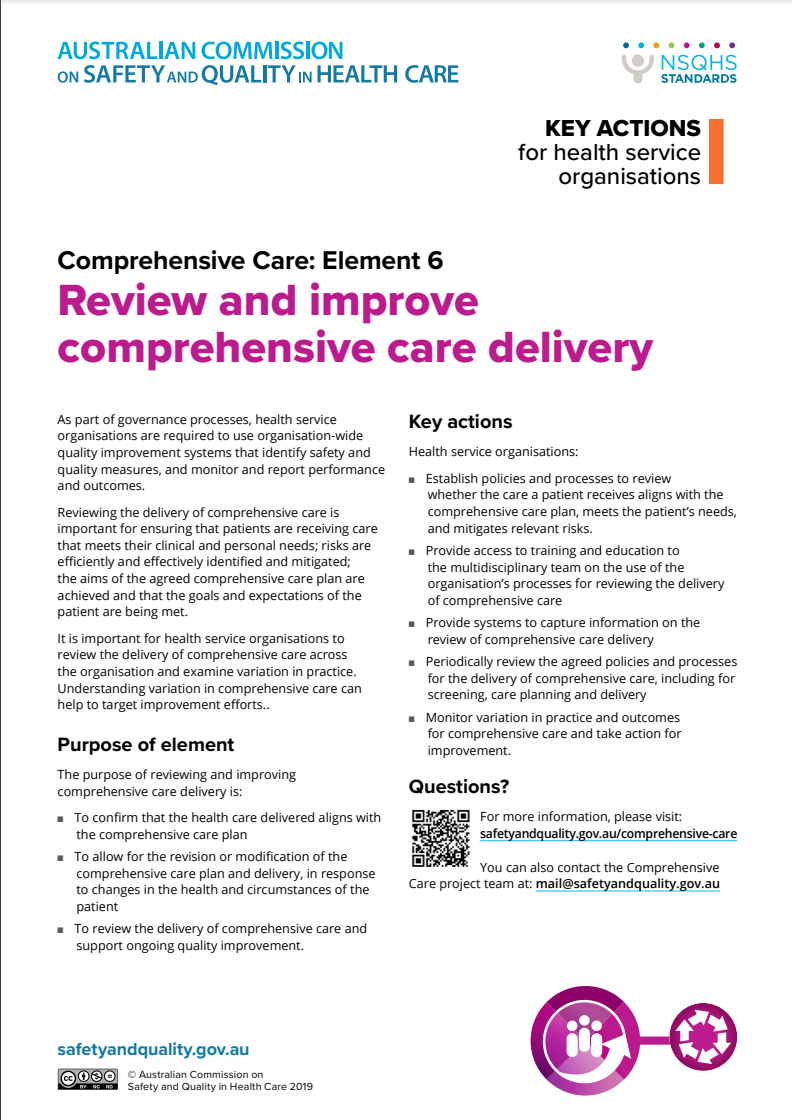
Comprehensive Care - Review and improve comprehensive care delivery - Key actions for health service organisations

Fact sheet
Published date

This resource outlines actions for health service organisations to review and improve comprehensive care delivery, focusing on aligning care with patients' needs and care plans. It emphasises regular assessment, multidisciplinary collaboration, and quality improvement to maintain responsive, person-centred care across services. 
Author
Australian Commission On Safety And Quality In Health Care
Key Theme
Corporate and clinical governance, Delivering comprehensive care and services, Assessment and planning
Standard
2: The Organisation, 3: The Care and Services, 5: Clinical Care
Outcomes
2.2a: Quality, safety and inclusion culture to support aged care workers to deliver quality care, 2.2b: Quality, safety and inclusion culture to support individuals, 3.2: Delivery of funded aged care services, 5.4: Comprehensive care
Comprehensive Care - Review and improve comprehensive care delivery - Key actions for health service organisations
/quality-standards/communication-clinical-handover

Communication at clinical handover

Guidance
Last Updated

This resource focuses on structured clinical handover processes to improve communication during patient care transitions. It highlights the importance of standardising handover procedures to make sure relevant information is effectively communicated, reducing errors and enhancing patient safety, especially during care transfers in healthcare settings, including aged care. 

This resource may refer to information that will be updated from 1 November 2025 to align with the new Aged Care Act and Quality Standards.
Author
Australian Commission On Safety And Quality In Health Care
Key Theme
Delivering comprehensive care and services, Care coordination and transitions, Assessment and planning
Standard
3: The Care and Services, 5: Clinical Care, 7: The Residential Community
Outcomes
3.3: Communicating for safety and quality, 3.4: Planning and coordination of funded aged care services, 5.4: Comprehensive care, 7.2: Transitions
Communication at clinical handover
/quality-standards/communicating-safety

Communicating for Safety

Guidance

This resource provides tools and guidance on improving clinical communication to enhance patient safety. It focuses on key communication touchpoints, such as handovers, decision-making, and care transitions. Designed to support healthcare providers, it offers practical strategies to reduce errors and improve outcomes in aged care and other healthcare settings. 

This resource may refer to information that will be updated from 1 November 2025 to align with the new Aged Care Act and Quality Standards.
Author
Australian Commission On Safety And Quality In Health Care
Key Theme
Delivering comprehensive care and services, Care coordination and transitions, Assessment and planning
Standard
3: The Care and Services, 5: Clinical Care, 7: The Residential Community
Outcomes
3.3: Communicating for safety and quality, 3.4: Planning and coordination of funded aged care services, 5.4: Comprehensive care, 7.2: Transitions
Communicating for Safety
/quality-standards/national-consensus-statement-essential-elements-recognising-and-responding-acute-physical-deterioration

National Consensus Statement - Essential elements for recognising and responding to acute physical deterioration

Guidance
Published date

This consensus statement outlines essential elements for recognising and responding to acute physiological deterioration in healthcare settings. It covers clinical processes like vital signs monitoring, diagnosis, and rapid response systems, as well as organisational aspects such as leadership, education, and evaluation. It provides generic information that can be applied to the aged care setting.

This resource may refer to information that will be updated from 1 November 2025 to align with the new Aged Care Act and Quality Standards.
Author
Australian Commission On Safety And Quality In Health Care
Key Theme
Care coordination and transitions, Delivering comprehensive care and services, Assessment and planning
Standard
5: Clinical Care, 3: The Care and Services
Outcomes
5.4: Comprehensive care, 3.1 Assessment and planning
National Consensus Statement - Essential elements for recognising and responding to acute physical deterioration
/quality-standards/implementing-comprehensive-care-standard-clinical-assessment-and-diagnosis

Implementing the Comprehensive Care Standard - Clinical assessment and diagnosis

Guidance
Published date

This document provides guidance on implementing the clinical assessment and diagnosis element of the Comprehensive Care Standard (National Safety and Quality Health Service Standards). It helps clinicians identify a person’s conditions or needs through examination and investigation. The resource supports safe, patient-centred care, improving diagnostic accuracy and promoting teamwork in healthcare settings, including aged care. 

This resource may refer to information that will be updated from 1 November 2025 to align with the new Aged Care Act and Quality Standards.

Author
Australian Commission On Safety And Quality In Health Care
Key Theme
Care coordination and transitions, Assessment and planning, Delivering comprehensive care and services
Standard
5: Clinical Care, 3: The Care and Services
Outcomes
5.4: Comprehensive care, 3.1 Assessment and planning
Implementing the Comprehensive Care Standard - Clinical assessment and diagnosis
/quality-standards/nsqmhcmo-standards-guide-service-providers

NSQMHCMO Standards Guide for Service Providers

Guidance
Published date

This guide helps service providers implement the National Safety and Quality Mental Health Standards for Community Managed Organisations. It covers governance, care models, and quality systems. While focused on mental health services, elements like governance and quality may be relevant to aged care. This resource may refer to information that will be updated from 1 November 2025 to align with the new Aged Care Act and Quality Standards.

Author
Australian Commission On Safety And Quality In Health Care
Key Theme
Clinical safety, Assessment and planning
Standard
5: Clinical Care, 3: The Care and Services
Outcomes
5.5: Safety of clinical care services, 3.1 Assessment and planning
NSQMHCMO Standards Guide for Service Providers


