
Aged care laws in Australia have now changed. The new Aged Care Act 2024 and Aged Care Rules 2025 now apply. While we complete updating of our website, including draft guidance and other materials, to align with the new laws, providers are advised to refer to the new Act and Rules for any required clarification of their obligations and legal responsibilities. Thank you for your patience.

Quality Standards Resource Centre

The Quality Standards Resource Centre helps extend understanding of the strengthened Aged Care Quality Standards, which take effect from 1 November 2025. The Resource Centre will be updated to reflect key changes made to the draft strengthened Standards. You can search for resources by using keywords, or filtering by standard, outcome, audience and theme. Before using the Resource Centre, please read the terms of use.

Displaying 1 to 9 of 9 result(s)
/quality-standards/free-aged-care-translation-service

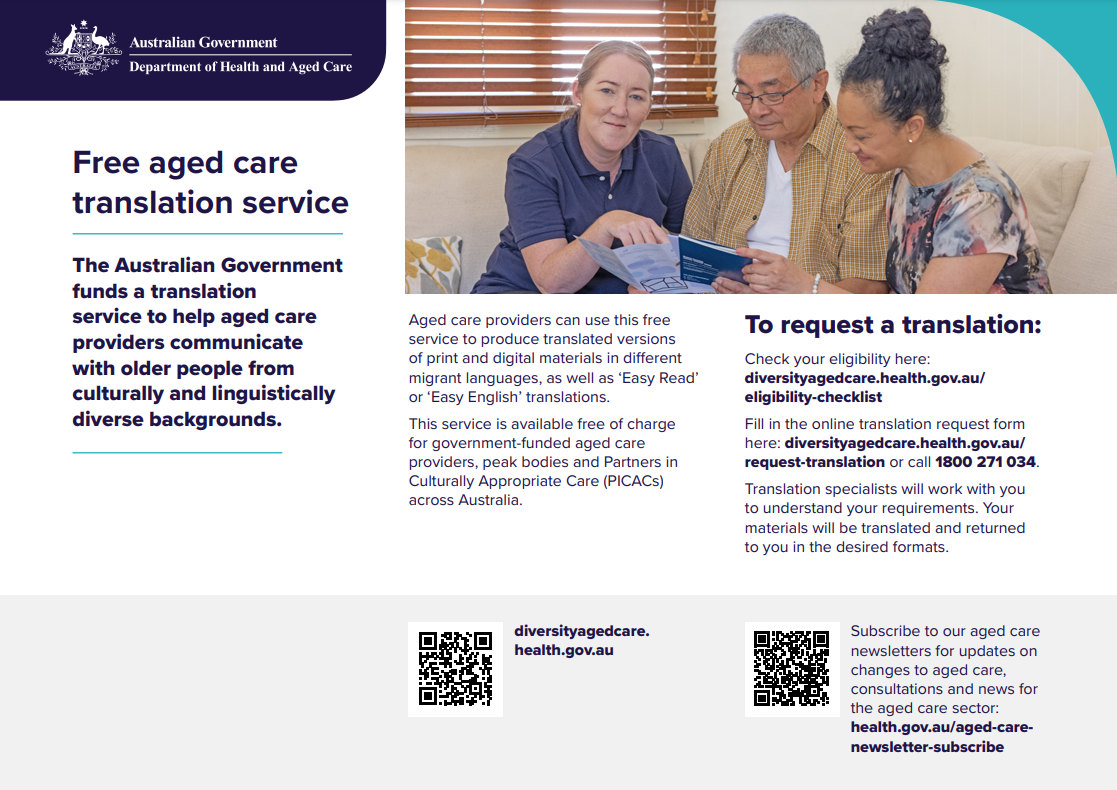
Free aged care translation service

Brochure
Published date

This resource provides information on a free translation and interpreting service funded by the government for aged care providers. It supports effective communication with older people from diverse backgrounds, offering language translation, sign language, and captioning services to enhance accessibility and inclusivity in aged care. 

This resource may refer to information that will be updated from 1 November 2025 to align with the new Aged Care Act and Quality Standards.
Author
Department of Health, Disability and Ageing
Key Theme
Person-centred care, Corporate and clinical governance, Delivering comprehensive care and services
Standard
1: The Individual, 2: The Organisation, 3: The Care and Services
Outcomes
1.1: Person-centred care, 2.1: Partnering with individuals, 3.3: Communicating for safety and quality
Free aged care translation service
/quality-standards/healthcare-identifiers-and-healthcare-identifier-service

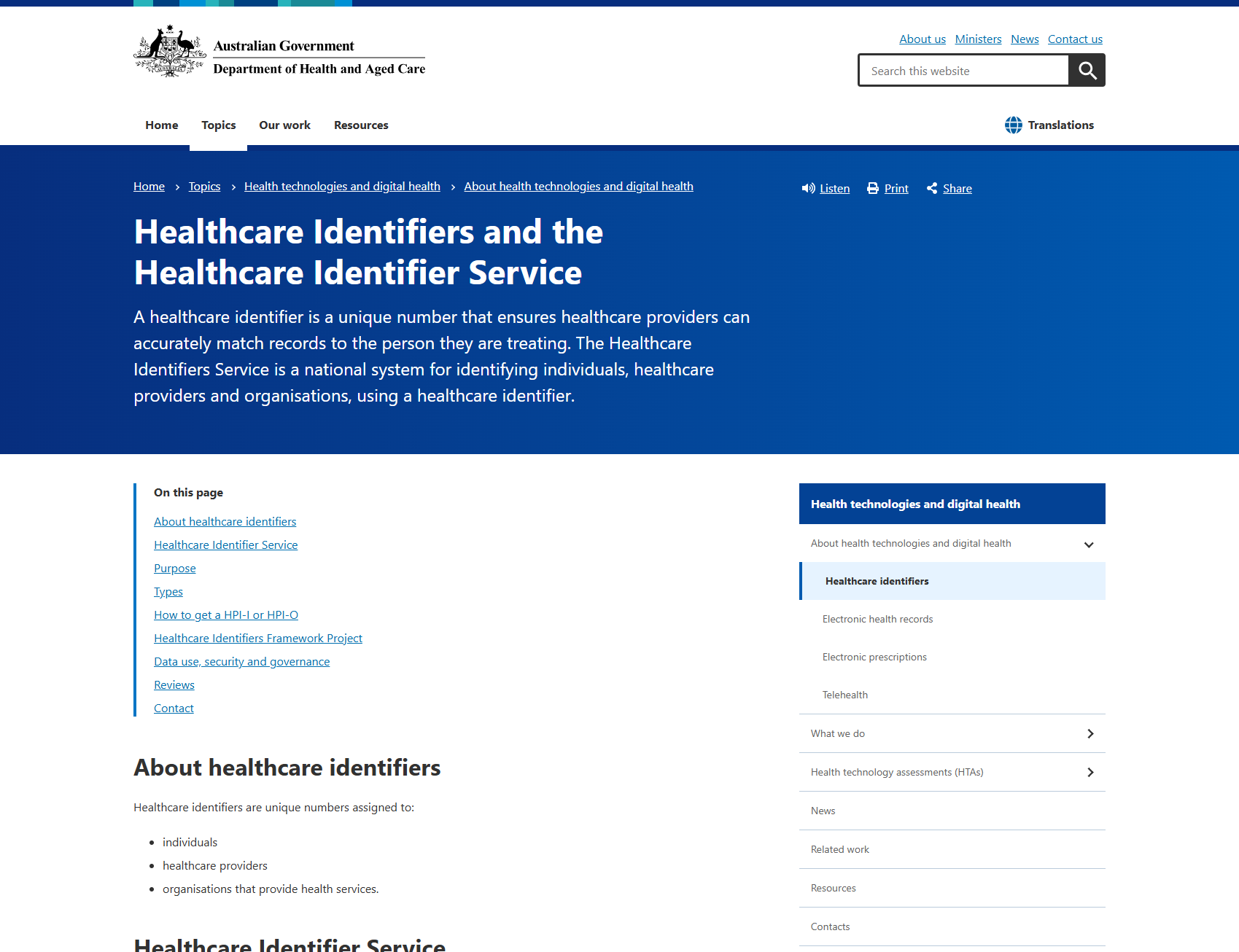
Healthcare Identifiers and the Healthcare Identifier Service

Guidance
Last Updated

This document explains the Healthcare Identifier Service, a national system for assigning unique healthcare identifiers to individuals, providers, and healthcare organisations. The service aims to improve patient safety, ensure accurate records, and facilitate secure data sharing across health, aged care, and allied health services. It includes privacy measures and public consultation outcomes for potential legislative improvements. 

This resource may refer to information that will be updated from 1 November 2025 to align with the new Aged Care Act and Quality Standards.

Author
Department of Health, Disability and Ageing
Key Theme
Corporate and clinical governance, Information management system, Workforce and human resources management, Care coordination and transitions
Standard
5: Clinical Care
Outcomes
5.1: Clinical governance
Healthcare Identifiers and the Healthcare Identifier Service
/quality-standards/national-aboriginal-and-torres-strait-islander-flexible-aged-care-program

National Aboriginal and Torres Strait Islander Flexible Aged Care Program

Guidance
Published date
Last Updated

This resource provides information on the National Aboriginal and Torres Strait Islander Flexible Aged Care Program. The program funds flexible and culturally appropriate aged care services for Aboriginal and Torres Strait Islander communities, mainly in rural and remote areas. It covers service provider requirements, funding processes, and adaptations to ongoing aged care reforms. 

This resource may refer to information that will be updated from 1 November 2025 to align with the new Aged Care Act and Quality Standards.

Author
Department of Health, Disability and Ageing
Key Theme
Person-centred care, Delivering comprehensive care and services, Corporate and clinical governance, Care coordination and transitions
Standard
3: The Care and Services, 2: The Organisation, 1: The Individual, 7: The Residential Community
Outcomes
3.2: Delivery of funded aged care services, 2.1: Partnering with individuals, 1.1: Person-centred care, 7.2: Transitions
National Aboriginal and Torres Strait Islander Flexible Aged Care Program
/quality-standards/clinical-governance-allied-health-practitioners

Clinical governance for allied health practitioners

Fact sheet
Published date

This fact sheet identifies the clinical governance and roles and responsibilities of allied health practitioners. It provides information on the National Model Clinical Governance Framework and lists the roles and responsibilities across Governance, leadership and culture, patient safety and quality systems, clinical performance and effectiveness and safe environment for the delivery of care. 

This resource may refer to information that will be updated from 1 November 2025 to align with the new Aged Care Act and Quality Standards.

Author
Department of Health, Disability and Ageing
Key Theme
Care coordination and transitions, Corporate and clinical governance, Workforce and human resources management
Standard
5: Clinical Care
Outcomes
5.1: Clinical governance
Clinical governance for allied health practitioners
/quality-standards/draft-national-consumer-engagement-strategy-health-and-wellbeing

Draft National Consumer Engagement Strategy for Health and Wellbeing

Guidance
Published date

This resource presents the Draft National Consumer Engagement Strategy for Health and Wellbeing, which aims to foster partnerships between health policymakers and communities. It is designed to involve people and communities in the development and implementation of preventive health policies. The strategy supports policymakers and program developers in engaging effectively with consumers to achieve improved health outcomes across Australia. 

Author
Department of Health, Disability and Ageing
Key Theme
Person-centred care, Corporate and clinical governance, Assessment and planning, Care coordination and transitions
Standard
1: The Individual, 2: The Organisation, 3: The Care and Services
Outcomes
1.1: Person-centred care, 2.1: Partnering with individuals, 3.1 Assessment and planning, 3.4: Planning and coordination of funded aged care services
Draft National Consumer Engagement Strategy for Health and Wellbeing
/quality-standards/electronic-prescribing

Electronic prescribing

Guidance
Last Updated

This resource outlines the framework for electronic prescribing, offering an alternative to paper prescriptions for healthcare providers and consumers. It explains the benefits of electronic prescriptions, such as reducing errors, improving efficiency, and supporting medication safety. The resource also covers technical and legislative requirements for implementing electronic prescriptions in various healthcare settings. 

This resource may refer to information that will be updated from 1 November 2025 to align with the new Aged Care Act and Quality Standards.

Author
Department of Health, Disability and Ageing
Key Theme
Medication management, Corporate and clinical governance, Information management system
Standard
5: Clinical Care
Outcomes
5.3: Safe and quality use of medicines, 5.1: Clinical governance
Electronic prescribing
/quality-standards/working-diverse-groups-aged-care-resources

Working with diverse groups in aged care - Resources

Guidance
Last Updated

This resource provides guidance for aged care providers on working with people from diverse backgrounds. It includes information on caring for people from culturally and linguistically diverse (CALD) backgrounds, LGBTI elders, care leavers, and Aboriginal and Torres Strait Islander Elders. Training programs and resources are available to support culturally appropriate care​. This resource may refer to information that will be updated from 1 November 2025 to align with the new Aged Care Act and Quality Standards.

Author
Department of Health, Disability and Ageing
Key Theme
Person-centred care, Corporate and clinical governance
Standard
1: The Individual, 2: The Organisation
Outcomes
1.1: Person-centred care, 2.1: Partnering with individuals
Working with diverse groups in aged care - Resources
/quality-standards/quality-improvement-guidance-aged-care-providers

Quality improvement guidance for aged care providers

Guidance
Last Updated

This resource offers guidance for aged care providers on implementing continuous quality improvement processes. It explains the ‘Plan, Do, Check, Act’ model to monitor and enhance care quality, using data and feedback to address issues. It also provides practical examples and tools to support providers in improving care and meeting regulatory requirements. This resource may refer to information that will be updated from 1 November 2025 to align with the new Aged Care Act and Quality Standards.

Author
Department of Health, Disability and Ageing
Key Theme
Accountability and quality system, Corporate and clinical governance
Standard
2: The Organisation
Outcomes
2.2a: Quality, safety and inclusion culture to support aged care workers to deliver quality care, 2.2b: Quality, safety and inclusion culture to support individuals, 2.3: Accountability, quality system and policies and procedures
Quality improvement guidance for aged care providers
/quality-standards/national-aged-care-mandatory-quality-indicator-program-qi-program

National Aged Care Mandatory Quality Indicator Program (QI Program)

Guidance
Published date

This resource provides information on the National Aged Care Mandatory Quality Indicator Program (QI Program). The program gathers data on 11 quality indicators from residential aged care services to enhance care standards and outcomes for residents. It includes resources, quick guides, consultation papers, and surveys for improving quality indicators in both residential and in-home aged care services. 

This resource may refer to information that will be updated from 1 November 2025 to align with the new Aged Care Act and Quality Standards.

Author
Department of Health, Disability and Ageing
Key Theme
Accountability and quality system, Corporate and clinical governance, Information management system, Workforce and human resources management
Standard
5: Clinical Care, 2: The Organisation
Outcomes
2.2a: Quality, safety and inclusion culture to support aged care workers to deliver quality care, 2.2b: Quality, safety and inclusion culture to support individuals, 2.3: Accountability, quality system and policies and procedures, 5.1: Clinical governance, 5.5: Safety of clinical care services
National Aged Care Mandatory Quality Indicator Program (QI Program)