National Aged Care Provider Conference 2024. Parallel session 3: Governing bodies working with older people in the design of their care (Residential services). Presentation by Louise Macleod, Aged Care Complaints Commissioner, ACQSC.
National Aged Care Provider Conference 2024. Parallel session 3: Governing bodies working with older people in the design of their care (Home services). Presentation by Executive Director, Approvals and Serious Incident Notifications Ann Wunsch, ACQSC.
National Aged Care Provider Conference 2024. Parallel session 3: Governing bodies working with older people in the design of their care (CHSP). Presentation by Janet Anderson, PSM Commissioner.
National Aged Care Provider Conference 2024. Closing Plenary: Bringing it all together – closing plenary with Commissioner Janet Anderson PSM, First Assistant Secretary, Quality Assurance, Department of Health and Aged Care Amy Laffan and pre-conference workshop representatives
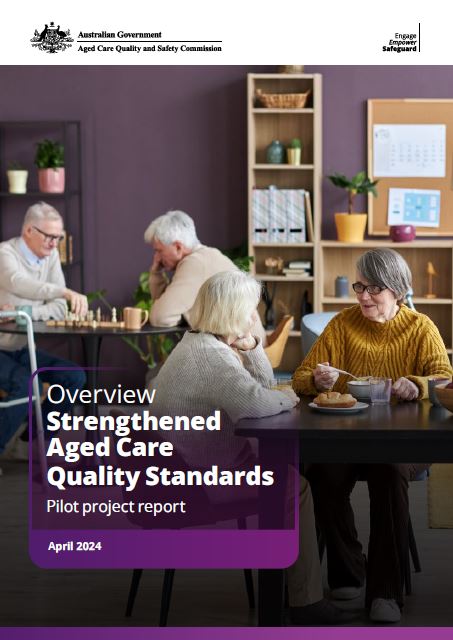
The strengthened Quality Standards pilot project final report outlines key insights, findings and lessons learnt from the pilot audits. The report will direct future work to be undertaken by the Commission in preparation for implementation of the strengthened Quality Standards and new audit methodology.
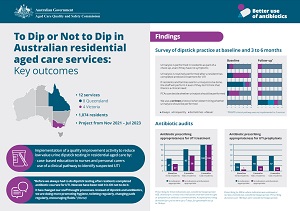
To Dip or Not to Dip (TDONTD) is a quality improvement intervention successfully implemented in UK and Australian aged care homes to improve UTI assessment and antibiotic prescribing appropriateness.
This implementation guide has been drawn from the experiences of homes and champions who have implemented TDONTD, along with feedback from aged care nurses and personal care assistants who have used TDONTD resources.

This visual abstract presents outcomes from a quality improvement project aimed at reducing low-value urine dipstick testing in aged care services. It included nurse education, implementing clinical pathways for UTI identification, and evaluating urinalysis practices and antibiotic prescribing. The findings demonstrate improved antibiotic prescribing appropriateness for UTIs over a 6-month follow-up period.
This resource may refer to information that will be updated from 1 November 2025 to align with the new Aged Care Act and Quality Standards.
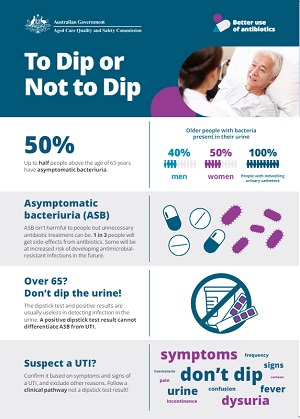
This huddle tool poster provides guidance on appropriate use of urine dipstick tests in older adults. It explains that asymptomatic bacteriuria (ASB) is common and not harmful, but that unnecessary antibiotic treatment can be. It suggests confirming urinary tract infections (UTIs) through clinical symptoms rather than dipstick results.
This resource may refer to information that will be updated from 1 November 2025 to align with the new Aged Care Act and Quality Standards.
 To Dip or Not to Dip - huddle tool A3 poster (PDF 393.96 KB)
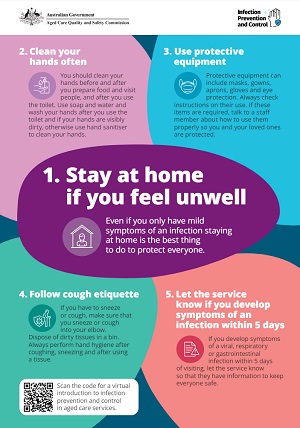
Infection prevention and control, also known as IPC, are the steps and processes that people can use to reduce the spread of harmful germs and bacteria. People who visit aged care services can help support IPC processes.
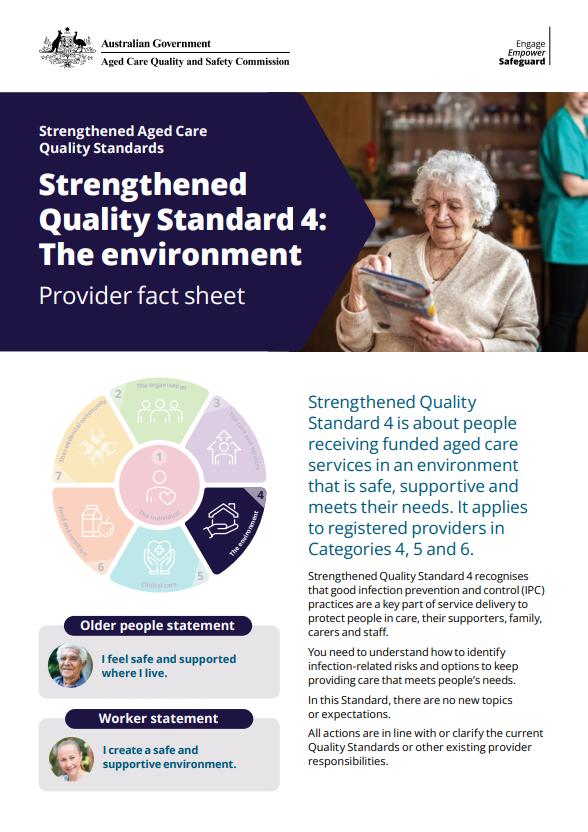
We have released a suite of fact sheets to help providers, aged care workers, and other stakeholders understand the new strengthened Quality Standards and their obligations in meeting them .
Strengthened Quality Standard 4 is about people receiving care and services in an environment that is safe, supportive and meets their needs. Good infection prevention and control (IPC) practices are a key part of service delivery to protect people in care, their family, carers and staff.
Standard 4: The environment (PDF 481.93 KB)
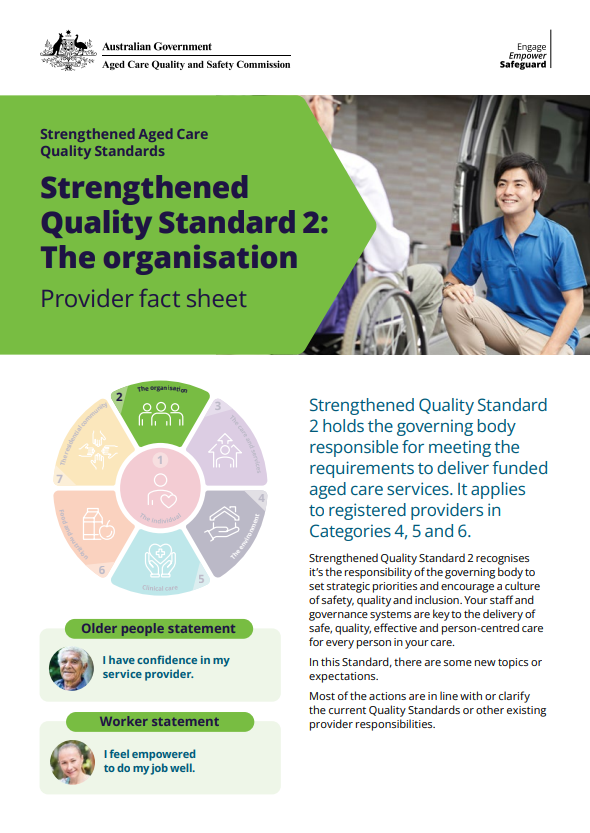
We have released a suite of fact sheets to help providers, aged care workers, and other stakeholders understand the new strengthened Quality Standards and their obligations in meeting them .
Strengthened Quality Standard 2 recognises that it’s the responsibility of the governing body to set strategic priorities and encourage a culture of safety and quality. Staff and governance systems are key to the delivery of safe, quality, effective and person-centred care for every person.
Standard 2: The organisation (PDF 548.55 KB)
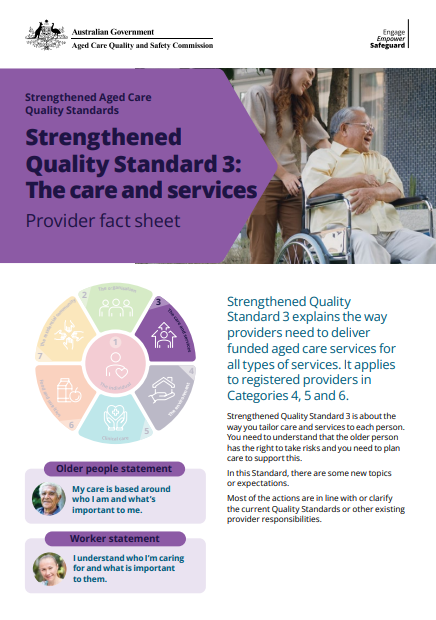
We have released a suite of fact sheets to help providers, aged care workers, and other stakeholders understand the new strengthened Quality Standards and their obligations in meeting them .
Strengthened Quality Standard 3 is about the way providers tailor care and services to each person. It's important to understand that the older person has the right to take risks and you need to plan care to support this.
Standard 3: The care and services (PDF 571.62 KB)
We have released a suite of fact sheets to help providers, aged care workers, and other stakeholders understand the new strengthened Quality Standards and their obligations in meeting them .
Strengthened Quality Standard 1 underpins the way providers and staff should treat older people. It explains how important it is to understand that each older person is unique and has a different life story.
Standard 1: The individual (PDF 537.58 KB)
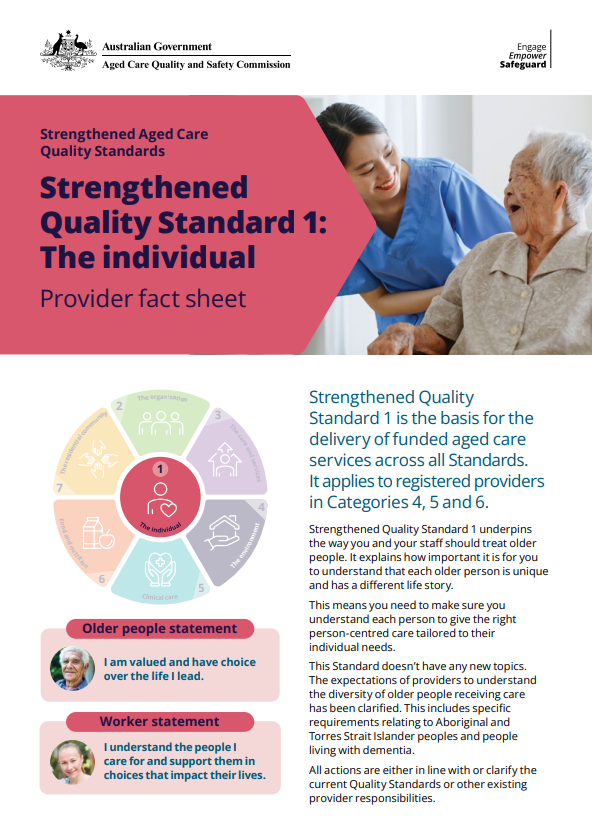
We have released a suite of fact sheets to help providers, aged care workers, and other stakeholders understand the new strengthened Quality Standards and their obligations in meeting them .
Strengthened Quality Standard 6 is about working with older people to find out what they like to eat and drink. Serving a choice of meals and drinks can make a huge difference to people receiving care’s quality of life. This Standard only applies to residential aged care services.
Standard 6: Food and nutrition (PDF 478.4 KB)
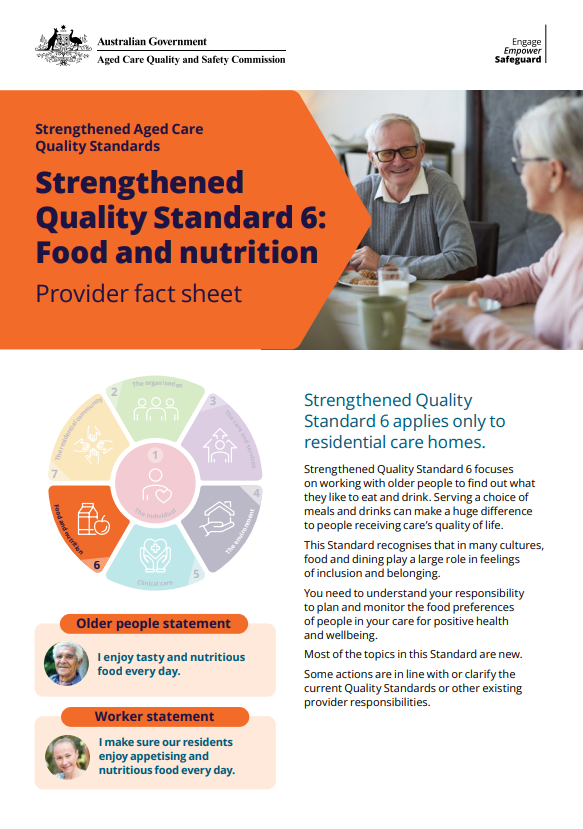
We have released a suite of fact sheets to help providers, aged care workers, and other stakeholders understand the new strengthened Quality Standards and their obligations in meeting them .
Strengthened Quality Standard 7 acknowledges that when people move into a residential service, the new community becomes a central part of their lives. It’s important for people to feel safe, included and respected. This Standard only applies to residential aged care services.
Standard 7: The residential community (PDF 482.81 KB)
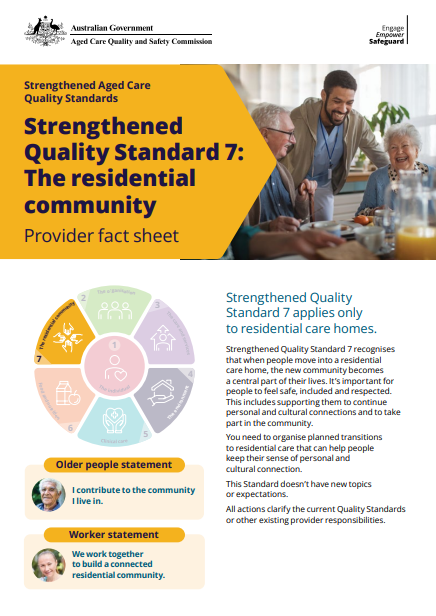
We have released a suite of fact sheets to help providers, aged care workers, and other stakeholders understand the new strengthened Quality Standards and their obligations in meeting them .
Strengthened Quality Standard 5 describes the responsibilities of providers to deliver safe and quality clinical care. Good clinical care improves a person’s quality of life, independence, confidence and their feeling of purpose in daily life.
Standard 5: Clinical care (PDF 482.49 KB)
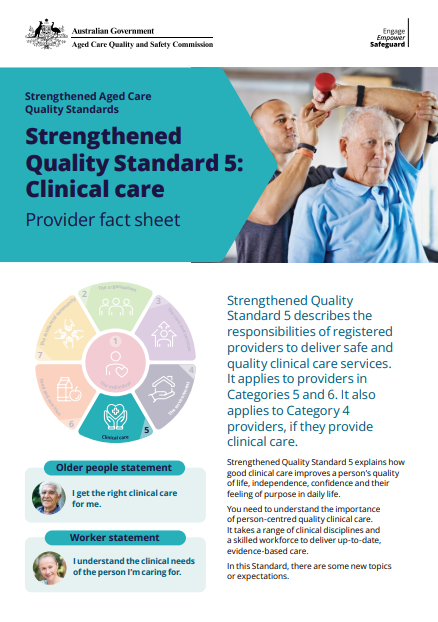
This resource is designed to be delivered as a presentation or workshop to staff within your aged care service.
Sections of the resource have been developed for you to edit and add in information specific to your aged care service, you’ll find these sections with square brackets and text in italics, for example [add in your text here].

Infection prevention and control, also known as IPC, are the steps and processes that people can use to reduce the spread of harmful germs and bacteria.
People who visit aged care services can help support IPC processes.
Watch our video series answering the most common questions we have received about the strengthened Aged Care Quality Standards.
In this third episode, Lisa Peterson PSM, Assistant Commissioner for Sector Capability and Regulatory Strategy, discusses the main changes from the current Standards to the strengthened Quality Standards, and gives insight as to how providers will be assessed against them.