Aged care laws in Australia have now changed. The new Aged Care Act 2024 and Aged Care Rules 2025 now apply. While we complete updating of our website, including draft guidance and other materials, to align with the new laws, providers are advised to refer to the new Act and Rules for any required clarification of their obligations and legal responsibilities. Thank you for your patience.

Quality Standards Resource Centre

The Quality Standards Resource Centre helps extend understanding of the strengthened Aged Care Quality Standards, which take effect from 1 November 2025. The Resource Centre will be updated to reflect key changes made to the draft strengthened Standards. You can search for resources by using keywords, or filtering by standard, outcome, audience and theme. Before using the Resource Centre, please read the terms of use.

Displaying 21 to 40 of 45 result(s)
/quality-standards/governing-reform-aged-care-practical-tools

Governing for Reform in Aged Care - Practical tools

Tool

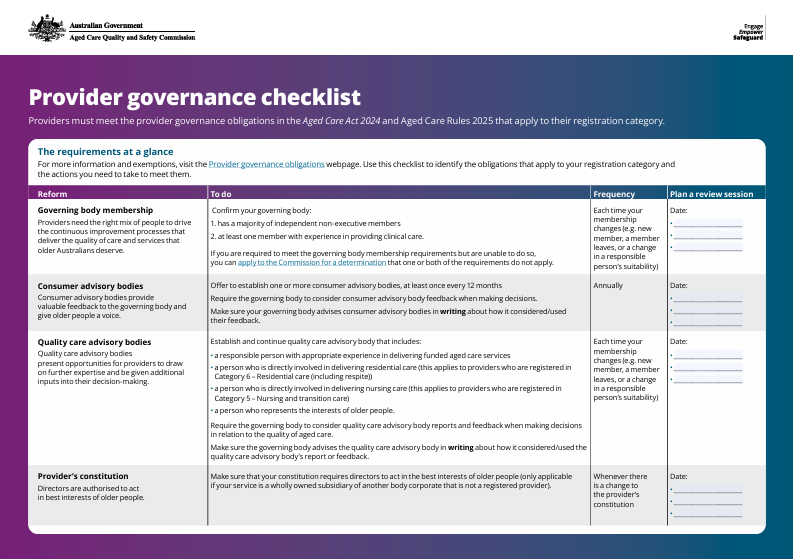
This resource provides practical tools for aged care governing bodies and executives to support governance processes. It includes templates for audit planning, risk management, performance reporting, and compliance monitoring, helping providers ensure effective oversight and decision-making aligned with the Aged Care Quality Standards​. 

This resource may refer to information that will be updated from 1 November 2025 to align with the new Aged Care Act and Quality Standards.

Author
Aged Care Quality & Safety Commission
Key Theme
Corporate and clinical governance, Accountability and quality system, Risk management system, Information management system, Workforce and human resources management
Standard
2: The Organisation
Outcomes
2.2a: Quality, safety and inclusion culture to support aged care workers to deliver quality care, 2.3: Accountability, quality system and policies and procedures, 2.4: Risk management, 2.7: Information management, 2.8: Workforce planning
Governing for Reform in Aged Care Program
/quality-standards/handbook-tools-support-medicine-management-multimorbidity-and-polypharmacy

Handbook of tools to support medicine management in multimorbidity and polypharmacy

Handbook
Published date

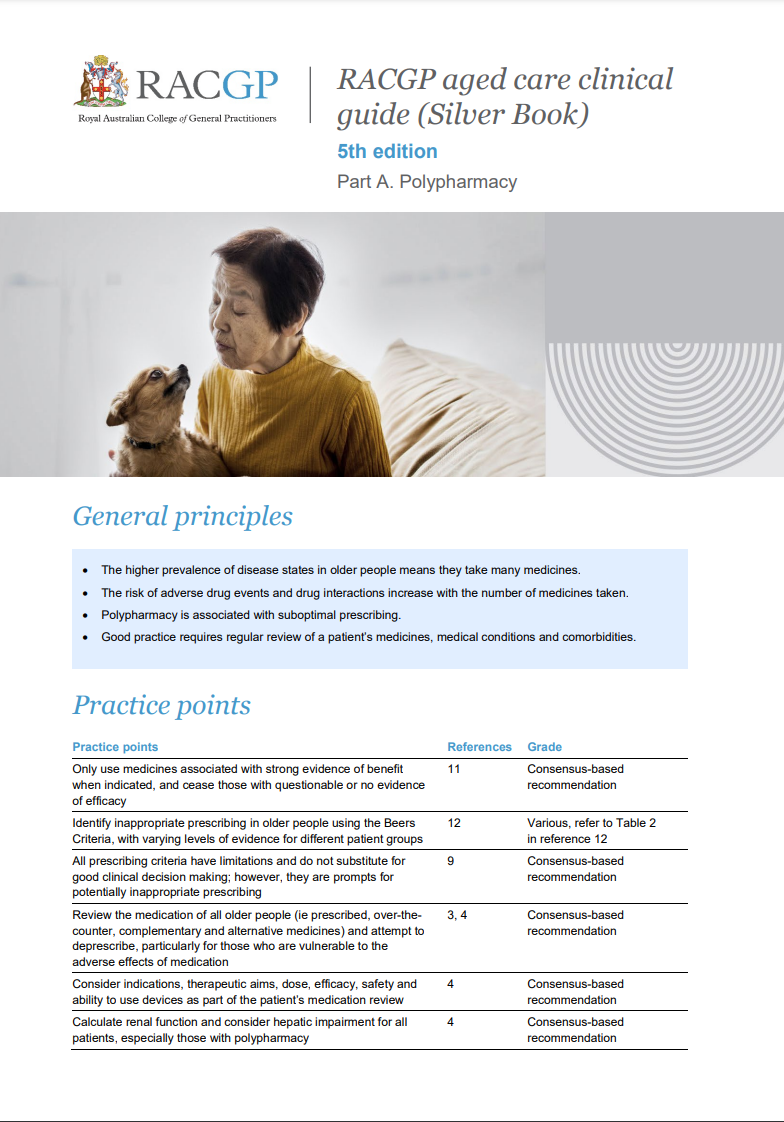
This handbook provides tools to support medicine management in multimorbidity and polypharmacy. The Department of Health and Aged Care commissioned the University of South Australia to develop the handbook. 

This resource may refer to information that will be updated from 1 November 2025 to align with the new Aged Care Act and Quality Standards.
Author
External resource
Key Theme
Medication management
Standard
5: Clinical Care
Outcomes
5.3: Safe and quality use of medicines
Handbook of tools to support medicine management in multimorbidity and polypharmacy
/quality-standards/high-risk-medicines-resources

High risk medicines resources

Guidance
Last Updated

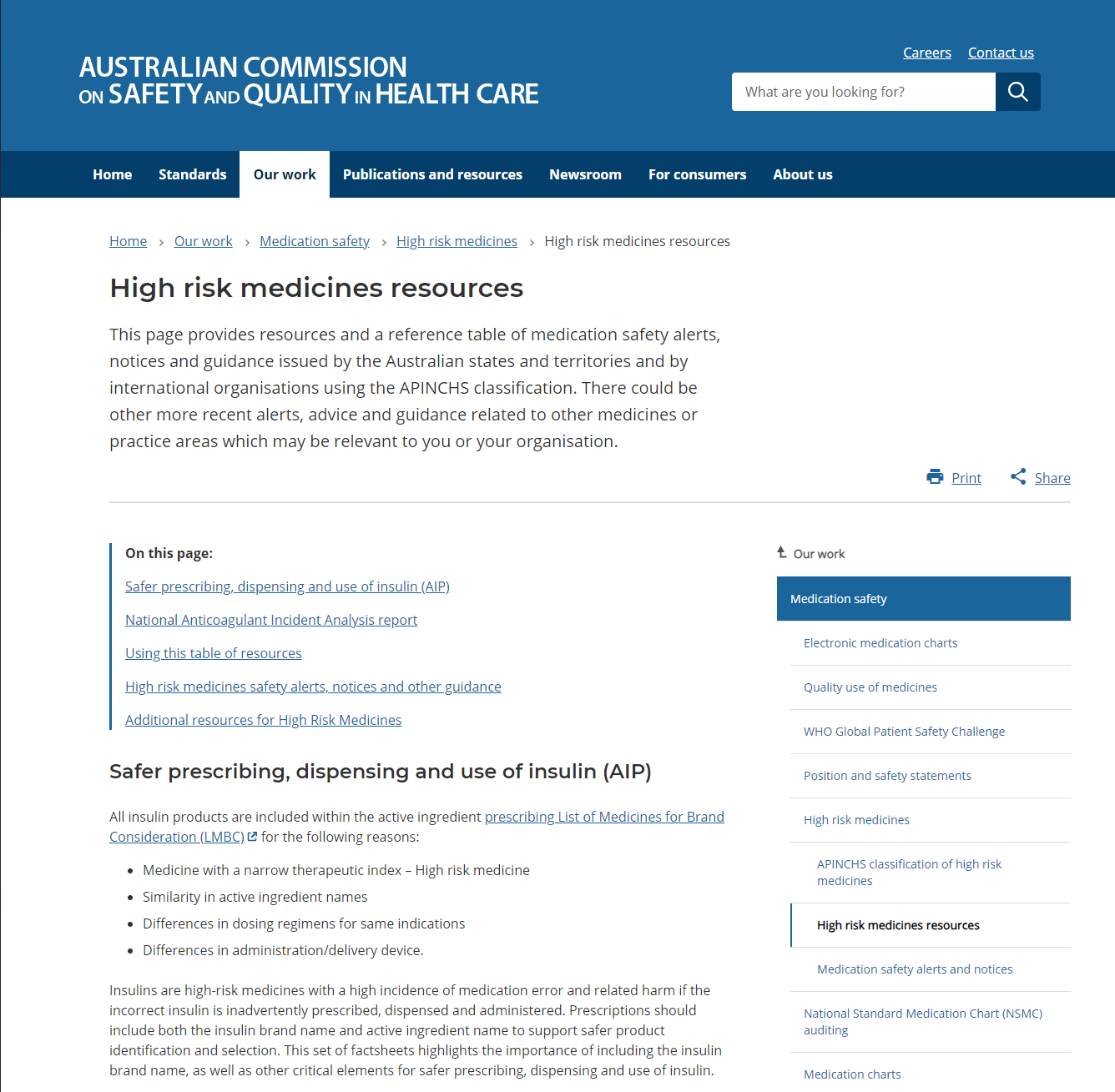
This resource provides guidance on high-risk medicines, including safety alerts, notices, and best practices for safe prescribing, dispensing, and administration. It includes information on insulin and anticoagulant safety, monitoring tools, and best practice recommendations to improve medication safety and reduce harm from high-risk medications across healthcare settings. 

This resource may refer to information that will be updated from 1 November 2025 to align with the new Aged Care Act and Quality Standards.
Author
Australian Commission On Safety And Quality In Health Care
Key Theme
Medication management
Standard
5: Clinical Care
Outcomes
5.3: Safe and quality use of medicines
High risk medicines resources
/quality-standards/reporting-adverse-events

Reporting adverse events

Guidance
Last Updated

This resource provides information on identifying and reporting adverse events related to medicines, vaccines, and medical devices. It outlines who can report, how to submit a report, the importance of these reports for safety monitoring, and the steps taken by the TGA in response to reported safety concerns. 

This resource may refer to information that will be updated from 1 November 2025 to align with the new Aged Care Act and Quality Standards.
Author
Department of Health, Disability and Ageing
Key Theme
Medication management
Standard
5: Clinical Care
Outcomes
5.3: Safe and quality use of medicines
Reporting adverse events
/quality-standards/report-problem-or-side-effect

Report a problem or side effect

Guidance

This resource provides information on how to report adverse events, side effects, or problems related to medicines, vaccines, and medical devices. It includes reporting procedures and information for consumers, health professionals, and industry, aiming to enhance safety and address breaches or non-compliant advertising. 

This resource may refer to information that will be updated from 1 November 2025 to align with the new Aged Care Act and Quality Standards.
Author
Department of Health, Disability and Ageing
Key Theme
Medication management
Standard
5: Clinical Care
Outcomes
5.3: Safe and quality use of medicines
Report a problem or side effect
/quality-standards/medication-management-health-practitioners

Medication management for health practitioners

Guidance
Last Updated

This resource supports health practitioners in managing medicines through the use of medication charts in aged care facilities and hospitals. It provides guidelines for safe prescribing, administration, and communication. The resource includes both paper-based and electronic medication chart systems to reduce errors, improve patient safety, and streamline medication management processes in aged care settings. 

This resource may refer to information that will be updated from 1 November 2025 to align with the new Aged Care Act and Quality Standards.

Author
Department of Health, Disability and Ageing
Key Theme
Medication management
Standard
5: Clinical Care
Outcomes
5.3: Safe and quality use of medicines
Medication management for health practitioners
/quality-standards/medication-its-your-choice

Medication: it's your choice

Guidance

This resource informs older Australians about their rights and choices regarding medication, including potential side effects, the importance of informed decision-making, and reducing unnecessary antibiotic and psychotropic use. It offers brochures, videos, and fact sheets to support understanding and provide guidance on alternative treatments and safe medication practices. 

This resource may refer to information that will be updated from 1 November 2025 to align with the new Aged Care Act and Quality Standards. 

Author
Aged Care Quality & Safety Commission
Key Theme
Medication management
Standard
5: Clinical Care
Outcomes
5.3: Safe and quality use of medicines
Medication: it's your choice
/quality-standards/medication-management

Medication management

Guidance

This resource provides information on medication management in aged care, focusing on psychotropics and antimicrobials. It includes tools for reducing inappropriate use, antimicrobial stewardship guidance, self-assessment resources, and quality bulletins. It aims to improve medication safety, prevent inappropriate prescribing, and support care providers in ensuring safe clinical practices.

This resource may refer to information that will be updated from 1 November 2025 to align with the new Aged Care Act and Quality Standards. 

Author
Aged Care Quality & Safety Commission
Key Theme
Medication management
Standard
5: Clinical Care
Outcomes
5.3: Safe and quality use of medicines
Medication management
/quality-standards/polypharmacy-consumer-perspective-national-medicines-symposium-2024

Polypharmacy Consumer Perspective - National Medicines Symposium 2024

Presentations
Published date

This is a presentation on Polypharmacy Consumer Perspective. It includes details of a case example, resolution and care management, and key principles related to medicines and goal of care. This resource may refer to information that will be updated from 1 November 2025 to align with the new Aged Care Act and Quality Standards.

Author
Australian Commission On Safety And Quality In Health Care
Key Theme
Medication management
Standard
5: Clinical Care
Outcomes
5.3: Safe and quality use of medicines
Polypharmacy Consumer Perspective - National Medicines Symposium 2024
/quality-standards/pharmaceutical-benefits-scheme-pbs-medication-chart-maximum-duration-residential-aged-care

Pharmaceutical Benefits Scheme (PBS) medication chart maximum duration in residential aged care

Fact sheet
Published date

This resource outlines the Pharmaceutical Benefits Scheme (PBS) medication chart's maximum duration in residential aged care. It explains the use of both paper-based and electronic National Residential Medication Charts (NRMC), highlighting their role in managing prescriptions, medication supply, and administration. The document provides guidance on compliance, chart expiry, and medication safety within aged care facilities. This resource may refer to information that will be updated from 1 November 2025 to align with the new Aged Care Act and Quality Standards.

Author
Department of Health, Disability and Ageing
Key Theme
Medication management
Standard
5: Clinical Care
Outcomes
5.3: Safe and quality use of medicines
Pharmaceutical Benefits Scheme (PBS) medication chart maximum duration in residential aged care
/quality-standards/national-aged-care-mandatory-quality-indicator-program

National Aged Care Mandatory Quality Indicator Program

Guidance

The National Aged Care Mandatory Quality Indicator Program aids residential aged care providers in enhancing their services by allowing them to benchmark their performance against national outcomes. The program resource provides guidance on data submission frequency, explains the program's role, and provides more information on open hours and contact details. 

This resource may refer to information that will be updated from 1 November 2025 to align with the new Aged Care Act and Quality Standards. 

Author
Aged Care Quality & Safety Commission
Key Theme
Accountability and quality system
Standard
5: Clinical Care
Outcomes
2.3: Accountability, quality system and policies and procedures, 2.2a: Quality, safety and inclusion culture to support aged care workers to deliver quality care, 2.2b: Quality, safety and inclusion culture to support individuals
National Aged Care Mandatory Quality Indicator Program
/quality-standards/national-mental-health-workforce-strategy-2022-2032

National Mental Health Workforce Strategy 2022–2032

Guidance
Last Updated

This resource outlines the National Mental Health Workforce Strategy 2022–2032, providing a roadmap to build a sustainable, skilled mental health workforce. It focuses on attracting, training, and retaining professionals to meet future demands, including those in aged care. The strategy supports coordinated mental health services across various sectors, ensuring a person-centred approach and promoting mental health careers. 

This resource may refer to information that will be updated from 1 November 2025 to align with the new Aged Care Act and Quality Standards.

Author
Department of Health, Disability and Ageing
Key Theme
Accountability and quality system
Standard
2: The Organisation
Outcomes
2.2a: Quality, safety and inclusion culture to support aged care workers to deliver quality care
National Mental Health Workforce Strategy 2022–2032
/quality-standards/governing-reform-aged-care-program

Governing for Reform in Aged Care Program

Guidance

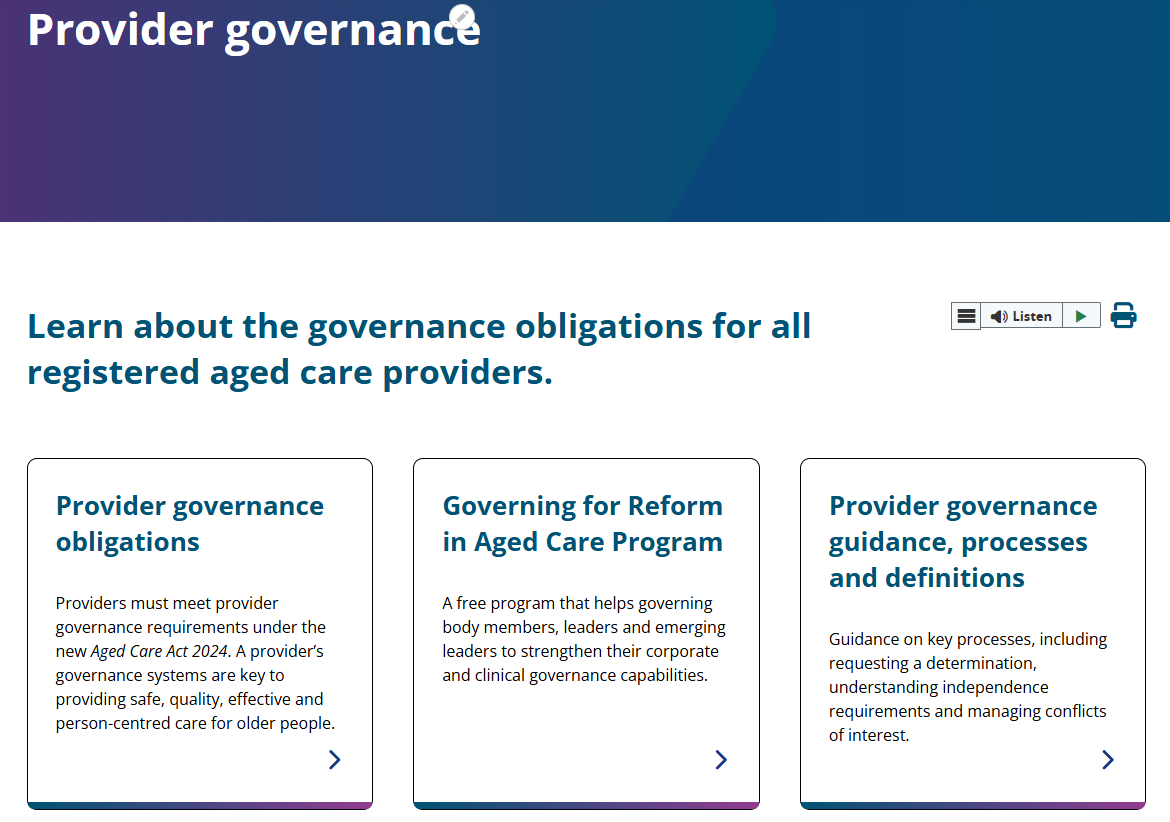
This resource outlines the Governing for Reform in Aged Care Program, designed to strengthen corporate and clinical governance capabilities for aged care leaders. It provides tools, online learning modules, webinars, and podcasts to support governance improvement and help leaders engage in reform efforts. 

This resource may refer to information that will be updated from 1 November 2025 to align with the new Aged Care Act and Quality Standards. 

Author
Aged Care Quality & Safety Commission
Key Theme
Corporate and clinical governance, Accountability and quality system, Risk management system, Incident management system, Feedback and complaints management system, Information management system, Workforce and human resources management, Emergency and disaster management
Standard
2: The Organisation
Outcomes
2.1: Partnering with individuals, 2.2a: Quality, safety and inclusion culture to support aged care workers to deliver quality care, 2.3: Accountability, quality system and policies and procedures, 2.4: Risk management, 2.5: Incident management, 2.6a: Complaints and feedback management for aged care workers, 2.6b: Complaints and feedback management for individuals, 2.7: Information management, 2.8: Workforce planning, 2.9: Human resource management, 2.10: Emergency and disaster management
Governing for Reform in Aged Care Program
/quality-standards/case-study-safe-and-appropriate-use-psychotropic-medicines-residential-aged-care

Case study - Safe and Appropriate use of Psychotropic Medicines - Residential Aged Care

Guidance
Published date

This resource is a fictional scenario that follows an older person’s care pathway with a residential aged care provider. The resource focuses on the systems and processes to support high-quality care of older people living with cognitive impairment. It includes 4 key priority areas: person-centred care, medication management, managing changed behaviours and transitions of care. 

This resource may refer to information that will be updated from 1 November 2025 to align with the new Aged Care Act and Quality Standards.

Author
Australian Commission On Safety And Quality In Health Care
Key Theme
Person-centred care, Delivering comprehensive care and services, Medication management
Standard
1: The Individual, 3: The Care and Services, 5: Clinical Care
Outcomes
1.1: Person-centred care, 3.2: Delivery of funded aged care services, 5.3: Safe and quality use of medicines, 5.6 Cognitive impairment  
Case study - Safe and Appropriate use of Psychotropic Medicines - Residential Aged Care
/quality-standards/case-study-safe-and-appropriate-use-psychotropic-medicines-home-aged-care

Case study - Safe and Appropriate use of Psychotropic Medicines - In-home Aged Care

Guidance
Published date

This resource is a fictional scenario that follows an older person’s care pathway with an in-home aged care provider. The resource focuses on the systems and processes to support high-quality care of older people living with dementia. It includes 4 key priority areas: person-centred care, medication management, managing changed behaviours and transitions of care. 

This resource may refer to information that will be updated from 1 November 2025 to align with the new Aged Care Act and Quality Standards.

Author
Australian Commission On Safety And Quality In Health Care
Key Theme
Person-centred care, Delivering comprehensive care and services, Medication management
Standard
1: The Individual, 3: The Care and Services, 5: Clinical Care
Outcomes
1.1: Person-centred care, 3.2: Delivery of funded aged care services, 5.3: Safe and quality use of medicines, 5.6 Cognitive impairment  
Case study - Safe and Appropriate use of Psychotropic Medicines - In-home Aged Care
/quality-standards/safe-and-appropriate-use-psychotropic-medicines-aged-care-fact-sheet

Safe and appropriate use of psychotropic medicines for aged care - Fact sheet

Fact sheet
Published date

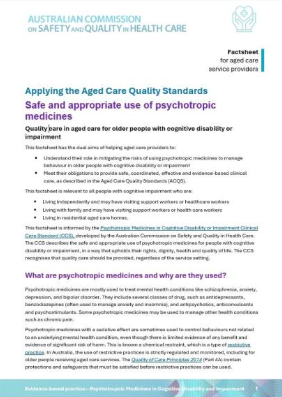
This fact sheet is informed by the Psychotropic Medicines in Cognitive Disability or Impairment Clinical Care Standard (CCS), developed by the Australian Commission on Safety and Quality in Health Care. The CCS describes the safe and appropriate use of psychotropic medicines for people with cognitive disability or impairment, in a way that upholds their rights, dignity, health and quality of life. 

This resource may refer to information that will be updated from 1 November 2025 to align with the new Aged Care Act and Quality Standards.

Author
Australian Commission On Safety And Quality In Health Care
Key Theme
Person-centred care, Delivering comprehensive care and services, Medication management
Standard
1: The Individual, 3: The Care and Services, 5: Clinical Care
Outcomes
1.1: Person-centred care, 3.2: Delivery of funded aged care services, 5.3: Safe and quality use of medicines, 5.6 Cognitive impairment  
Safe and appropriate use of psychotropic medicines for aged care - Fact sheet
/quality-standards/clinical-governance-and-quality-improvement-support-medication-management

Clinical governance and quality improvement to support medication management

Guidance
Last Updated

This resource outlines clinical governance and quality improvement systems to support safe medication management. It requires health service organisations to implement systems for procuring, prescribing, dispensing, and monitoring medicines. 

This resource may refer to information that will be updated from 1 November 2025 to align with the new Aged Care Act and Quality Standards.

Author
Australian Commission On Safety And Quality In Health Care
Key Theme
Medication management
Standard
5: Clinical Care
Outcomes
5.3: Safe and quality use of medicines
Clinical governance and quality improvement to support medication management
/quality-standards/medicines-use-older-people

Medicines use in older people

Guidance
Published date

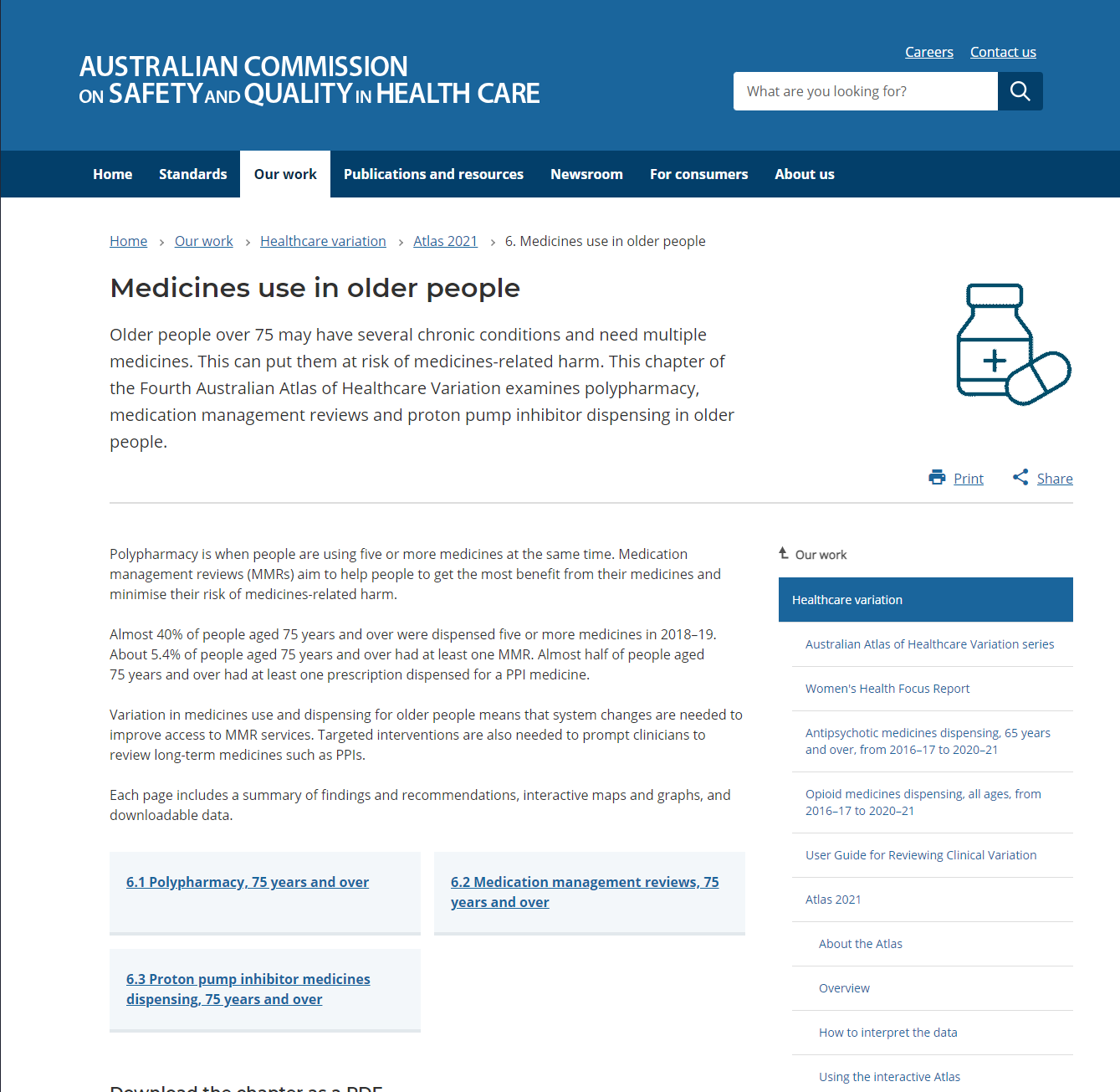
This resource is chapter six of the Fourth Atlas 2021 of Healthcare Variations. The chapter examines medicines use in people aged 75 and over, focusing on polypharmacy, medication management reviews (MMRs), and proton pump inhibitor (PPI) dispensing. It highlights variations in medication use and recommends improving access to MMR services and interventions for safe, effective medication use in older populations. 
Author
Australian Commission On Safety And Quality In Health Care
Key Theme
Medication management
Standard
5: Clinical Care
Outcomes
5.3: Safe and quality use of medicines
Medicines use in older people
/quality-standards/cultural-respect-framework-2016-2026-aboriginal-and-torres-strait-islander-health

Cultural Respect Framework 2016-2026 for Aboriginal and Torres Strait Islander health

Guidance
Published date

This resource outlines a national approach to building a culturally respectful health system for Aboriginal and Torres Strait Islander people. It focuses on 6 domains, including communication, workforce development, and data evaluation, to ensure culturally safe, accessible care. It is applicable to aged care, helping providers meet cultural safety standards and improve health outcomes for Aboriginal and Torres Strait Islander people.

Author
External resource
Key Theme
Person-centred care, Corporate and clinical governance, Accountability and quality system, Delivering comprehensive care and services
Standard
1: The Individual, 2: The Organisation, 3: The Care and Services
Outcomes
1.1: Person-centred care, 2.2a: Quality, safety and inclusion culture to support aged care workers to deliver quality care, 2.2b: Quality, safety and inclusion culture to support individuals, 3.2: Delivery of funded aged care services
Cultural Respect Framework 2016-2026 for Aboriginal and Torres Strait Islander health
/quality-standards/electronic-prescribing

Electronic prescribing

Guidance
Last Updated

This resource outlines the framework for electronic prescribing, offering an alternative to paper prescriptions for healthcare providers and consumers. It explains the benefits of electronic prescriptions, such as reducing errors, improving efficiency, and supporting medication safety. The resource also covers technical and legislative requirements for implementing electronic prescriptions in various healthcare settings. 

This resource may refer to information that will be updated from 1 November 2025 to align with the new Aged Care Act and Quality Standards.
Author
Department of Health, Disability and Ageing
Key Theme
Medication management, Corporate and clinical governance, Information management system
Standard
5: Clinical Care
Outcomes
5.3: Safe and quality use of medicines, 5.1: Clinical governance
Electronic prescribing