The Quality Standards Resource Centre helps extend understanding of the strengthened Aged Care Quality Standards, which take effect from 1 November 2025. The Resource Centre will be updated to reflect key changes made to the draft strengthened Standards. You can search for resources by using keywords, or filtering by standard, outcome, audience and theme. Before using the Resource Centre, please read the terms of use.
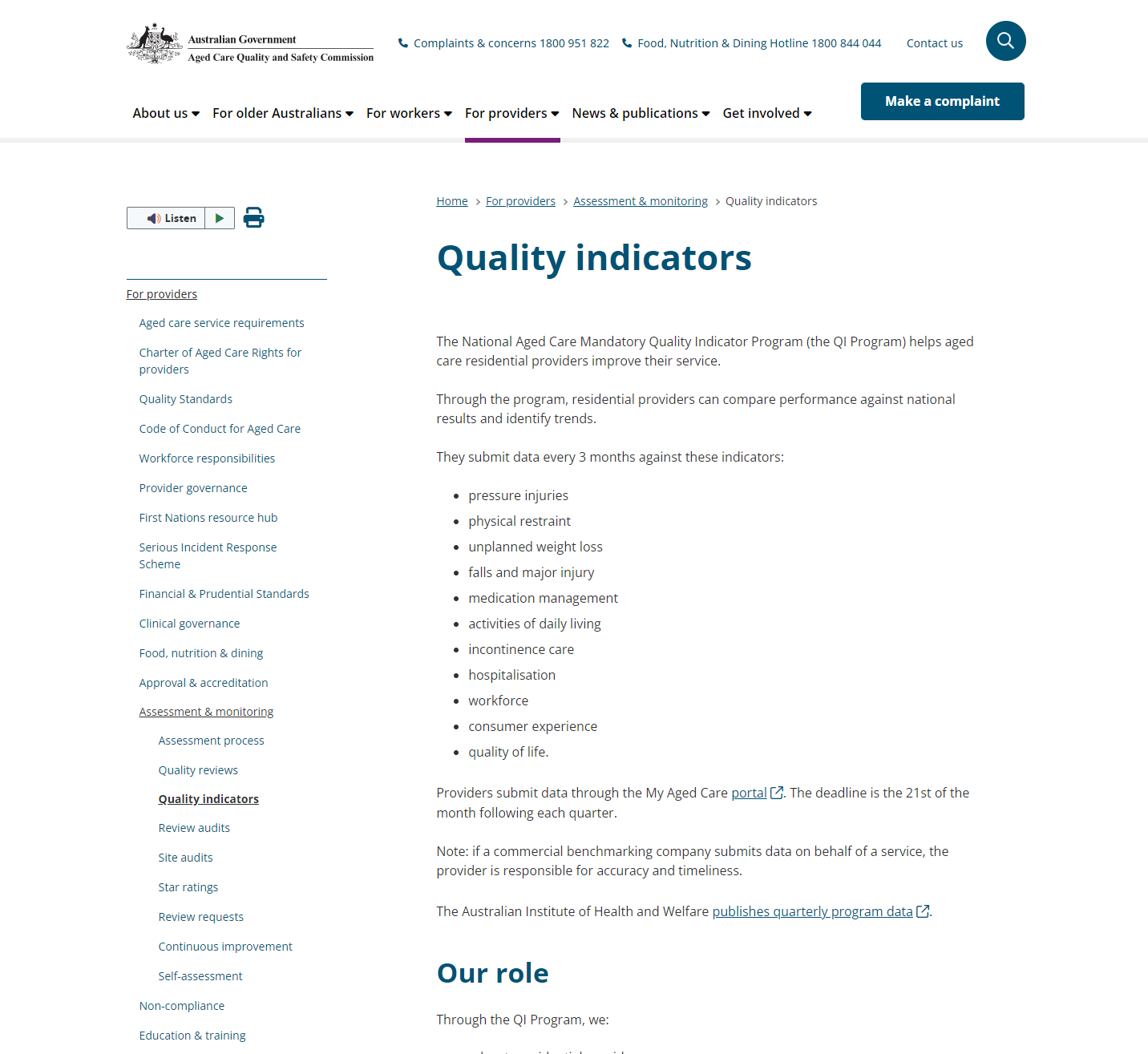
National Aged Care Mandatory Quality Indicator Program
The National Aged Care Mandatory Quality Indicator Program aids residential aged care providers in enhancing their services by allowing them to benchmark their performance against national outcomes. The program resource provides guidance on data submission frequency, explains the program's role, and provides more information on open hours and contact details.
This resource may refer to information that will be updated from 1 November 2025 to align with the new Aged Care Act and Quality Standards.
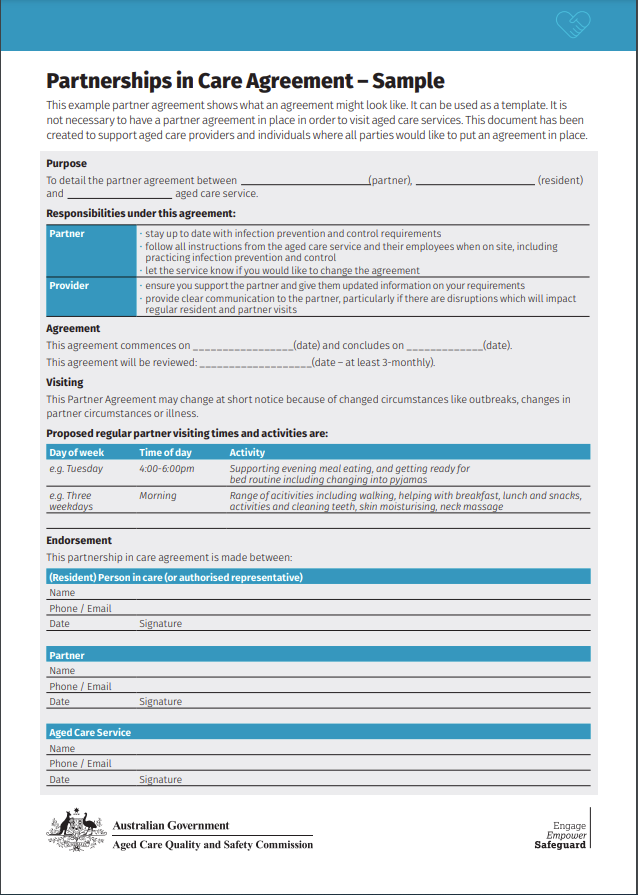
Partnerships in Care Agreement – Sample
This resource is a sample of what a partner agreement might look like. It can be used as a template. This document has been created to support aged care providers and individuals where all parties would like to put an agreement in place.
This resource may refer to information that will be updated from 1 November 2025 to align with the new Aged Care Act and Quality Standards.
 Partnerships in Care Agreement – Sample (PDF 108.45 KB)
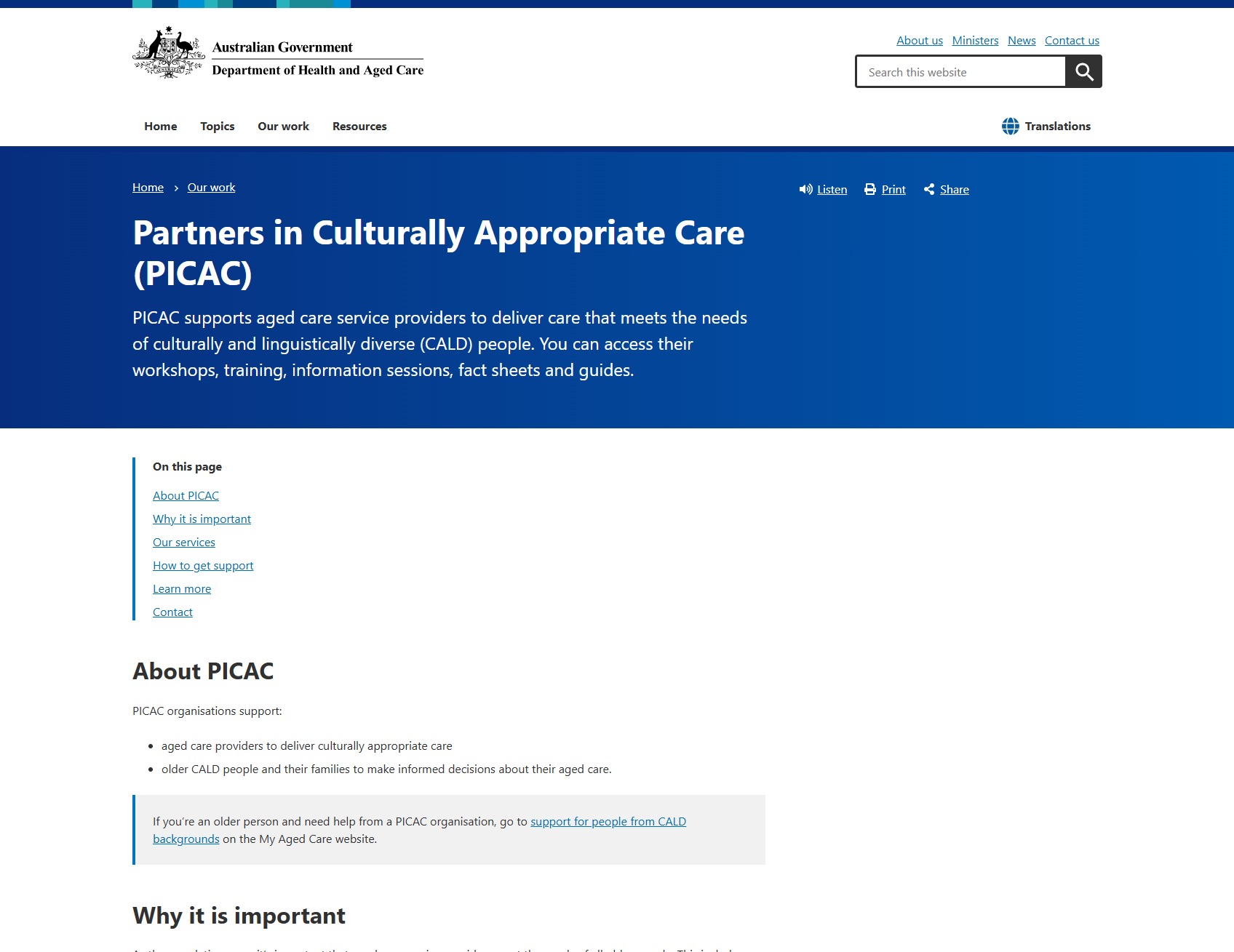
Partners in Culturally Appropriate Care (PICAC)
This resource supports aged care providers in delivering culturally appropriate care for people from culturally and linguistically diverse (CALD) backgrounds. It offers free training, workshops, and resources, helping providers understand and respect diverse needs, ensuring safe, inclusive, and culturally responsive care across all settings.
This resource may refer to information that will be updated from 1 November 2025 to align with the new Aged Care Act and Quality Standards.
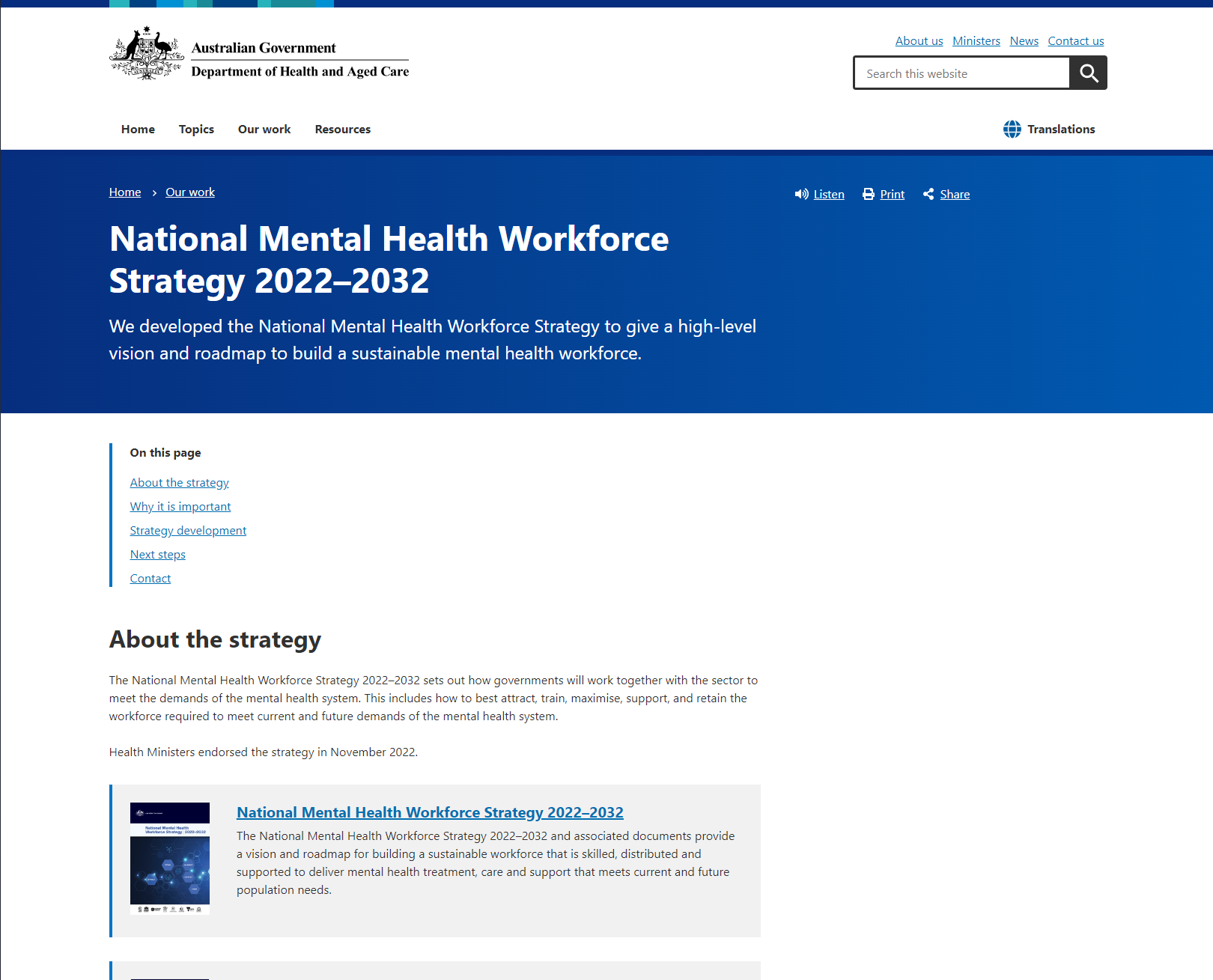
National Mental Health Workforce Strategy 2022–2032
This resource outlines the National Mental Health Workforce Strategy 2022–2032, providing a roadmap to build a sustainable, skilled mental health workforce. It focuses on attracting, training, and retaining professionals to meet future demands, including those in aged care. The strategy supports coordinated mental health services across various sectors, ensuring a person-centred approach and promoting mental health careers.
This resource may refer to information that will be updated from 1 November 2025 to align with the new Aged Care Act and Quality Standards.
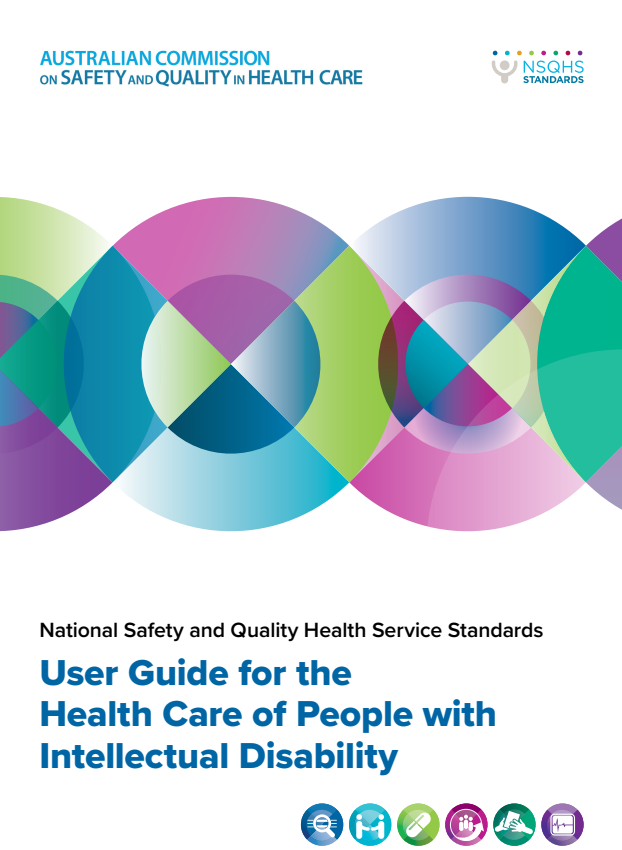
NSQHS Standards User Guide for the Health Care of People with Intellectual Disability
This resource provides guidance for the health care of people with intellectual disability. The user guide is part of the Australian Commission on Safety and Quality in Health Care's National Safety and Quality Health Service (NSQHS) Standards. The resource was developed in response to significant evidence of poor health outcomes for people with intellectual disability in Australia’s health system.
This resource may refer to information that will be updated from 1 November 2025 to align with the new Aged Care Act and Quality Standards.
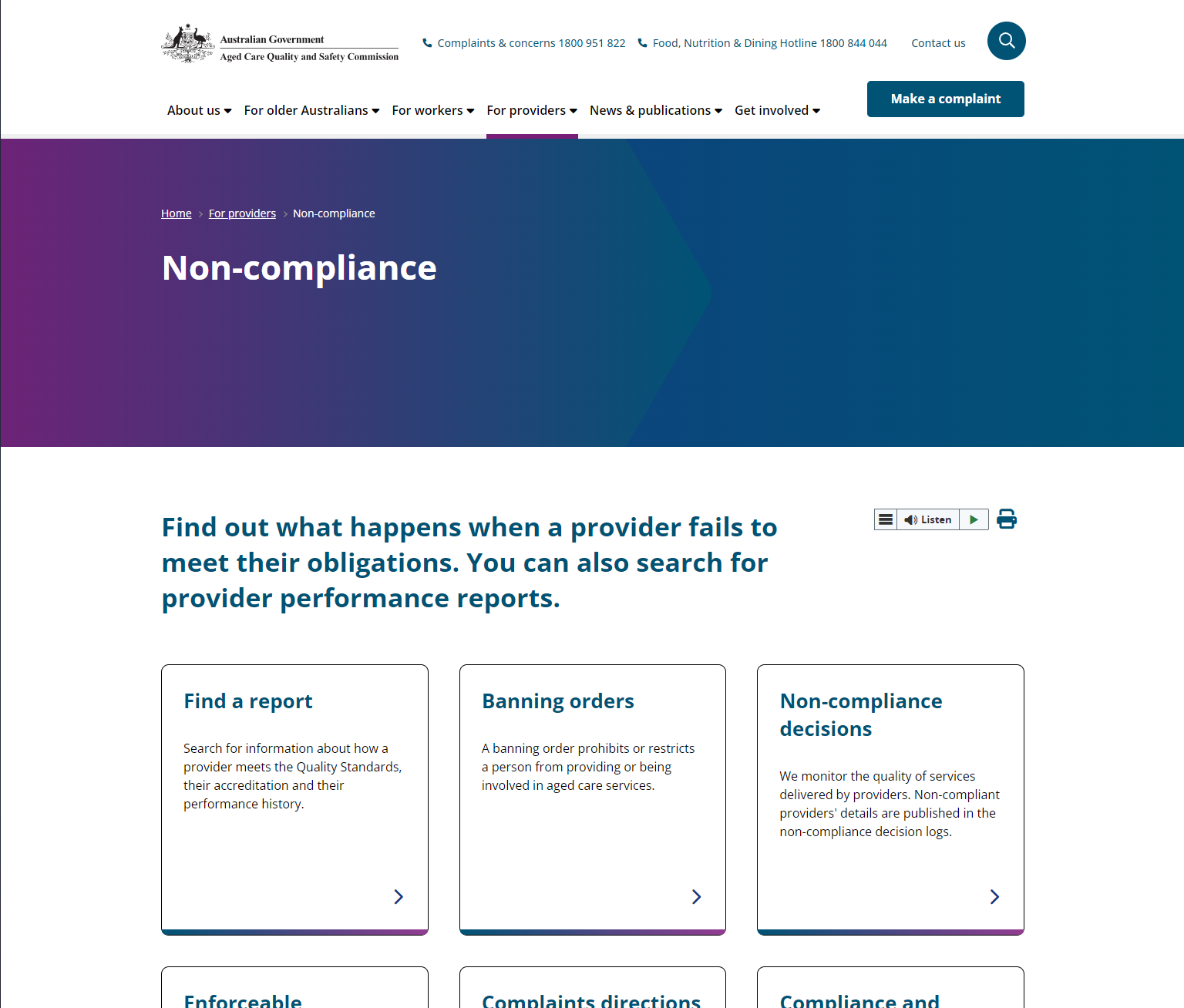
Non-compliance
This resource outlines the processes for managing non-compliance in aged care services. It includes information on banning orders, enforceable undertakings, and how the Commission addresses non-compliance through monitoring, complaints directions, and enforcement policies. Providers can also search for performance reports to track compliance.
This resource may refer to information that will be updated from 1 November 2025 to align with the new Aged Care Act and Quality Standards.
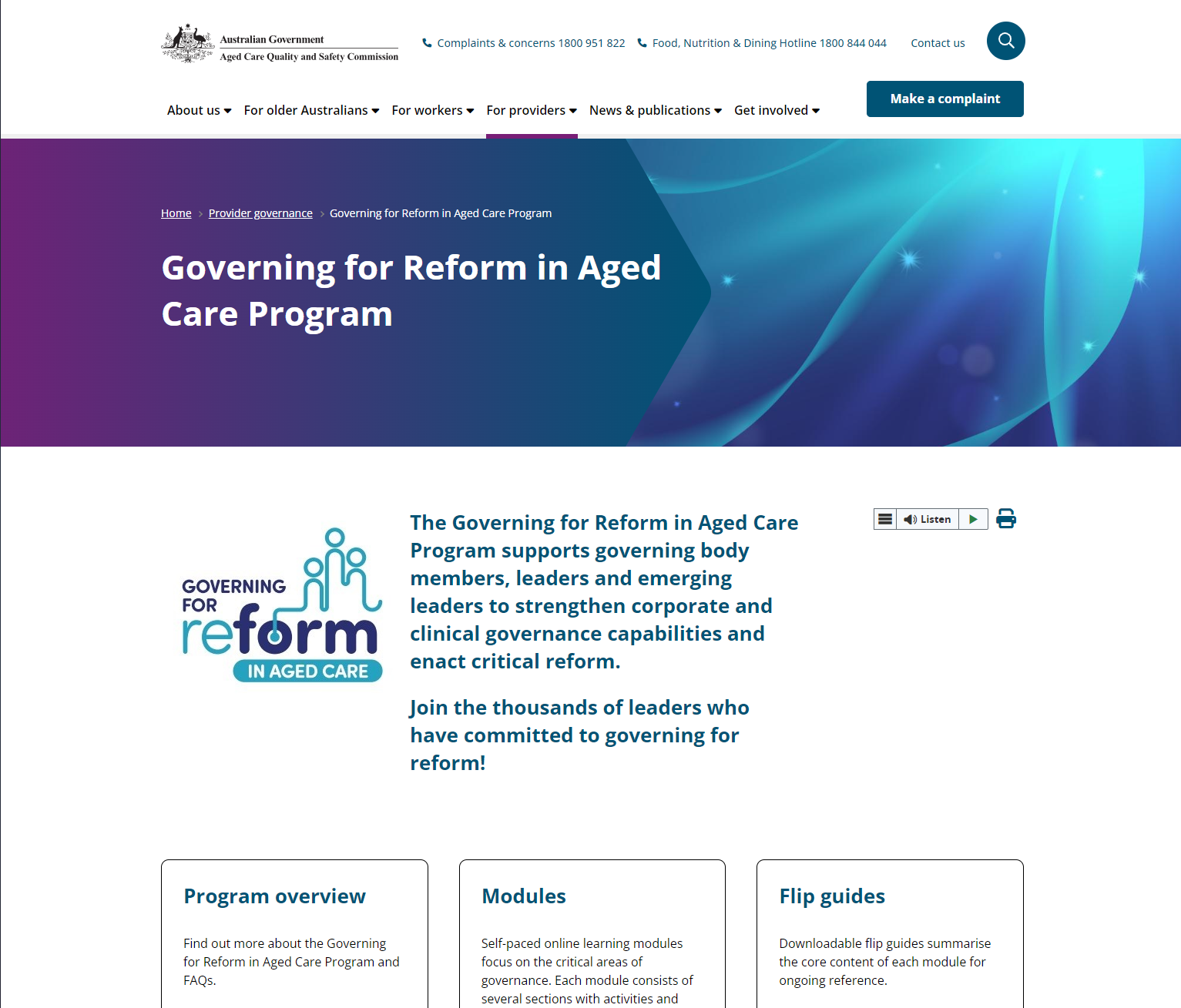
Governing for Reform in Aged Care Program
This resource outlines the Governing for Reform in Aged Care Program, designed to strengthen corporate and clinical governance capabilities for aged care leaders. It provides tools, online learning modules, webinars, and podcasts to support governance improvement and help leaders engage in reform efforts.
This resource may refer to information that will be updated from 1 November 2025 to align with the new Aged Care Act and Quality Standards.
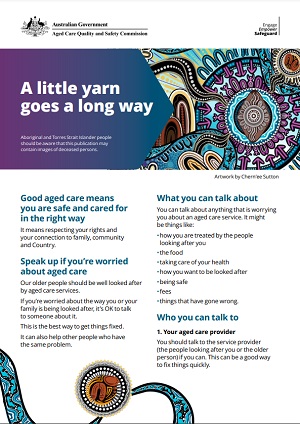
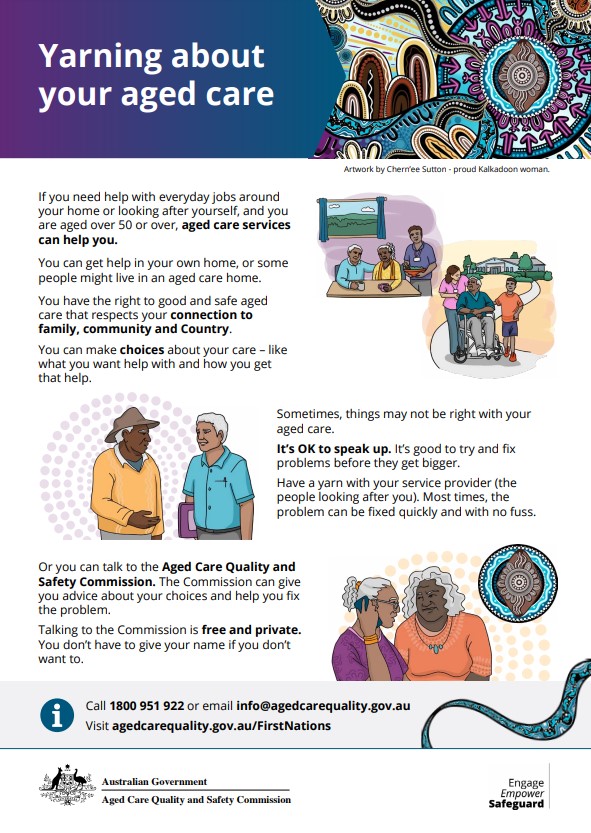
A little yarn goes a long way - Fact sheet
The ‘A little yarn goes a long way’ fact sheet has been developed to inform older Aboriginal and Torres Strait Islander people, and their friends and family, about the support available to help them resolve concerns about aged care services, and why it’s important to raise these concerns.
Information is also available in 7 different languages including: English, Alyawarra, Arrernte, Luritja, Pitjantjatjarra, Torres Strait Creole and Warlpiri.
English - A little yarn goes a long way (PDF 769.91 KB)
Alyawarra - A little yarn goes a long way (PDF 3.74 MB)
Arrernte - A little yarn goes a long way (PDF 3.73 MB)
Luritja - A little yarn goes a long way (PDF 3.73 MB)
Pitjantjatjarra - A little yarn goes a long way (PDF 3.73 MB)
Torres Strait Creole - A little yarn goes a long way (PDF 3.74 MB)
Warlpiri - A little yarn goes a long way (PDF 3.73 MB)
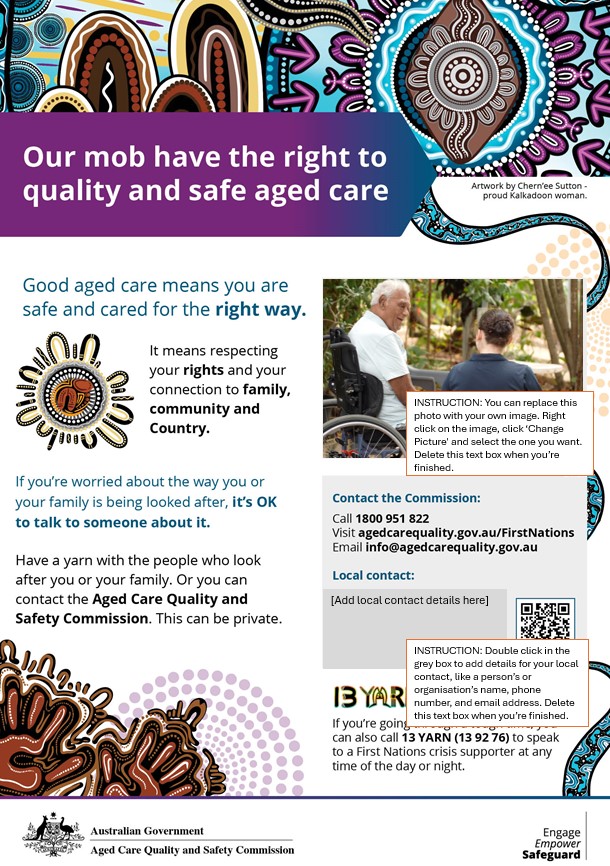
Explaining aged care and your rights – locally tailorable poster - First Nations resources
We’ve developed a tailorable poster for you to edit with your own local details, and print and display at community notice boards or waiting areas.

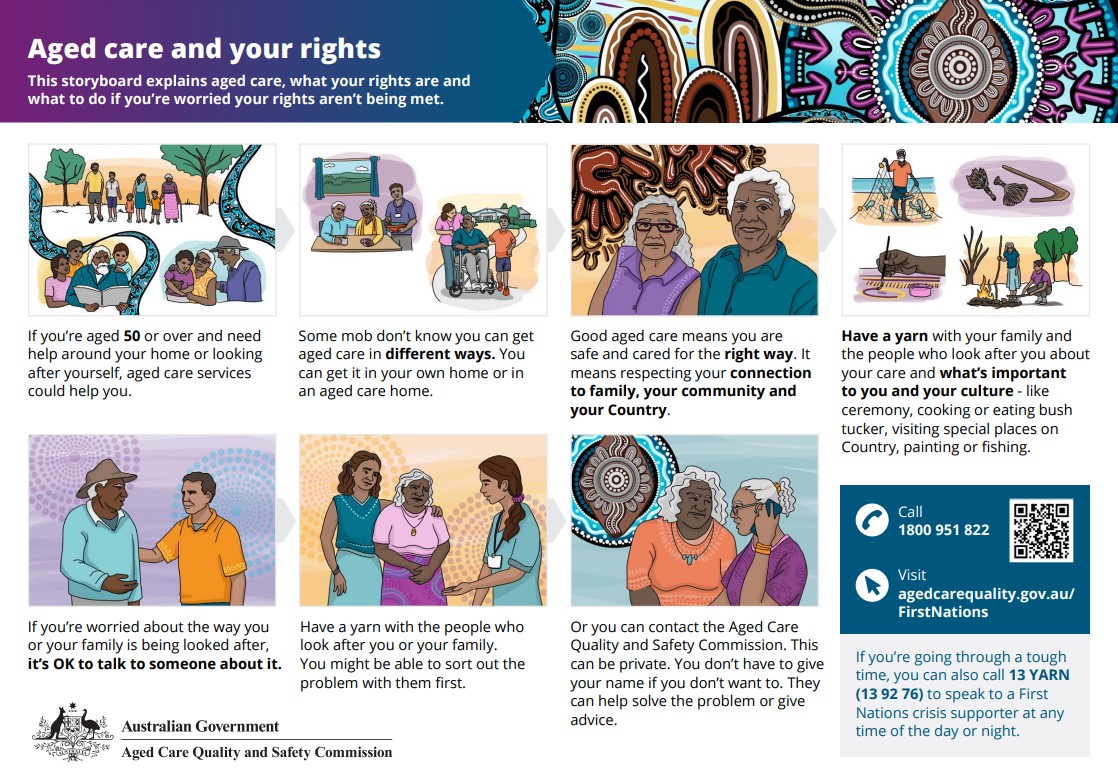
First Nations - Visual Storyboard - Aged care and your rights
The storyboards use pictures to explain aged care, your rights and what to do if your rights aren’t being met.
Aged care and your rights – visual storyboard (PDF 803.63 KB)
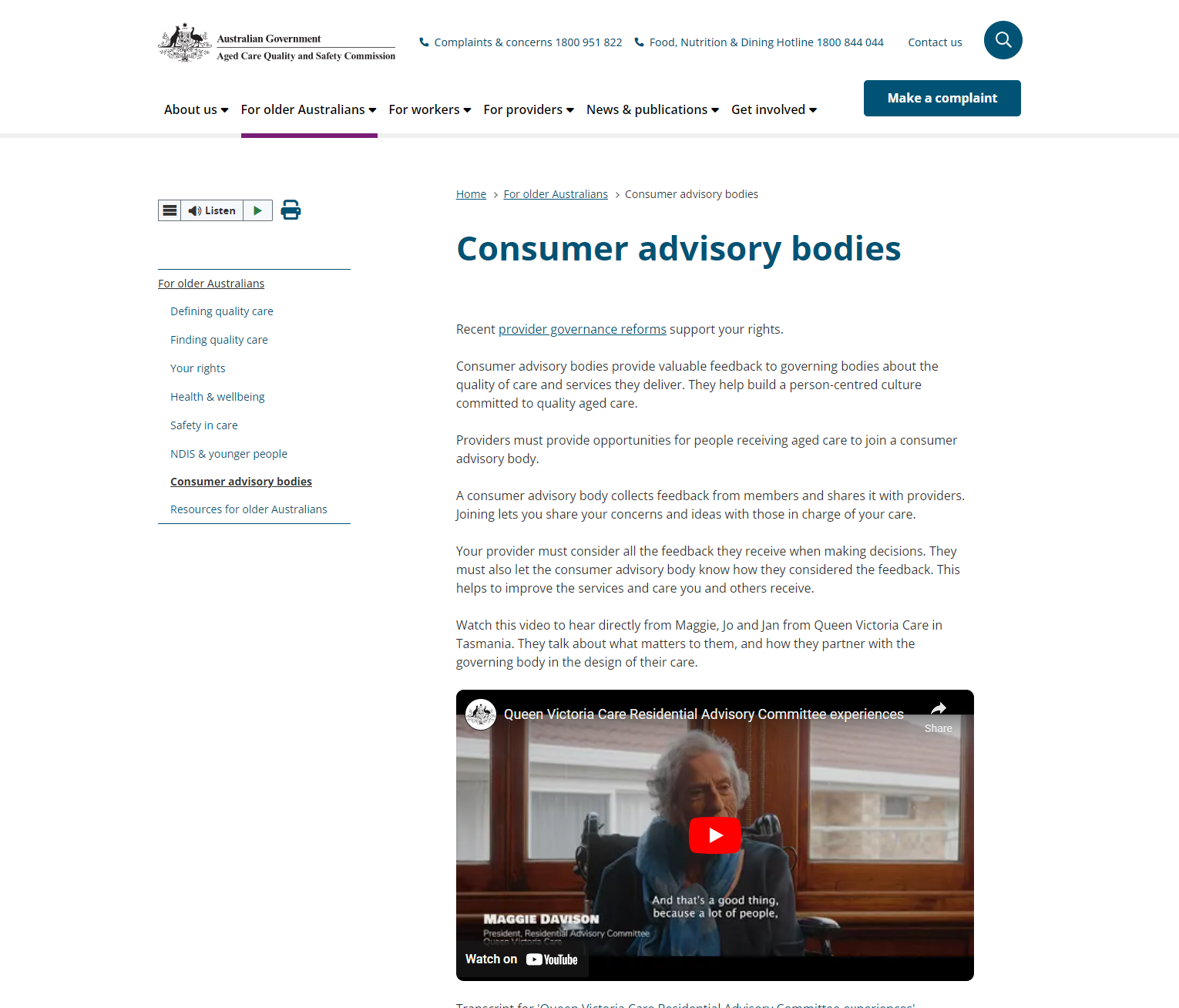
Consumer advisory bodies
This resource explains the role of consumer advisory bodies in aged care, which provide feedback to governing bodies on care and services. It outlines the process for joining, the importance of feedback in decision-making, and the responsibility of providers to offer participation opportunities annually.
This resource may refer to information that will be updated from 1 November 2025 to align with the new Aged Care Act and Quality Standards.
First Nations - Visual information sheet - Your rights when accessing aged care
Yarning about your aged care (PDF 645.07 KB)
Provider Governance Policy
Under the new Act, registered providers will need to meet certain governance obligations.
Our Provider Governance Policy outlines our expectations of providers and guiding principles of good governance. It includes:
- definitions and principles of good governance
- provider governance obligations
- how we collect provider governance information
- how we respond to provider governance risks.
Provider Governance Policy (PDF 2.07 MB)
Your questions answered – Compliance
In this video, Peter Edwards, Executive Director, Compliance and Enforcement Group, answers your questions about how we will manage non-compliance from 1 November 2025.

Case study - Safe and Appropriate use of Psychotropic Medicines - Residential Aged Care
This resource is a fictional scenario that follows an older person’s care pathway with a residential aged care provider. The resource focuses on the systems and processes to support high-quality care of older people living with cognitive impairment. It includes 4 key priority areas: person-centred care, medication management, managing changed behaviours and transitions of care.
This resource may refer to information that will be updated from 1 November 2025 to align with the new Aged Care Act and Quality Standards.
Case study - Safe and Appropriate use of Psychotropic Medicines - In-home Aged Care
This resource is a fictional scenario that follows an older person’s care pathway with an in-home aged care provider. The resource focuses on the systems and processes to support high-quality care of older people living with dementia. It includes 4 key priority areas: person-centred care, medication management, managing changed behaviours and transitions of care.
This resource may refer to information that will be updated from 1 November 2025 to align with the new Aged Care Act and Quality Standards.

Safe and appropriate use of psychotropic medicines for aged care - Fact sheet
This fact sheet is informed by the Psychotropic Medicines in Cognitive Disability or Impairment Clinical Care Standard (CCS), developed by the Australian Commission on Safety and Quality in Health Care. The CCS describes the safe and appropriate use of psychotropic medicines for people with cognitive disability or impairment, in a way that upholds their rights, dignity, health and quality of life.
This resource may refer to information that will be updated from 1 November 2025 to align with the new Aged Care Act and Quality Standards.
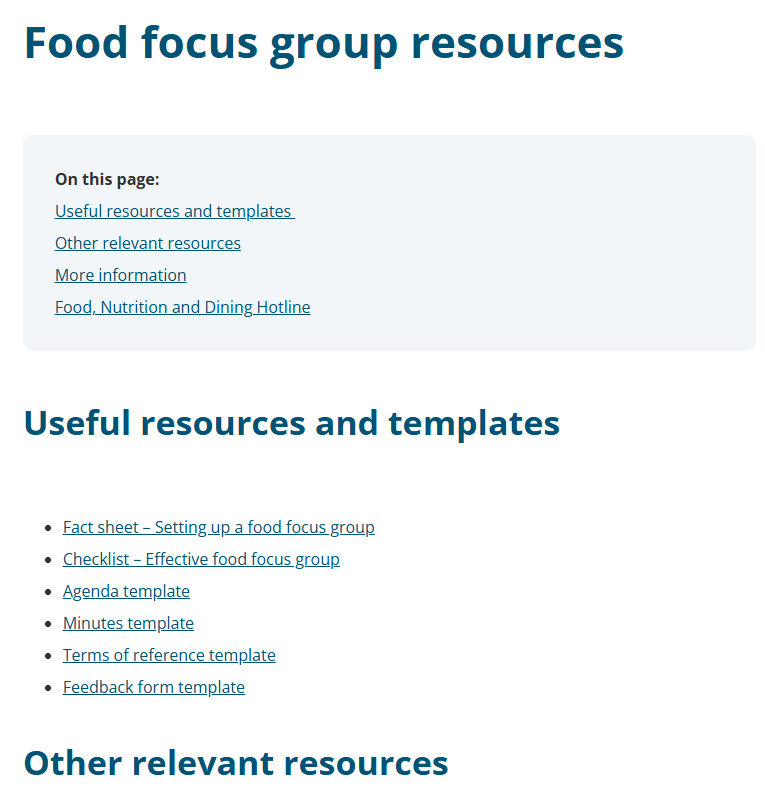
Food focus group resources
This resource is a collection of resources about food focus groups. It includes a fact sheet about setting up a food focus group and a checklist for an effective food focus group. It also contains associated templates, including agenda, minutes, terms of reference and feedback form.
This resource may refer to information that will be updated from 1 November 2025 to align with the new Aged Care Act and Quality Standards.
What is open disclosure? - video
This video explains open disclosure and what older people can expect from their registered provider during the process. It highlights key aspects such as communication, transparency, and how concerns will be addressed.

Social and emotional wellbeing resources for Aboriginal and Torres Strait Islander Peoples
This page provides resources for Aboriginal and Torres Strait Islander people on social and emotional wellbeing. It contains information on support services, scholarships, lived experience centres, stories and other resources for mental health.