Aged care laws in Australia have now changed. The new Aged Care Act 2024 and Aged Care Rules 2025 now apply. While we complete updating of our website, including draft guidance and other materials, to align with the new laws, providers are advised to refer to the new Act and Rules for any required clarification of their obligations and legal responsibilities. Thank you for your patience.

Quality Standards Resource Centre

The Quality Standards Resource Centre helps extend understanding of the strengthened Aged Care Quality Standards, which take effect from 1 November 2025. The Resource Centre will be updated to reflect key changes made to the draft strengthened Standards. You can search for resources by using keywords, or filtering by standard, outcome, audience and theme. Before using the Resource Centre, please read the terms of use.

Displaying 41 to 60 of 73 result(s)
/quality-standards/pharmaceutical-benefits-scheme-pbs-medication-chart-maximum-duration-residential-aged-care

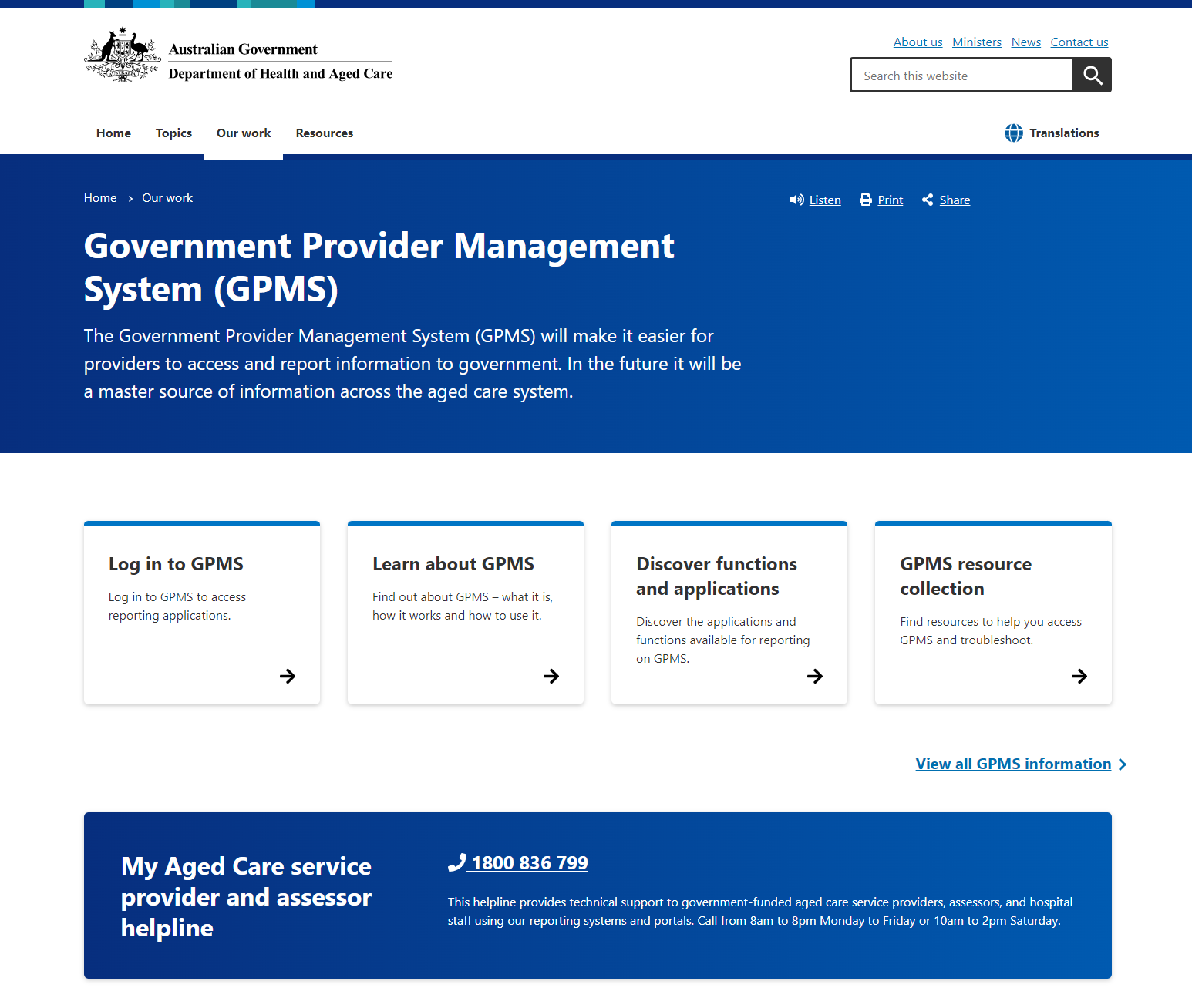
Pharmaceutical Benefits Scheme (PBS) medication chart maximum duration in residential aged care

Fact sheet
Published date

This resource outlines the Pharmaceutical Benefits Scheme (PBS) medication chart's maximum duration in residential aged care. It explains the use of both paper-based and electronic National Residential Medication Charts (NRMC), highlighting their role in managing prescriptions, medication supply, and administration. The document provides guidance on compliance, chart expiry, and medication safety within aged care facilities. This resource may refer to information that will be updated from 1 November 2025 to align with the new Aged Care Act and Quality Standards.
Author
Department of Health, Disability and Ageing
Key Theme
Medication management
Standard
5: Clinical Care
Outcomes
5.3: Safe and quality use of medicines
Pharmaceutical Benefits Scheme (PBS) medication chart maximum duration in residential aged care
/quality-standards/national-aged-care-mandatory-quality-indicator-program

National Aged Care Mandatory Quality Indicator Program

Guidance

The National Aged Care Mandatory Quality Indicator Program aids residential aged care providers in enhancing their services by allowing them to benchmark their performance against national outcomes. The program resource provides guidance on data submission frequency, explains the program's role, and provides more information on open hours and contact details. 

This resource may refer to information that will be updated from 1 November 2025 to align with the new Aged Care Act and Quality Standards. 

Author
Aged Care Quality & Safety Commission
Key Theme
Accountability and quality system
Standard
5: Clinical Care
Outcomes
2.3: Accountability, quality system and policies and procedures, 2.2a: Quality, safety and inclusion culture to support aged care workers to deliver quality care, 2.2b: Quality, safety and inclusion culture to support individuals
National Aged Care Mandatory Quality Indicator Program
/quality-standards/non-compliance

Non-compliance

Guidance

This resource outlines the processes for managing non-compliance in aged care services. It includes information on banning orders, enforceable undertakings, and how the Commission addresses non-compliance through monitoring, complaints directions, and enforcement policies. Providers can also search for performance reports to track compliance​. 

This resource may refer to information that will be updated from 1 November 2025 to align with the new Aged Care Act and Quality Standards. 

Author
Aged Care Quality & Safety Commission
Key Theme
Accountability and quality system
Standard
2: The Organisation
Outcomes
2.3: Accountability, quality system and policies and procedures
Non-compliance
/quality-standards/governing-reform-aged-care-program

Governing for Reform in Aged Care Program

Guidance

This resource outlines the Governing for Reform in Aged Care Program, designed to strengthen corporate and clinical governance capabilities for aged care leaders. It provides tools, online learning modules, webinars, and podcasts to support governance improvement and help leaders engage in reform efforts. 

This resource may refer to information that will be updated from 1 November 2025 to align with the new Aged Care Act and Quality Standards. 

Author
Aged Care Quality & Safety Commission
Key Theme
Corporate and clinical governance, Accountability and quality system, Risk management system, Incident management system, Feedback and complaints management system, Information management system, Workforce and human resources management, Emergency and disaster management
Standard
2: The Organisation
Outcomes
2.1: Partnering with individuals, 2.2a: Quality, safety and inclusion culture to support aged care workers to deliver quality care, 2.3: Accountability, quality system and policies and procedures, 2.4: Risk management, 2.5: Incident management, 2.6a: Complaints and feedback management for aged care workers, 2.6b: Complaints and feedback management for individuals, 2.7: Information management, 2.8: Workforce planning, 2.9: Human resource management, 2.10: Emergency and disaster management
Governing for Reform in Aged Care Program
/quality-standards/provider-governance-policy

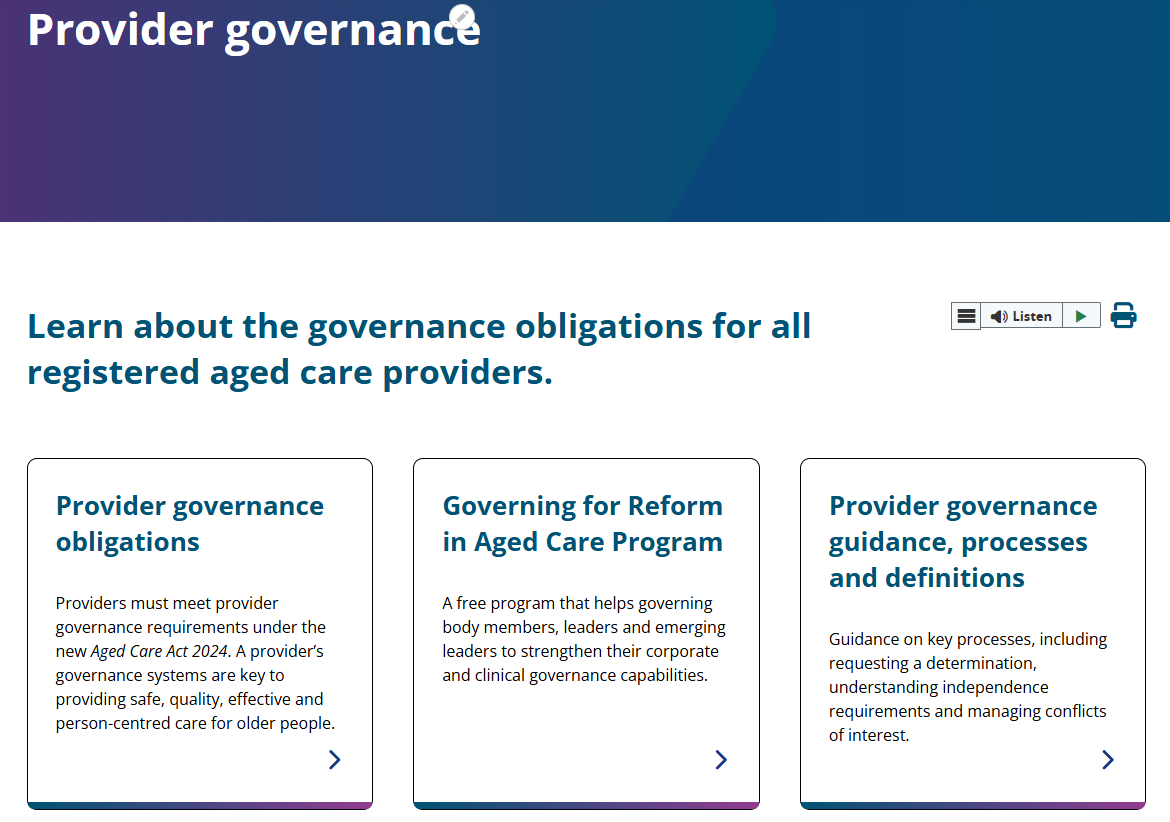
Provider Governance Policy

Guidance, Policy
Published date

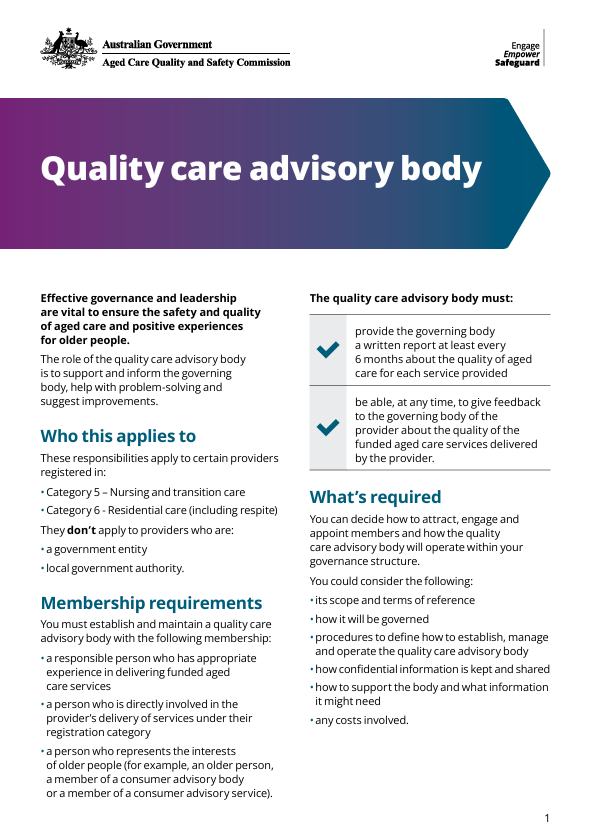
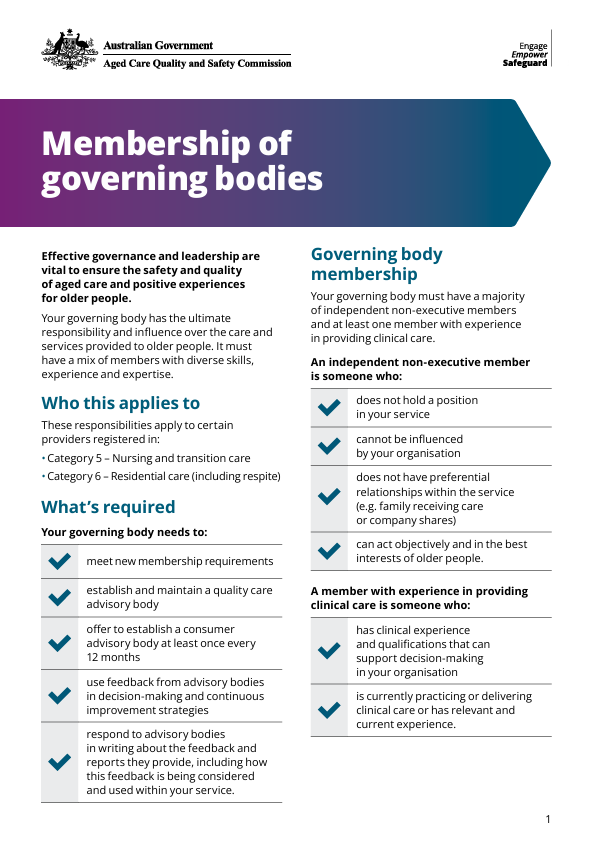
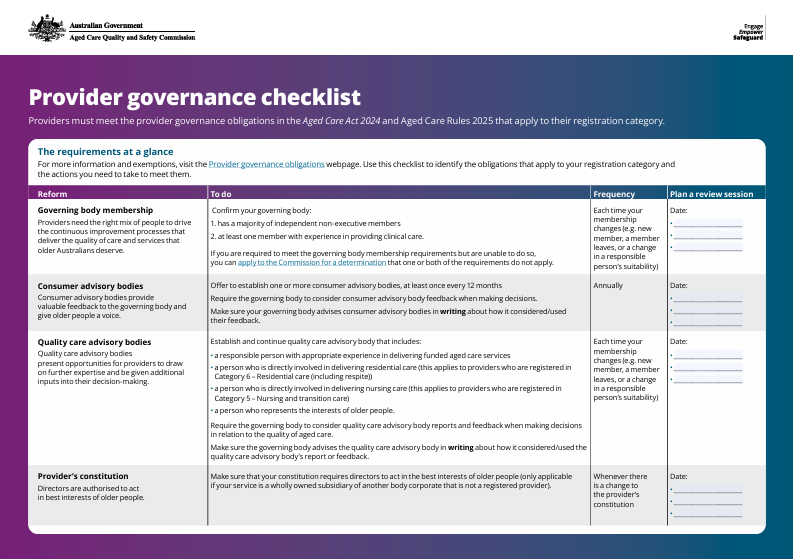
Under the new Act, registered providers will need to meet certain governance obligations.

Our Provider Governance Policy outlines our expectations of providers and guiding principles of good governance. It includes:

  • definitions and principles of good governance
  • provider governance obligations
  • how we collect provider governance information  
  • how we respond to provider governance risks.
Provider Governance Policy  (PDF  2.07 MB)
Author
Aged Care Quality & Safety Commission
Key Theme
Accountability and quality system
Standard
2: The Organisation
Outcomes
2.3: Accountability, quality system and policies and procedures
Provider governance policy
/quality-standards/your-questions-answered-compliance

Your questions answered – Compliance

Video
Published date
Last Updated

In this video, Peter Edwards, Executive Director, Compliance and Enforcement Group, answers your questions about how we will manage non-compliance from 1 November 2025. 

Author
Aged Care Quality & Safety Commission
Key Theme
Accountability and quality system, Risk management system
Standard
2: The Organisation
Outcomes
2.3: Accountability, quality system and policies and procedures, 2.4: Risk management
Your questions answered – Compliance
/quality-standards/case-study-safe-and-appropriate-use-psychotropic-medicines-residential-aged-care

Case study - Safe and Appropriate use of Psychotropic Medicines - Residential Aged Care

Guidance
Published date

This resource is a fictional scenario that follows an older person’s care pathway with a residential aged care provider. The resource focuses on the systems and processes to support high-quality care of older people living with cognitive impairment. It includes 4 key priority areas: person-centred care, medication management, managing changed behaviours and transitions of care. 

This resource may refer to information that will be updated from 1 November 2025 to align with the new Aged Care Act and Quality Standards.
Author
Australian Commission On Safety And Quality In Health Care
Key Theme
Person-centred care, Delivering comprehensive care and services, Medication management
Standard
1: The Individual, 3: The Care and Services, 5: Clinical Care
Outcomes
1.1: Person-centred care, 3.2: Delivery of funded aged care services, 5.3: Safe and quality use of medicines, 5.6 Cognitive impairment  
Case study - Safe and Appropriate use of Psychotropic Medicines - Residential Aged Care
/quality-standards/case-study-safe-and-appropriate-use-psychotropic-medicines-home-aged-care

Case study - Safe and Appropriate use of Psychotropic Medicines - In-home Aged Care

Guidance
Published date

This resource is a fictional scenario that follows an older person’s care pathway with an in-home aged care provider. The resource focuses on the systems and processes to support high-quality care of older people living with dementia. It includes 4 key priority areas: person-centred care, medication management, managing changed behaviours and transitions of care. 

This resource may refer to information that will be updated from 1 November 2025 to align with the new Aged Care Act and Quality Standards.
Author
Australian Commission On Safety And Quality In Health Care
Key Theme
Person-centred care, Delivering comprehensive care and services, Medication management
Standard
1: The Individual, 3: The Care and Services, 5: Clinical Care
Outcomes
1.1: Person-centred care, 3.2: Delivery of funded aged care services, 5.3: Safe and quality use of medicines, 5.6 Cognitive impairment  
Case study - Safe and Appropriate use of Psychotropic Medicines - In-home Aged Care
/quality-standards/safe-and-appropriate-use-psychotropic-medicines-aged-care-fact-sheet

Safe and appropriate use of psychotropic medicines for aged care - Fact sheet

Fact sheet
Published date

This fact sheet is informed by the Psychotropic Medicines in Cognitive Disability or Impairment Clinical Care Standard (CCS), developed by the Australian Commission on Safety and Quality in Health Care. The CCS describes the safe and appropriate use of psychotropic medicines for people with cognitive disability or impairment, in a way that upholds their rights, dignity, health and quality of life. 

This resource may refer to information that will be updated from 1 November 2025 to align with the new Aged Care Act and Quality Standards.
Author
Australian Commission On Safety And Quality In Health Care
Key Theme
Person-centred care, Delivering comprehensive care and services, Medication management
Standard
1: The Individual, 3: The Care and Services, 5: Clinical Care
Outcomes
1.1: Person-centred care, 3.2: Delivery of funded aged care services, 5.3: Safe and quality use of medicines, 5.6 Cognitive impairment  
Safe and appropriate use of psychotropic medicines for aged care - Fact sheet
/quality-standards/what-open-disclosure-video

What is open disclosure? - video

Video
Published date
Last Updated

This video explains open disclosure and what older people can expect from their registered provider during the process. It highlights key aspects such as communication, transparency, and how concerns will be addressed. 

Author
Aged Care Quality & Safety Commission
Key Theme
Accountability and quality system, Feedback and complaints management system
Standard
2: The Organisation
Outcomes
2.3: Accountability, quality system and policies and procedures, 2.6a: Complaints and feedback management for aged care workers, 2.6b: Complaints and feedback management for individuals
Open disclosure - video
/quality-standards/clinical-governance-and-quality-improvement-support-medication-management

Clinical governance and quality improvement to support medication management

Guidance
Last Updated

This resource outlines clinical governance and quality improvement systems to support safe medication management. It requires health service organisations to implement systems for procuring, prescribing, dispensing, and monitoring medicines. 

This resource may refer to information that will be updated from 1 November 2025 to align with the new Aged Care Act and Quality Standards.
Author
Australian Commission On Safety And Quality In Health Care
Key Theme
Medication management
Standard
5: Clinical Care
Outcomes
5.3: Safe and quality use of medicines
Clinical governance and quality improvement to support medication management
/quality-standards/medicines-use-older-people

Medicines use in older people

Guidance
Published date

This resource is chapter six of the Fourth Atlas 2021 of Healthcare Variations. The chapter examines medicines use in people aged 75 and over, focusing on polypharmacy, medication management reviews (MMRs), and proton pump inhibitor (PPI) dispensing. It highlights variations in medication use and recommends improving access to MMR services and interventions for safe, effective medication use in older populations. 
Author
Australian Commission On Safety And Quality In Health Care
Key Theme
Medication management
Standard
5: Clinical Care
Outcomes
5.3: Safe and quality use of medicines
Medicines use in older people
/quality-standards/effective-incident-management-education-pack

Effective incident management education pack

Guidance, Presentations
Published date

The Effective incident management education pack is designed for providers to deliver to their own staff. It can be delivered in full or delivered as a series of shorter sessions where you can focus on the sections that are most relevant to your setting or the time you have available. 

This pack will support your staff to understand the role they play in effectively managing incidents at your aged care service and help them understand what an incident management system is and its key elements. 

Author
Aged Care Quality & Safety Commission
Key Theme
Accountability and quality system
Standard
2: The Organisation
Outcomes
2.3: Accountability, quality system and policies and procedures, 2.5: Incident management, 2.6b: Complaints and feedback management for individuals
Effective incident management education pack
/quality-standards/electronic-prescribing

Electronic prescribing

Guidance
Last Updated

This resource outlines the framework for electronic prescribing, offering an alternative to paper prescriptions for healthcare providers and consumers. It explains the benefits of electronic prescriptions, such as reducing errors, improving efficiency, and supporting medication safety. The resource also covers technical and legislative requirements for implementing electronic prescriptions in various healthcare settings. 

This resource may refer to information that will be updated from 1 November 2025 to align with the new Aged Care Act and Quality Standards.
Author
Department of Health, Disability and Ageing
Key Theme
Medication management, Corporate and clinical governance, Information management system
Standard
5: Clinical Care
Outcomes
5.3: Safe and quality use of medicines, 5.1: Clinical governance
Electronic prescribing
/quality-standards/electronic-prescriptions

Electronic prescriptions

Guidance
Published date
Last Updated

This resource provides an overview of electronic prescriptions, which offer a digital alternative to paper prescriptions. It explains how electronic prescriptions can be issued by healthcare providers and stored on digital devices for convenience. The resource also details the benefits of the Active Script List (ASL) for managing multiple prescriptions, enhancing efficiency and medicine safety.

Author
External resource
Key Theme
Medication management, Information management system, Corporate and clinical governance
Standard
5: Clinical Care
Outcomes
5.3: Safe and quality use of medicines, 5.1: Clinical governance
Electronic prescriptions
/quality-standards/quality-improvement-guidance-aged-care-providers

Quality improvement guidance for aged care providers

Guidance
Last Updated

This resource offers guidance for aged care providers on implementing continuous quality improvement processes. It explains the ‘Plan, Do, Check, Act’ model to monitor and enhance care quality, using data and feedback to address issues. It also provides practical examples and tools to support providers in improving care and meeting regulatory requirements. This resource may refer to information that will be updated from 1 November 2025 to align with the new Aged Care Act and Quality Standards.

Author
Department of Health, Disability and Ageing
Key Theme
Accountability and quality system, Corporate and clinical governance
Standard
2: The Organisation
Outcomes
2.2a: Quality, safety and inclusion culture to support aged care workers to deliver quality care, 2.2b: Quality, safety and inclusion culture to support individuals, 2.3: Accountability, quality system and policies and procedures
Quality improvement guidance for aged care providers
/quality-standards/open-disclosure-resources-consumers

Open Disclosure resources for consumers

Guidance
Last Updated

This resource provides information on open disclosure in healthcare, explaining what people should expect if harm occurs during care. It includes fact sheets in various languages and outlines how to prepare for open disclosure discussions. The resource aims to support transparent communication and improve care safety across healthcare settings, including aged care. This resource may refer to information that will be updated from 1 November 2025 to align with the new Aged Care Act and Quality Standards.

Author
Australian Commission On Safety And Quality In Health Care
Key Theme
Feedback and complaints management system, Accountability and quality system
Standard
2: The Organisation
Outcomes
2.6b: Complaints and feedback management for individuals, 2.3: Accountability, quality system and policies and procedures
Open Disclosure resources for consumers
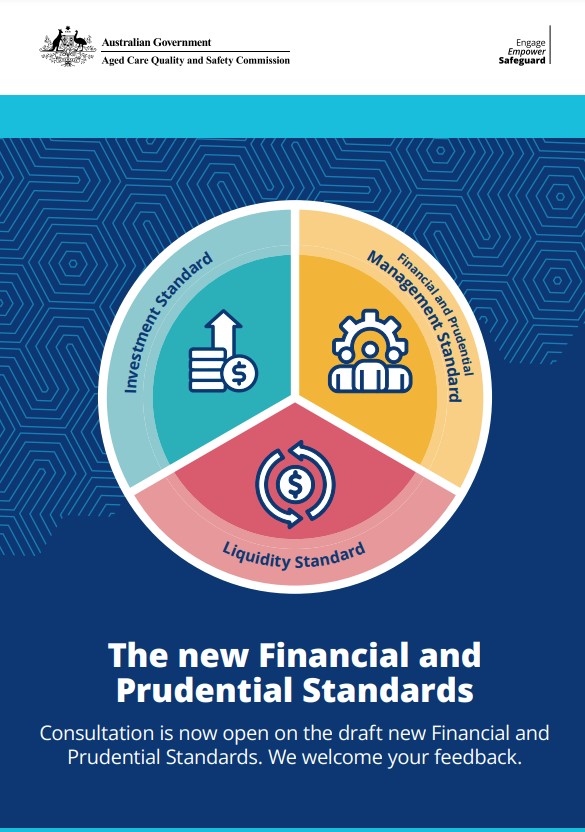
/quality-standards/financial-and-prudential-monitoring-compliance-and-intervention-framework

Financial and Prudential Monitoring, Compliance and Intervention Framework

Guidance
Last Updated

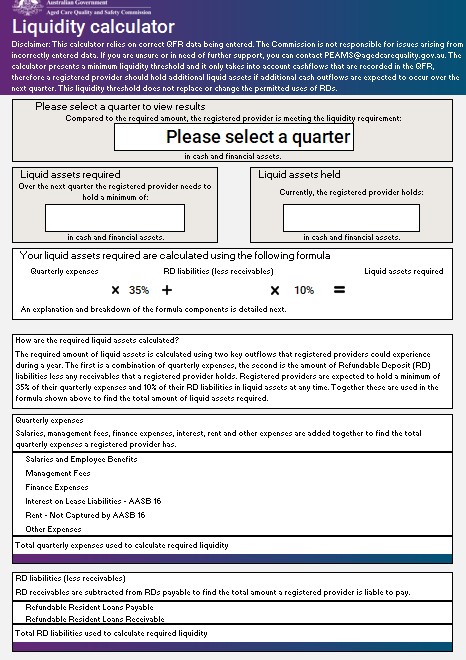
This resource outlines the Financial and Prudential Monitoring, Compliance and Intervention Framework for aged care providers. It aims to enhance financial transparency, requiring stricter reporting, oversight, and adherence to prudential standards. The framework helps ensure financial stability, protects refundable accommodation deposits, and supports the continuity of care in residential aged care. It includes phased implementation and future regulatory changes.

Author
Department of Health, Disability and Ageing
Key Theme
Accountability and quality system
Standard
2: The Organisation
Outcomes
2.3: Accountability, quality system and policies and procedures
Financial and Prudential Monitoring, Compliance and Intervention Framework
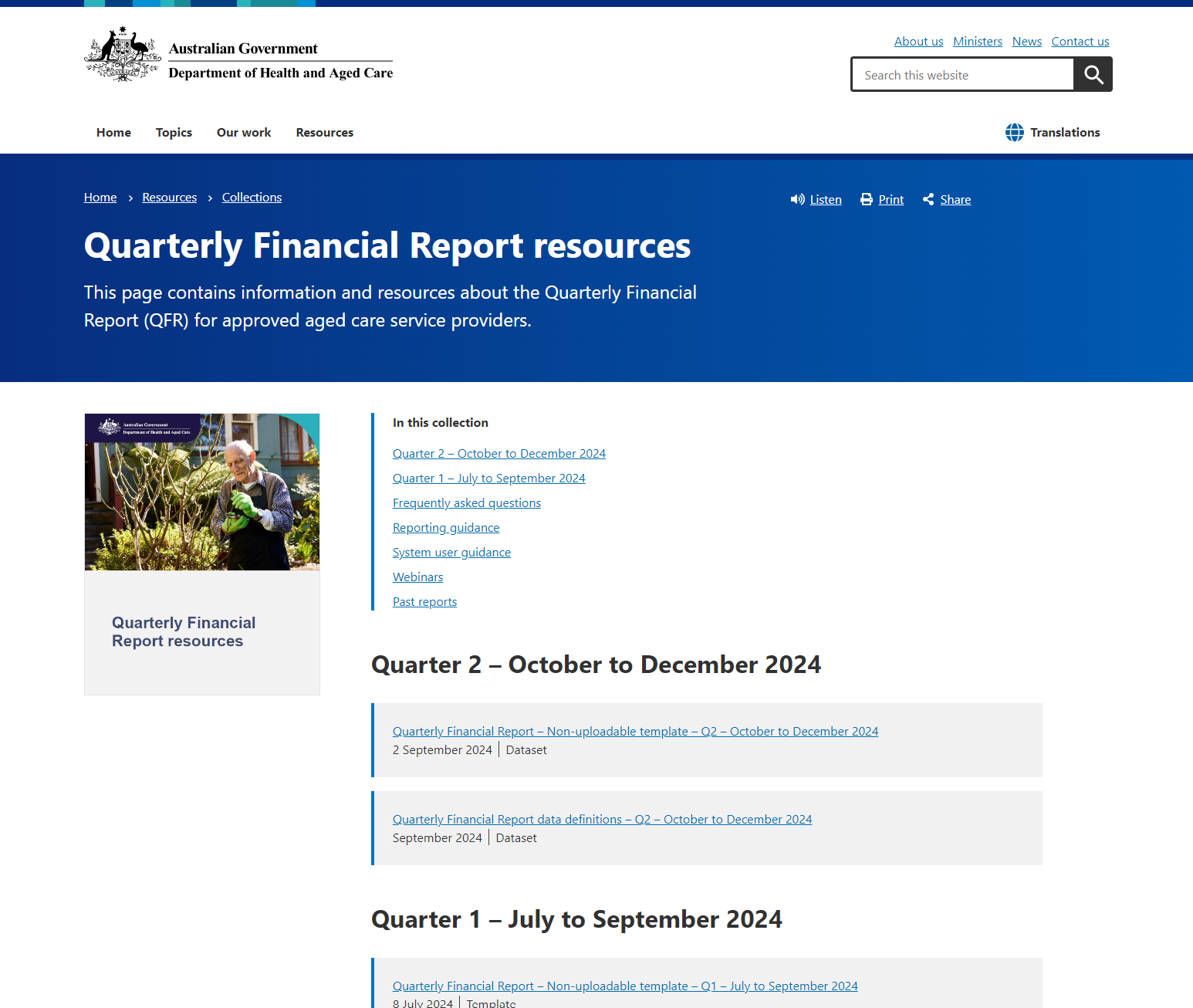
/quality-standards/government-provider-management-system-resources

Government Provider Management System resources

Guidance
Last Updated

This resource provides user guides, quick reference materials, and videos to support aged care providers in using the Government Provider Management System (GPMS). It covers essential tasks such as managing user details, financial reporting, and service information. The GPMS ensures accurate and efficient data management for regulatory compliance and operational oversight in aged care services. 

This resource may refer to information that will be updated from 1 November 2025 to align with the new Aged Care Act and Quality Standards.

Author
Department of Health, Disability and Ageing
Key Theme
Information management system, Accountability and quality system
Standard
2: The Organisation
Outcomes
2.7: Information management, 2.3: Accountability, quality system and policies and procedures
Government Provider Management System resources
/quality-standards/government-provider-management-system-gpms

Government Provider Management System (GPMS)

Guidance
Last Updated

This resource provides an overview of the Government Provider Management System (GPMS), designed to simplify access to and reporting of information by aged care providers to the government. It includes user guides, fact sheets, and troubleshooting support for managing organisational details, notifications, and financial reporting in compliance with aged care requirements. 

This resource may refer to information that will be updated from 1 November 2025 to align with the new Aged Care Act and Quality Standards.

Author
Department of Health, Disability and Ageing
Key Theme
Information management system, Accountability and quality system
Standard
2: The Organisation
Outcomes
2.7: Information management, 2.3: Accountability, quality system and policies and procedures
Government Provider Management System (GPMS)