The Quality Standards Resource Centre helps extend understanding of the strengthened Aged Care Quality Standards, which took effect from 1 November 2025. You can search for resources by using keywords, or filtering by standard, outcome and audience. Before using the Resource Centre, please read the terms of use.
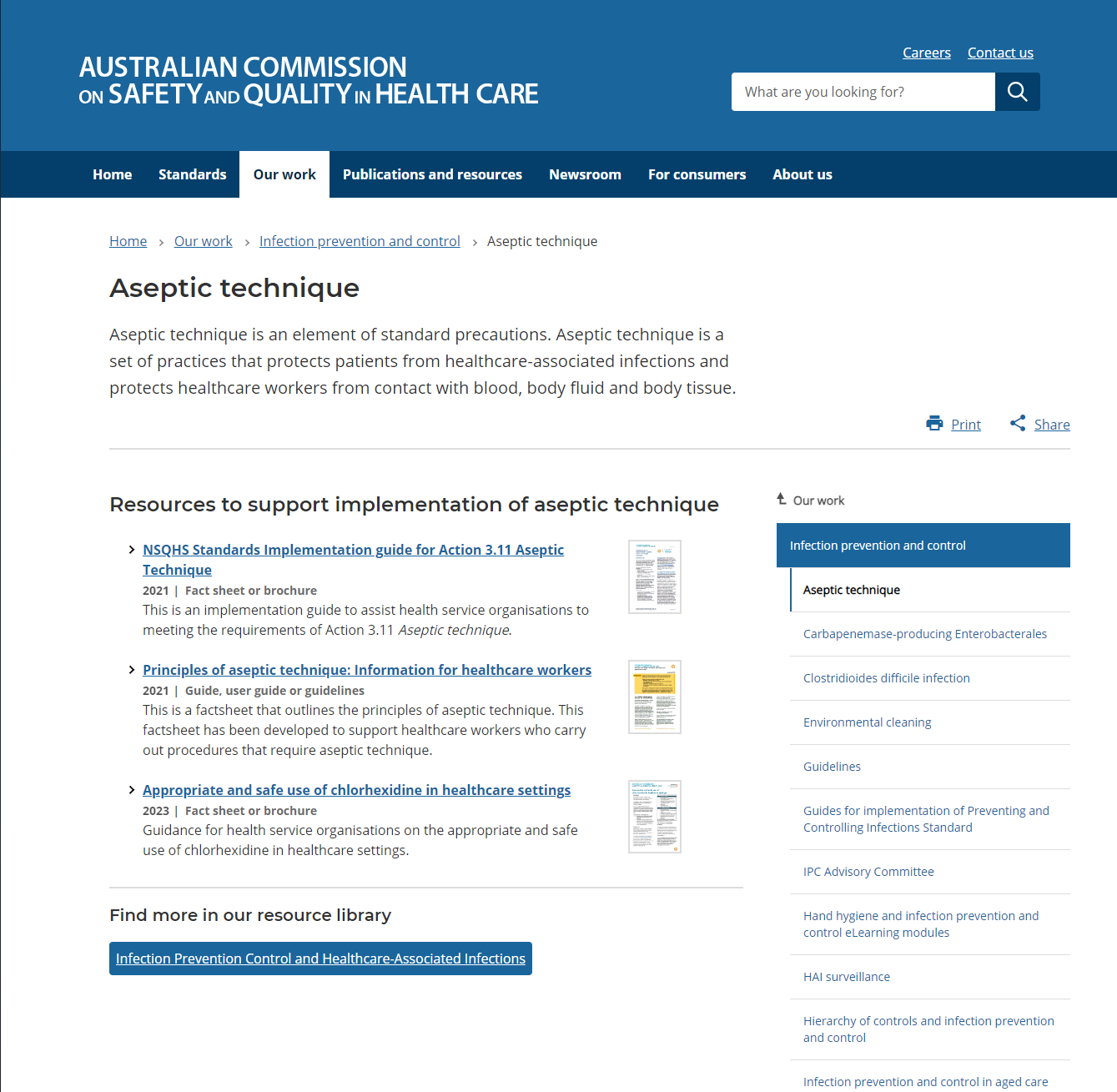
Aseptic technique
This resource provides information on aseptic techniques to support service provides adapt practices to protect patients from healthcare-associated infections and healthcare workers from contact with blood, body fluid and body tissue. It provides guides for implementation, principles of aseptic technique and safe use of chlorhexidine.
This resource may refer to information that will be updated from 1 July 2025 to align with the new Aged Care Act and Quality Standards.
AMR - Antimicrobial resistance
The AMR provides information on antimicrobial resistance and it's threats to human and animal health. It contains information on how to reduce it's spread, news, AMR resources and other resources on antimicrobial resistance.
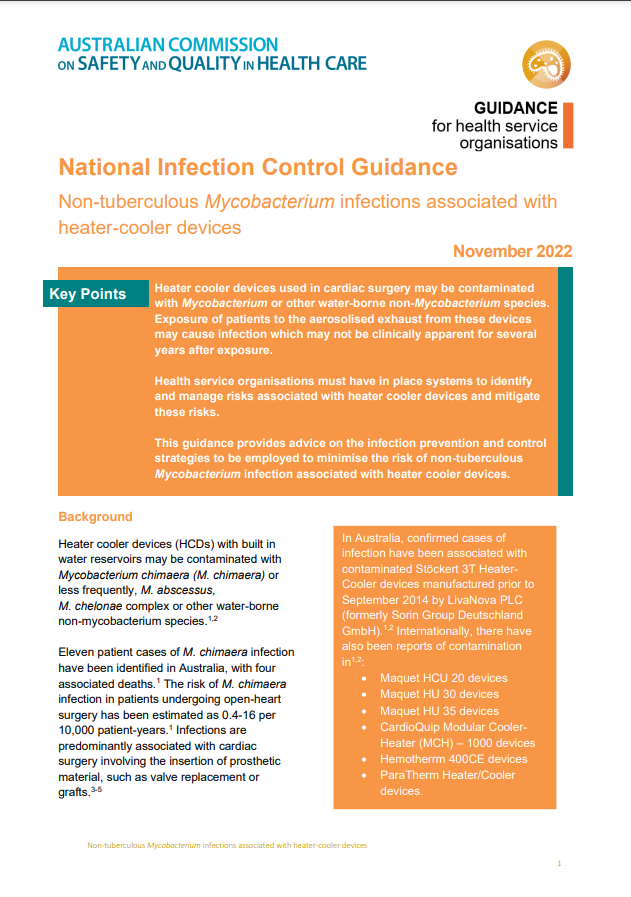
National Infection Control Guidance Non-tuberculous Mycobacterium infections associated with heater-cooler devices
This guidance addresses the infection risks associated with heater-cooler devices, particularly Non-tuberculous Mycobacterium infections. It provides recommendations for Australian healthcare organisations on managing these risks, including using safety notices and infection control guidelines. It should be used alongside state and territory health advice. This resource may apply to healthcare contexts outside of aged care and please consider the applicability of this resource to your care setting.
Preventing and Controlling Infections Standard
The Preventing and Controlling Infections Standard (National Safety and Quality Health Service Standards) outlines infection prevention and control strategies, antimicrobial stewardship, the safe use of resources, and evidence-based practices. It aims to minimise infection risks and ensure the safety of people receiving care and workforce members. It also supports compliance with infection control standards in healthcare and aged care settings. This resource may apply to healthcare contexts outside of aged care and please consider the applicability of this resource to your care setting.
Recommendations for the control of carbapenemase-producing Enterobacterales
This resource provides guidance on preventing and managing carbapenemase-producing Enterobacterales (CPE) in healthcare. It covers screening, outbreak control, and environmental cleaning, helping to reduce antimicrobial resistance. The resource supports infection control policies and aims to enhance safety in aged care and health service organisations.
This resource may refer to information that will be updated from 1 November 2025 to align with the new Aged Care Act and Quality Standards.
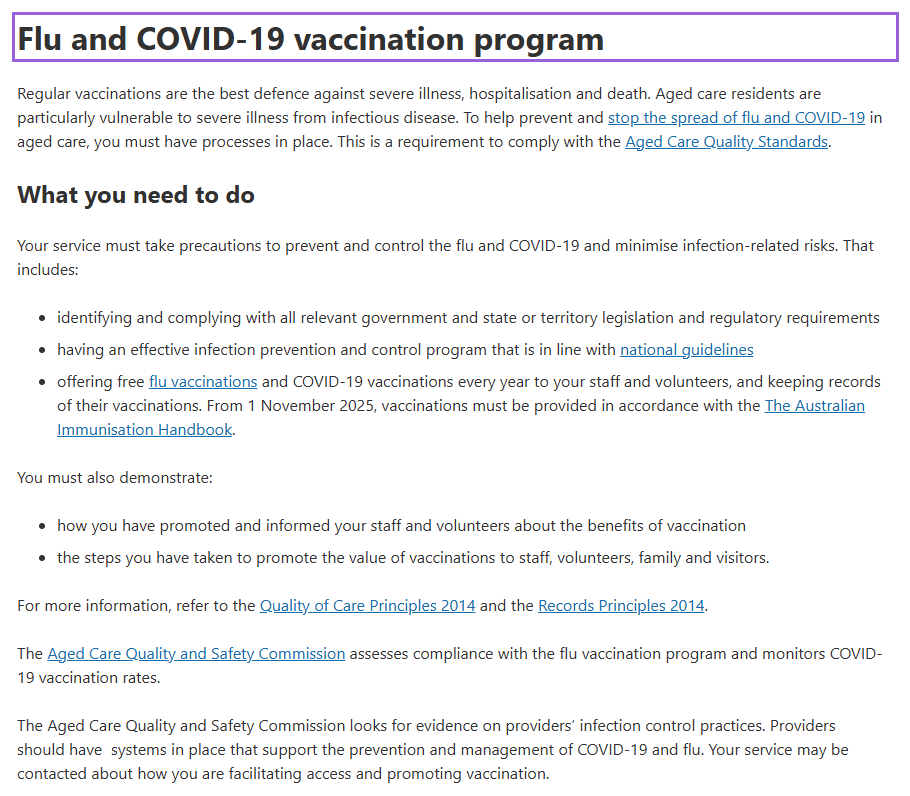
Flu and COVID-19 vaccination program
This resource outlines the flu and COVID-19 vaccination program for residential aged care providers. It includes information about what services must do to take precautions to prevent and control the flu and COVID-19 and minimise infection-related risks. This resource may refer to information that will be updated from 1 November 2025 to align with the new Aged Care Act and Quality Standards.
Dementia-friendly environments - Dining areas, kitchens and eating
This resource provides guidelines for creating dementia-friendly dining and kitchen spaces, emphasising sensory engagement, personalised meal experiences, and a home-like environment. It includes practical adjustments for lighting, noise, seating, and social interaction to enhance dining enjoyment.
This resource was developed by a state/territory government or organisation and therefore its applicability and usefulness may be limited.
Dementia enabling environments
The Dementia Enabling Environments website, developed by Alzheimer's WA, provides guidance and resources to help create enabling environments for a person living with dementia. It includes design principles for different environment types, include home and residential aged care facilities.
This resource was developed by a state/territory government or organisation and therefore its applicability and usefulness may be limited.
Infection prevention and control - ACSQH
This resource provides guidelines to reduce infection transmission risks in healthcare settings. It provides information on standard and transmission-based precautions, specific diseases or conditions, other infection prevention and control strategies and promotional resources practices such as hand hygiene, use of personal protective equipment, and environmental cleaning.
This resource may refer to information that will be updated from 1 November 2025 to align with the new Aged Care Act and Quality Standards.
Government support for providers and workers
This resource outlines government support for aged care providers managing COVID-19 outbreaks. It covers information on infection prevention measures, vaccination assistance, and mental health resources to help providers maintain care quality and safety during outbreaks.
This resource may refer to information that will be updated from 1 November 2025 to align with the new Aged Care Act and Quality Standards.
Infection prevention and control in aged care - Cognitive decline and dementia
How to create an environment with strong infection prevention and control practices while continuing to provide a positive experience for people with cognitive decline and dementia.
This resource may refer to information that will be updated from 1 November 2025 to align with the new Aged Care Act and Quality Standards

National Aged Care Design Principles and Guidelines
This guide provides guidance on different systems and tools that can be used in residential aged care and community settings. It includes topics such as clinical handover and continuity of care (medication management), information technology systems, My Aged Care, quality improvement, and more. This resource complements Part A: Common clinical conditions in aged care and Part B: General approaches to aged care of the RACGP aged care clinical guide (Silver Book).