The Quality Standards Resource Centre helps extend understanding of the strengthened Aged Care Quality Standards, which take effect from 1 November 2025. The Resource Centre will be updated to reflect key changes made to the draft strengthened Standards. You can search for resources by using keywords, or filtering by standard, outcome, audience and theme. Before using the Resource Centre, please read the terms of use.
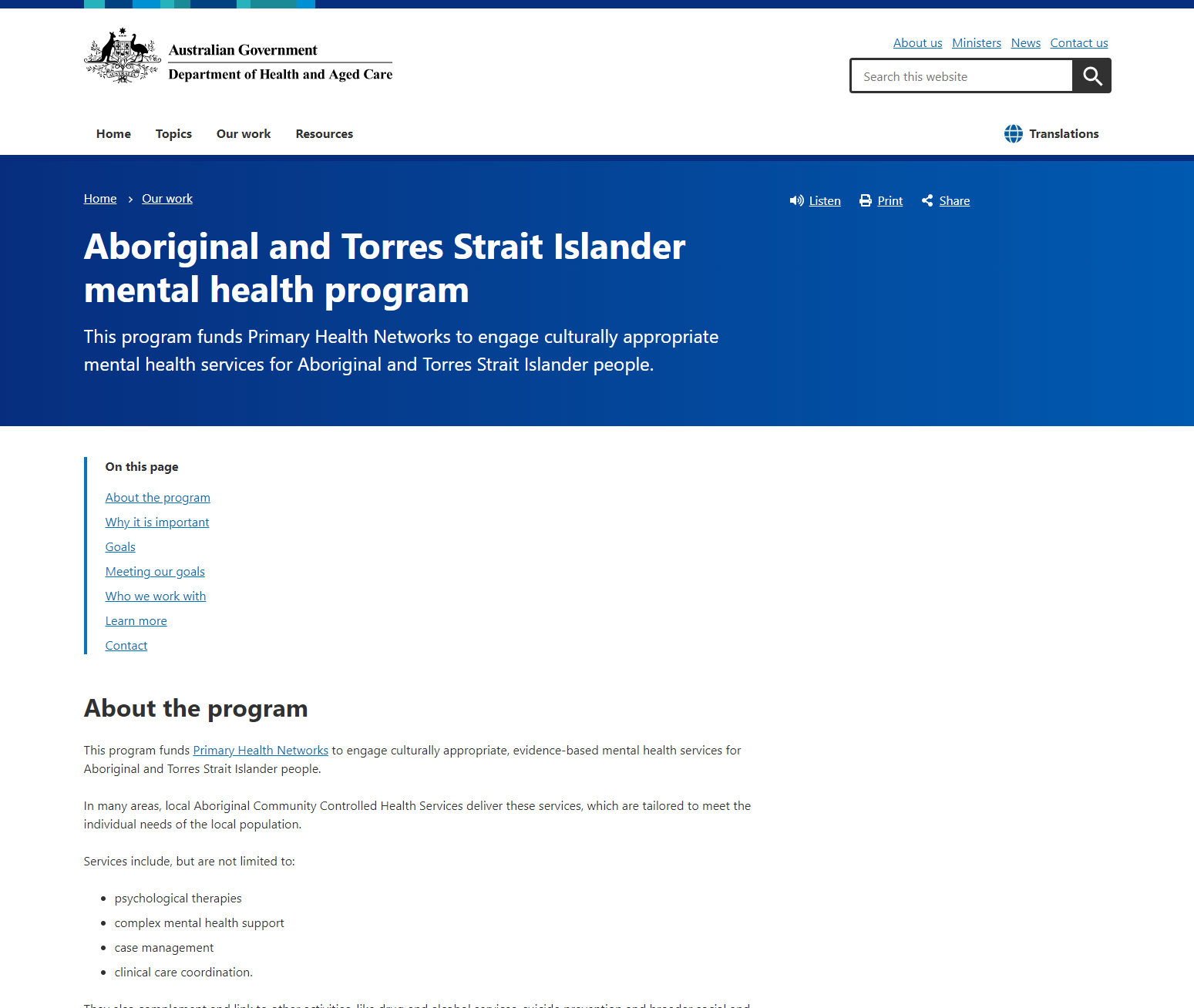
Aboriginal and Torres Strait Islander mental health program
This resource provides information on a mental health program for Aboriginal and Torres Strait Islander people. It includes funding for culturally appropriate mental health services, offering psychological therapies, complex care, and clinical coordination. The program integrates with other services such as drug and alcohol support and suicide prevention initiatives.
This resource may refer to information that will be updated from 1 July 2025 to align with the new Aged Care Act and Quality Standards.
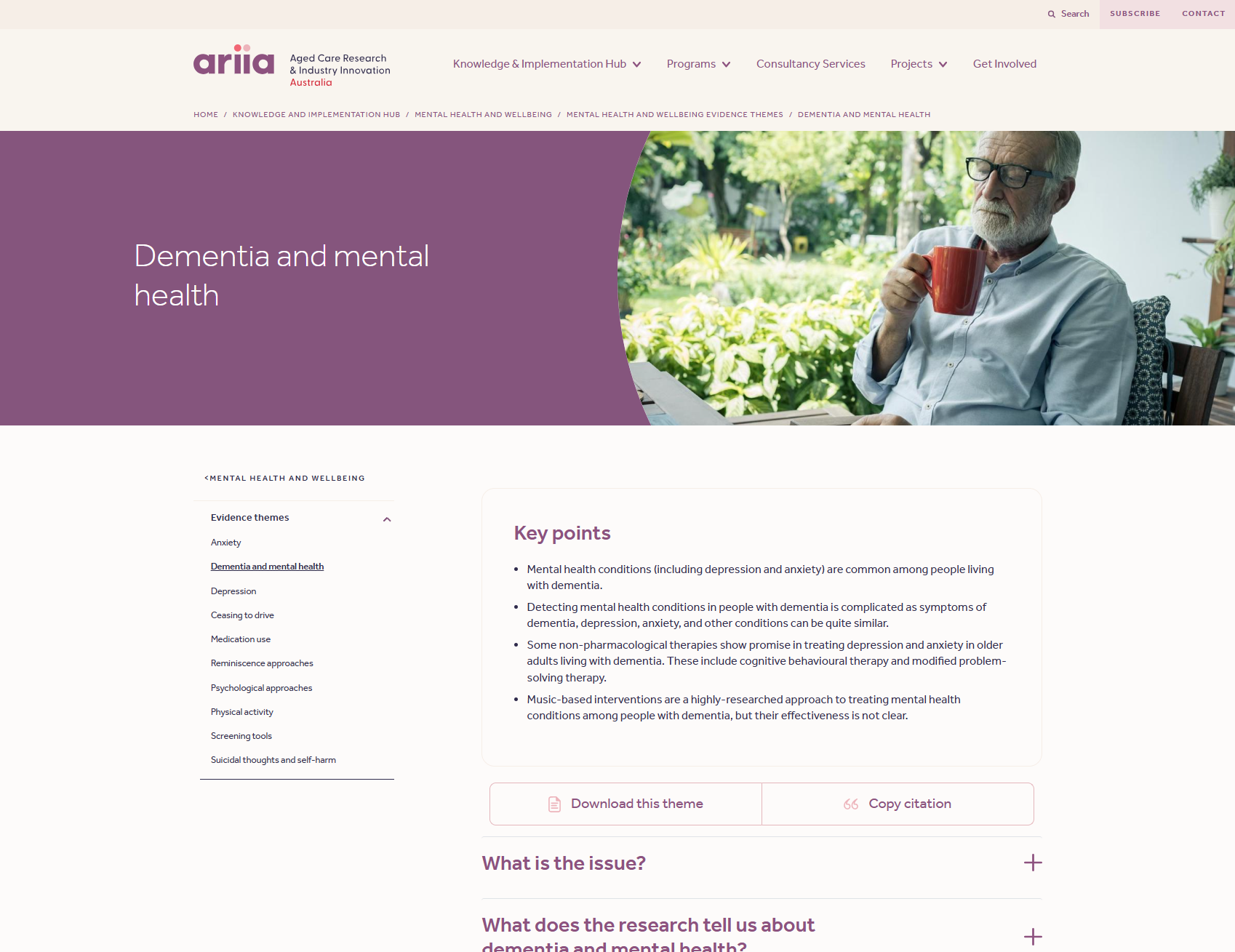
Mental health and wellbeing - Dementia and mental health
This resource examines mental health challenges in people living with dementia, covering complexities in diagnosing conditions like depression and anxiety. It provides evidence-based insights on therapeutic approaches, including music and cognitive therapies, and offers tools to aid aged care providers in supporting mental health in dementia care.
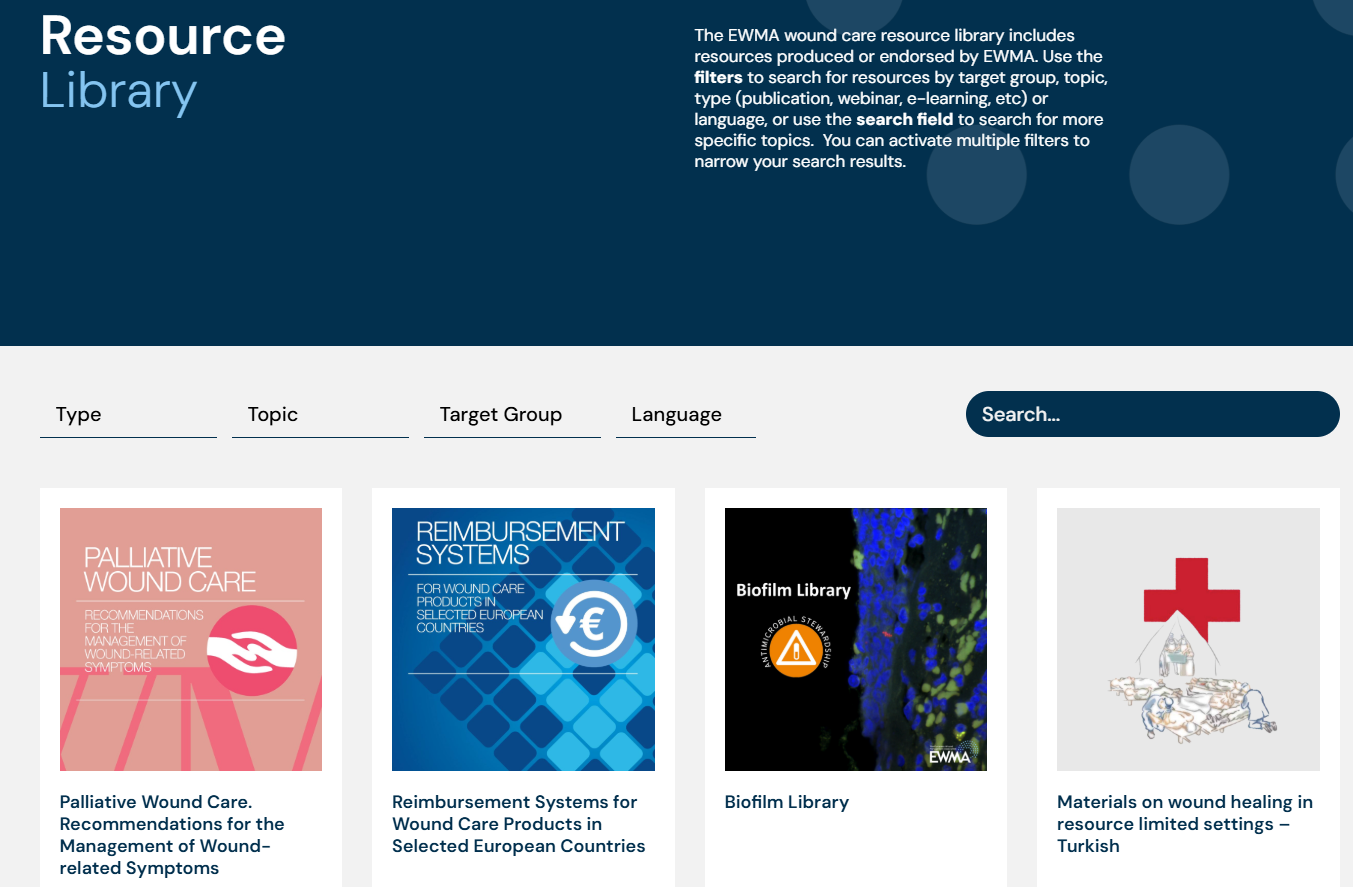
European Wound Management Association - Resource Library
This resource library offers a collection of wound care materials, including publications, webinars, and e-learning modules, covering topics like wound healing, infection management, compression therapy, and advanced treatments. It provides resources for various target groups and is available in multiple languages.
This resource was developed internationally and therefore its applicability and usefulness may be limited.
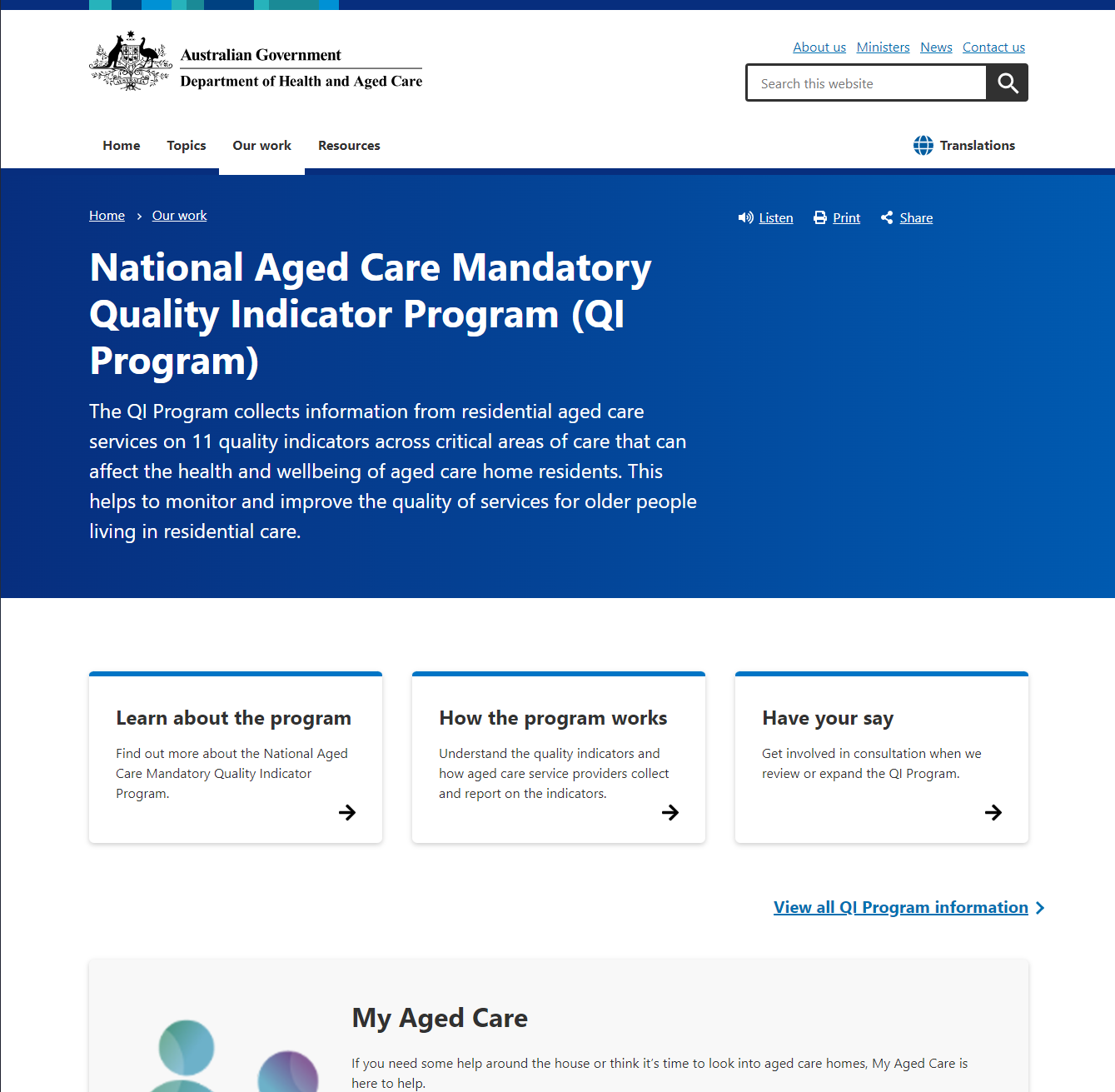
National Aged Care Mandatory Quality Indicator Program (QI Program)
This resource provides information on the National Aged Care Mandatory Quality Indicator Program (QI Program). The program gathers data on 11 quality indicators from residential aged care services to enhance care standards and outcomes for residents. It includes resources, quick guides, consultation papers, and surveys for improving quality indicators in both residential and in-home aged care services.
This resource may refer to information that will be updated from 1 November 2025 to align with the new Aged Care Act and Quality Standards.
Food, nutrition and dining stand-up discussion notes
This resource provides discussion notes to improve the food, nutrition, and dining experience in aged care settings. It includes reflective questions for corporate teams and care staff, focusing on governance, resident choice, oral health, and support for those with swallowing difficulties. The resource promotes continuous improvement and quality care through group discussions. This resource may refer to information that will be updated from 1 November 2025 to align with the new Aged Care Act and Quality Standards.
 Stand-up discussion notes (DOCX 6.68 MB)

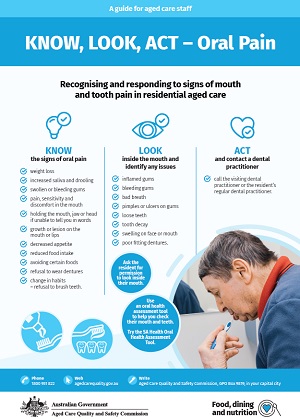
KNOW, LOOK, ACT - Oral Pain aged care staff poster
This poster serves as a resource for aged care staff to recognise and respond to signs of oral pain in residents. It provides guidance on identifying mouth and tooth pain and taking appropriate action to address these issues. The poster is available for download and use in residential aged care settings. This resource may refer to information that will be updated from 1 November 2025 to align with the new Aged Care Act and Quality Standards.
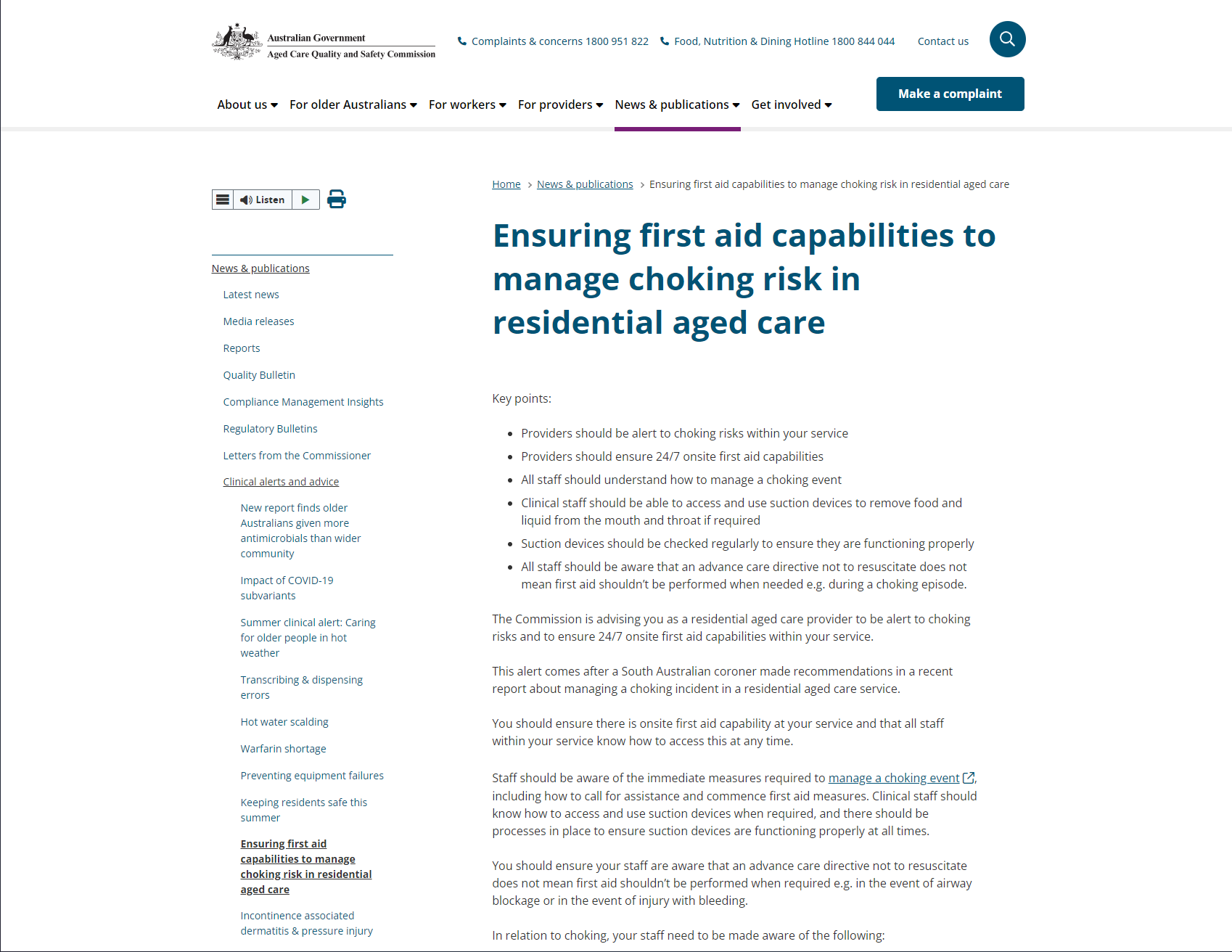
Ensuring first aid capabilities to manage choking risk in residential aged care
This page provides guidance for residential aged care services on managing choking risks. It advises 24/7 first aid capabilities, staff training on choking incidents, the use of suction devices, and understanding that advance care directives do not prevent the administering of first aid. The alert also recommends collaborating with speech pathologists, documenting discussions, and managing choking events through incident review and support.
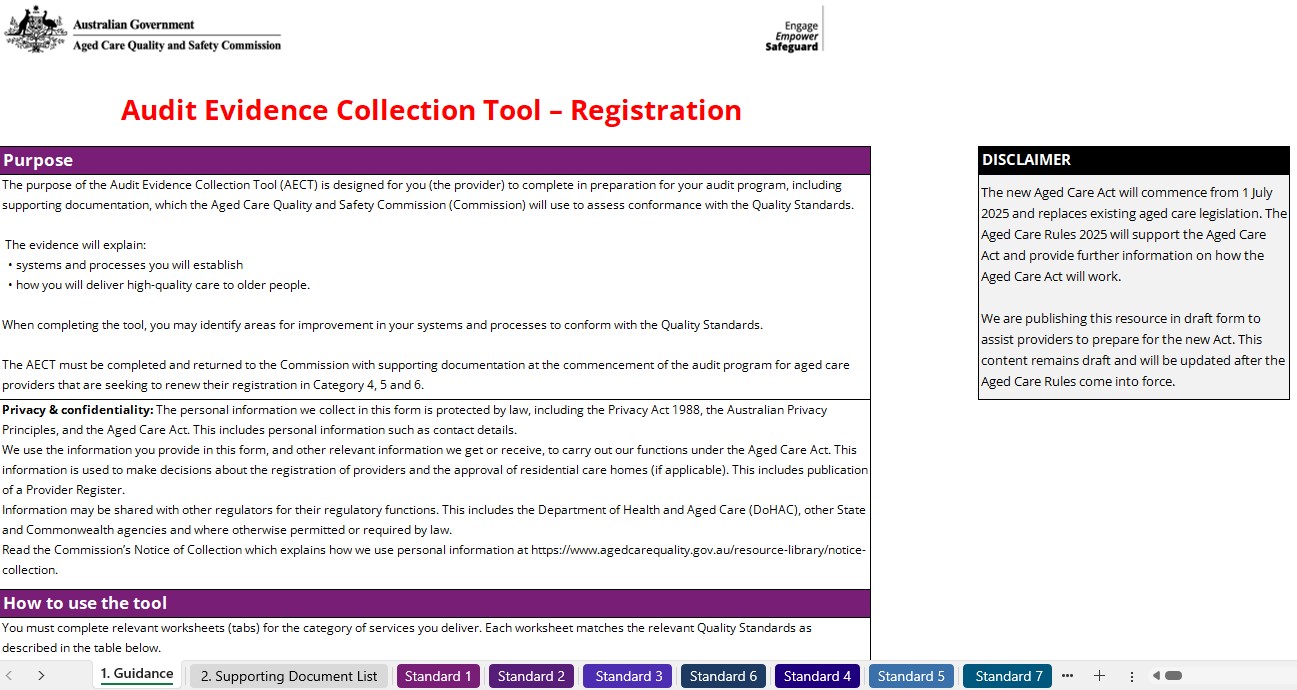
Audit Evidence Collection Tool (AECT) – Registration
Organisations or persons must complete the Audit Evidence Collection Tool (AECT) – Registration as part of the initial registration audit. This is compulsory for organisations or persons applying for registration in categories 4, 5 and 6 from 1 November 2025.
The registration audit helps us to understand if the organisation or person can conform with the related strengthened Aged Care Quality Standards.
We use this tool to collect evidence about:
 Audit Evidence Collection Tool (AECT) – Registration (XLSX 457.4 KB)
Audit Evidence Collection Tool (AECT) – Renewal
Providers must complete the Audit Evidence Collection Tool (AECT) – Renewal as part of a renewal audit in registration categories 4, 5 and 6. This is compulsory for providers from 1 November 2025.
Providers only need to complete this tool once as part of the audit program.
The renewal audit helps us to understand if the provider can conform with the related strengthened Aged Care Quality Standards.
We use this tool to collect evidence about:
- your systems and processes
- how you deliver high-quality care to older people.
Audit Evidence Collection Tool (AECT) – Renewal (XLSX 418.69 KB)
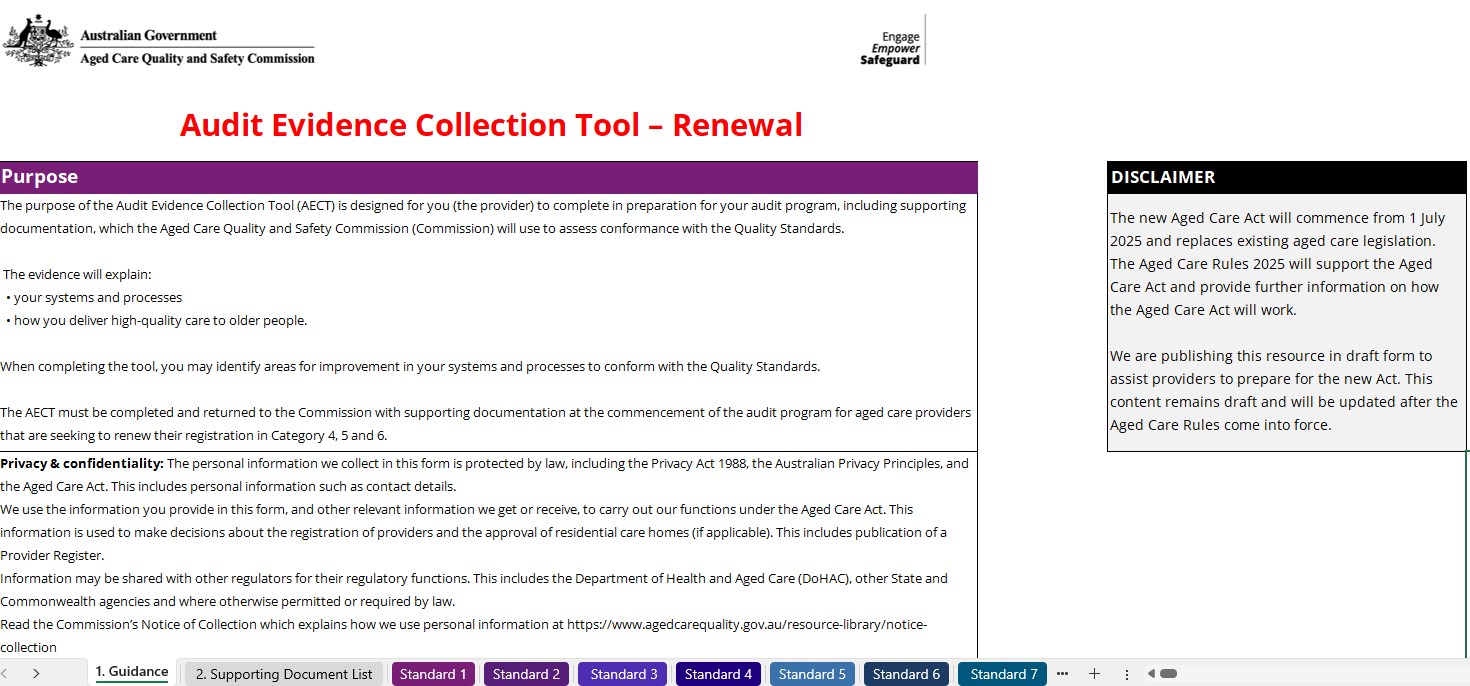
Audit Evidence Collection Tool (AECT) – Variation
Providers must complete the Audit Evidence Collection Tool (AECT) – Variation as part of a variation audit, where they are asking to add categories 4, 5 or 6 to their registration. This is compulsory for providers from 1 November 2025.
The variation audit helps us to understand if the provider can conform with the related strengthened Aged Care Quality Standards.
We use this tool to collect evidence about:
- the systems and processes you will establish
- how you will deliver high-quality care to older people.
Audit Evidence Collection Tool (AECT) – Variation (XLSX 453.08 KB)
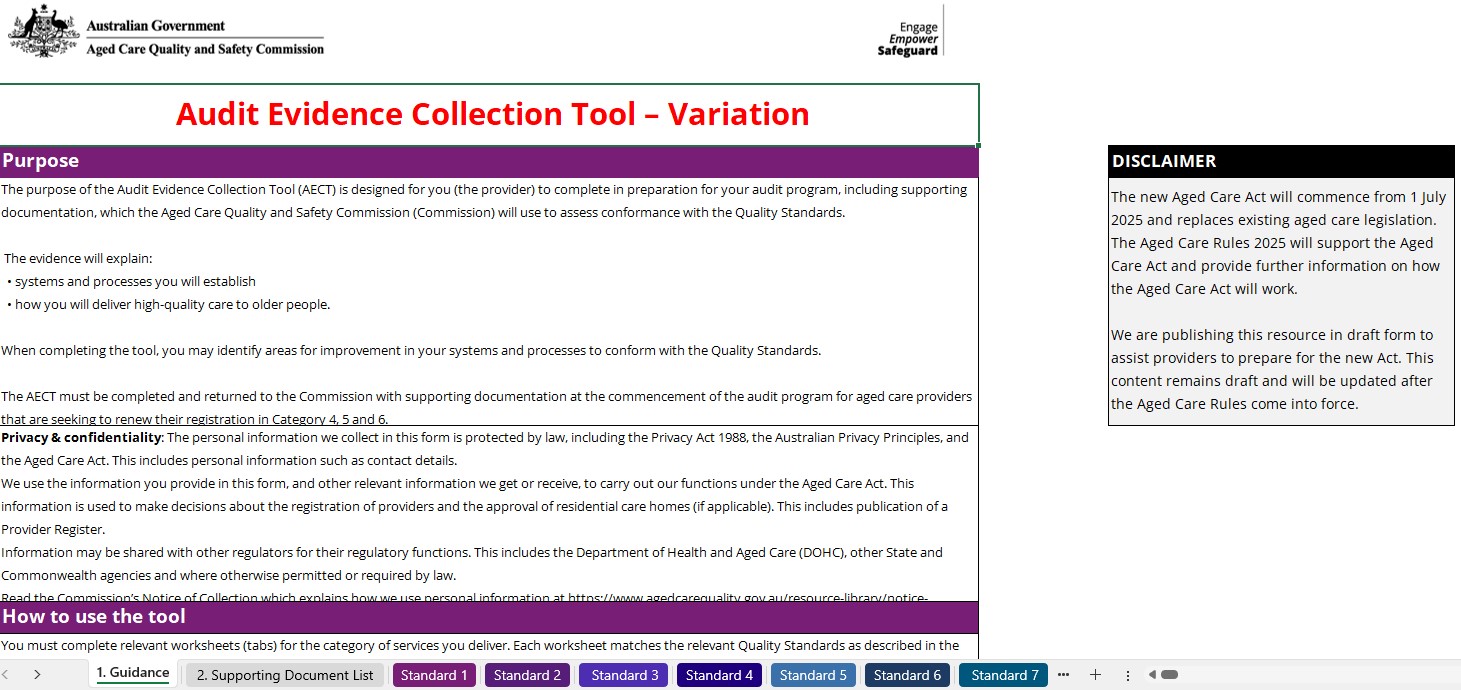
Care Delivery Evidence Collection Tool (CDECT) – Care delivery location (Category 4 & 5)
Providers must complete this tool as part of a renewal audit in registration categories 4 and 5.
We will identify a targeted sample of care delivery locations (Category 4 & 5). You will be notified of this sample and the CDECT – Care delivery location must only be completed for these targeted sample locations.
We use this tool to collect evidence about care and services delivered in a home or community setting.
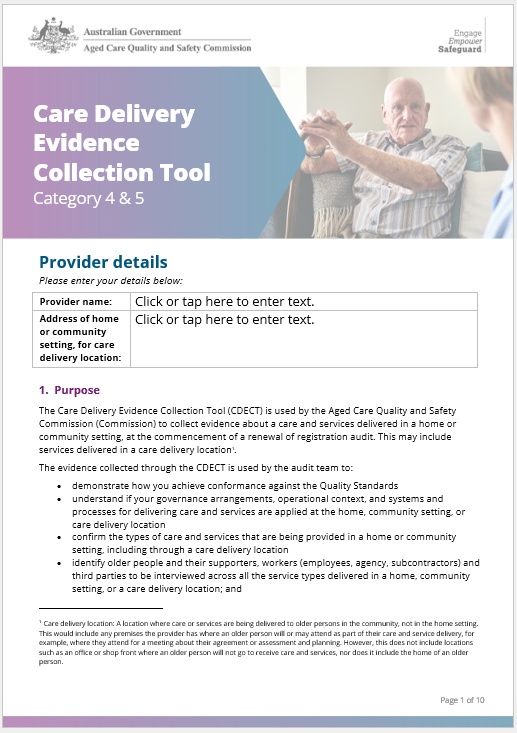
Care Delivery Evidence Collection Tool (CDECT) – Residential (Category 6)
Providers must complete this tool as part of a renewal audit in registration category 6.
The CDECT – Residential must be completed once for each category 6 service.
We use this tool to collect evidence about the residential care home.
Renewal of registration audit guide
This guide helps you prepare for and take part in a renewal of registration audit.
It describes:
- the purpose of audits and how they inform (help us make) registration decisions
- the 3 stages of the audit process (initiation, delivery, reporting)
- what to expect and what to do at each stage
- the types of evidence we consider during audits
- how we define our audit ratings
- the audit tools we use
- other relevant resources.
 Renewal of registration audit guide (PDF 471.25 KB)
Variation of registration audit
This guide helps you prepare for and take part in a variation of registration audit.
It describes:
- the purpose of audits and how they inform (help us make) registration decisions
- the 3 stages of the audit process (initiation, delivery, reporting)
- what to expect and what to do at each stage
- the types of evidence we consider during audits
- how we define our audit ratings
- the audit tools we use
- other relevant resources.
Variation of registration audit (PDF 434.03 KB)

Food, nutrition and dining: a reflection on practice
This training PowerPoint is a presentation that trainers/managers can download, customise and use to promote discussion and educate their staff to support and improve the food, nutrition and dining experience of consumers in their care.
The resource is designed to support reflective discussions about what ‘best practice’ looks like and a reflection on how it applies in practice. This resource may refer to information that will be updated from 1 November 2025 to align with the new Aged Care Act and Quality Standards.

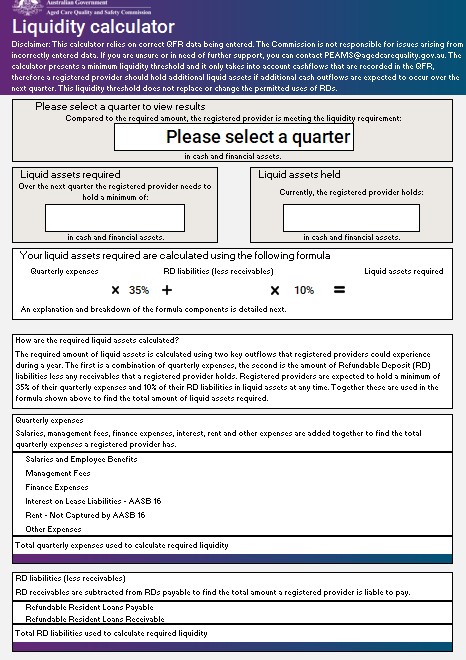
Liquidity calculator for registered providers in the aged care sector
This calculator informs registered providers of the minimum level of liquid assets they are required to hold calculated based on Quarterly Financial Report (QFR) financial statements.
Liquidity calculator instructions (PDF 1 MB)
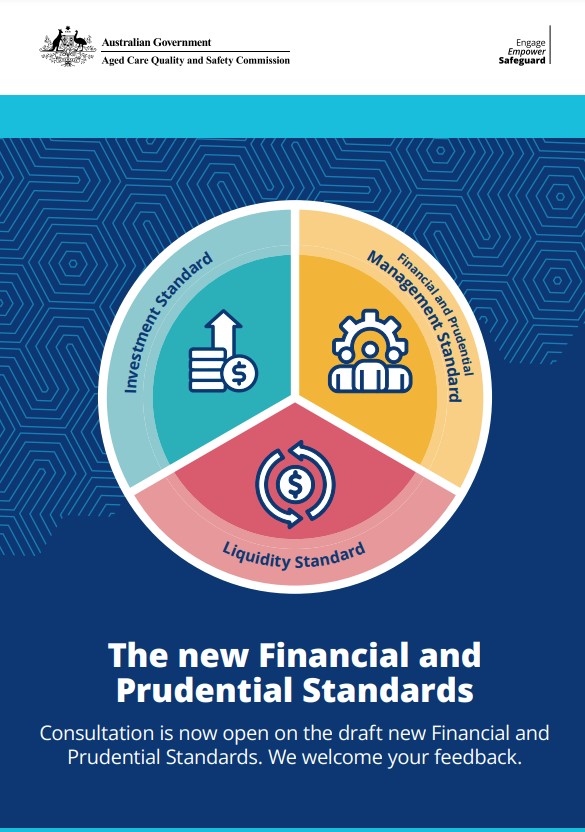
The new Financial and Prudential Standards
The new Financial and Prudential Standards will be introduced with the commencement of the new Aged Care Act. The new Standards set out the minimum requirements for good financial and prudential management of registered aged care providers. Registered providers must comply with the Financial and Prudential Standards that apply to them as a condition of their registration.
The new Financial and Prudential Standards (PDF 1.59 MB)