The Quality Standards Resource Centre helps extend understanding of the strengthened Aged Care Quality Standards, which took effect from 1 November 2025. You can search for resources by using keywords, or filtering by standard, outcome and audience. Before using the Resource Centre, please read the terms of use.
Cultural Safety for Health Professionals
This portal provides links to Aboriginal and Torres Strait Islander health and cultural safety publications, policies, resources and programs. It also providers workforce support information and content relevant to specific health professional roles. The information supports health professionals to deliver culturally safe and responsive care.
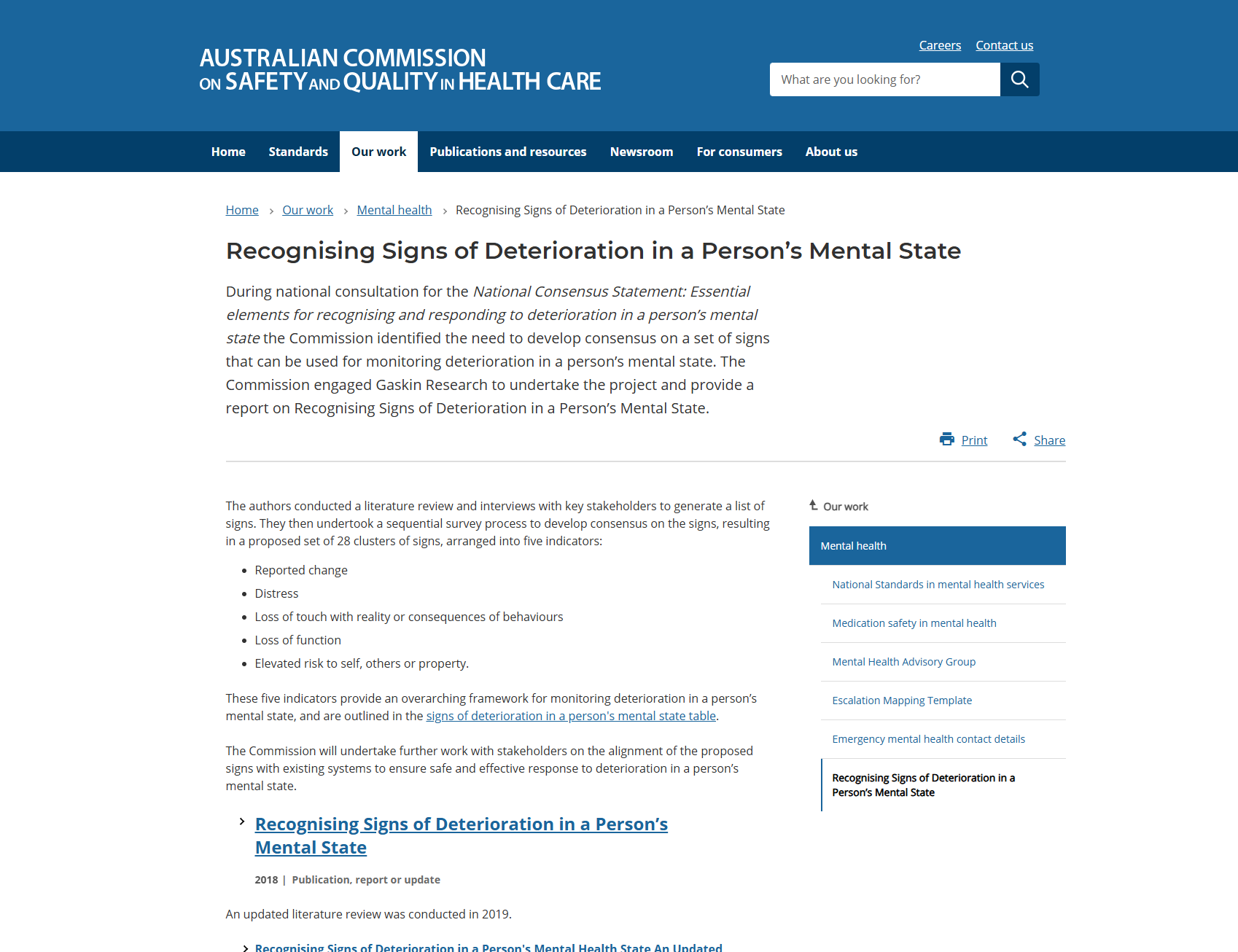
Recognising Signs of Deterioration in a Person’s Mental State
This resource provides a framework for recognising signs of mental state deterioration, organised into 5 key indicators: reported change, distress, loss of reality, loss of function, and elevated risk. It supports healthcare providers in monitoring mental health changes to enable timely and effective responses across care settings. This resource may apply to healthcare contexts outside of aged care. Please consider the applicability of this resource to your care setting.
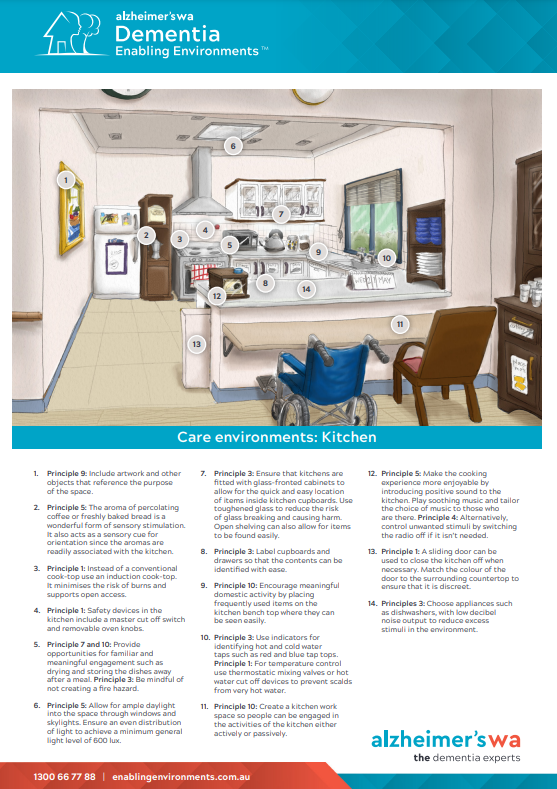
Dementia enabling environments - Care environments: Kitchen
This resource, developed by Alzheimer's WA, is a Dementia Enabling Environments illustration information sheet about kitchens in care environments. It includes principles to create enabling spaces and information about how to design the physical environment to maximise enablement and wellbeing for people living with dementia.
This resource was developed by a state/territory government or organisation and therefore its applicability and usefulness may be limited.
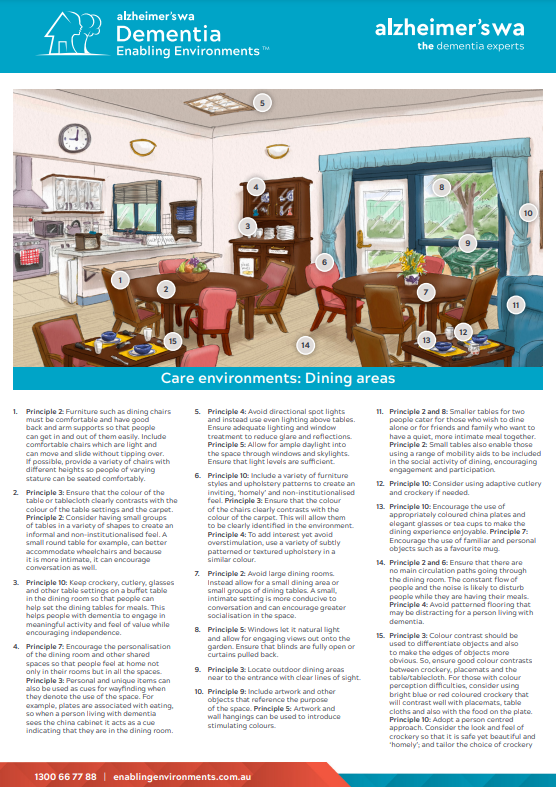
Dementia enabling environments - Care environments: Dining areas
This resource, developed by Alzheimer's WA, is a Dementia Enabling Environments illustration information sheet about dining areas in care environments. It includes principles to create enabling spaces and information about how to design the physical environment to maximise enablement and wellbeing for people living with dementia.
This resource was developed by a state/territory government or organisation and therefore its applicability and usefulness may be limited.
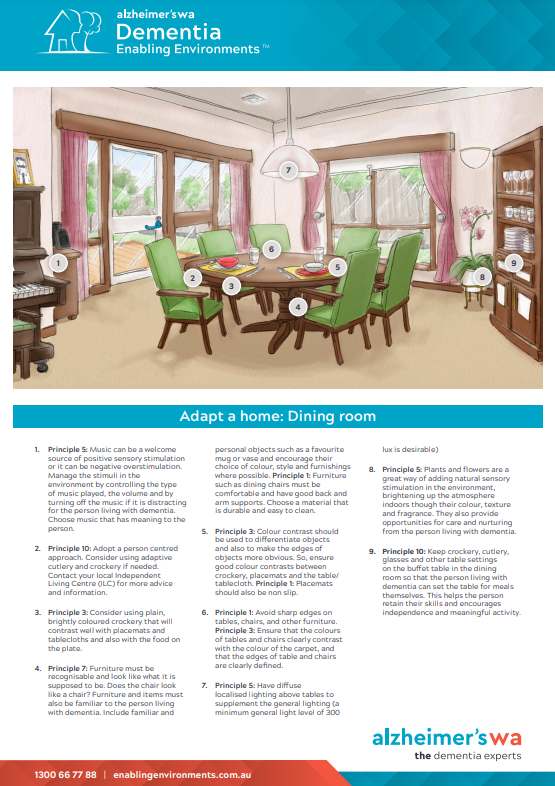
Dementia enabling environments - Adapt a home: Dining room
This resource, developed by Alzheimer's WA, is a Dementia Enabling Environments illustration information sheet about adapting a home, focusing on the dining room. It includes principles to integrate enabling design and make changes within the physical environment to maximise enablement and wellbeing for people living with dementia.
This resource was developed by a state/territory government or organisation and therefore its applicability and usefulness may be limited.
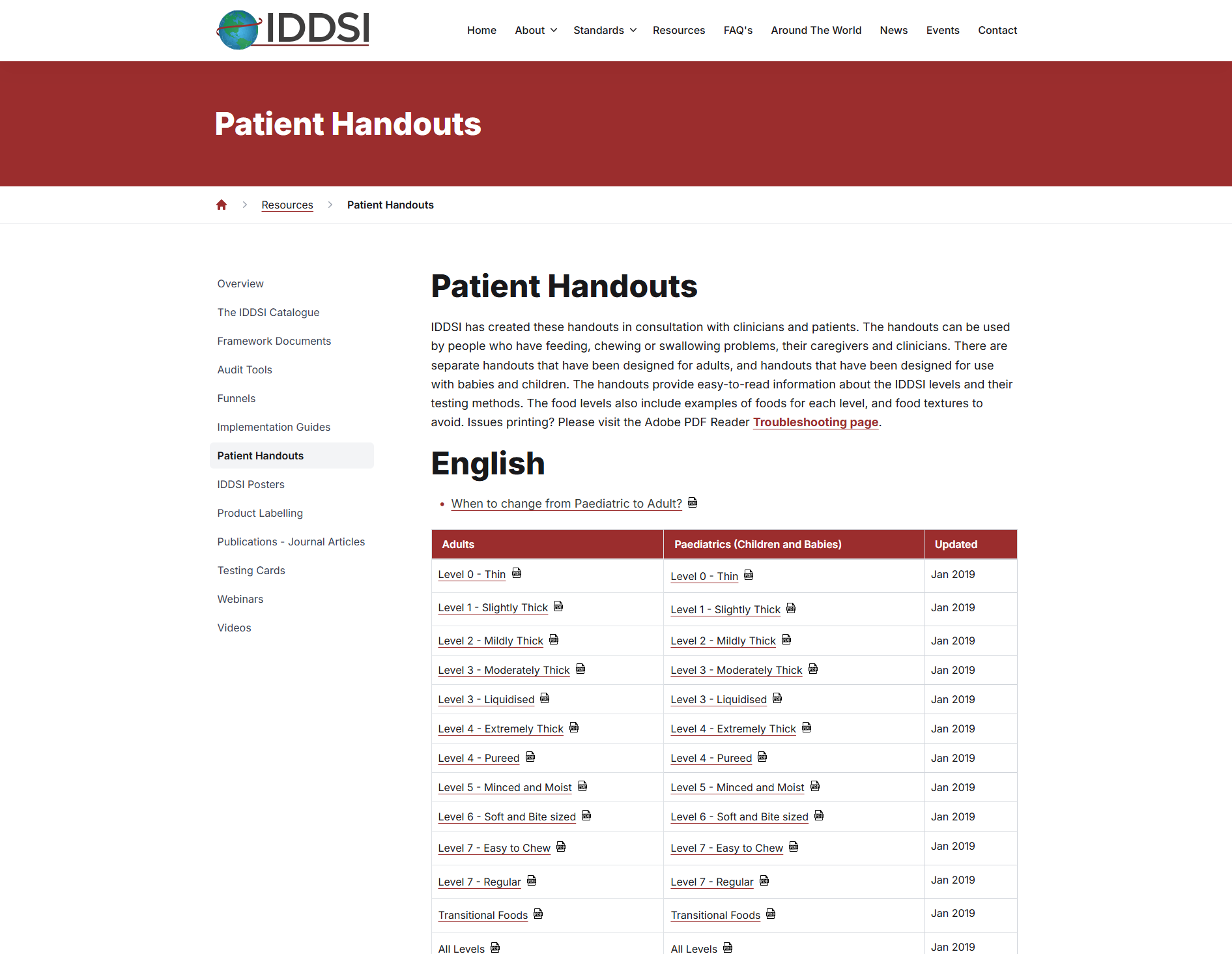
International Dysphagia Diet Initiative - Patient Handouts
This resource provides handouts tailored for people with feeding, chewing, or swallowing difficulties and their carers. It explains the IDDSI framework, describing food texture levels and appropriate testing methods. Separate versions are available for adults and children, each detailing recommended food textures to support safe swallowing practices.
This resource was developed internationally and therefore its applicability and usefulness may be limited.
Participating with consumers
This resource provides information sheets for residents, families, and carers to support decision-making in residential aged care. Covering topics such as pain management, falls, and medicines, it promotes health literacy, enabling consumers to engage in discussions and report care issues effectively.
This resource was developed by a state/territory government or organisation and therefore its applicability and usefulness may be limited.
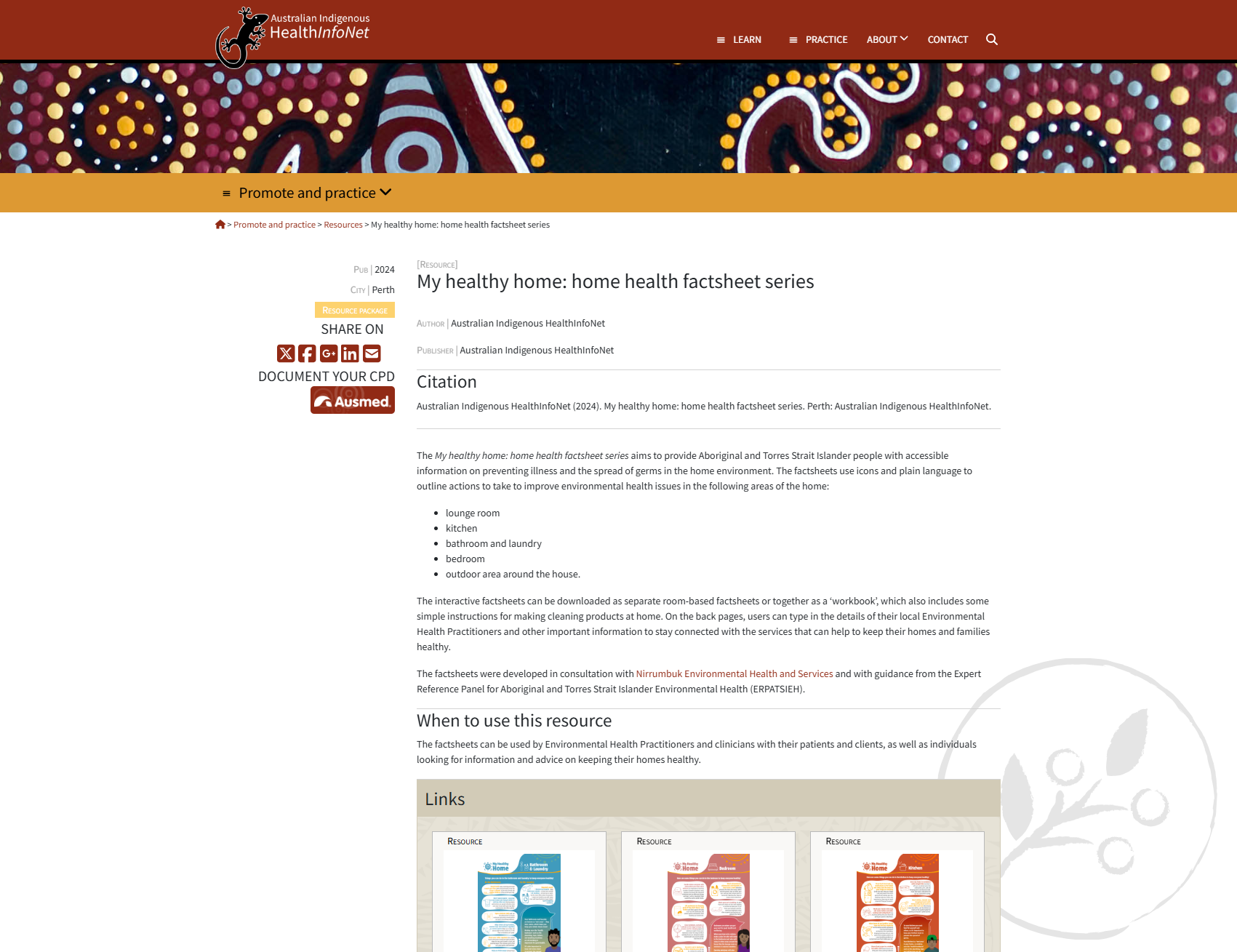
My healthy home: home health factsheet series
This resource offers accessible health information for Aboriginal and Torres Strait Islander people on preventing illness in the home. It includes room-based fact sheets with actions to improve environmental health, available as individual sheets or a workbook. This resource includes state-specific information and therefore its applicability and usefulness may be limited.
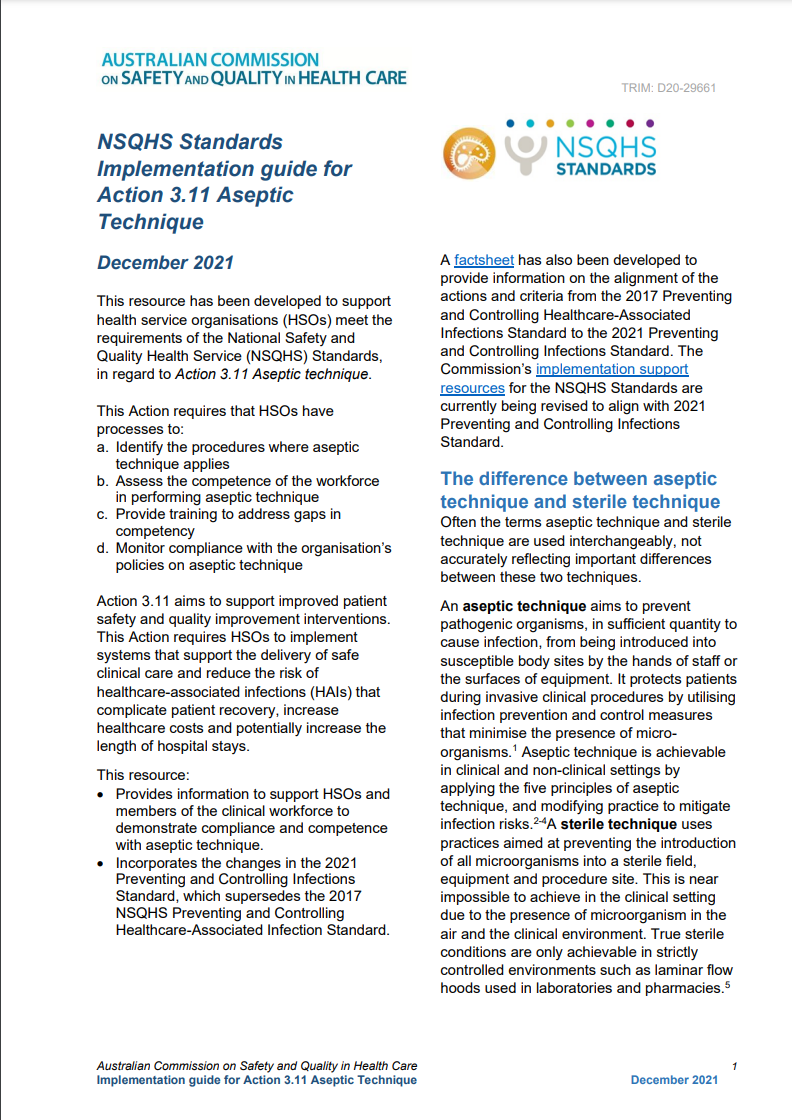
NSQHS Standards Implementation guide for Action 3.11 Aseptic Technique
This resource is an implementation guide designed to help health service organisations meet the requirements of Action 3.11 on aseptic technique under the NSQHS Standards. It outlines how to identify procedures requiring aseptic technique, assess workforce competence, provide relevant training, and monitor compliance. It aims to reduce healthcare-associated infections, ensuring safer care delivery, particularly relevant to aged care providers.This resource may apply to healthcare contexts outside of aged care.
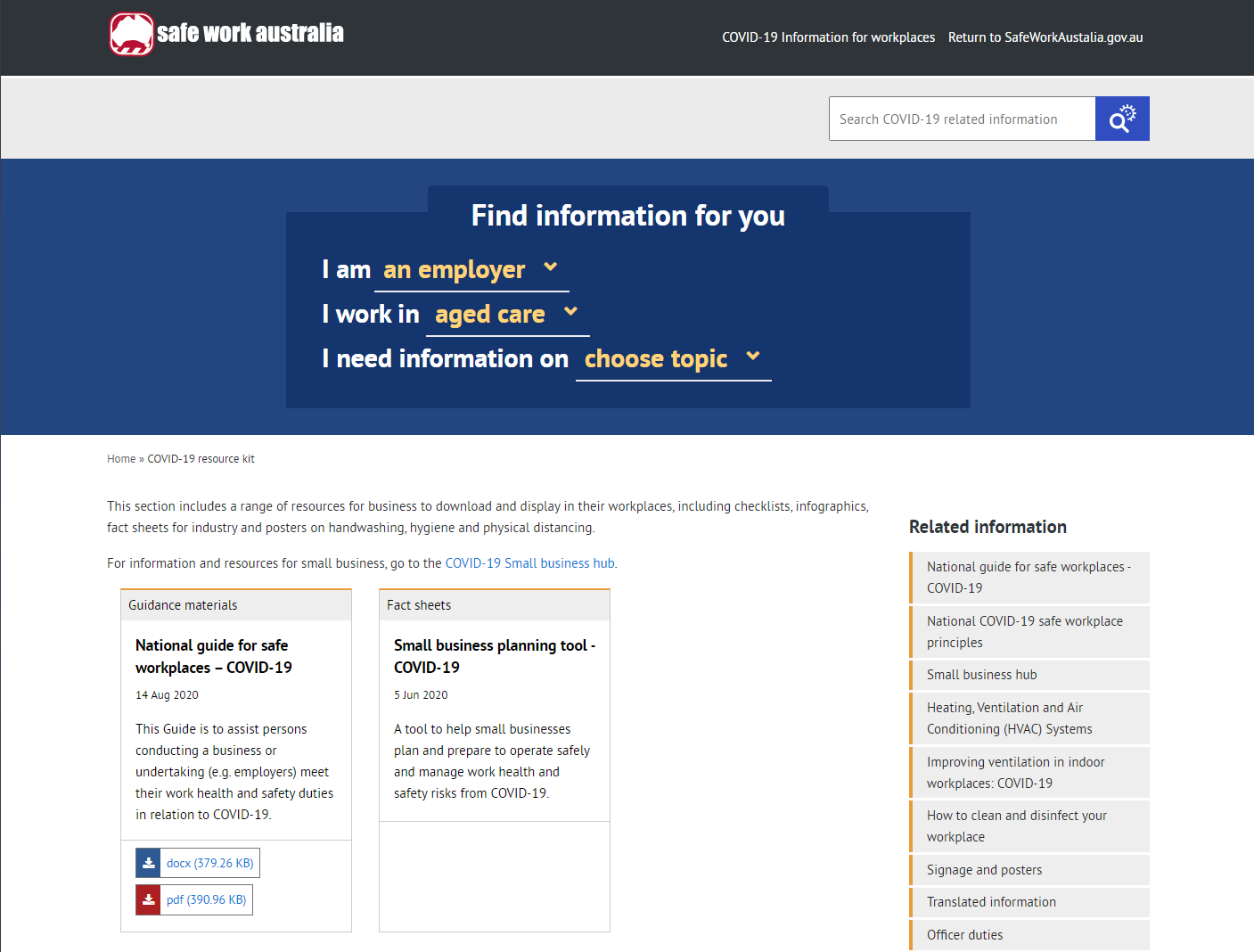
COVID-19 resource kit
This resource kit provides downloadable tools for businesses, including aged care, to manage COVID-19 risks. It includes checklists, posters, and infographics covering hygiene, physical distancing, cleaning, and response actions if a worker contracts COVID-19. These materials help workplaces implement safe practices and reduce the spread of the virus.
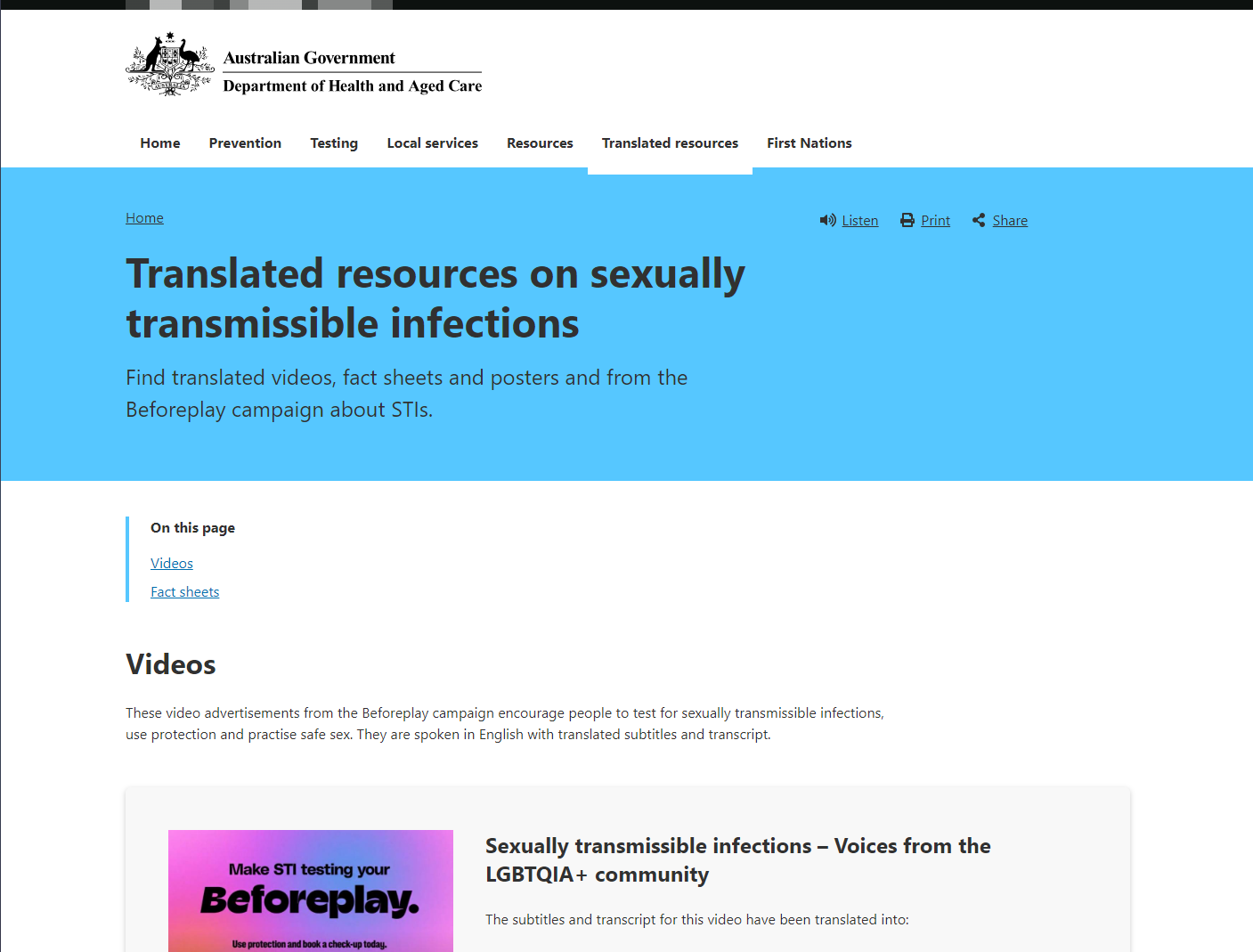
Translated resources on sexually transmissible infections
This resource provides translated videos, fact sheets, and posters from the Beforeplay campaign to educate multicultural communities about sexually transmissible infections (STIs). It promotes STI testing, safe sex practices, and includes materials in multiple languages to improve accessibility and encourage conversations around sexual health.
Resources on sexually transmissible infections
This resource offers materials from the Beforeplay campaign to raise awareness about sexually transmissible infections (STIs). It provides videos, fact sheets, and posters aimed at educating people on STI prevention, testing, and protection, with tailored resources for various groups including young people, couples, and healthcare professionals.
Ageing and Communication
This resource discusses age-related communication changes, covering sensory, speech, language, and cognitive adjustments. It offers strategies for improving communication, such as using hearing aids, choosing quiet settings, and involving speech pathologists, helping older people and their families maintain effective and enjoyable communication.
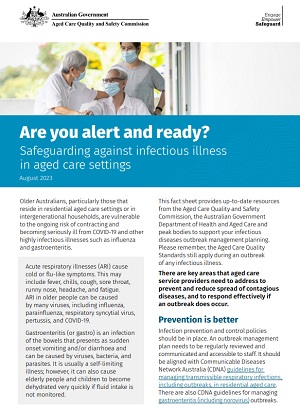
Are you alert and ready? Safeguarding against infectious illness in aged care settings
Older Australians, particularly those that reside in residential aged care settings or in multigenerational households, are vulnerable to the ongoing risk of contracting and becoming seriously ill from COVID-19 and other highly infectious illnesses such as influenza and gastroenteritis.
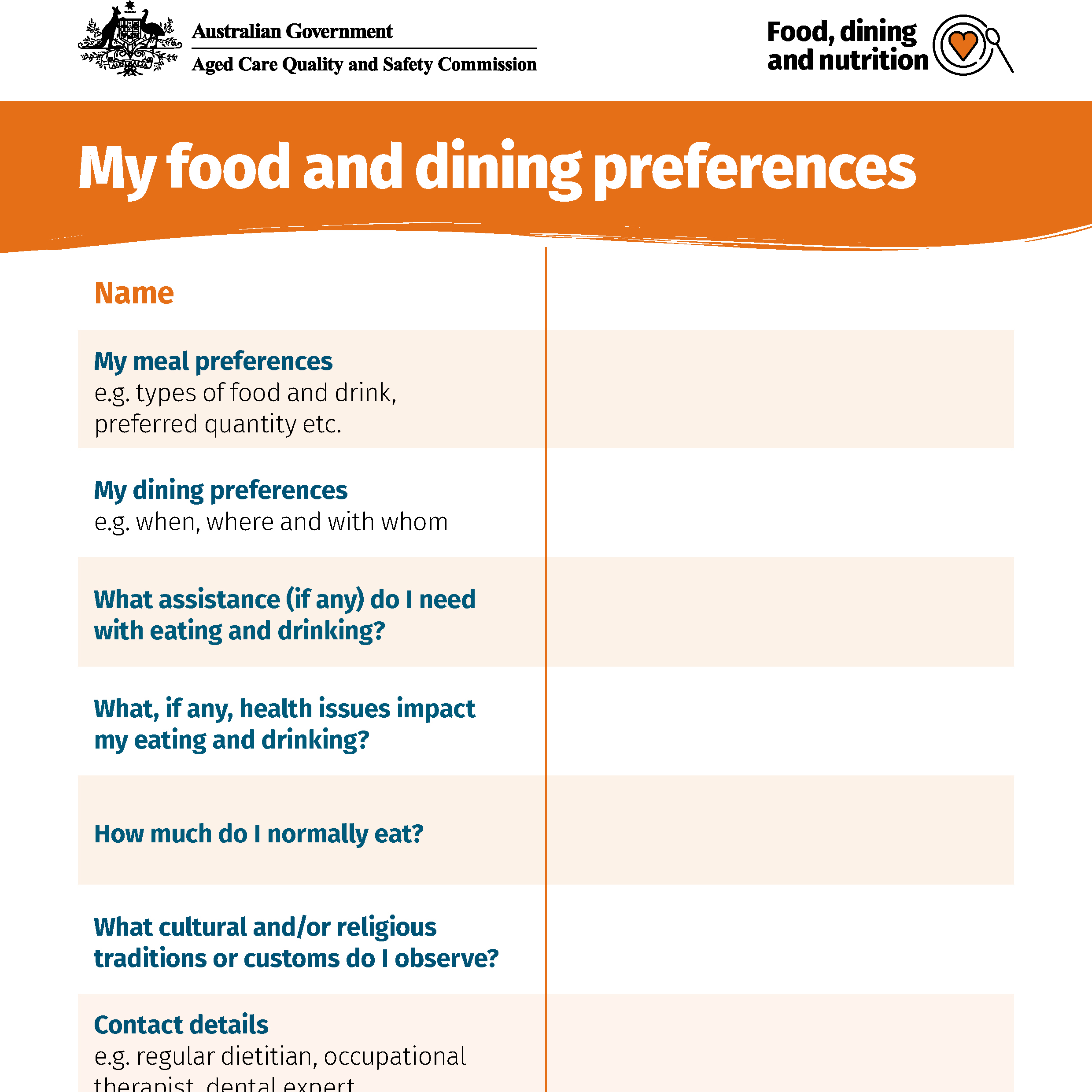
My food and dining preferences - form
This fact sheet helps aged care residents communicate their food and dining preferences. It includes sections for meal choices, dining preferences, assistance needs, health considerations, cultural or religious customs, and contact information for allied health professionals. It also advises staff to monitor changes in weight and contact a dietitian if needed.
This resource may refer to information that will be updated from 1 November 2025 to align with the new Aged Care Act and Quality Standards.
 My food and dining preferences form (PDF 378.98 KB)
Arabic - تفضيلاتي في الطعام وعادات الأكل (PDF 426.01 KB)
French - Mes préférences alimentaires et de repas (PDF 365.82 KB)
German - Meine Essens- und Speisevorlieben (PDF 358.86 KB)
Greek - Οι προτιμήσεις μου για το φαγητό και τα γεύματα (PDF 359.43 KB)
Hungarian - Étel- és étkezési preferenciák (PDF 369.35 KB)
Macedonian - Моите желби во врска со храната и јадењето (PDF 358.79 KB)
Maltese - Il-preferenzi tiegħi tal-ikel u l-ikliet (PDF 364.67 KB)
Portuguese - Minhas preferências alimentares e gastronômicas (PDF 373.26 KB)
Russian - Мои предпочтения в еде и приеме пищи (PDF 353.14 KB)
Serbian - Моје жеље које се тичу хране и обедовања (PDF 353.84 KB)
Simplified Chinese - 我的饮食及用餐偏好 (PDF 420.97 KB)
Traditional Chinese - 我的飲食及用餐偏好 (PDF 422.91 KB)
Spanish - Mis preferencias de alimentos y comidas (PDF 365.1 KB)
Vietnamese - Sở thích ăn uống và thực phẩm của tôi (PDF 340.54 KB)
My food and dining preferences form (PDF 378.98 KB)
Arabic - تفضيلاتي في الطعام وعادات الأكل (PDF 426.01 KB)
French - Mes préférences alimentaires et de repas (PDF 365.82 KB)
German - Meine Essens- und Speisevorlieben (PDF 358.86 KB)
Greek - Οι προτιμήσεις μου για το φαγητό και τα γεύματα (PDF 359.43 KB)
Hungarian - Étel- és étkezési preferenciák (PDF 369.35 KB)
Macedonian - Моите желби во врска со храната и јадењето (PDF 358.79 KB)
Maltese - Il-preferenzi tiegħi tal-ikel u l-ikliet (PDF 364.67 KB)
Portuguese - Minhas preferências alimentares e gastronômicas (PDF 373.26 KB)
Russian - Мои предпочтения в еде и приеме пищи (PDF 353.14 KB)
Serbian - Моје жеље које се тичу хране и обедовања (PDF 353.84 KB)
Simplified Chinese - 我的饮食及用餐偏好 (PDF 420.97 KB)
Traditional Chinese - 我的飲食及用餐偏好 (PDF 422.91 KB)
Spanish - Mis preferencias de alimentos y comidas (PDF 365.1 KB)
Vietnamese - Sở thích ăn uống và thực phẩm của tôi (PDF 340.54 KB)
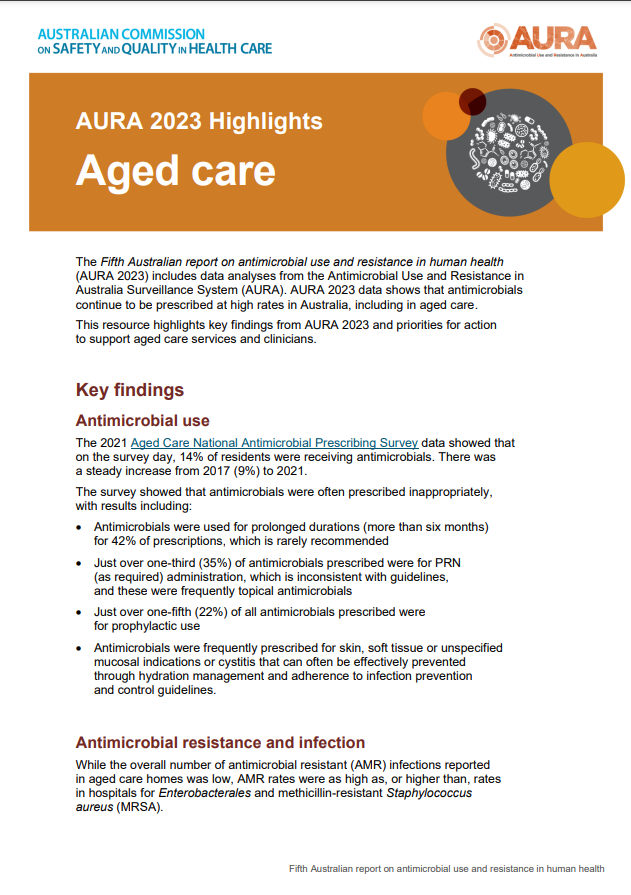
AURA 2023 Highlights for Aged care
This resource summarises key findings from the AURA 2023 report, focusing on antimicrobial use and resistance in aged care. It provides priorities for action to reduce inappropriate prescriptions, promote antimicrobial stewardship, and improve infection prevention and control in aged care settings, aligning with quality standards to enhance care for older people.
This resource may refer to information that will be updated from 1 November 2025 to align with the new Aged Care Act and Quality Standards.
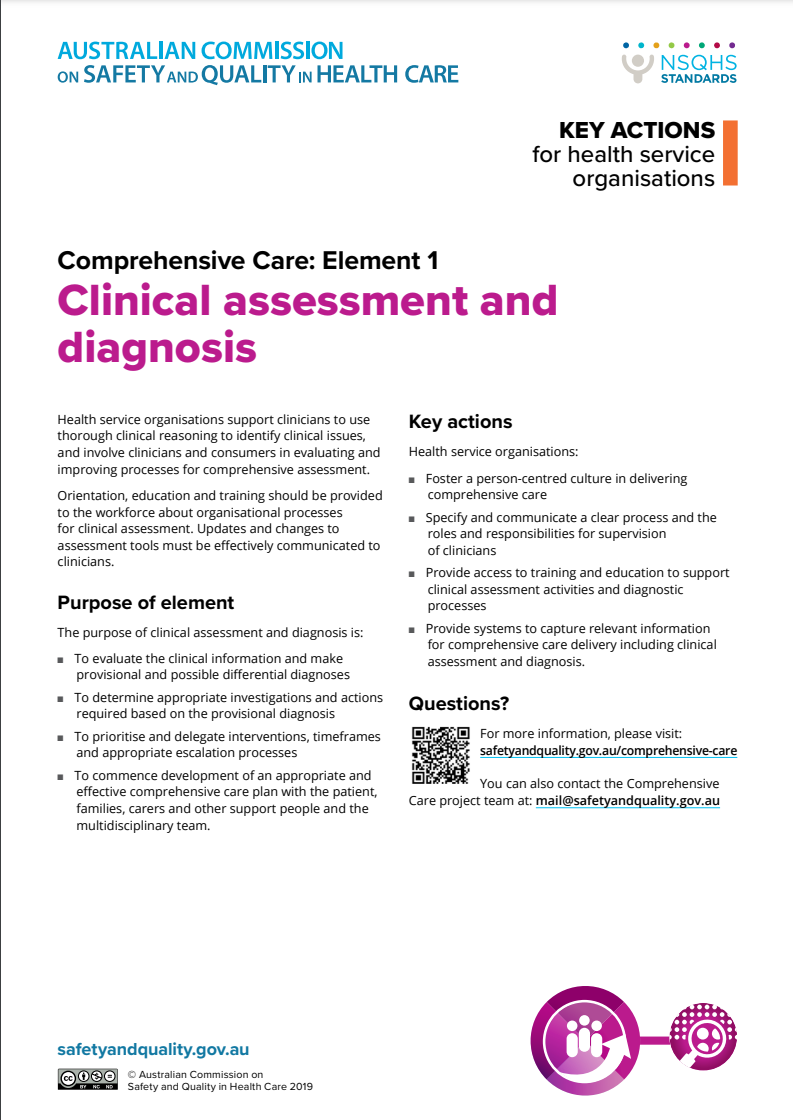
Comprehensive Care - Clinical assessment and diagnosis - Key actions for health service organisations
This resource provides actions for health service organisations to support clinical assessment and diagnosis, promoting a person-centred approach and comprehensive care planning. It highlights training, clear communication of roles, and systems for documenting diagnoses and care plans.
This resource may apply to healthcare contexts outside of aged care. Please consider the applicability of this resource to your care setting. This resource may refer to information that will be updated from 1 November 2025 to align with the new Aged Care Act and Quality Standards.
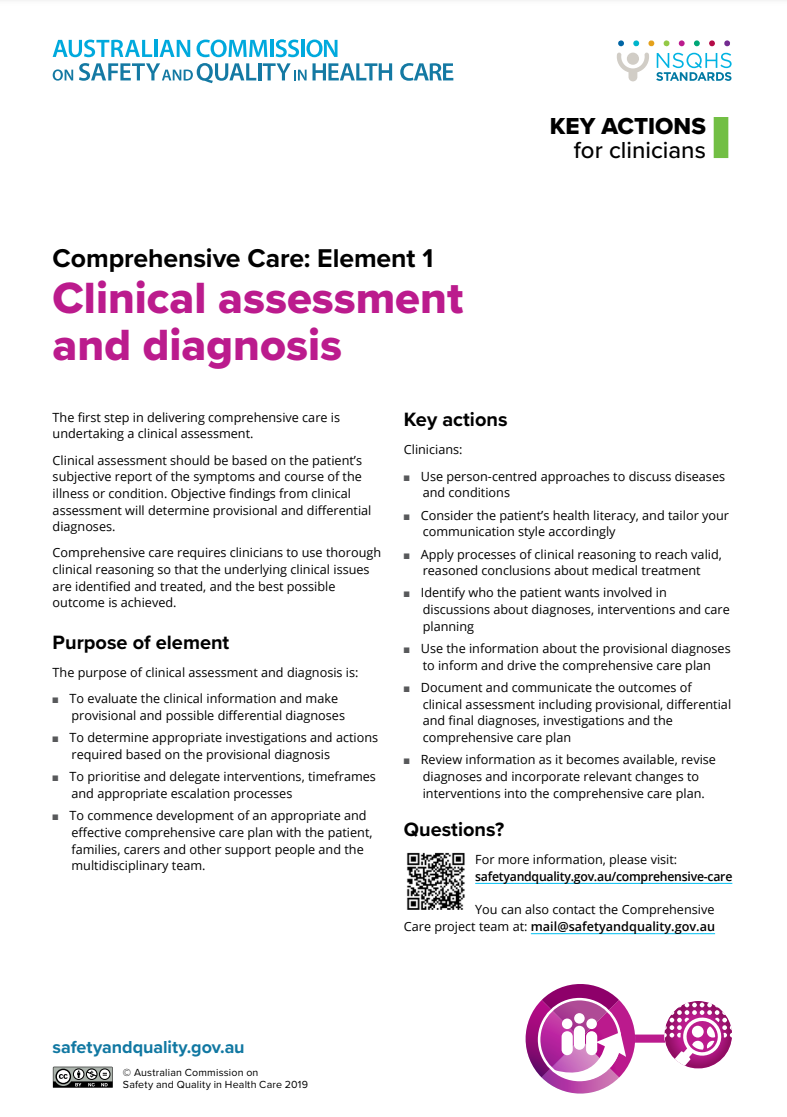
Comprehensive Care - Clinical assessment and diagnosis - Key actions for clinicians
This resource provides actions for health service organisations to support clinical assessment and diagnosis, promoting a person-centred approach and comprehensive care planning. It highlights training, clear communication of roles, and systems for documenting diagnoses and care plans.
This resource may apply to healthcare contexts outside of aged care. Please consider the applicability of this resource to your care setting. This resource may refer to information that will be updated from 1 November 2025 to align with the new Aged Care Act and Quality Standards.
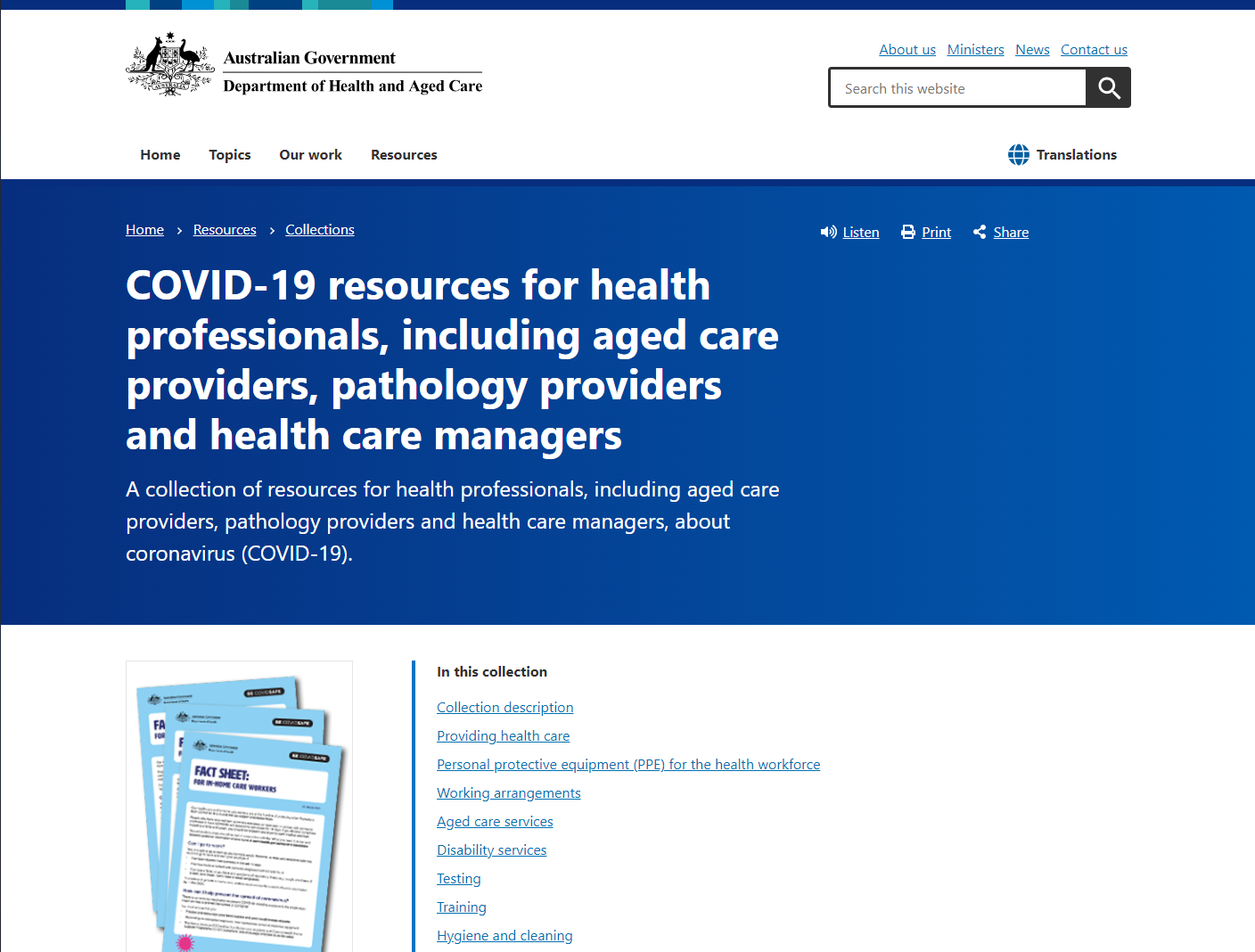
COVID-19 resources for health professionals, including aged care providers, pathology providers and health care managers
This resource offers COVID-19 guidance for health professionals and aged care providers. It includes information on managing outbreaks, infection control, PPE use, and telehealth services. These resources support safe and effective care delivery while ensuring compliance with guidelines during the pandemic in aged care settings.
This resource may refer to information that will be updated from 1 November 2025 to align with the new Aged Care Act and Quality Standards.
Dining in residential aged care - tips and tricks fact sheet
This fact sheet provides practical tips for enhancing dining experiences in residential aged care settings. It offers guidance on food presentation, meal assistance, creating a respectful and enjoyable atmosphere, supporting independence, and providing culturally appropriate dining options. The aim is to improve mealtime satisfaction while maintaining older peoples' dignity and people's preferences.
This resource may refer to information that will be updated from 1 November 2025 to align with the new Aged Care Act and Quality Standards.
Dining in residential aged care – tips, tricks and what to avoid (PDF 484.37 KB)