Monitoring is a regulatory activity to collect information about provider or worker compliance with their obligations under the Aged Care Act. Monitoring helps us understand if risks and harms to older people are being managed.
We use a range of monitoring tools, including education, engagement, regulation and enforcement.
 Monitoring Policy (PDF 826.89 KB)
This education pack is designed for providers in both home and residential care settings to deliver to their own staff. It can be delivered in full or delivered as a series of shorter sessions where you can focus on the sections that are most relevant to your organisation and training needs.

Our Managing Worker Risk Policy explains our approach in detecting, assessing and responding to risks arising from the actions, inactions and behaviours of workers.
This policy includes information about:
Managing worker risk policy (PDF 386.18 KB)
Our Compliance and Enforcement Policy applies from 1 November 2025.
The Policy explains the compliance and enforcement actions we can take to:
Compliance and Enforcement Policy (May 2026) (PDF 575.31 KB)
The Aged Care Act 2024 (the Act) provides people with rights and protections from retaliation when they share information and make disclosures that qualify for protection under the Aged Care Act, about registered providers, responsible persons and aged care workers.
Our Managing Whistleblower Disclosures Policy explains how we receive, manage and use information shared with us that qualifies for whistleblower protections under the Act.
Managing Whistleblower Disclosures Policy (PDF 366.91 KB)
The fact sheet is a quick reference guide that explains what you need to do to meet the Financial and Prudential Management Standard. It includes the key requirements, who they apply to and a checklist.
The Effective incident management education pack is designed for providers to deliver to their own staff. It can be delivered in full or delivered as a series of shorter sessions where you can focus on the sections that are most relevant to your setting or the time you have available.
This pack will support your staff to understand the role they play in effectively managing incidents at your aged care service and help them understand what an incident management system is and its key elements.
This document is an example of the content covered in a standard senior management meeting.
The senior management meeting is held with the audit team and 2 to 5 representatives of the applicant's or provider's senior management. The meeting is to gather evidence and understand how senior management lead and contribute to the overall assessment of governance arrangements, systems, and processes, to deliver safe and quality care within the organisation. We hold the meeting online and we have one senior management meeting for each audit program.
Standard senior management meeting agenda (PDF 218.73 KB)
In this video, Peter Edwards, Executive Director, Compliance and Enforcement Group, answers your questions about how we will manage non-compliance from 1 November 2025.

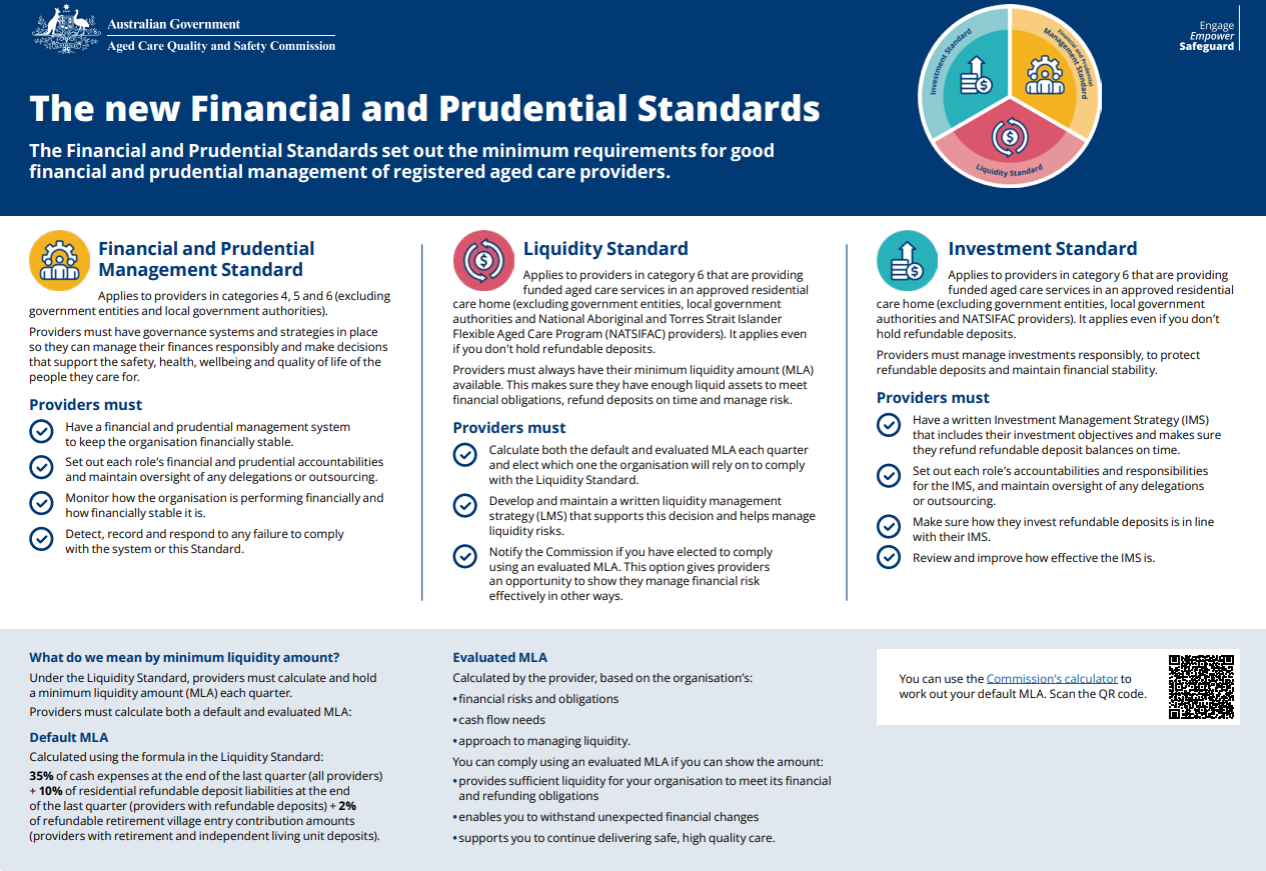
The new Financial and Prudential Standards will be introduced with the commencement of the new Aged Care Act. The new Standards set out the minimum requirements for good financial and prudential management of registered aged care providers. Registered providers must comply with the Financial and Prudential Standards that apply to them as a condition of their registration.
The new Financial and Prudential Standards (PDF 1.59 MB)
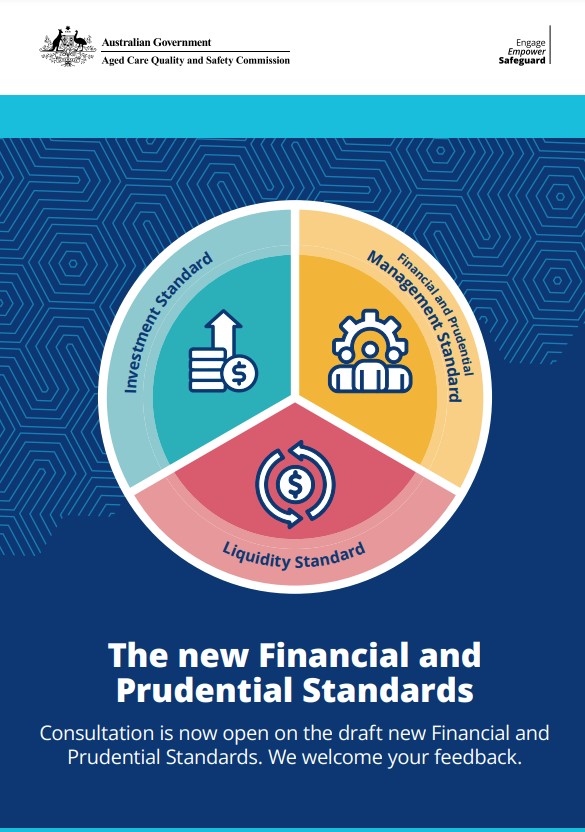
The new Financial and Prudential Standards will be introduced with the new Aged Care Act. The new Standards set out the minimum requirements for good financial and prudential management of registered aged care providers.
The new Financial and Prudential Standards - poster (PDF 265.47 KB)
Outbreak management planning is a key part of infection prevention and control. This document supports both the development of a new outbreak management plan (OMP) and the quality assurance of existing plans. It details common OMP sections to get you started as you tailor your OMP to your service.
This resource may refer to information that will be updated from 1 November 2025 to align with the new Aged Care Act and Quality Standards.
Outbreak Management Plan - Key features (PDF 839.81 KB)
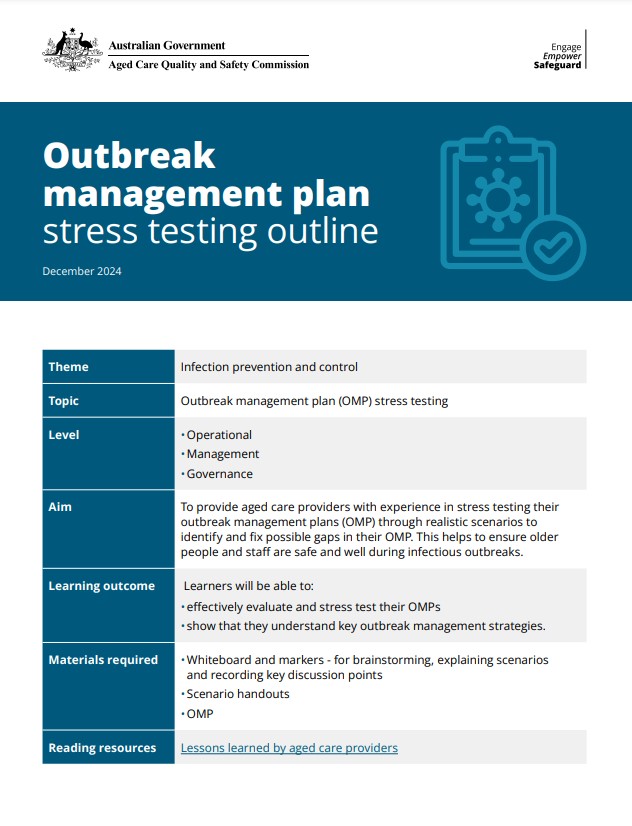
Having a comprehensive and organisation-specific outbreak management plan (OMP) helps your organisation to be prepared for the management of infections and outbreaks within your service. A key part of this readiness is ensuring that your OMP is fit-for-purpose and that everyone across the organisation can implement it if required. One way to maintain readiness and support continuous improvement of your OMP is to run regular drills, or stress tests, of your plan.
Outbreak Management Plan - stress testing outline (PDF 424.34 KB)
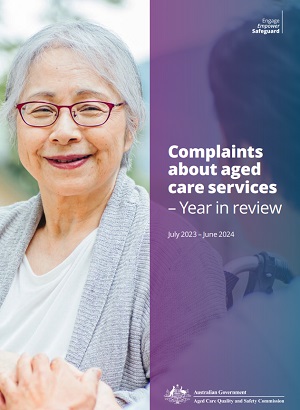
The Complaints about aged care services – Year in review (July 2023-June 2024) report explores the complaints we have received about aged care providers in 2023-24.
In this report, we draw attention to clear patterns and trends in the complaints made about residential care and home services respectively.
The report also covers:
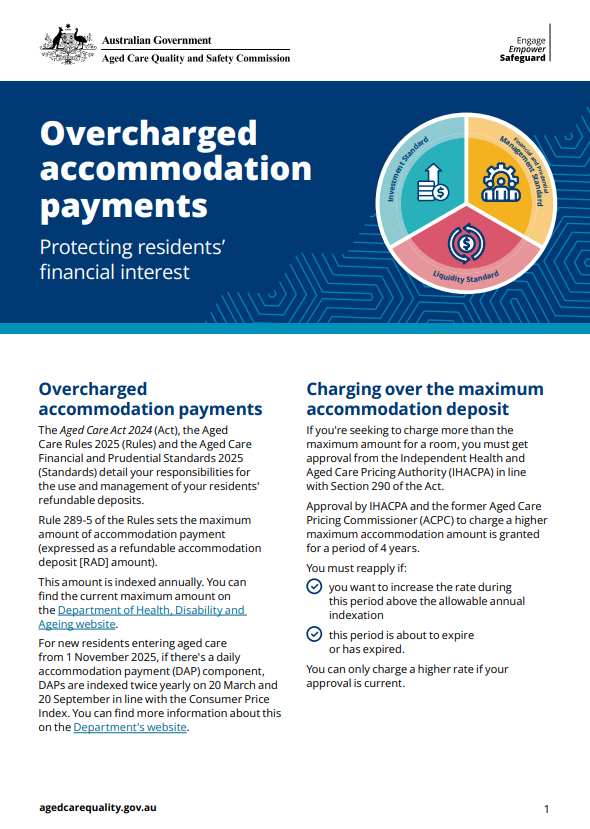
The Aged Care Act 2024, the Aged Care Rules 2025 and the Aged Care Financial and Prudential Standards 2025 detail your responsibilities for the use and management of your residents' refundable deposits. This fact sheet outlines what you need to do if you intend to charge above the maximum room price, including the approval and governance requirements, and what you need to do if you have overcharged any residents.
Overcharged accommodation payments (PDF 767.09 KB)
This training PowerPoint is a presentation that trainers/managers can download, customise and use to promote discussion and educate their staff to support and improve the food, nutrition and dining experience of consumers in their care.
The resource is designed to support reflective discussions about what ‘best practice’ looks like and a reflection on how it applies in practice. This resource may refer to information that will be updated from 1 November 2025 to align with the new Aged Care Act and Quality Standards.

A fact sheet for volunteer managers in aged care.
Joint letter from the Commission and the Department of Health and Aged Care to approved providers on medication management.
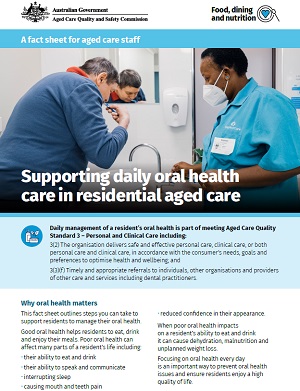
This fact sheet outlines steps you can take to support residents to manage their oral health.
Hand hygiene is about cleaning your hands. It is an important part of how you protect yourself from getting sick and it helps to keep you and the person you care for safe. Learn how to clean your hands with sanitiser through this short video.