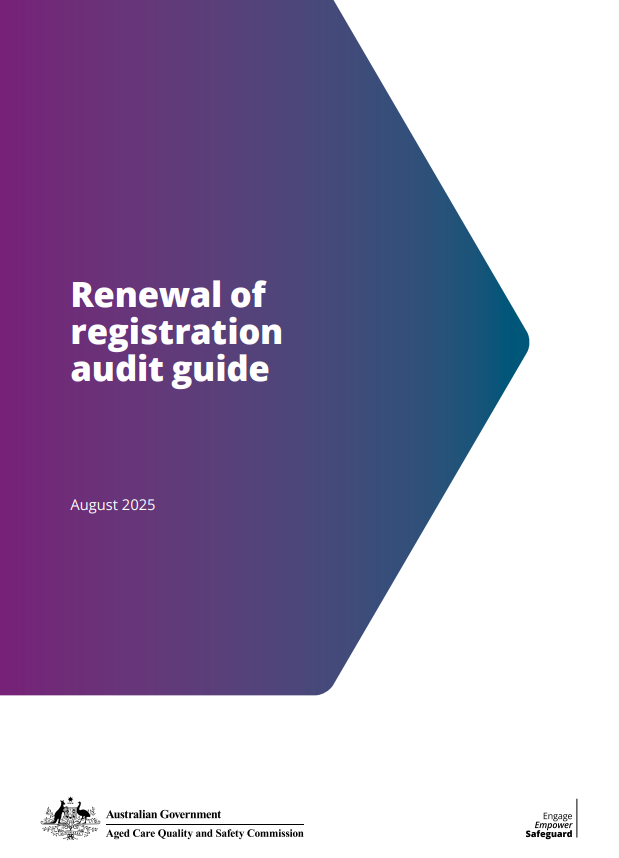
A welcome letter template that consumer advisory body members can use to communicate with new members.
 Consumer advisory body welcome letter template (DOCX 3.8 MB)
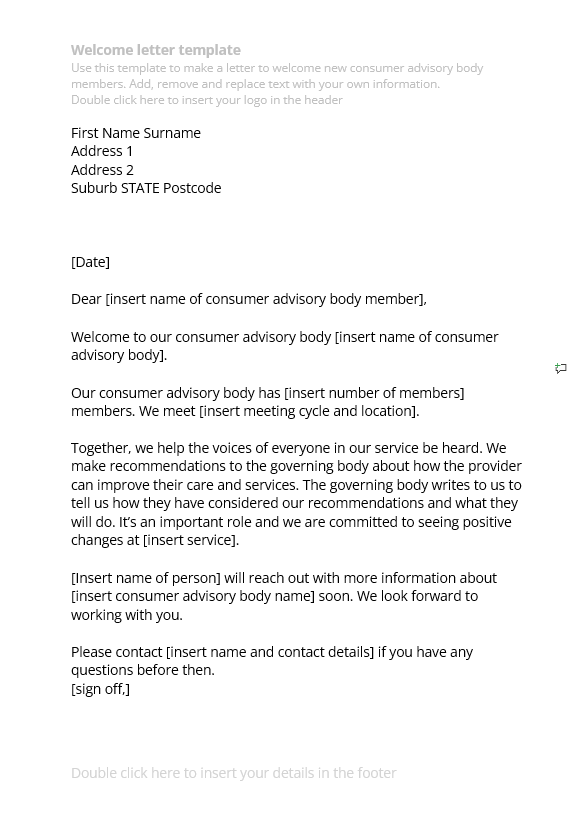
A template that consumer advisory body members can use to plan their meeting agendas.
Consumer advisory body meeting agenda template (DOCX 2.39 MB)
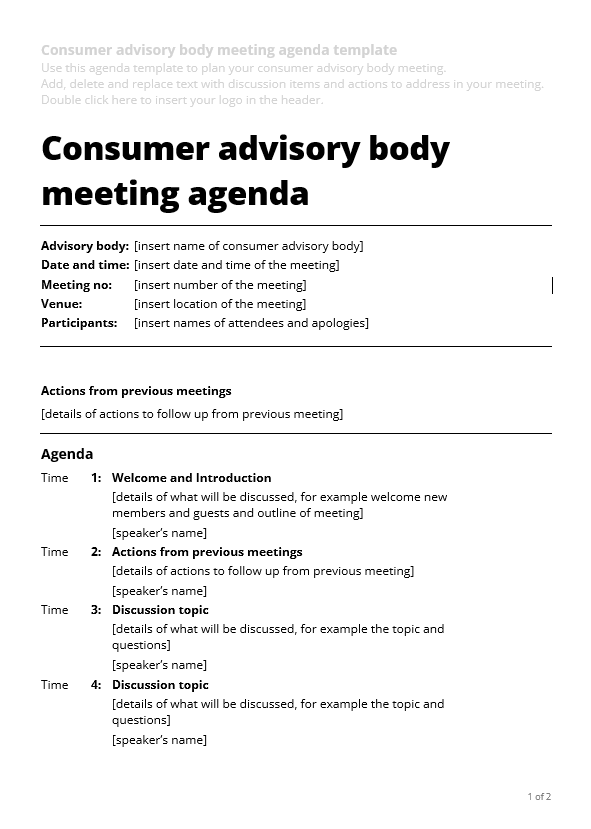
A template that consumer advisory body members can use in their meetings to take minutes.
Consumer advisory body minutes template (DOCX 2.4 MB)
This Cost Recovery Implementation Statement (CRIS) provides information on the charging arrangements (fees) for providers to register, renew registration, or vary registration, as well as any associated audits.
These fees and fee waivers will apply under the new Aged Care Act, commencing 1 November 2025.
 Cost Recovery Implementation Statement (PDF 552.51 KB)
The introduction of the new Aged Care Act means changes to the regulatory activities the Commission undertakes. Read this guide to learn more about why we charge fees, and the fees and fee waivers that will apply to providers from 1 November 2025.
Guide and scenarios - Fees for providers (PDF 499.16 KB)

This fact sheet provides a high-level overview of provider fees, why we charge them and who they apply to.
Fees for providers - Factsheet (PDF 289.33 KB)
The fact sheet is a quick reference guide that explains what you need to do to meet the Investment Standard. It includes the key requirements, who they apply to and a checklist.
Disclaimer: The new Aged Care Act 2024 (new Aged Care Act) will start from 1 November 2025. It replaces existing aged care legislation. The Aged Care Rules 2025 will support the new Aged Care Act. They’ll also provide more information on how the new Aged Care Act will work.
Investment Standard fact sheet for providers (PDF 554.32 KB)
The fact sheet is a quick reference guide that explains what you need to do to meet the Financial and Prudential Management Standard. It includes the key requirements, who they apply to and a checklist.
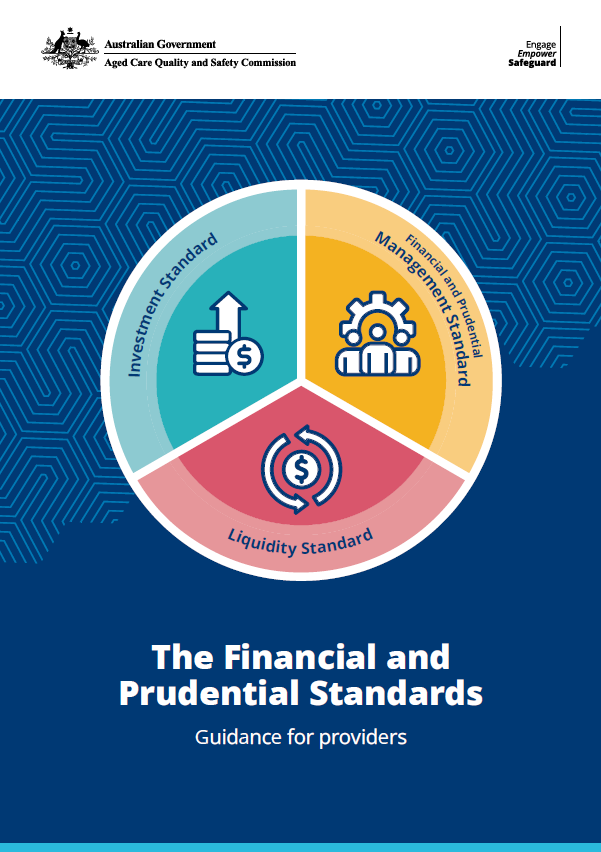
The Financial and Prudential Standards: Guidance for providers explains the new Financial and Prudential Standards, your obligations, and our regulatory approach. It also includes:
- an expanded Liquidity Standard section which sets out how providers must work out two minimum liquidity amounts (MLAs) each quarter
- clearer definitions of cash expenses, cash, and cash equivalents
- checklists for each Standard.
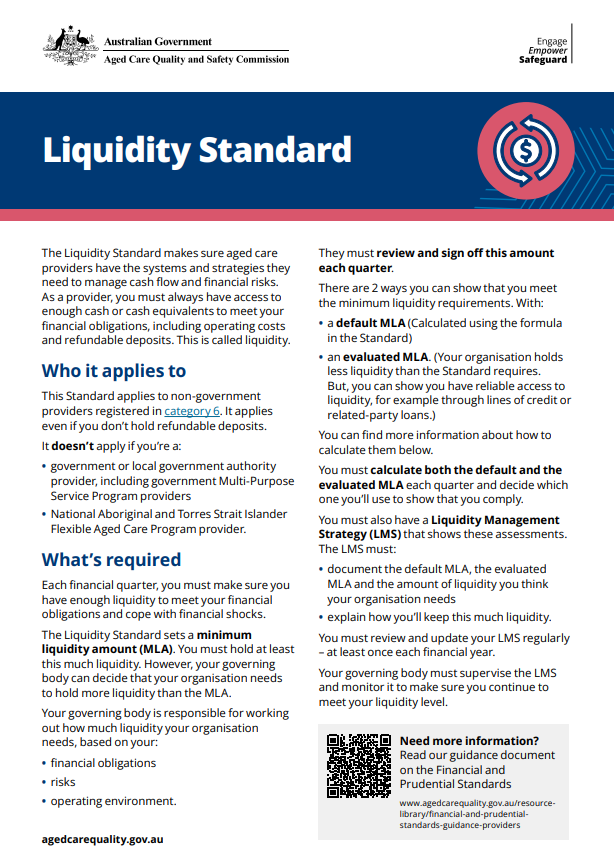
The fact sheet is a quick reference guide that explains what you need to do to meet the Liquidity Standard. It includes the key requirements, who they apply to and a checklist.
Liquidity Standard fact sheet for providers (PDF 998.05 KB)
New Financial and Prudential Standards - exposure draft. This is the final version of the draft legislation which outlines the requirements for providers.
A visual guide for conversations between providers/workers and older people about aged care. It includes notes for providers/workers to help guide the conversation.

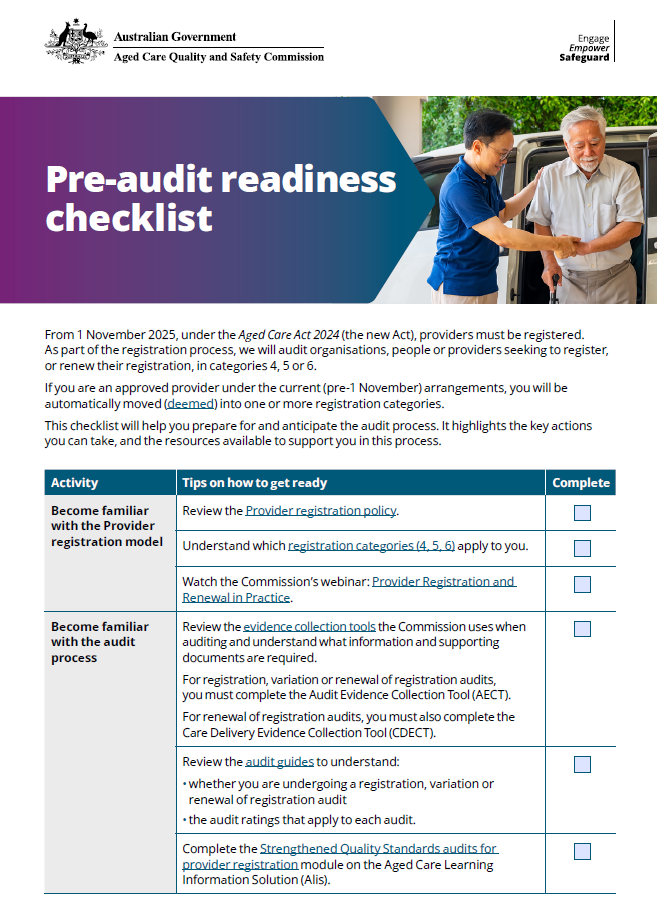
This checklist will help you prepare for and anticipate the audit process. It highlights the key actions you can take, and the resources available to support you in this process.
Pre-audit readiness checklist (PDF 272.12 KB)
The Effective incident management education pack is designed for providers to deliver to their own staff. It can be delivered in full or delivered as a series of shorter sessions where you can focus on the sections that are most relevant to your setting or the time you have available.
This pack will support your staff to understand the role they play in effectively managing incidents at your aged care service and help them understand what an incident management system is and its key elements.

Under the new Aged Care Act, commencing on 1 November 2025, our charging arrangements (the activities we charge fees for) will be different. This document outlines the current fees we charge and the fees we propose to charge under the new Aged Care Act.
Fee comparison tables (PDF 283.36 KB)
This fact sheet explains how you can ask for a review of our decision about your complaint or make a complaint about our service.
Asking for a review of a complaint decision (PDF 197.1 KB)
This toolkit has a range of printable resources, including a fact sheet, checklist, feedback form and meeting templates. The resources can help providers work with older people to improve their food and dining.
Food focus group toolkit (PDF 1.68 MB)

The Aged Care Quality Standards (Quality Standards) are being strengthened to improve aged care for older people. They will take effect with the new Aged Care Act from 1 November 2025. We’ve created a range of resources to support you and your staff to understand the strengthened Quality Standards and how to apply them in practice.
Strengthened Quality Standards resources overview (PDF 362.26 KB)
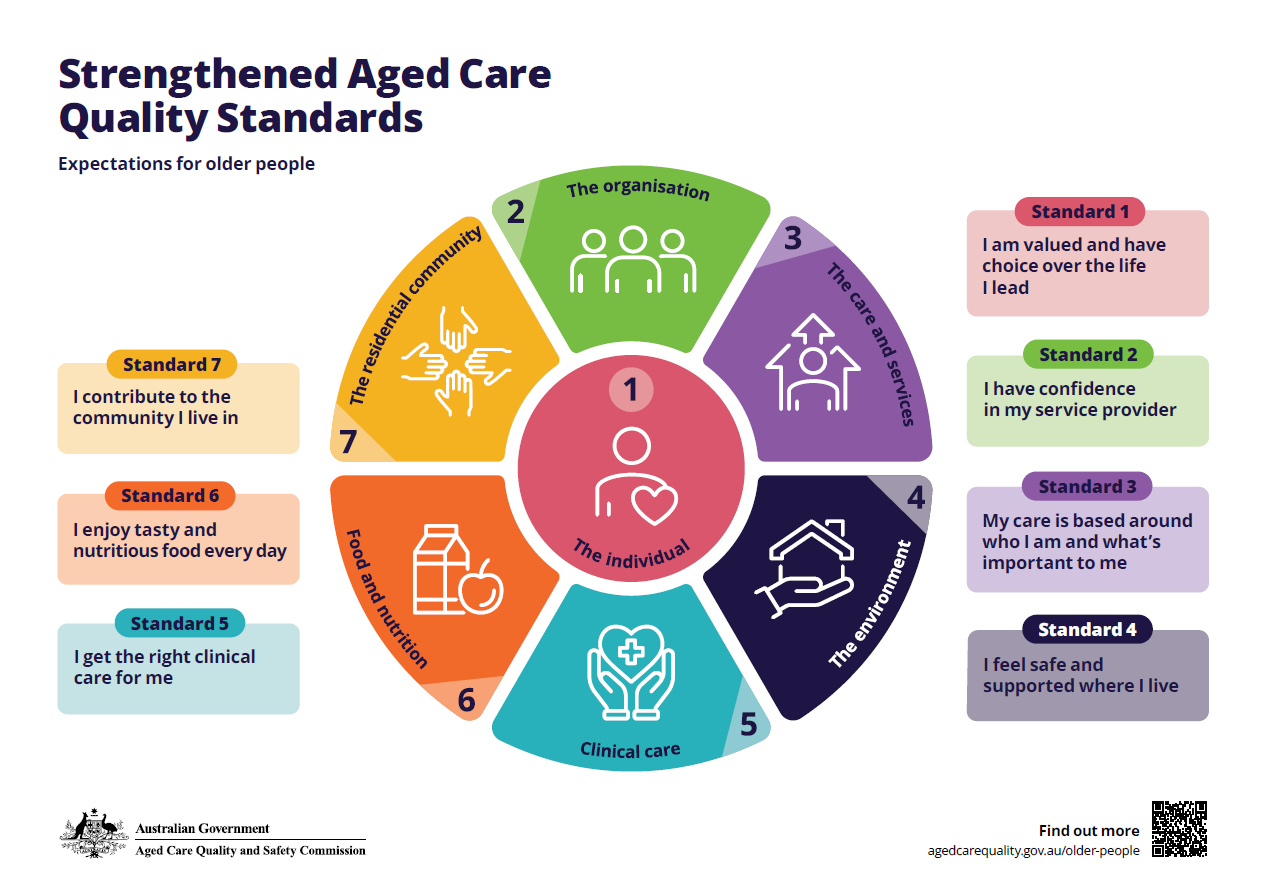
A printable double-sided A3 poster to help workers and older people understand the intent of the strengthened Aged Care Quality Standards.
This guide helps you prepare for and take part in a renewal of registration audit.
It describes:
- the purpose of audits and how they inform (help us make) registration decisions
- the 3 stages of the audit process (initiation, delivery, reporting)
- what to expect and what to do at each stage
- the types of evidence we consider during audits
- how we define our audit ratings
- the audit tools we use
- other relevant resources.
Renewal of registration audit guide (PDF 471.26 KB)