The Quality Standards Resource Centre helps extend understanding of the strengthened Aged Care Quality Standards, which took effect from 1 November 2025. You can search for resources by using keywords, or filtering by standard, outcome and audience. Before using the Resource Centre, please read the terms of use.
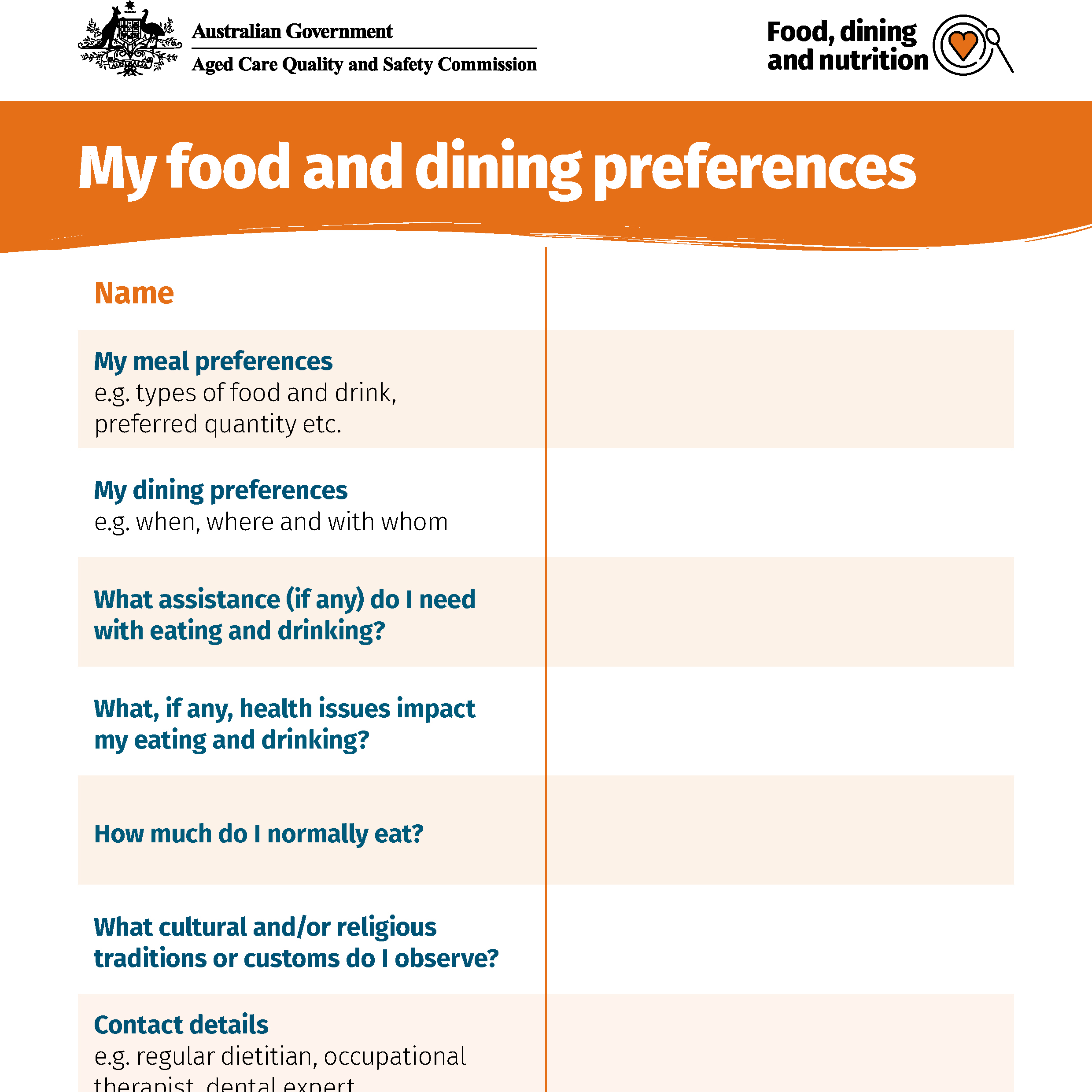
My food and dining preferences - form
This fact sheet helps aged care residents communicate their food and dining preferences. It includes sections for meal choices, dining preferences, assistance needs, health considerations, cultural or religious customs, and contact information for allied health professionals. It also advises staff to monitor changes in weight and contact a dietitian if needed.
This resource may refer to information that will be updated from 1 November 2025 to align with the new Aged Care Act and Quality Standards.
 My food and dining preferences form (PDF 378.98 KB)
Arabic - تفضيلاتي في الطعام وعادات الأكل (PDF 426.01 KB)
French - Mes préférences alimentaires et de repas (PDF 365.82 KB)
German - Meine Essens- und Speisevorlieben (PDF 358.86 KB)
Greek - Οι προτιμήσεις μου για το φαγητό και τα γεύματα (PDF 359.43 KB)
Hungarian - Étel- és étkezési preferenciák (PDF 369.35 KB)
Macedonian - Моите желби во врска со храната и јадењето (PDF 358.79 KB)
Maltese - Il-preferenzi tiegħi tal-ikel u l-ikliet (PDF 364.67 KB)
Portuguese - Minhas preferências alimentares e gastronômicas (PDF 373.26 KB)
Russian - Мои предпочтения в еде и приеме пищи (PDF 353.14 KB)
Serbian - Моје жеље које се тичу хране и обедовања (PDF 353.84 KB)
Simplified Chinese - 我的饮食及用餐偏好 (PDF 420.97 KB)
Traditional Chinese - 我的飲食及用餐偏好 (PDF 422.91 KB)
Spanish - Mis preferencias de alimentos y comidas (PDF 365.1 KB)
Vietnamese - Sở thích ăn uống và thực phẩm của tôi (PDF 340.54 KB)
My food and dining preferences form (PDF 378.98 KB)
Arabic - تفضيلاتي في الطعام وعادات الأكل (PDF 426.01 KB)
French - Mes préférences alimentaires et de repas (PDF 365.82 KB)
German - Meine Essens- und Speisevorlieben (PDF 358.86 KB)
Greek - Οι προτιμήσεις μου για το φαγητό και τα γεύματα (PDF 359.43 KB)
Hungarian - Étel- és étkezési preferenciák (PDF 369.35 KB)
Macedonian - Моите желби во врска со храната и јадењето (PDF 358.79 KB)
Maltese - Il-preferenzi tiegħi tal-ikel u l-ikliet (PDF 364.67 KB)
Portuguese - Minhas preferências alimentares e gastronômicas (PDF 373.26 KB)
Russian - Мои предпочтения в еде и приеме пищи (PDF 353.14 KB)
Serbian - Моје жеље које се тичу хране и обедовања (PDF 353.84 KB)
Simplified Chinese - 我的饮食及用餐偏好 (PDF 420.97 KB)
Traditional Chinese - 我的飲食及用餐偏好 (PDF 422.91 KB)
Spanish - Mis preferencias de alimentos y comidas (PDF 365.1 KB)
Vietnamese - Sở thích ăn uống và thực phẩm của tôi (PDF 340.54 KB)
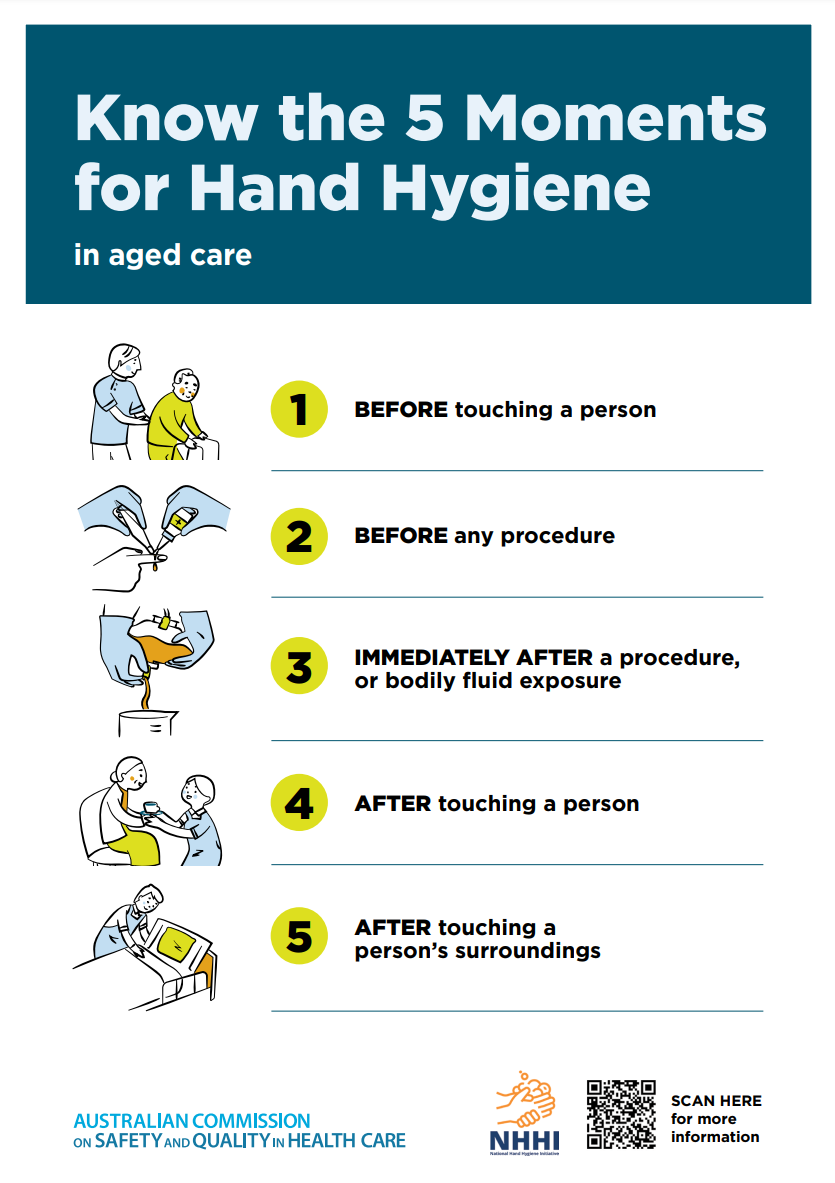
The 5 Moments for Hand Hygiene in aged care
This resource is a poster outlining the ‘5 Moments for Hand Hygiene’ in aged care settings. It provides clear guidance on when to perform hand hygiene: before touching a person, before a procedure, immediately after a procedure or bodily fluid exposure, after touching a person, and after touching a person's surroundings.
This resource may refer to information that will be updated from 1 November 2025 to align with the new Aged Care Act and Quality Standards.
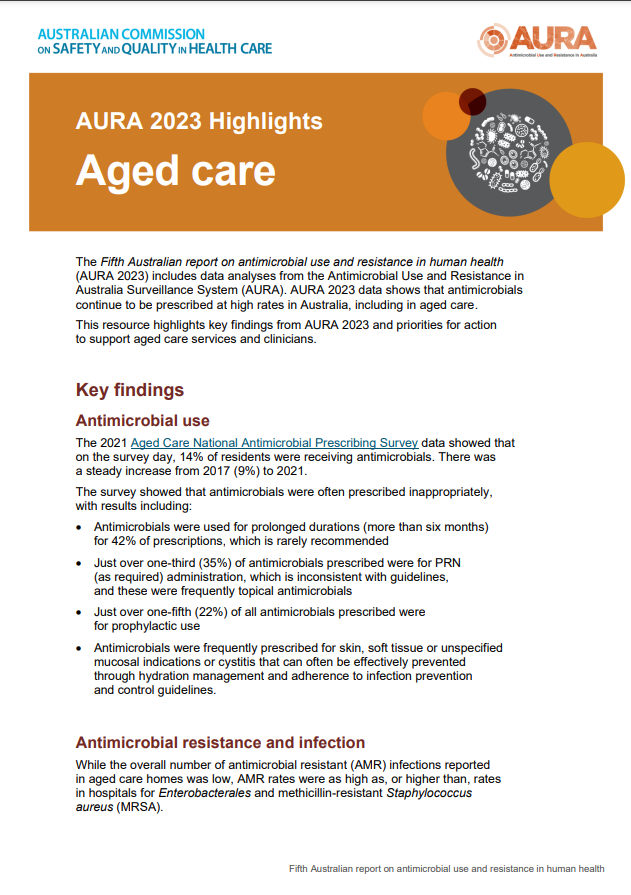
AURA 2023 Highlights for Aged care
This resource summarises key findings from the AURA 2023 report, focusing on antimicrobial use and resistance in aged care. It provides priorities for action to reduce inappropriate prescriptions, promote antimicrobial stewardship, and improve infection prevention and control in aged care settings, aligning with quality standards to enhance care for older people.
This resource may refer to information that will be updated from 1 November 2025 to align with the new Aged Care Act and Quality Standards.
Comprehensive Care - Clinical assessment and diagnosis - Key actions for health service organisations
This resource provides actions for health service organisations to support clinical assessment and diagnosis, promoting a person-centred approach and comprehensive care planning. It highlights training, clear communication of roles, and systems for documenting diagnoses and care plans.
This resource may apply to healthcare contexts outside of aged care. Please consider the applicability of this resource to your care setting. This resource may refer to information that will be updated from 1 November 2025 to align with the new Aged Care Act and Quality Standards.
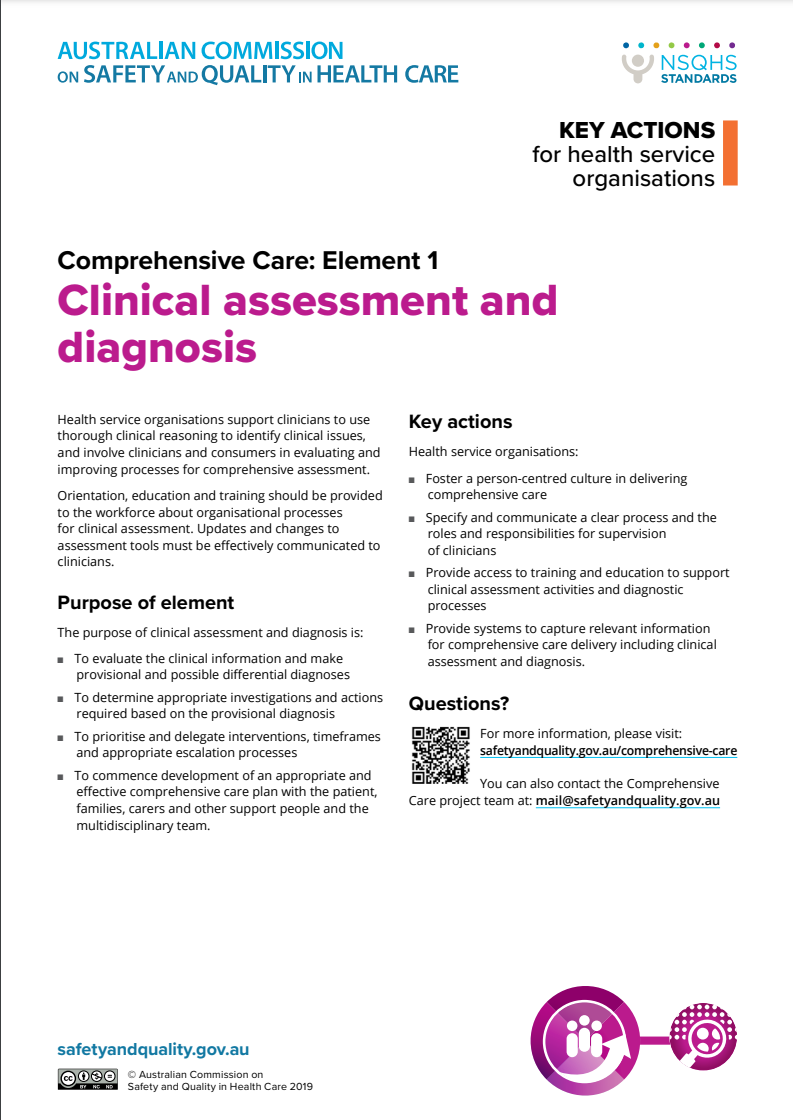
Comprehensive Care - Clinical assessment and diagnosis - Key actions for clinicians
This resource provides actions for health service organisations to support clinical assessment and diagnosis, promoting a person-centred approach and comprehensive care planning. It highlights training, clear communication of roles, and systems for documenting diagnoses and care plans.
This resource may apply to healthcare contexts outside of aged care. Please consider the applicability of this resource to your care setting. This resource may refer to information that will be updated from 1 November 2025 to align with the new Aged Care Act and Quality Standards.
COVID-19 resources for health professionals, including aged care providers, pathology providers and health care managers
This resource offers COVID-19 guidance for health professionals and aged care providers. It includes information on managing outbreaks, infection control, PPE use, and telehealth services. These resources support safe and effective care delivery while ensuring compliance with guidelines during the pandemic in aged care settings.
This resource may refer to information that will be updated from 1 November 2025 to align with the new Aged Care Act and Quality Standards.
Dining in residential aged care - tips and tricks fact sheet
This fact sheet provides practical tips for enhancing dining experiences in residential aged care settings. It offers guidance on food presentation, meal assistance, creating a respectful and enjoyable atmosphere, supporting independence, and providing culturally appropriate dining options. The aim is to improve mealtime satisfaction while maintaining older peoples' dignity and people's preferences.
This resource may refer to information that will be updated from 1 November 2025 to align with the new Aged Care Act and Quality Standards.
Dining in residential aged care – tips, tricks and what to avoid (PDF 484.37 KB)
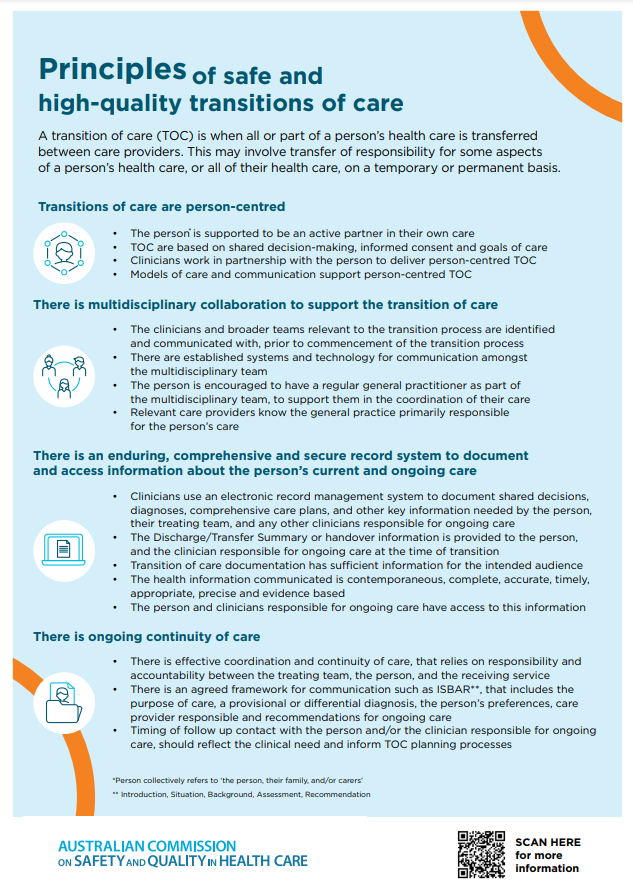
Fact sheet - Principles of safe and high-quality transitions of care
This resource outlines the principles for safe and high-quality transitions of care, emphasising person-centred care, multidisciplinary collaboration, and effective communication. It highlights the need for secure documentation, continuity of care, and coordination among healthcare teams to make sure smooth transitions and minimise risks during transfers between care providers.
This resource may refer to information that will be updated from 1 November 2025 to align with the new Aged Care Act and Quality Standards.
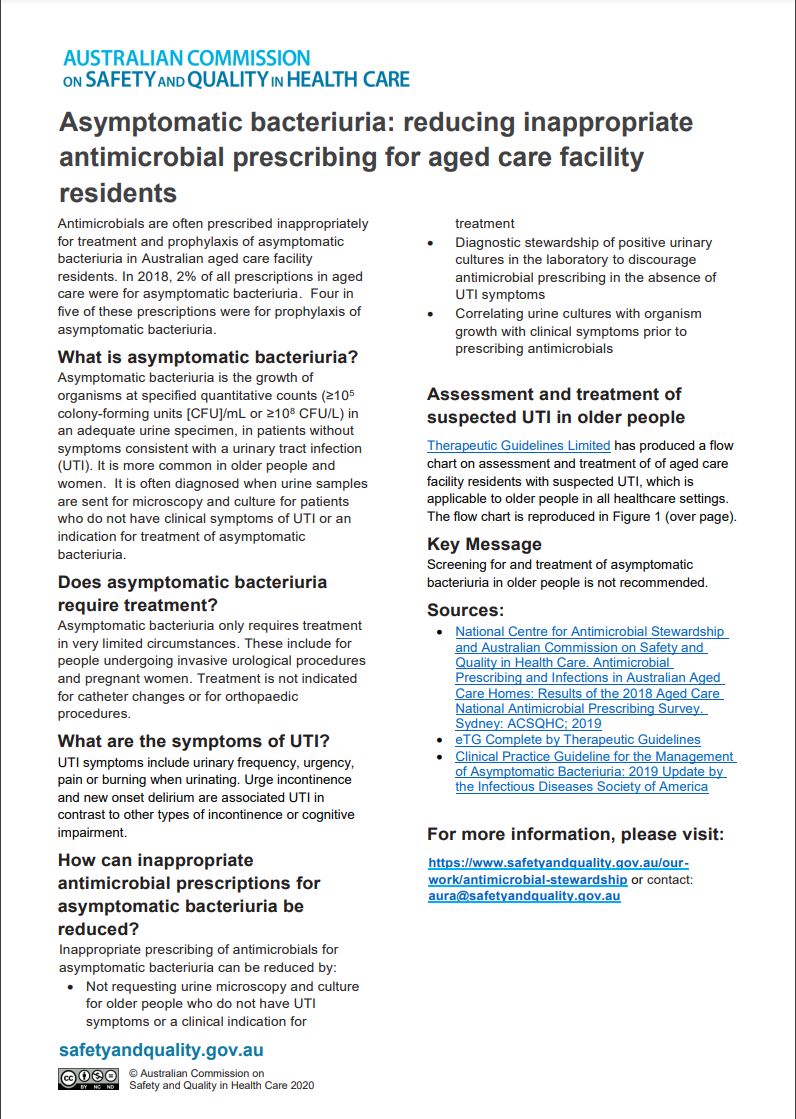
Fact sheet - Asymptomatic bacteriuria
This fact sheet offers guidance on managing asymptomatic bacteriuria and reducing inappropriate antimicrobial prescribing for residents of aged care facilities. It details symptoms, strategies to decrease unwarranted antimicrobial prescriptions for asymptomatic bacteriuria, and an assessment and treatment framework for residents suspected of urinary tract infections.
This resource may refer to information that will be updated from 1 November 2025 to align with the new Aged Care Act and Quality Standards.
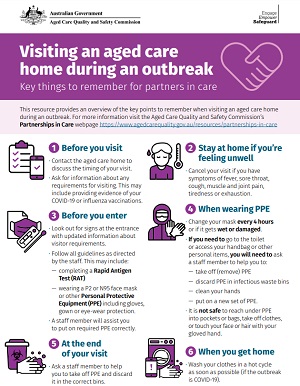
Visiting an aged care home during an outbreak - A3 poster
This A3 poster can be used by aged care facilities during an outbreak. It explains the key things for partners in care to remember when visiting an aged care home during an outbreak.
This resource may refer to information that will be updated from 1 November 2025 to align with the new Aged Care Act and Quality Standards.
Visiting an aged care home during an outbreak poster (PDF 323.5 KB)
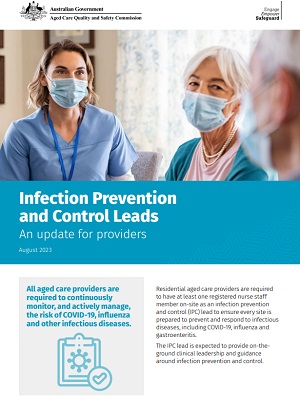
Infection Prevention and Control Leads: Updates for providers
This fact sheet provides updated information for providers of aged care on effective infection prevention and control capability. This is critical to the safe, effective delivery of personal and clinical care in aged care. This is particularly the case during the coronavirus COVID-19 pandemic.
Comprehensive Care - Review and improve comprehensive care delivery - Key actions for health service organisations
This resource outlines actions for health service organisations to review and improve comprehensive care delivery, focusing on aligning care with patients' needs and care plans. It emphasises regular assessment, multidisciplinary collaboration, and quality improvement to maintain responsive, person-centred care across services.
Frequently asked questions about consent
This fact sheet covers the frequently asked questions about consent in aged care.
Frequently asked questions about consent (PDF 433.26 KB)
Caring for Older People in heatwaves – Residential Aged Care
This resource provides guidance to care for older people living in residential aged care services during a heatwave. The resource includes checklists to guide providers to support older people before, during and after a heatwave. It includes clinical assessment guidance and where to find more information about heatwaves.
This resource may refer to information that will be updated from 1 November 2025 to align with the new Aged Care Act and Quality Standards.
Guiding principles to achieve continuity in medication management collection
This collection of resources is related to the guiding principles for medication management.The guiding principles aim to promote the quality use of medicines when moving between different health care settings and health care providers. The collection includes the guiding principles and the corresponding glossary, user guide and fact sheet. This resource may apply to healthcare contexts outside of aged care.
This resource may refer to information that will be updated from 1 November 2025 to align with the new Aged Care Act and Quality Standards.
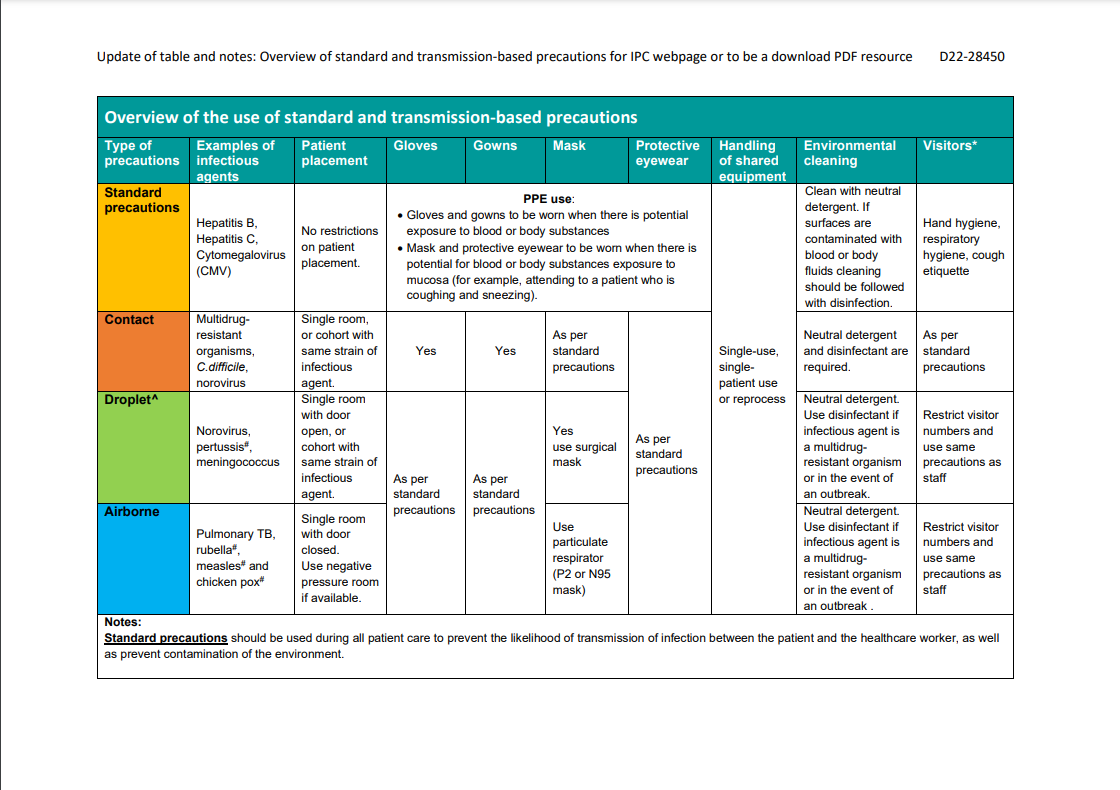
Use of standard and transmission-based precautions
This resource provides an overview of standard and transmission-based precautions, including personal protective equipment (PPE) use and patient placement requirements. It helps healthcare providers minimise infection risks by guiding appropriate PPE selection and patient placement based on local risk assessments, ensuring safe and effective infection prevention practices in aged care settings.
This resource may refer to information that will be updated from 1 November 2025 to align with the new Aged Care Act and Quality Standards.
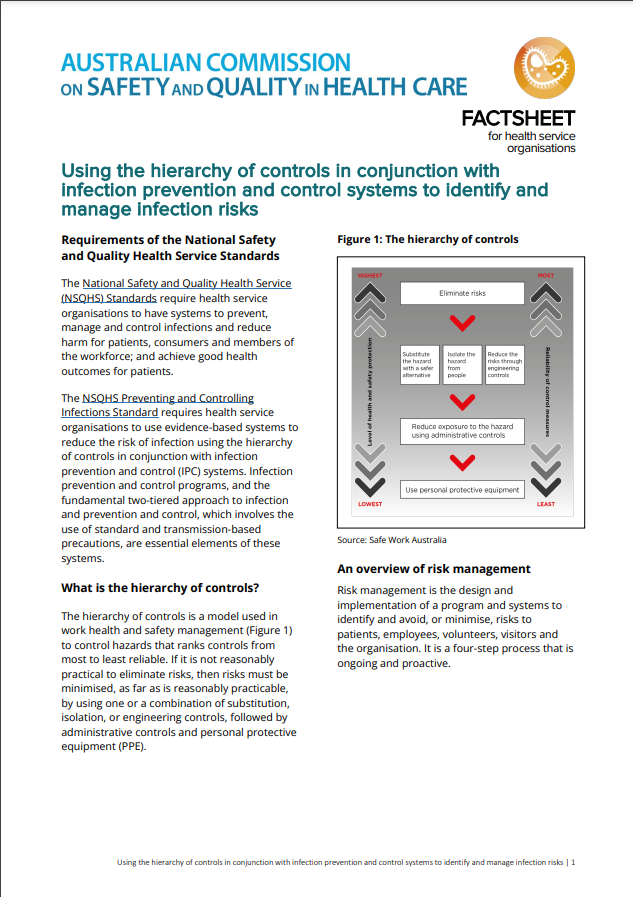
Use of the hierarchy of controls in infection prevention and control
This fact sheet provides guidance on using the hierarchy of controls with infection prevention systems to manage infection risks. It outlines strategies such as elimination, isolation, engineering controls, and personal protective equipment (PPE) to help aged care providers maintain infection control and ensure safe care environments.
This resource may refer to information that will be updated from 1 November 2025 to align with the new Aged Care Act and Quality Standards.
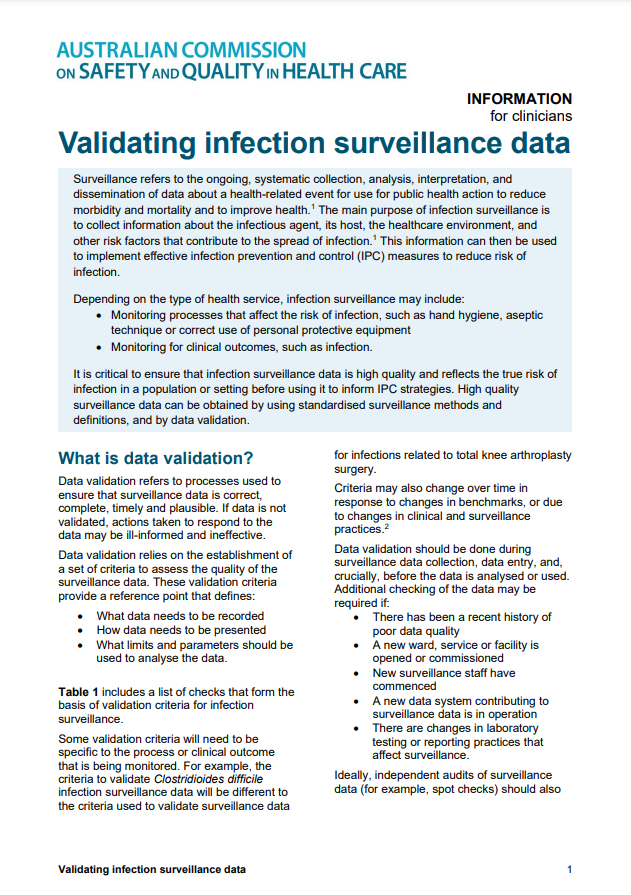
Validating infection surveillance data
This fact sheet provides guidance on validating infection surveillance data. It supports infection control teams in ensuring data accuracy and completeness, essential for effective infection control strategies. The resource outlines steps for both manual and automated validation methods and includes a checklist for common practices.
This resource may refer to information that will be updated from 1 November 2025 to align with the new Aged Care Act and Quality Standards.
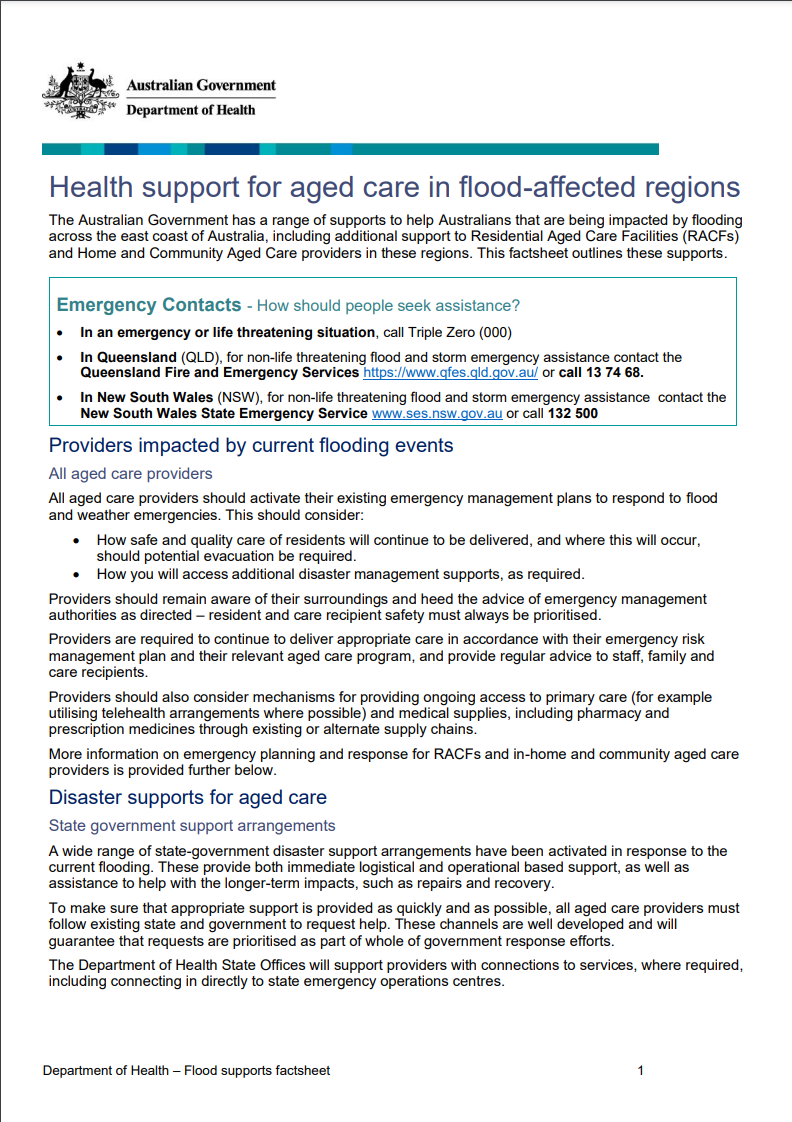
Health support for aged care in flood-affected regions
This resource outlines support available for aged care providers in flood-affected regions. It includes guidance on emergency management, workforce arrangements, access to medical supplies, and disaster relief funding. The document also provides state-specific emergency contacts and resources to help maintain service continuity during and after floods.
This resource may refer to information that will be updated from 1 November 2025 to align with the new Aged Care Act and Quality Standards.
Infection prevention and control resources for consumers
This resource provides fact sheets for consumers and carers on infection prevention and control, including hand hygiene and healthcare-associated infections. It covers common infections such as MRSA, CPE, and CDI, offering guidance on prevention, treatment, and risk factors to help reduce the spread of infections in aged care settings.
This resource may refer to information that will be updated from 1 November 2025 to align with the new Aged Care Act and Quality Standards.