The Quality Standards Resource Centre helps extend understanding of the strengthened Aged Care Quality Standards, which took effect from 1 November 2025. You can search for resources by using keywords, or filtering by standard, outcome and audience. Before using the Resource Centre, please read the terms of use.
palliAGED - Practice Centre
This resource provides information for care workers about palliative care. The Practice Centre provides links to, and information about, tools and resources to use in practice and improve care and outcomes in palliative care. It includes sections on improving practice, symptoms, medicines and tipsheets.
Palliative Care Australia
This resource is the Palliative Care Australia website. The website contains targeted guidance and resources for service providers and health care professionals. The resource also includes information about the National Palliative Care Standards, which provide guidance on best practice palliative care in different settings.
palliAGED - Evidence Centre
This resource provides evidence-based information for the healthcare sector about palliative care. It includes evidence summaries on topics related to palliative care, such as advance care planning, advocacy, care coordination, goals of care, nutrition and needs assessment.
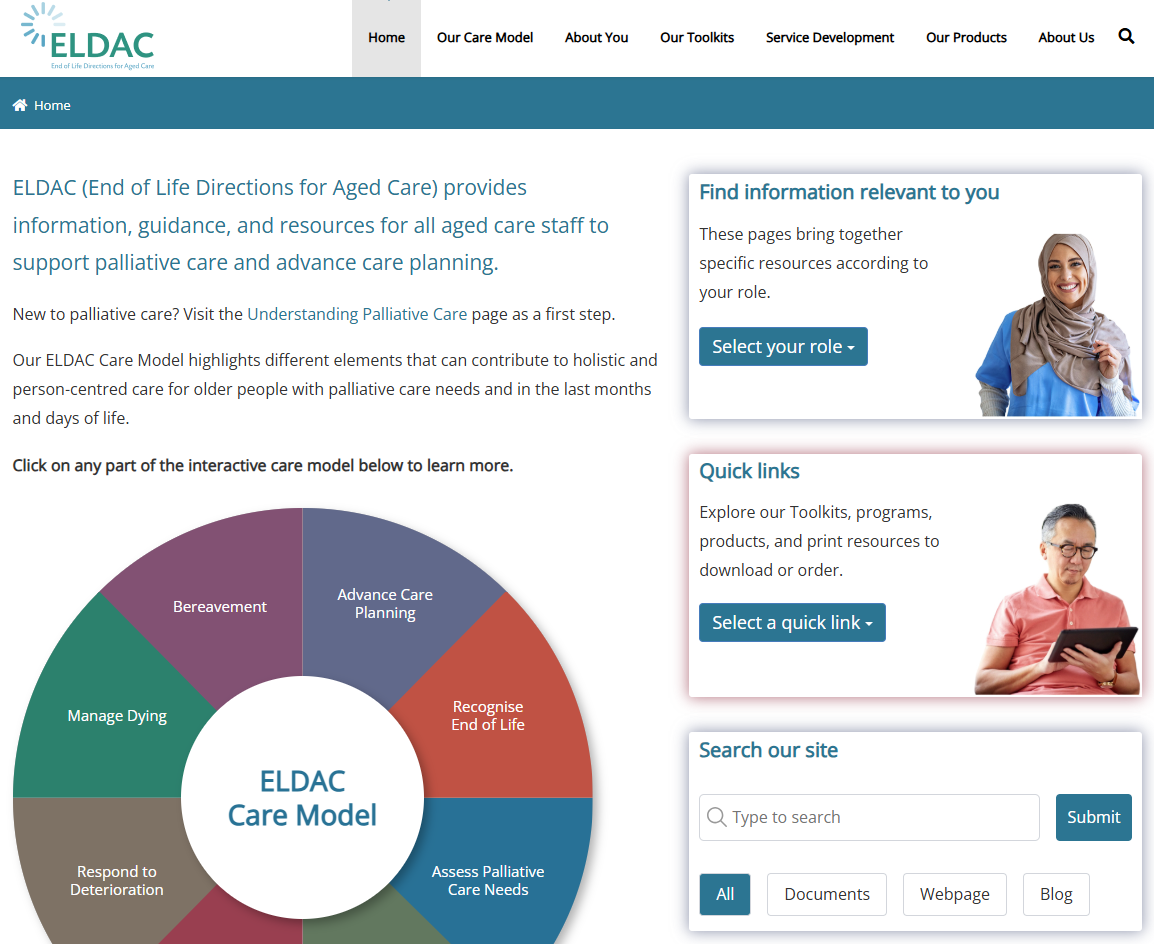
End of Life Directions for Aged Care
This resource is the ELDAC (End of Life Directions for Aged Care) website. It provides information, guidance and resources for aged care providers and staff supporting palliative care and advance care planning. Information can be accessed by selecting a topic from the ELDAC care model, for example, providing palliative care, responding to deterioration and bereavement. Information can also be filtered using search functions such as role type, quick links, resource type and keywords.
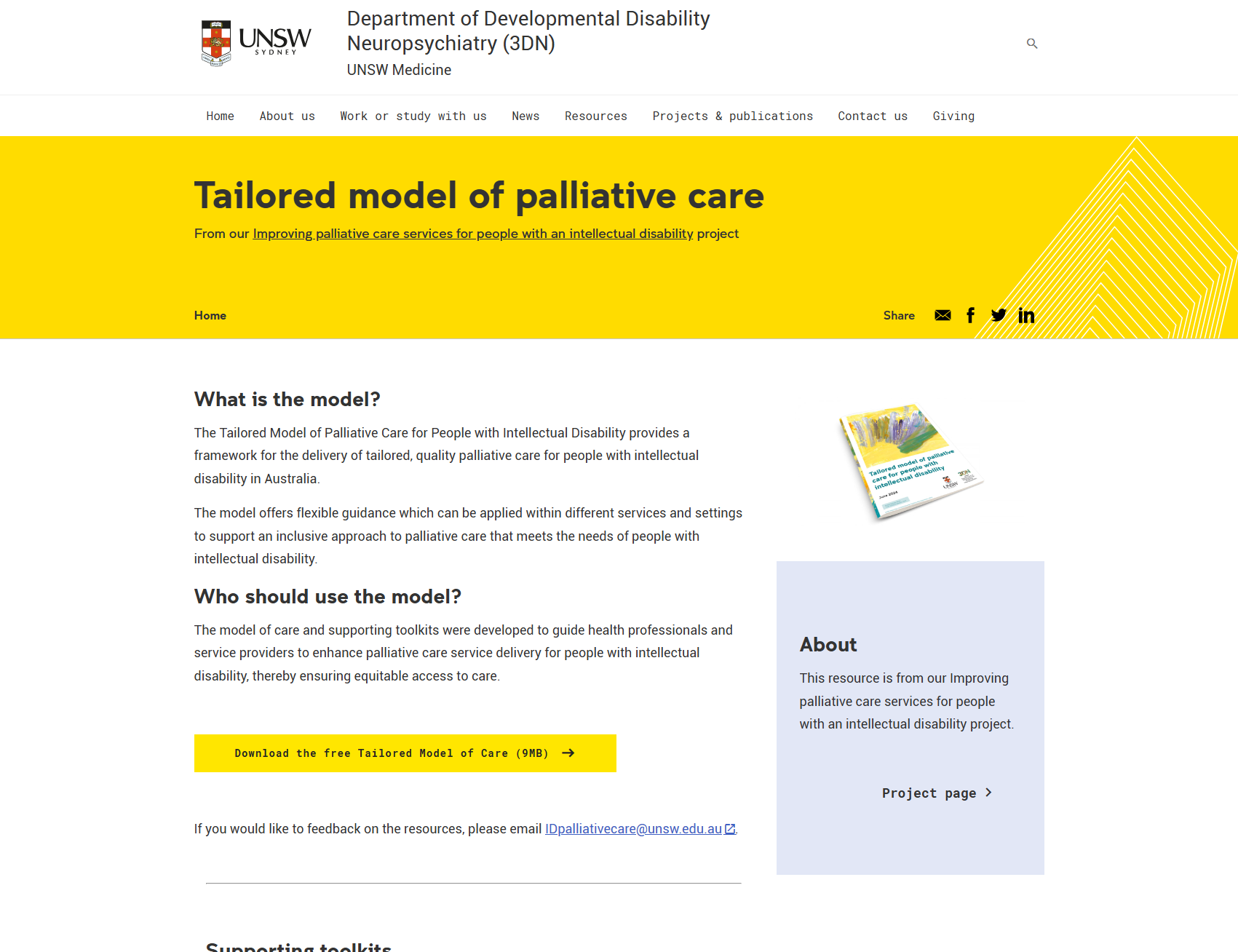
Tailored model of palliative care for people with intellectual disability
This model provides a framework for delivering tailored palliative care for people with intellectual disabilities, aiming for equitable access across various care settings. Supporting toolkits offer resources for health professionals and families to enhance communication and collaborative care.
This resource was developed by a state/territory government or organisation and therefore its applicability and usefulness may be limited.
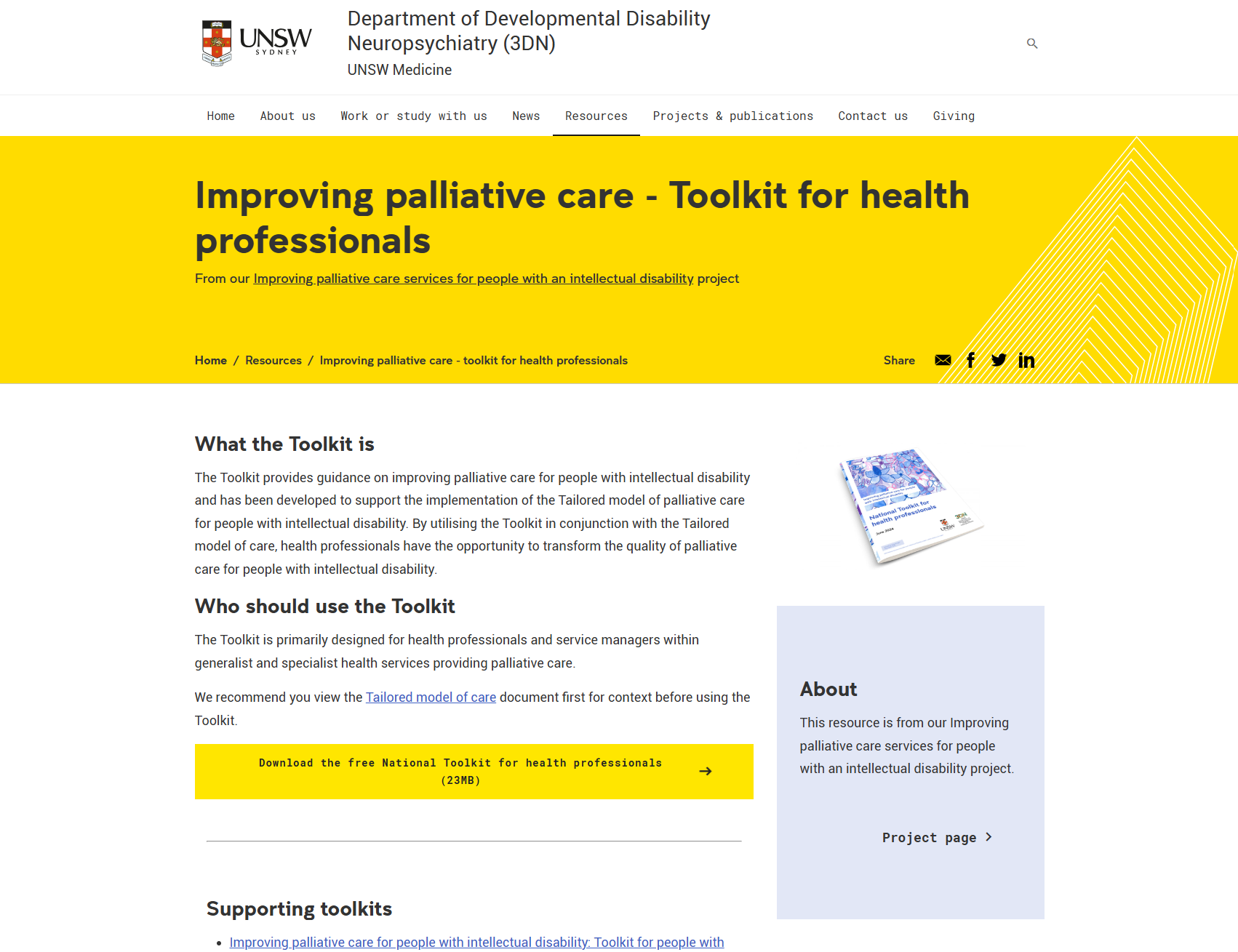
Improving palliative care - Toolkit for health professionals
This toolkit supports health professionals in delivering palliative care for people with intellectual disabilities by providing resources, guidance on communication, and tailored care strategies. It aims to enhance service quality through understanding specific needs and collaborative care planning.
This resource was developed by a state/territory government or organisation and therefore its applicability and usefulness may be limited.
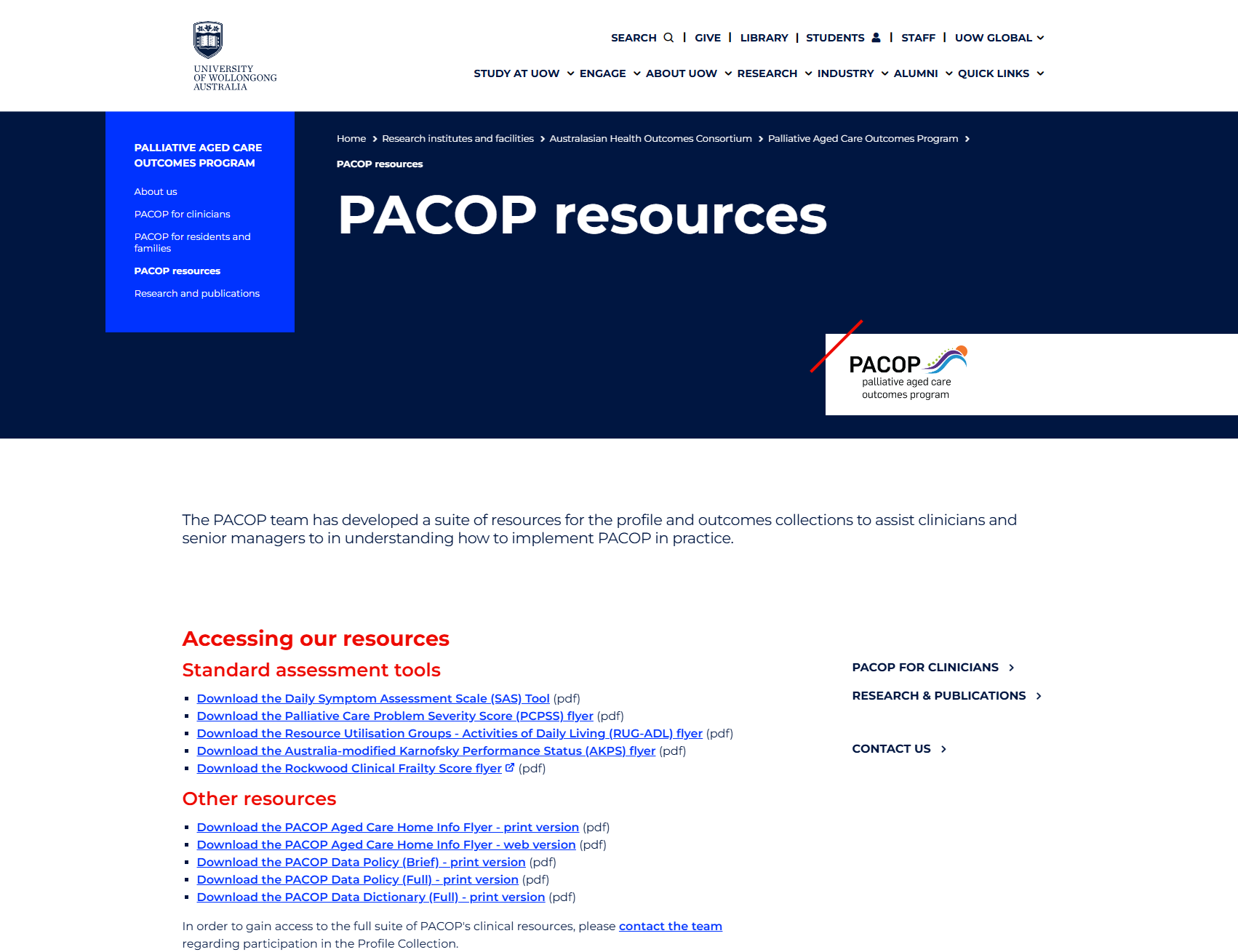
Palliative Aged Care Outcomes Program - Resources
This resource offers tools and guidelines for palliative care outcome measurement, including assessment scales for symptom severity, frailty, and daily living activities. It supports clinicians and managers in implementing standardised data collection to improve care quality in aged care settings.
This resource was developed by a state/territory government or organisation and therefore its applicability and usefulness may be limited.
Standardised care processes
This resource offers evidence-based standardised care processes for aged care providers, covering high-risk clinical areas such as falls, pain, incontinence, and dehydration. It provides structured guidelines to support best practices, ensuring consistent and safe care for older people in residential settings.
This resource was developed by a state/territory government or organisation and therefore its applicability and usefulness may be limited.
Participating with consumers
This resource provides information sheets for residents, families, and carers to support decision-making in residential aged care. Covering topics such as pain management, falls, and medicines, it promotes health literacy, enabling consumers to engage in discussions and report care issues effectively.
This resource was developed by a state/territory government or organisation and therefore its applicability and usefulness may be limited.
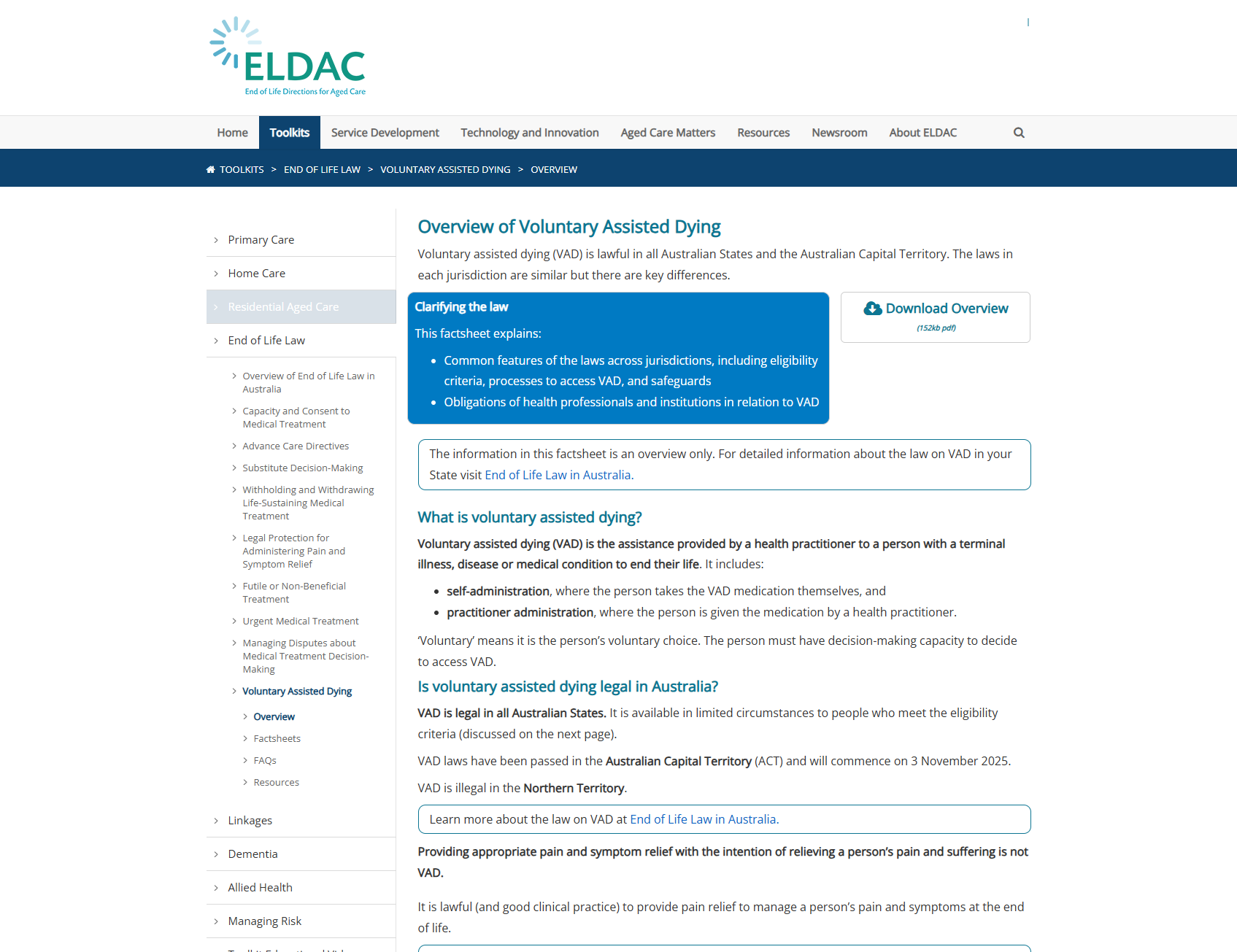
Overview of Voluntary Assisted Dying
This resource provides an overview of voluntary assisted dying (VAD) in Australia, detailing eligibility criteria, procedures, and legal requirements. It covers how VAD laws vary across jurisdictions, safeguards in place, and responsibilities for health professionals and institutions. Health professionals can conscientiously object but may still have legal responsibilities.
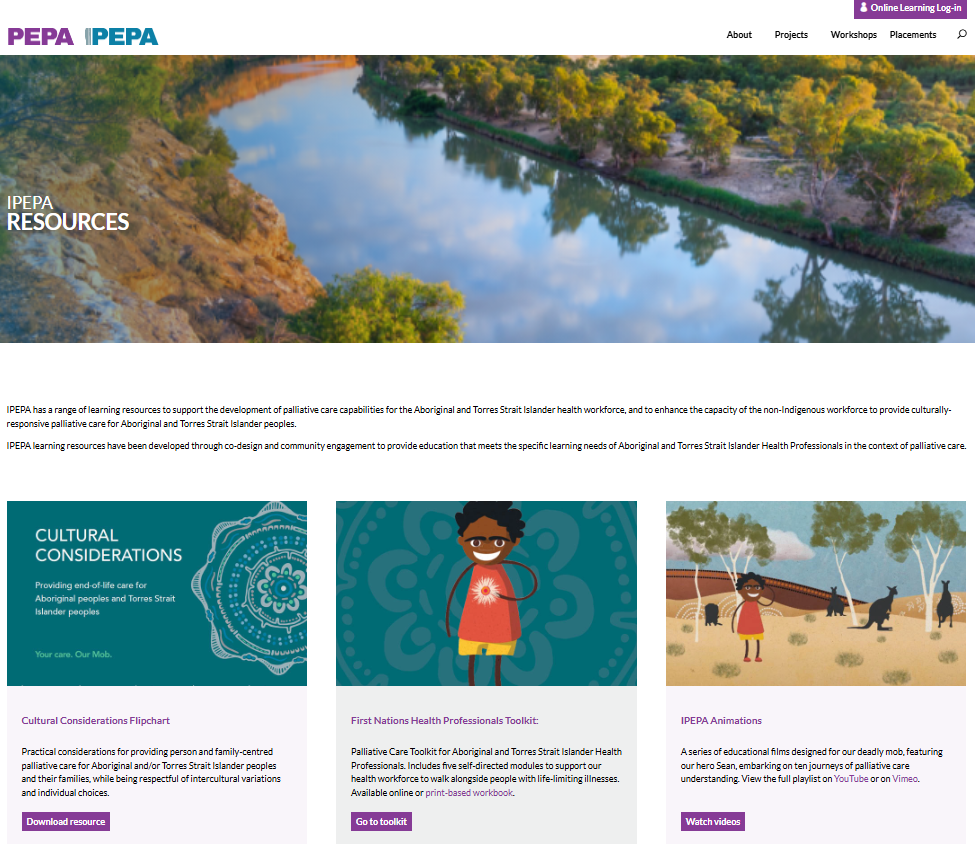
Indigenous Program of Experience in the Palliative Approach
This page provides resources about palliative care for Aboriginal and Torres Strait Islander health workers, and resources to support the non-Indigenous workforce provide culturally-responsive palliative care for Aboriginal and Torres Strait Islander peoples.
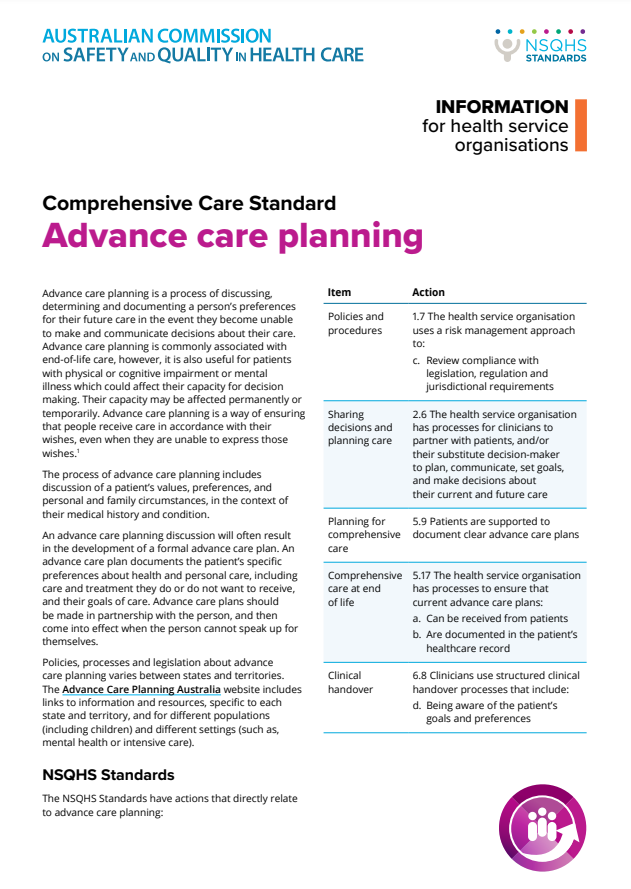
Advance care planning - Information for health service organisations
This resource outlines how health service organisations can support advance care planning within the Comprehensive Care Standard (National Safety and Quality Health Service Standards). It highlights the importance of documenting a patient’s preferences for future care and ensuring systems are in place to act on these plans. It also provides actions related to policies, sharing decisions, comprehensive care, and clinical handover.
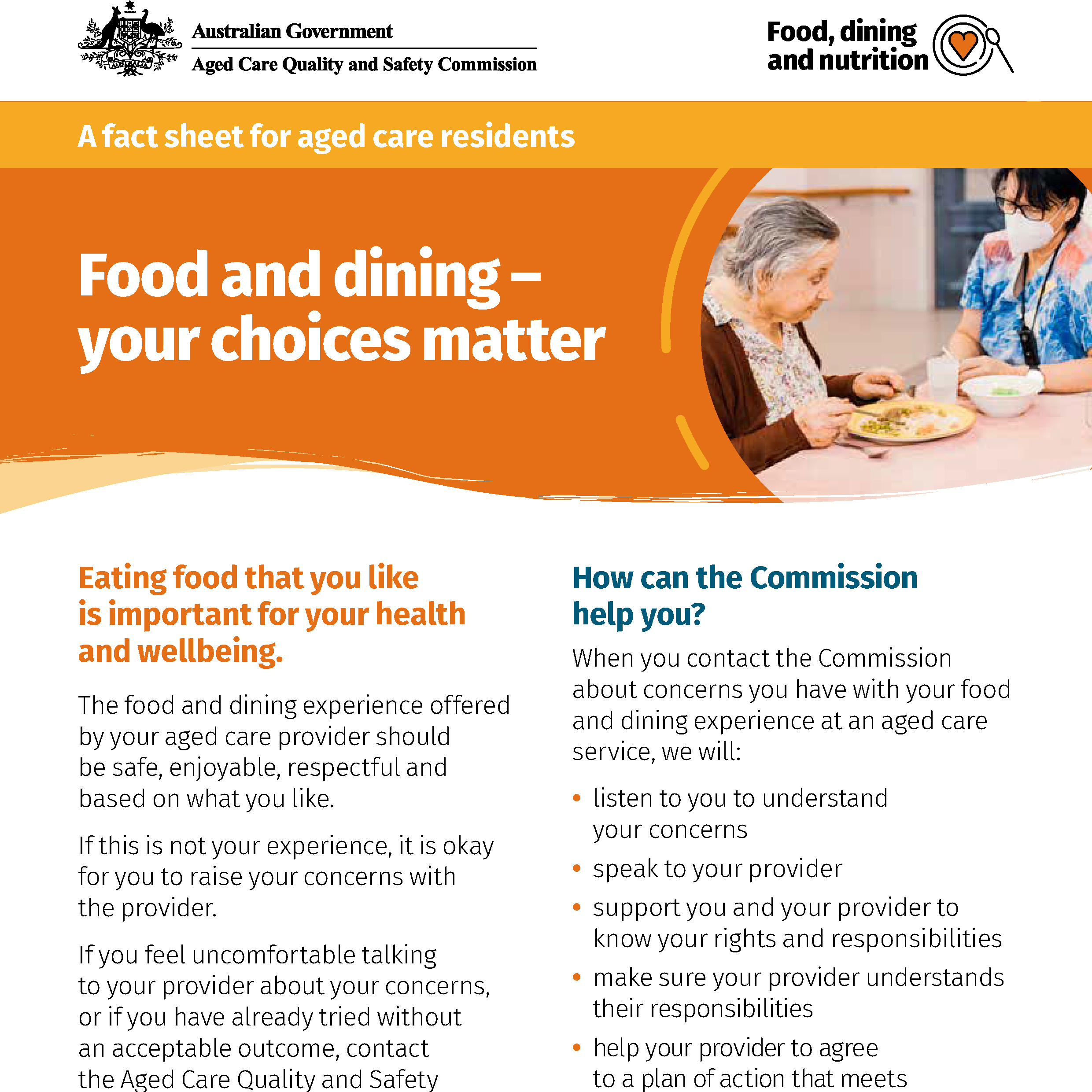
Food and dining - your choices matter
This fact sheet informs aged care residents of their rights to safe, enjoyable, and respectful dining experiences. It outlines steps for raising concerns with providers about food and dining, offers a preference form for residents to communicate their dietary needs, and provides contact information for support services if issues remain unresolved. This resource may refer to information that will be updated from 1 November 2025 to align with the new Aged Care Act and Quality Standards.
 English - Food and dining – your choices matter (PDF 484.79 KB)
Arabic - تهمّّنا تفضيلاتكم في الطعام وعادات الأكل (PDF 767.17 KB)
Chinese Simplified - 食品和餐饮—— 您的选择很重要 (PDF 785.39 KB)
Chinese Traditional - 食品和餐飲—— 您的選擇很重要 (PDF 788.7 KB)
French - Alimentation et repas – vos choix sont importants (PDF 684.4 KB)
German - Essen und Speisen – Ihre Wahl zählt (PDF 686.18 KB)
Greek - Φαγητό και γεύματα – οι επιλογές σας έχουν σημασία (PDF 690.89 KB)
Hungarian - Ételek és étkezés – az Ön döntése számít (PDF 684.42 KB)
Macedonian - Храна и јадење - вашиот избор е важен (PDF 683.21 KB)
Maltese - L-ikel u l-ikliet - l-għażliet tiegħek huma importanti (PDF 685.65 KB)
Russian - Питание и прием пищи: ваш выбор имеет значение (PDF 682.53 KB)
Serbian - Храна и обедовање – ваш избор је важан (PDF 681.46 KB)
Spanish - Alimentos y comidas: sus preferencias importan (PDF 679.42 KB)
English - Food and dining – your choices matter (PDF 484.79 KB)
Arabic - تهمّّنا تفضيلاتكم في الطعام وعادات الأكل (PDF 767.17 KB)
Chinese Simplified - 食品和餐饮—— 您的选择很重要 (PDF 785.39 KB)
Chinese Traditional - 食品和餐飲—— 您的選擇很重要 (PDF 788.7 KB)
French - Alimentation et repas – vos choix sont importants (PDF 684.4 KB)
German - Essen und Speisen – Ihre Wahl zählt (PDF 686.18 KB)
Greek - Φαγητό και γεύματα – οι επιλογές σας έχουν σημασία (PDF 690.89 KB)
Hungarian - Ételek és étkezés – az Ön döntése számít (PDF 684.42 KB)
Macedonian - Храна и јадење - вашиот избор е важен (PDF 683.21 KB)
Maltese - L-ikel u l-ikliet - l-għażliet tiegħek huma importanti (PDF 685.65 KB)
Russian - Питание и прием пищи: ваш выбор имеет значение (PDF 682.53 KB)
Serbian - Храна и обедовање – ваш избор је важан (PDF 681.46 KB)
Spanish - Alimentos y comidas: sus preferencias importan (PDF 679.42 KB)
Governing for Reform in Aged Care Program
This resource outlines the Governing for Reform in Aged Care Program, designed to strengthen corporate and clinical governance capabilities for aged care leaders. It provides tools, online learning modules, webinars, and podcasts to support governance improvement and help leaders engage in reform efforts.
This resource may refer to information that will be updated from 1 November 2025 to align with the new Aged Care Act and Quality Standards.
Complaints about aged care services report
This resource provides reports on complaints about aged care services, offering insights for providers to improve complaint handling. It includes data, case studies, and guided questions to help providers address concerns in both residential and home care settings, supporting better outcomes for people receiving care.
This resource may refer to information that will be updated from 1 November 2025 to align with the new Aged Care Act and Quality Standards.
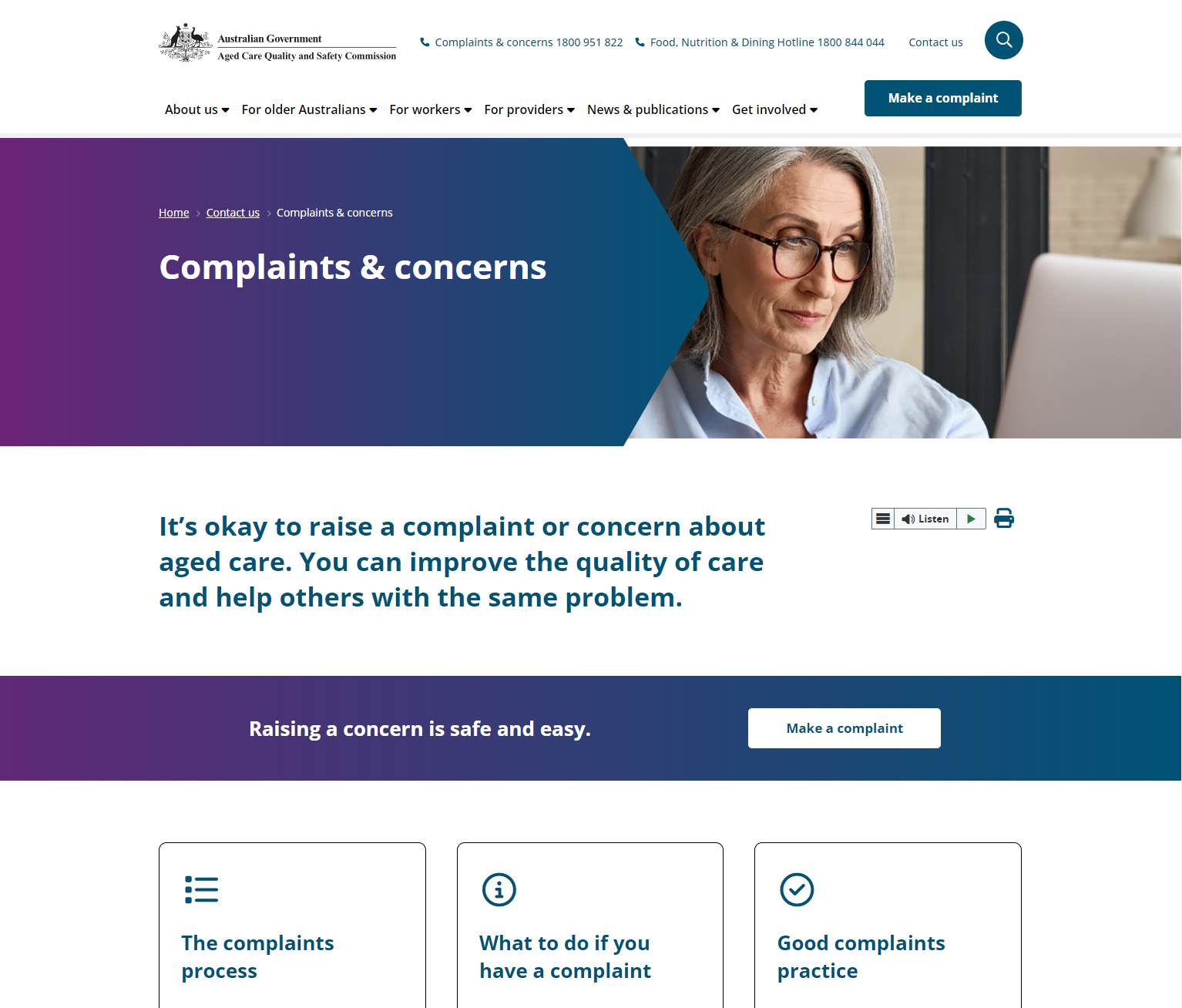
Complaints & concerns
This resource explains how to raise complaints or concerns about aged care services. It outlines the complaints process, how to submit confidential or anonymous complaints, and the importance of good complaints handling in improving care quality. Providers are required to have systems for addressing and resolving complaints.
This resource may refer to information that will be updated from 1 November 2025 to align with the new Aged Care Act and Quality Standards.
What is open disclosure? - video
This video explains open disclosure and what older people can expect from their registered provider during the process. It highlights key aspects such as communication, transparency, and how concerns will be addressed.

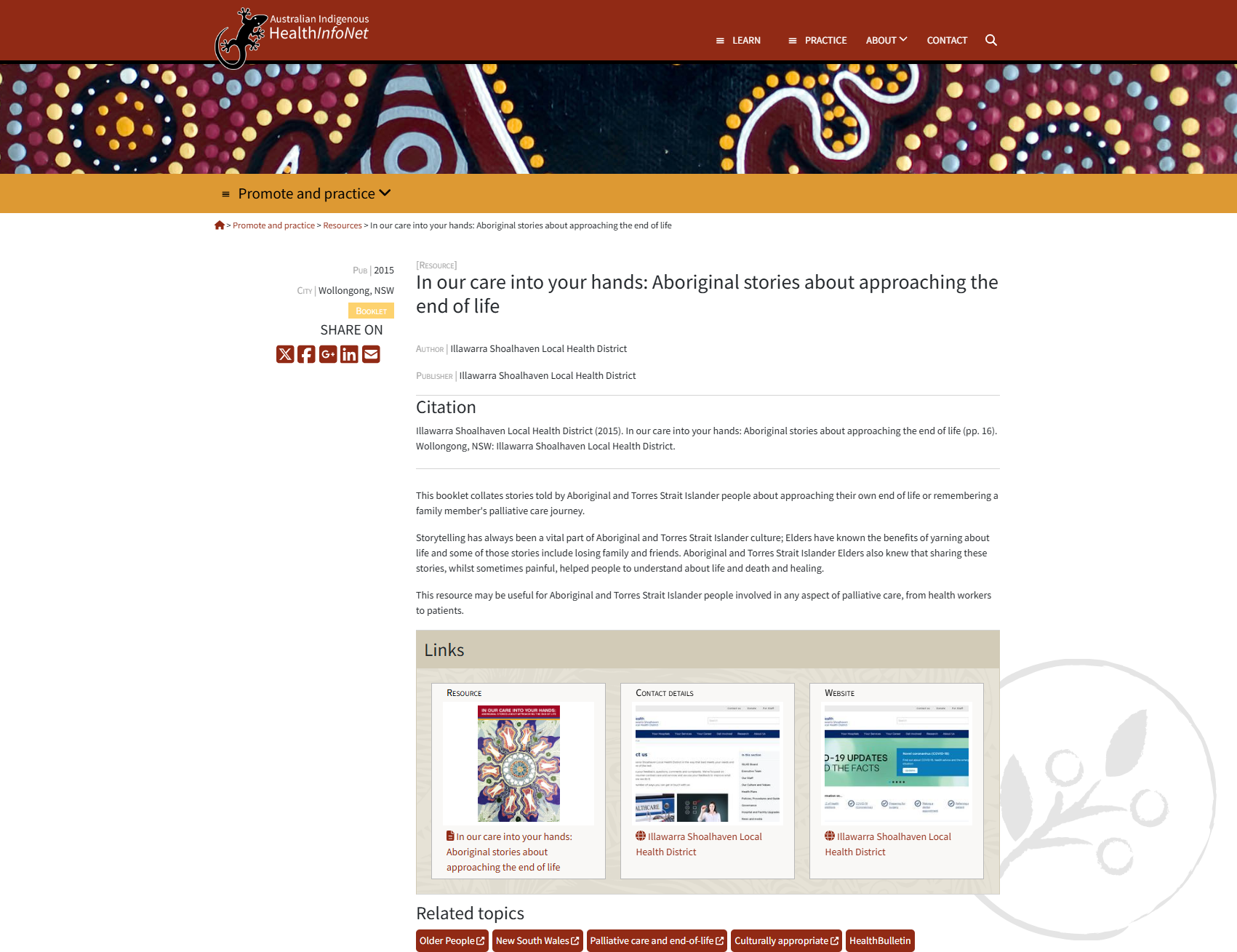
In our care into your hands: Aboriginal stories about approaching the end of life
This 2015 resource shares Aboriginal and Torres Strait Islander stories about approaching end of life, emphasising cultural practices and the role of storytelling in palliative care. It offers insight into supporting culturally sensitive care for people nearing the end of life.
This resource was developed by a state/territory government or organisation and therefore its applicability and usefulness may be limited.
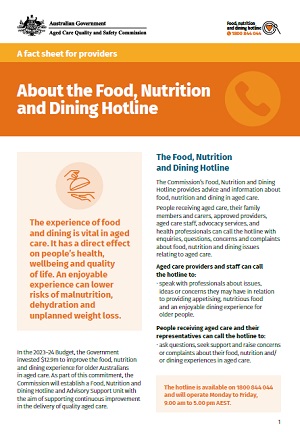
About the Food, Nutrition and Dining Hotline – provider and worker fact sheet
This resource provides information about the Food, Nutrition, and Dining Hotline, which offers advice and addresses concerns regarding food and dining in aged care. It allows aged care providers, staff, residents, families, and carers to raise issues about nutrition, menu planning, and dining experiences to improve quality and care outcomes. This resource may refer to information that will be updated from 1 November 2025 to align with the new Aged Care Act and Quality Standards.
Better Practice Complaint Handling Guide
This resource provides best practice guidance for handling complaints within public service agencies and private providers. It outlines the principles for creating an effective, customer-focused complaint system, including steps for logging, resolving, and communicating complaints. The guide also provides insights on staff training, performance benchmarks, and systemic improvement to enhance service quality and public trust, with relevance for aged care providers ensuring fair and transparent complaint resolution processes.