The Quality Standards Resource Centre helps extend understanding of the strengthened Aged Care Quality Standards, which took effect from 1 November 2025. You can search for resources by using keywords, or filtering by standard, outcome and audience. Before using the Resource Centre, please read the terms of use.
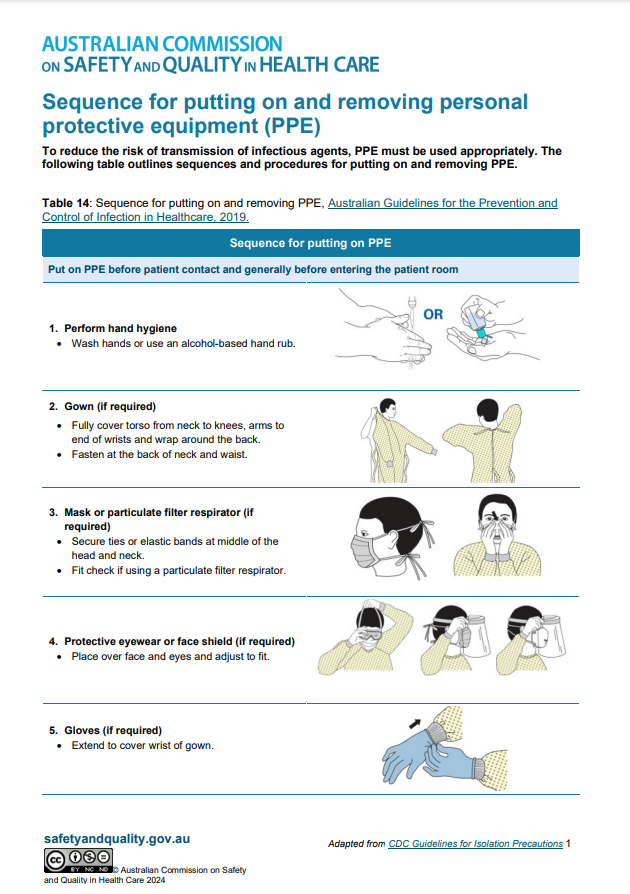
Sequence for putting on and removing personal protective equipment (PPE)
This poster outlines the correct sequence for putting on and removing personal protective equipment (PPE) to reduce the transmission of infectious agents. It provides step-by-step instructions for healthcare workers to ensure safe use of gowns, masks, gloves, and protective eyewear.
This resource may apply to healthcare contexts outside of aged care. Please consider the applicability of this resource to your care setting. This resource may refer to information that will be updated from 1 November 2025 to align with the new Aged Care Act and Quality Standards.
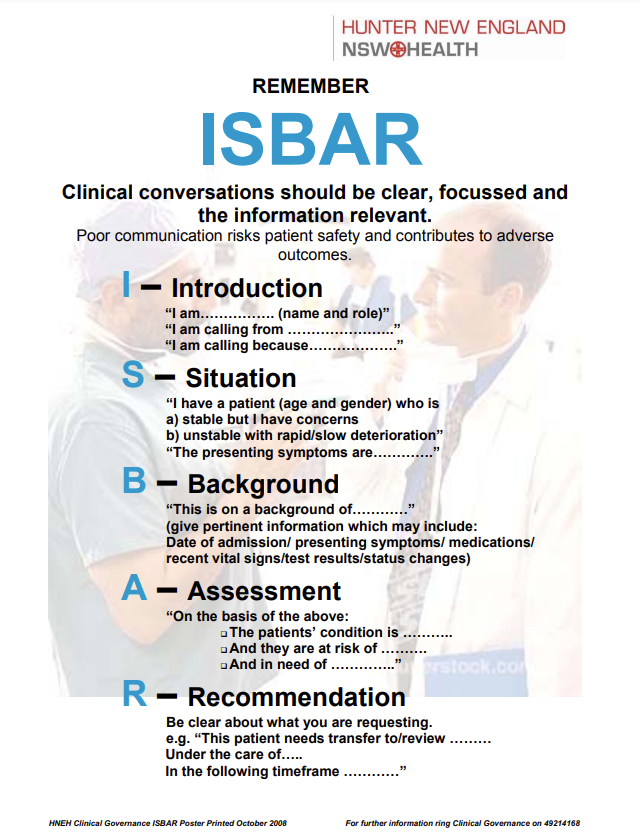
ISBAR Poster
This poster is a tool for improving clinical handover. It outlines the principles of ISBAR: Introduction, Situation, Background, Assessment, Recommendation. This supports clinical conversations to be clear, focused and relevant.
This resource may refer to information that will be updated from 1 November 2025 to align with the new Aged Care Act and Quality Standards.
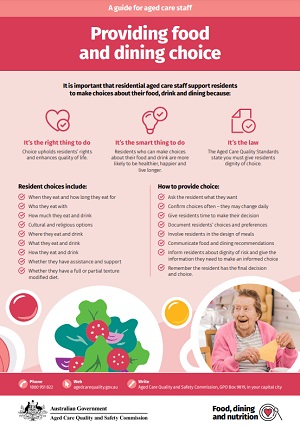
Providing food and dining choice - aged care staff poster
This guide supports aged care staff in providing food and dining choices for residents. It outlines the importance of upholding residents' rights to choose, enhancing their health and quality of life. The guide recommends confirming preferences regularly, involving residents in meal planning, and respecting individual choices regarding when, where, and what they eat or drink. This resource may refer to information that will be updated from 1 November 2025 to align with the new Aged Care Act and Quality Standards.
 Providing food and dining choice - aged care staff poster (PDF 445.57 KB)
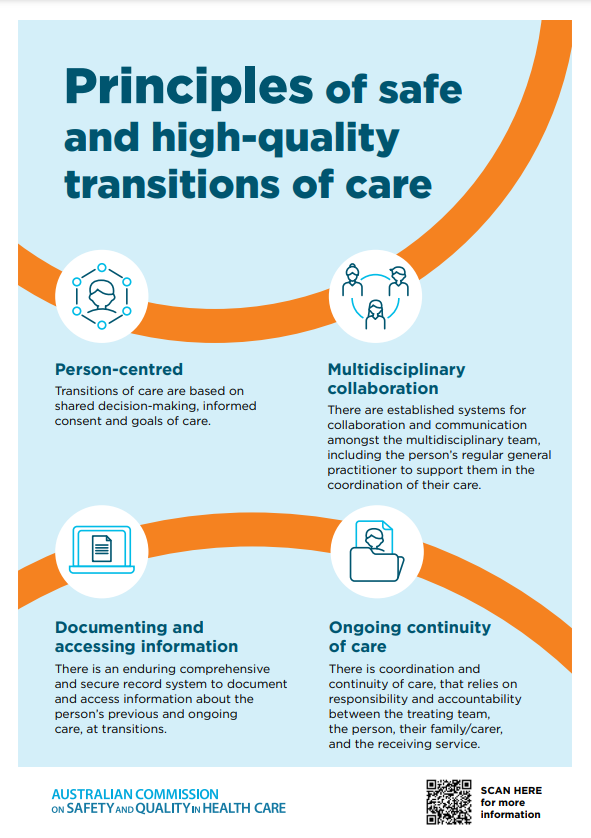
Poster - Principles of safe and high-quality transitions of care
This resource outlines the principles of safe and high-quality transitions of care. It highlights the importance of person-centred care, multidisciplinary collaboration, and clear communication between providers. It ensures coordination, accountability, and secure documentation to support continuity of care when transferring people between care settings. This resource may refer to information that will be updated from 1 November 2025 to align with the new Aged Care Act and Quality Standards.
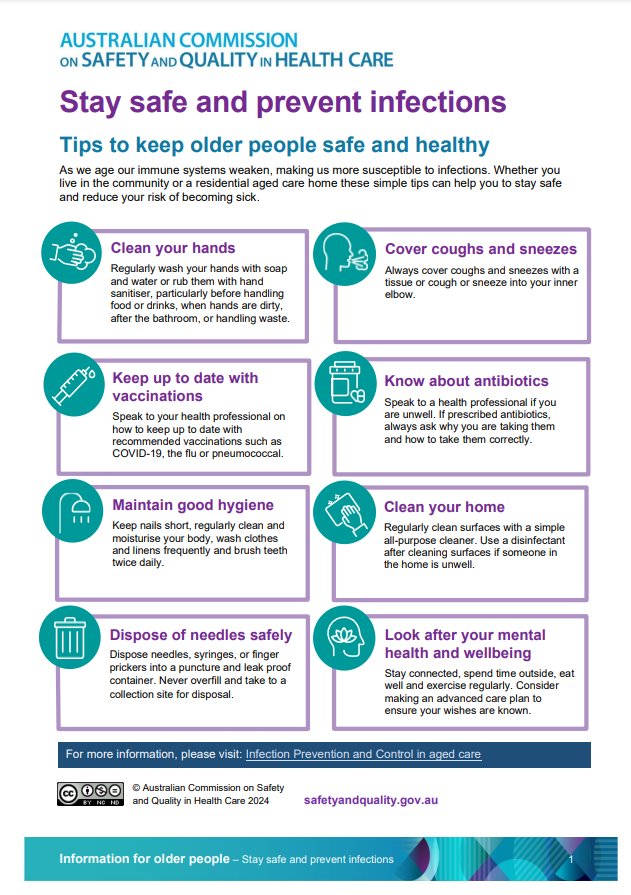
Preventing infections – aged care consumer fact sheet
This fact sheet provides essential tips for older people on how to prevent infections. It covers hand hygiene, vaccinations, home cleaning, proper disposal of needles, and mental health care. The resource is designed to support infection prevention practices in both community and aged care settings.
This resource may refer to information that will be updated from 1 November 2025 to align with the new Aged Care Act and Quality Standards.
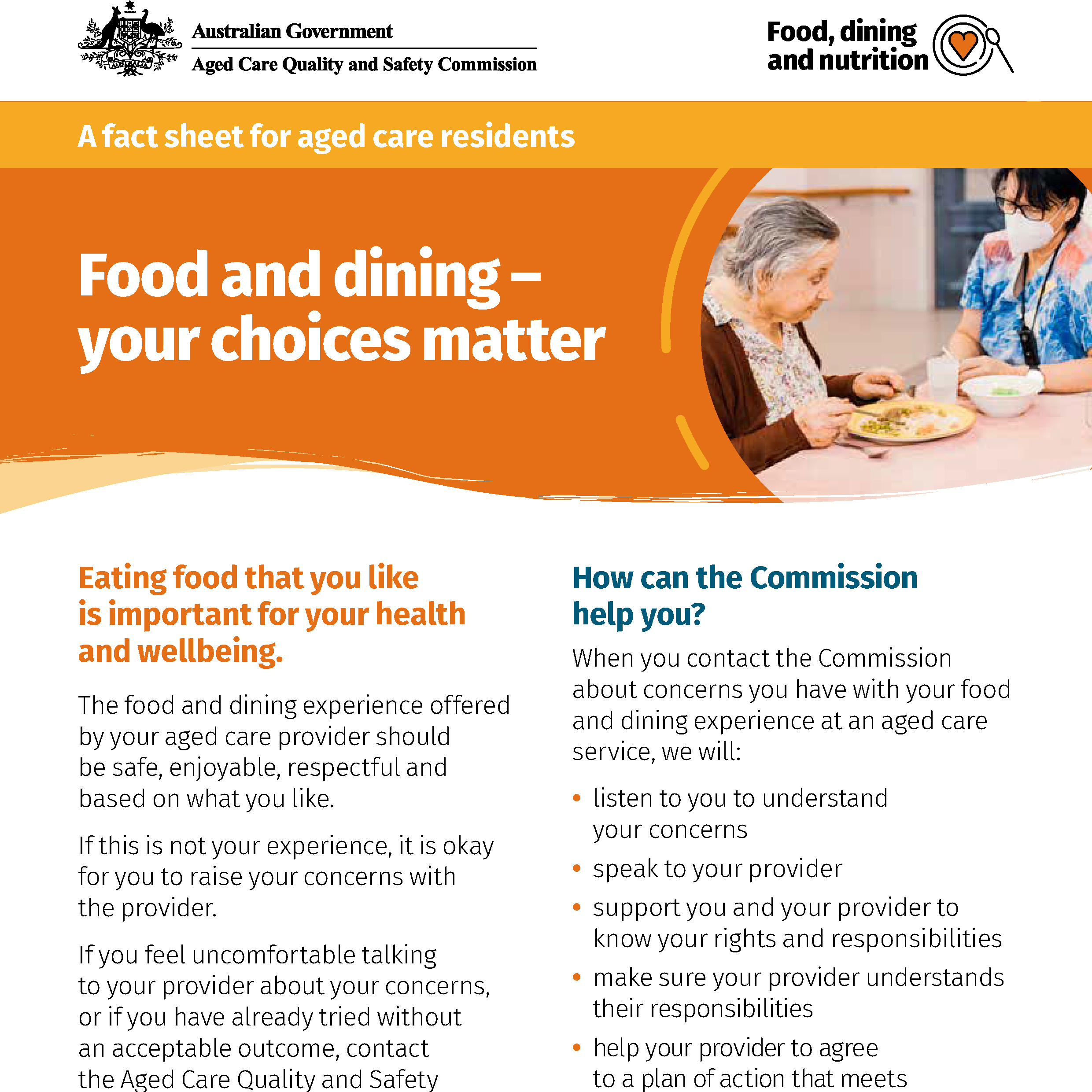
Food and dining - your choices matter
This fact sheet informs aged care residents of their rights to safe, enjoyable, and respectful dining experiences. It outlines steps for raising concerns with providers about food and dining, offers a preference form for residents to communicate their dietary needs, and provides contact information for support services if issues remain unresolved. This resource may refer to information that will be updated from 1 November 2025 to align with the new Aged Care Act and Quality Standards.
English - Food and dining – your choices matter (PDF 484.79 KB)
Arabic - تهمّّنا تفضيلاتكم في الطعام وعادات الأكل (PDF 767.17 KB)
Chinese Simplified - 食品和餐饮—— 您的选择很重要 (PDF 785.39 KB)
Chinese Traditional - 食品和餐飲—— 您的選擇很重要 (PDF 788.7 KB)
French - Alimentation et repas – vos choix sont importants (PDF 684.4 KB)
German - Essen und Speisen – Ihre Wahl zählt (PDF 686.18 KB)
Greek - Φαγητό και γεύματα – οι επιλογές σας έχουν σημασία (PDF 690.89 KB)
Hungarian - Ételek és étkezés – az Ön döntése számít (PDF 684.42 KB)
Macedonian - Храна и јадење - вашиот избор е важен (PDF 683.21 KB)
Maltese - L-ikel u l-ikliet - l-għażliet tiegħek huma importanti (PDF 685.65 KB)
Russian - Питание и прием пищи: ваш выбор имеет значение (PDF 682.53 KB)
Serbian - Храна и обедовање – ваш избор је важан (PDF 681.46 KB)
Spanish - Alimentos y comidas: sus preferencias importan (PDF 679.42 KB)
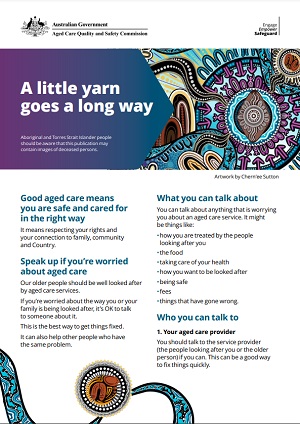
A little yarn goes a long way - Fact sheet
The ‘A little yarn goes a long way’ fact sheet has been developed to inform older Aboriginal and Torres Strait Islander people, and their friends and family, about the support available to help them resolve concerns about aged care services, and why it’s important to raise these concerns.
Information is also available in 7 different languages including: English, Alyawarra, Arrernte, Luritja, Pitjantjatjarra, Torres Strait Creole and Warlpiri.
English - A little yarn goes a long way (PDF 769.91 KB)
Alyawarra - A little yarn goes a long way (PDF 3.74 MB)
Arrernte - A little yarn goes a long way (PDF 3.73 MB)
Luritja - A little yarn goes a long way (PDF 3.73 MB)
Pitjantjatjarra - A little yarn goes a long way (PDF 3.73 MB)
Torres Strait Creole - A little yarn goes a long way (PDF 3.74 MB)
Warlpiri - A little yarn goes a long way (PDF 3.73 MB)
Explaining aged care and your rights – locally tailorable poster - First Nations resources
We’ve developed a tailorable poster for you to edit with your own local details, and print and display at community notice boards or waiting areas.

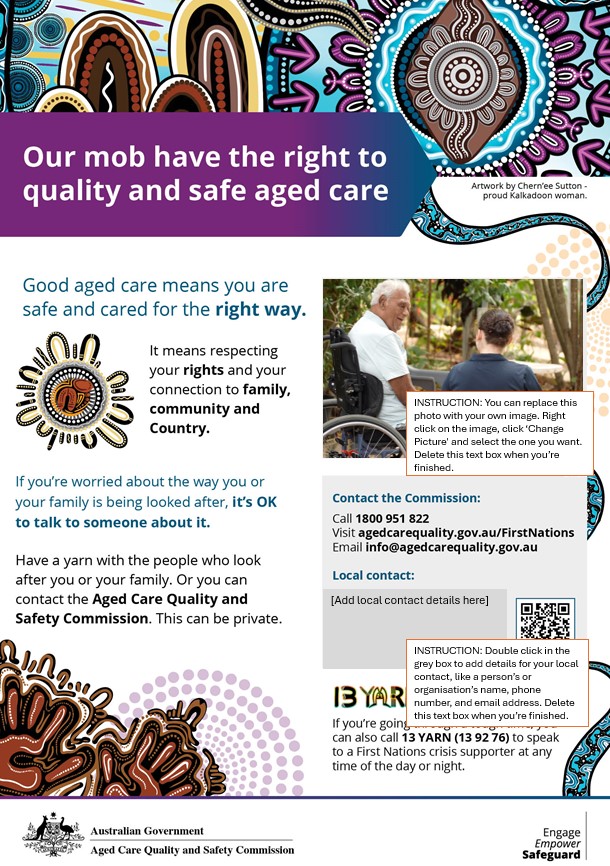
Preventing falls in residential aged care services - Fact sheet
This fact sheet supports the Falls Guidelines for Australian Residential Aged Care Services. It includes recommendations from the falls guidelines about multifaceted interventions, exercise, hip protectors, dairy food provision, vitamin D supplements, and osteoporosis medicines.
This resource may refer to information that will be updated from 1 November 2025 to align with the new Aged Care Act and Quality Standards.
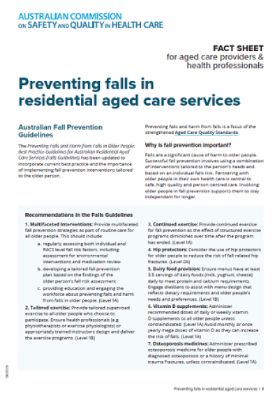
Preventing falls in community care - Fact sheet
This fact sheet supports the Falls Guidelines for Community Care. It includes recommendations from the falls guidelines including exercise to prevent falls, home safety interventions, multi component interventions, and single interventions for specific risk factors.
This resource may refer to information that will be updated from 1 November 2025 to align with the new Aged Care Act and Quality Standards.
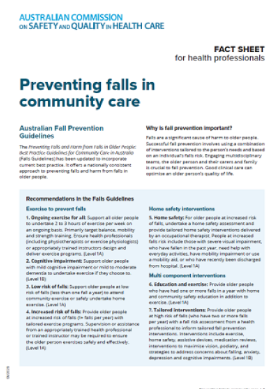
Safe and appropriate use of psychotropic medicines for aged care - Fact sheet
This fact sheet is informed by the Psychotropic Medicines in Cognitive Disability or Impairment Clinical Care Standard (CCS), developed by the Australian Commission on Safety and Quality in Health Care. The CCS describes the safe and appropriate use of psychotropic medicines for people with cognitive disability or impairment, in a way that upholds their rights, dignity, health and quality of life.
This resource may refer to information that will be updated from 1 November 2025 to align with the new Aged Care Act and Quality Standards.
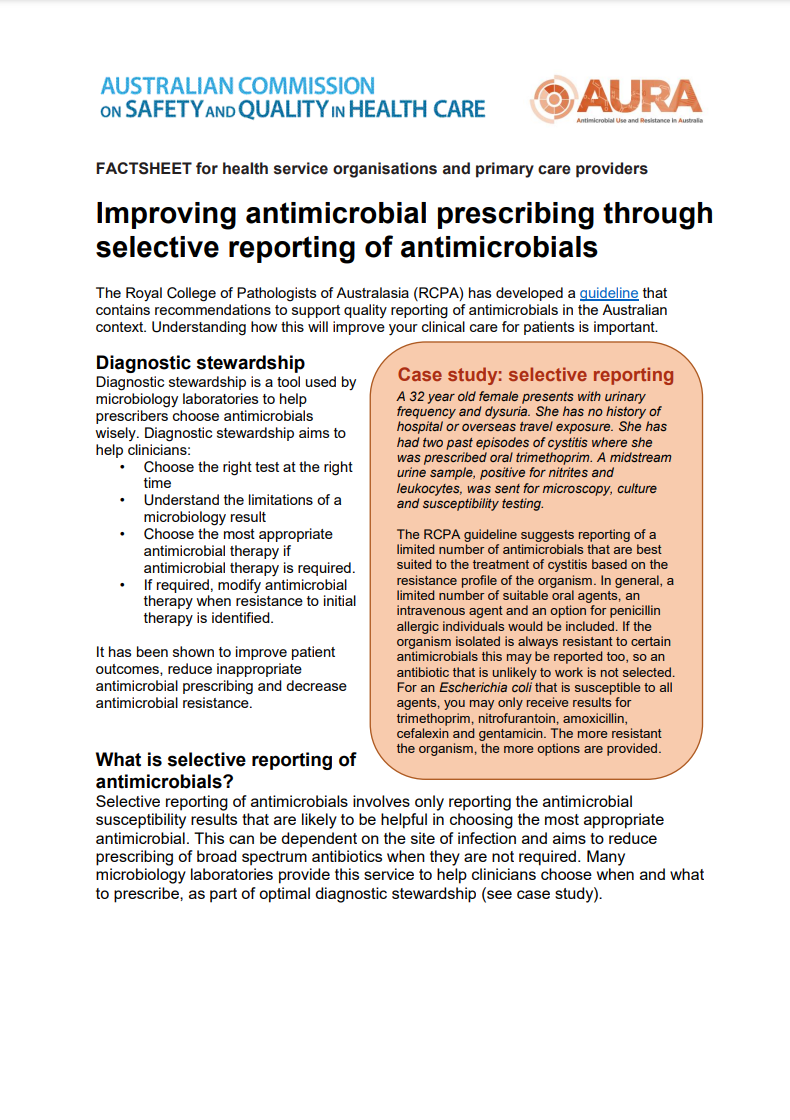
Fact sheet - Improving antimicrobial prescribing through selective reporting of antimicrobials
This fact sheet provides guidance on improving antimicrobial prescribing through selective reporting of antimicrobials for health service organisations and primary care providers. It includes information on diagnostic stewardship, definitions and the importance of selective reporting and other relevant information to support organisations and providers.
This resource may refer to information that will be updated from 1 November 2025 to align with the new Aged Care Act and Quality Standards.
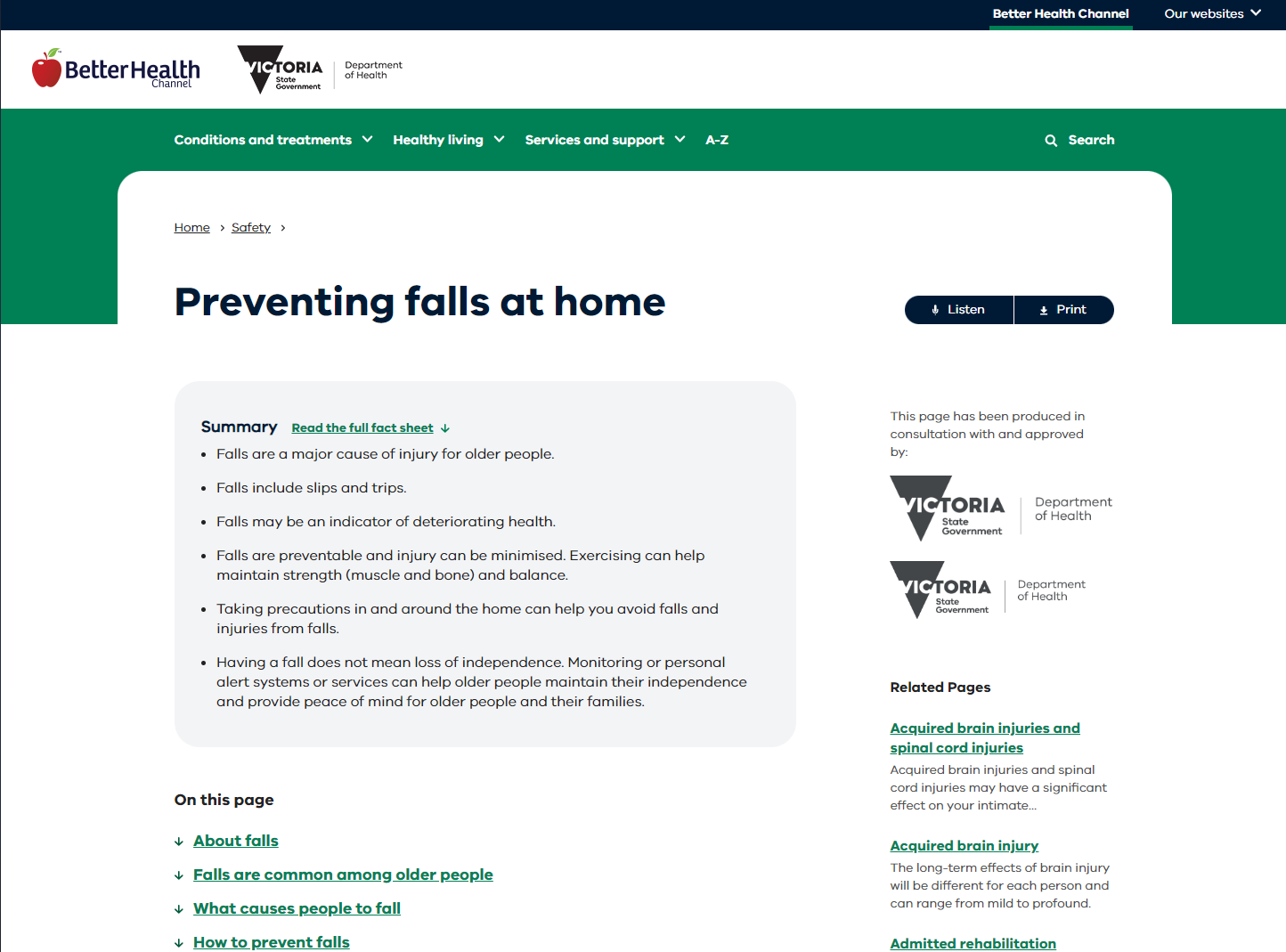
Preventing falls at home
This resource provides information on preventing falls at home for older people. It explains common causes of falls, such as poor lighting and slippery surfaces, and offers practical solutions like home modifications, exercise, and footwear adjustments. The document emphasises maintaining safety in and around the home to reduce the risk of falls.
This resource was developed by a state/territory government or organisation and therefore its applicability and usefulness may be limited.
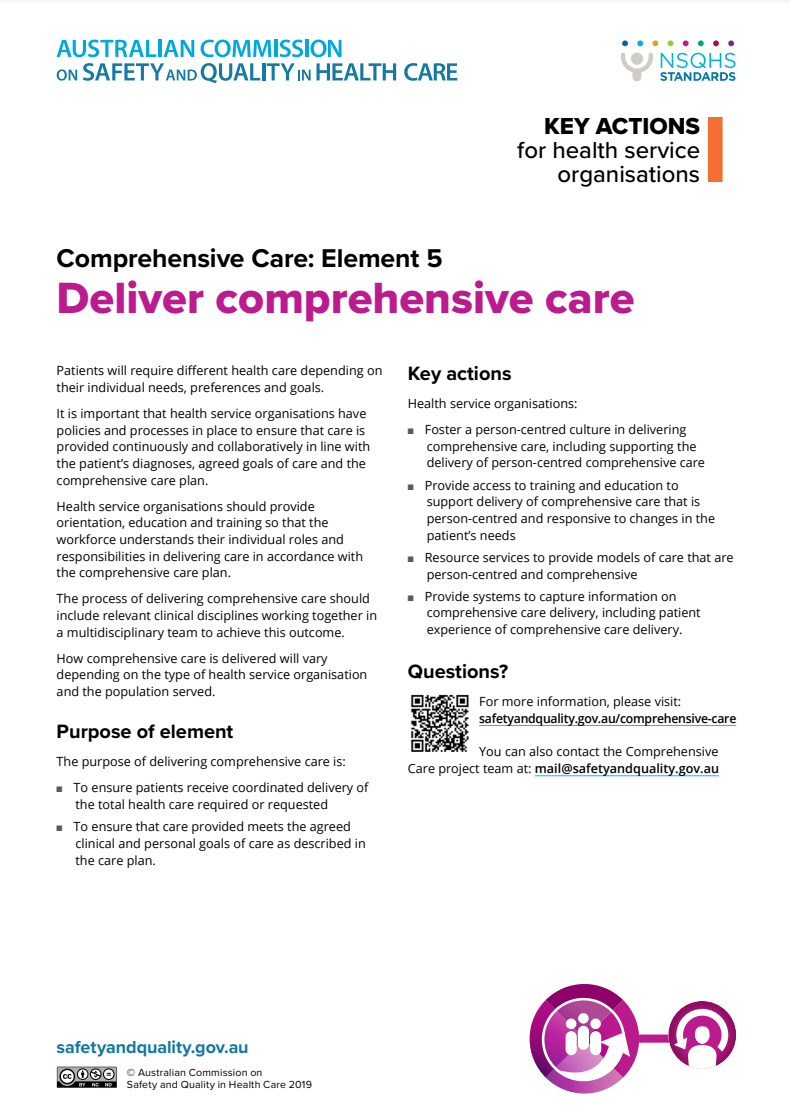
Comprehensive Care - Element 5: Deliver comprehensive care - Actions for health service organisations
This resource outlines the key actions for health service organisations to deliver comprehensive care. It ensures care is provided continuously and collaboratively, aligning with the patient’s diagnoses, goals, and care plan. It promotes a person-centred, multidisciplinary approach, with staff training to support comprehensive care delivery. Applicable to multiple settings, including aged care.
This resource may refer to information that will be updated from 1 November 2025 to align with the new Aged Care Act and Quality Standards.
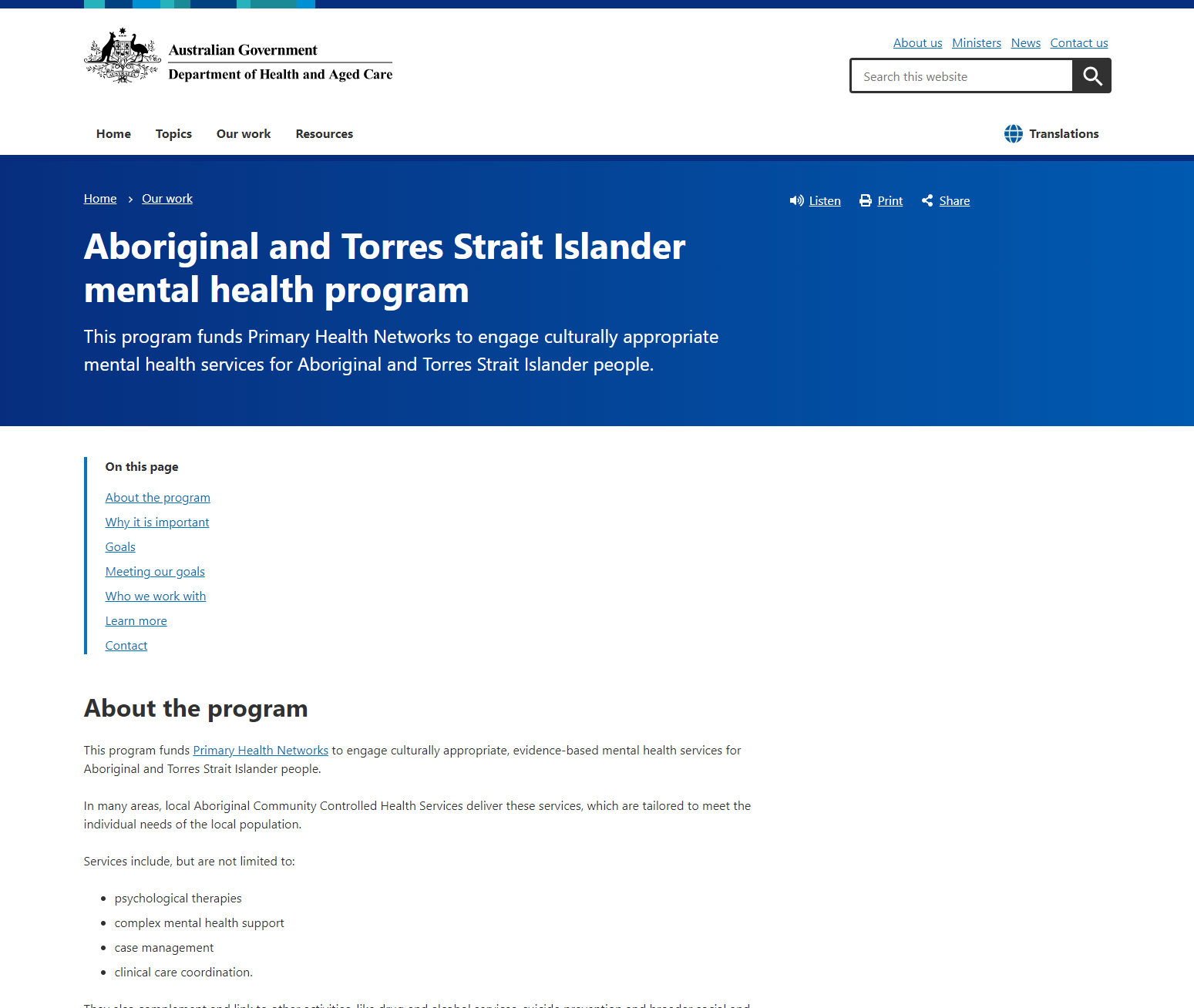
Aboriginal and Torres Strait Islander mental health program
This resource provides information on a mental health program for Aboriginal and Torres Strait Islander people. It includes funding for culturally appropriate mental health services, offering psychological therapies, complex care, and clinical coordination. The program integrates with other services such as drug and alcohol support and suicide prevention initiatives.
This resource may refer to information that will be updated from 1 July 2025 to align with the new Aged Care Act and Quality Standards.
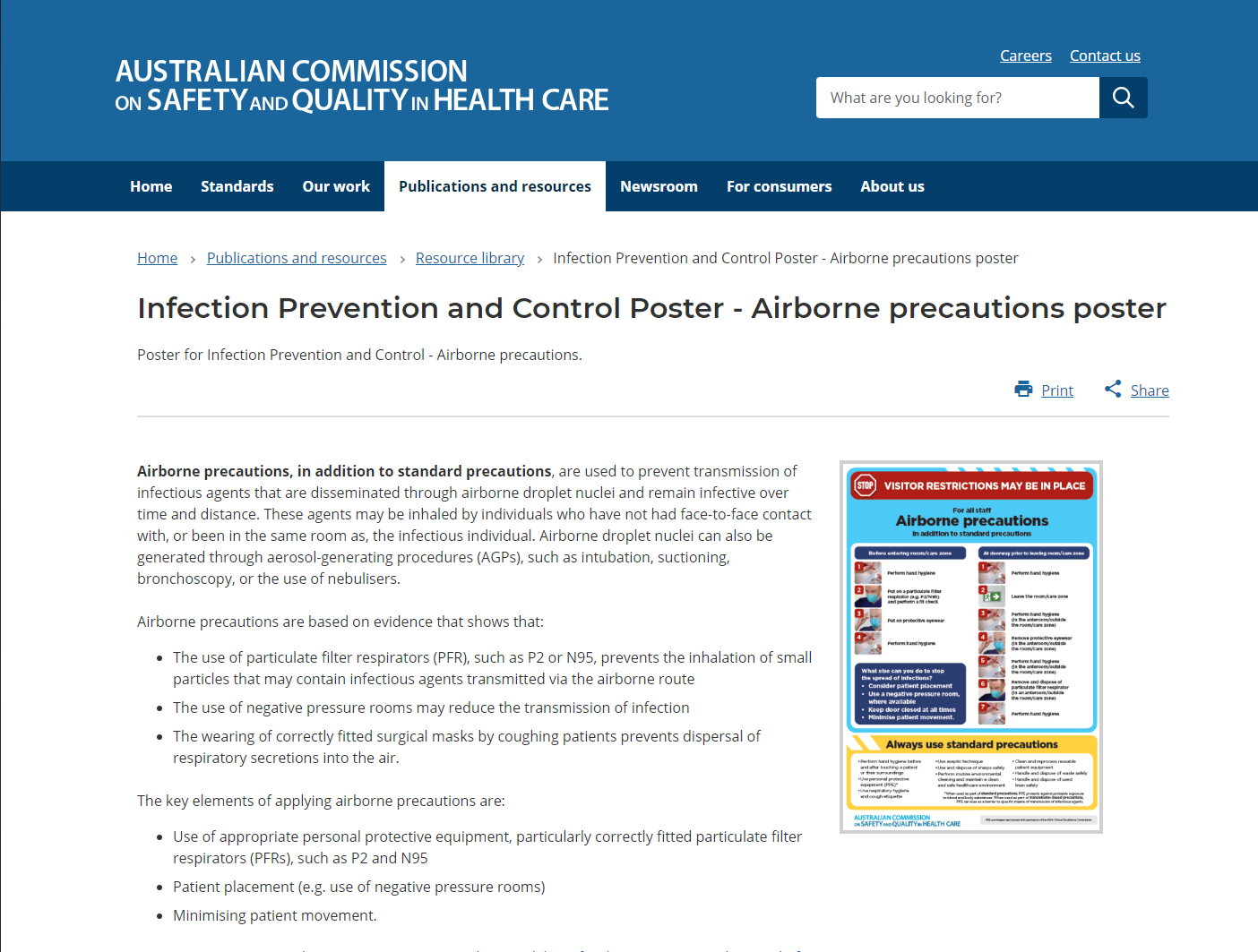
Infection Prevention and Control Poster - Airborne precautions poster
This poster outlines airborne precautions, in addition to standard precautions, for infection prevention and control. It provides guidance on preventing transmission of infectious agents through airborne droplet nuclei using personal protective equipment (PPE), negative pressure rooms, and limiting patient movement to reduce infection risks.
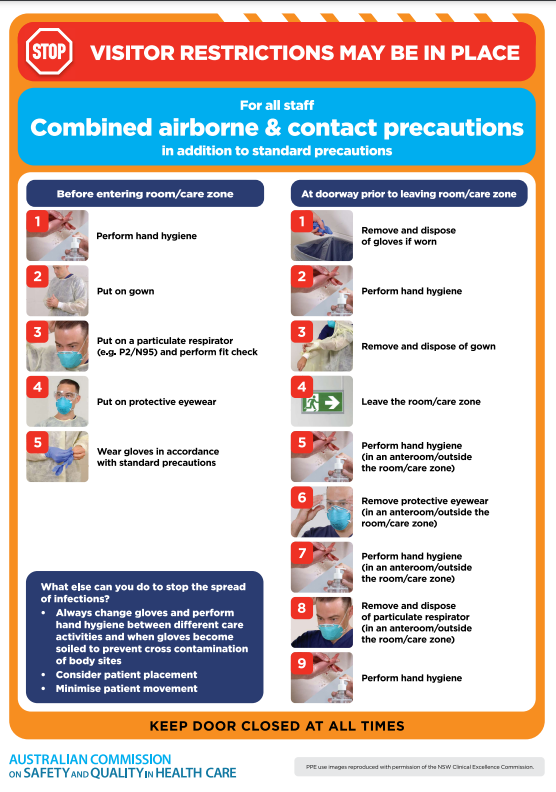
Infection Prevention and Control Poster – Combined airborne and contact precautions
This poster provides guidance on combined airborne and contact precautions for infection prevention and control. It includes information on using personal protective equipment (PPE) and other measures to minimise the spread of infectious agents transmitted through both airborne particles and direct contact.
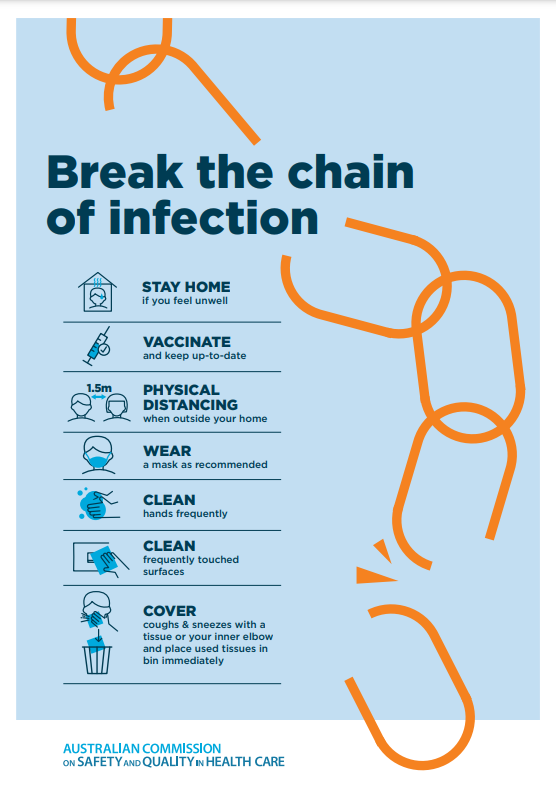
Break The Chain of Infection Poster
This poster outlines key steps to break the chain of infection, including staying home if unwell, physical distancing, frequent handwashing, cleaning surfaces, and covering coughs or sneezes. It aims to prevent the spread of respiratory infections and supports infection prevention practices in healthcare settings.
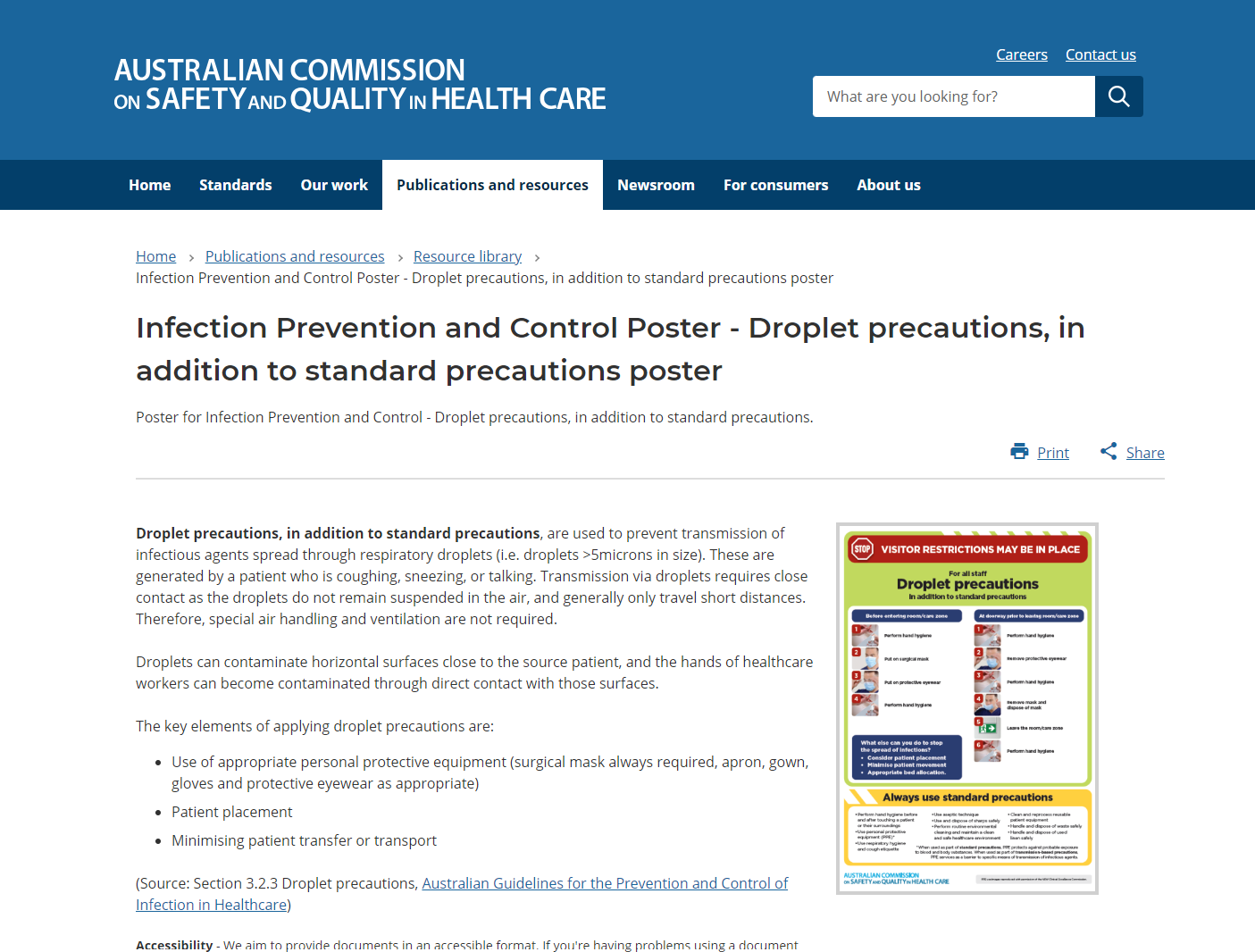
Infection Prevention and Control Poster - Droplet precautions, in addition to standard precautions poster
This resource is a poster on droplet precautions, in addition to standard precautions, for infection prevention. It outlines measures to prevent the transmission of infectious agents spread through respiratory droplets, such as using appropriate personal protective equipment (PPE), patient placement, and minimising patient transport. This resource may apply to healthcare contexts outside of aged care. Please consider the applicability of this resource to your care setting.
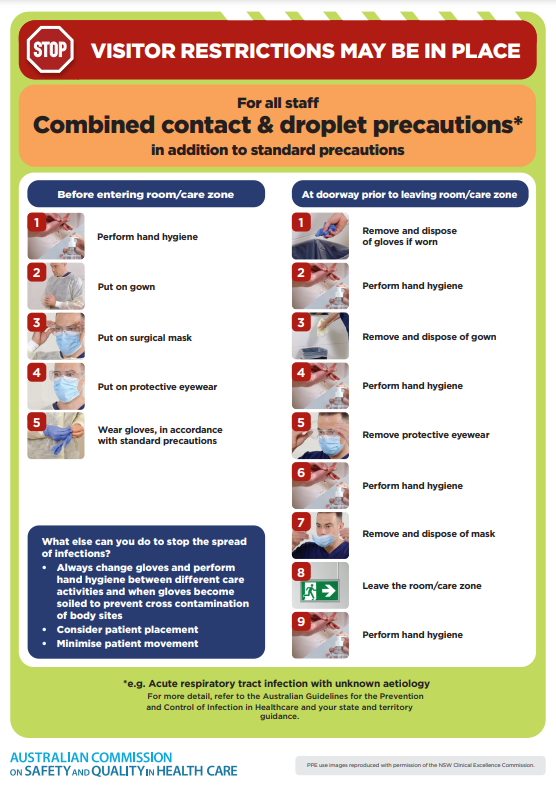
Infection Prevention and Control Poster – Combined contact and droplet precautions
This poster outlines combined contact and droplet precautions for infection prevention and control, in addition to standard precautions. It provides guidance on the use of personal protective equipment (PPE) and other measures to reduce the transmission of infectious agents through direct contact and respiratory droplets.