The Quality Standards Resource Centre helps extend understanding of the strengthened Aged Care Quality Standards, which took effect from 1 November 2025. You can search for resources by using keywords, or filtering by standard, outcome and audience. Before using the Resource Centre, please read the terms of use.
Case study - Safe and Appropriate use of Psychotropic Medicines - In-home Aged Care
This resource is a fictional scenario that follows an older person’s care pathway with an in-home aged care provider. The resource focuses on the systems and processes to support high-quality care of older people living with dementia. It includes 4 key priority areas: person-centred care, medication management, managing changed behaviours and transitions of care.
This resource may refer to information that will be updated from 1 November 2025 to align with the new Aged Care Act and Quality Standards.

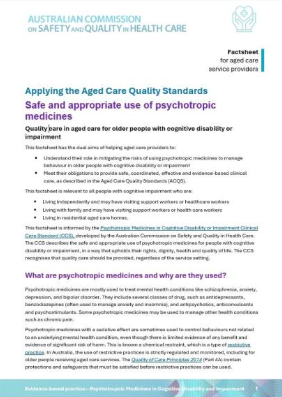
Safe and appropriate use of psychotropic medicines for aged care - Fact sheet
This fact sheet is informed by the Psychotropic Medicines in Cognitive Disability or Impairment Clinical Care Standard (CCS), developed by the Australian Commission on Safety and Quality in Health Care. The CCS describes the safe and appropriate use of psychotropic medicines for people with cognitive disability or impairment, in a way that upholds their rights, dignity, health and quality of life.
This resource may refer to information that will be updated from 1 November 2025 to align with the new Aged Care Act and Quality Standards.
Food focus group resources
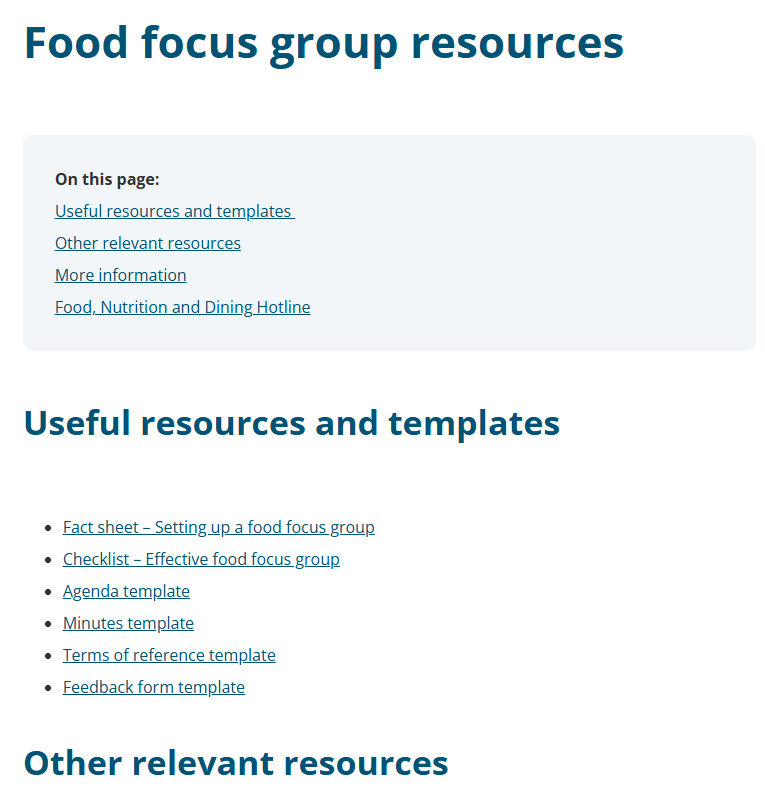
This resource is a collection of resources about food focus groups. It includes a fact sheet about setting up a food focus group and a checklist for an effective food focus group. It also contains associated templates, including agenda, minutes, terms of reference and feedback form.
This resource may refer to information that will be updated from 1 November 2025 to align with the new Aged Care Act and Quality Standards.
Renewal of registration audit guide
This guide helps you prepare for and take part in a renewal of registration audit.
It describes:
- the purpose of audits and how they inform (help us make) registration decisions
- the 3 stages of the audit process (initiation, delivery, reporting)
- what to expect and what to do at each stage
- the types of evidence we consider during audits
- how we define our audit ratings
- the audit tools we use
- other relevant resources.
 Renewal of registration audit guide (PDF 471.26 KB)
Supporting visitors and partners in care with IPC
This resource offers guidance for aged care providers on supporting visitors and partners in care through infection prevention and control (IPC) measures. It includes training resources to help visitors follow IPC protocols and maintain safe care, especially during infectious outbreaks, through the 'Partnerships in Care' program.
This resource may refer to information that will be updated from 1 November 2025 to align with the new Aged Care Act and Quality Standards.
Celebrating successes in engaging people to improve food, nutrition and dining
This resource highlights successful practices in engaging older people to improve food, nutrition, and dining experiences. Providers can use examples like food focus groups, family involvement in recipe changes, and resident-led dining committees to promote enjoyable, dignified, and inclusive dining. It fosters better health, wellbeing, and relationships with staff.
This resource may refer to information that will be updated from 1 November 2025 to align with the new Aged Care Act and Quality Standards.
Food, nutrition & dining: resources for workers
This resource provides aged care workers with tools to enhance food, nutrition, and dining experiences for people in their care. It includes practical guides on offering choice, managing swallowing difficulties, promoting oral health, and creating an enjoyable dining environment, all while ensuring adherence to aged care standards.
This resource may refer to information that will be updated from 1 November 2025 to align with the new Aged Care Act and Quality Standards.
Nourishing connections: The vital role of social dining in aged care
This resource explains how social dining in aged care can enhance nutrition and wellbeing by fostering social connections. It encourages creating positive dining environments that promote engagement and respect personal preferences during mealtimes.
This resource may refer to information that will be updated from 1 November 2025 to align with the new Aged Care Act and Quality Standards.
Supporting people living with dementia to eat and drink well
This resource provides guidance for aged care services on how to support people living with dementia to eat and drink well. It highlights innovative approaches such as creating familiar, enjoyable meals, reducing mealtime interruptions, and offering 24-hour access to nutritious foods. These strategies help address challenges like malnutrition and dehydration.
This resource may refer to information that will be updated from 1 November 2025 to align with the new Aged Care Act and Quality Standards.
Using technology to improve the dining experience
This resource provides guidance on how technology, such as virtual reality (VR) and mobile applications, can enhance the dining experience in aged care settings. These tools are designed to increase engagement, support meal choices, improve communication with families, and contribute to overall wellbeing by making mealtimes more enjoyable.
This resource may refer to information that will be updated from 1 November 2025 to align with the new Aged Care Act and Quality Standards.
Visitor restrictions
This resource provides guidelines on visitor restrictions for aged care services during infectious outbreaks, such as COVID-19. It includes information on managing the impact of restrictions, ensuring the safety and wellbeing of care recipients, and balancing health risks with the need for social connection to prevent negative physical and psychological effects.
This resource may refer to information that will be updated from 1 November 2025 to align with the new Aged Care Act and Quality Standards.
Short Term Restorative Care Program
This resource outlines the Short Term Restorative Care (STRC) Program which offers early interventions aimed at reversing or slowing functional decline in older people to enhance their wellbeing. It provides care for up to 8 weeks in home or residential settings, helping people regain independence. STRC is part of a broader care system, alongside other aged care services.
This resource may refer to information that will be updated from 1 November 2025 to align with the new Aged Care Act and Quality Standards.
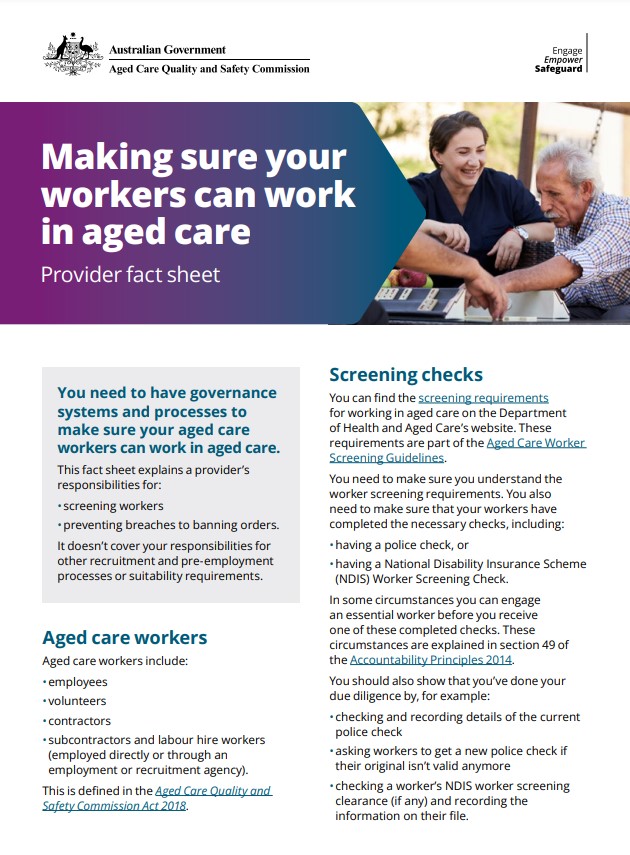
Making sure your workers can work in aged care
Registered providers need to have governance systems and processes to make sure their aged care workers can work in aged care. This fact sheet explains providers’ obligations to:
- screen aged care workers
- make sure aged care workers don’t have banning orders against them that restrict or ban them from being involved in aged care.
Making sure your workers can work in aged care (PDF 469.26 KB)
Outbreak Management Plan - key features
Outbreak management planning is a key part of infection prevention and control. This document supports both the development of a new outbreak management plan (OMP) and the quality assurance of existing plans. It details common OMP sections to get you started as you tailor your OMP to your service.
This resource may refer to information that will be updated from 1 November 2025 to align with the new Aged Care Act and Quality Standards.
Outbreak Management Plan - Key features (PDF 839.81 KB)

Outbreak Management Plan - stress testing outline
Having a comprehensive and organisation-specific outbreak management plan (OMP) helps your organisation to be prepared for the management of infections and outbreaks within your service. A key part of this readiness is ensuring that your OMP is fit-for-purpose and that everyone across the organisation can implement it if required. One way to maintain readiness and support continuous improvement of your OMP is to run regular drills, or stress tests, of your plan.
Outbreak Management Plan - stress testing outline (PDF 424.34 KB)
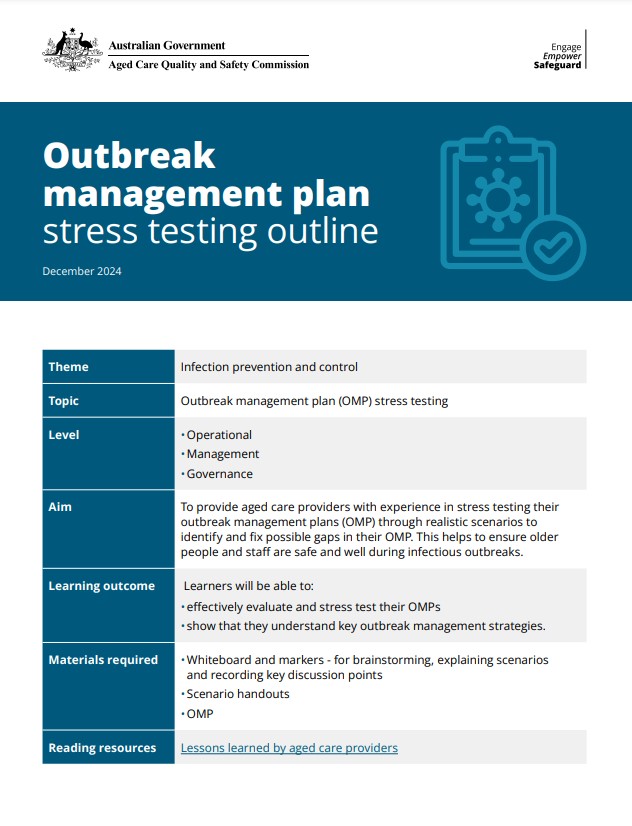
Liquidity calculator for registered providers in the aged care sector
This calculator informs registered providers of the minimum level of liquid assets they are required to hold calculated based on Quarterly Financial Report (QFR) financial statements.
 Liquidity calculator instructions (PDF 768.4 KB)
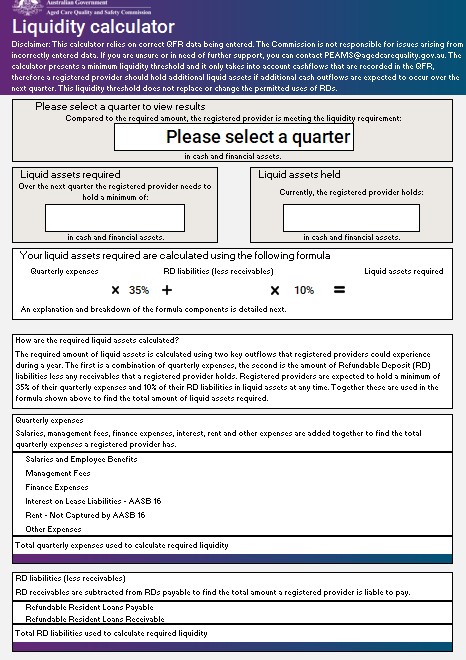
First Nations - Workplace poster - Standard 1 The individual
These workplace standards posters demonstrate the strengthened Standards and what they mean for aged care providers and workers. You can print these out and display them around your workplace.
First Nations - Visual information sheet - Your rights when accessing aged care
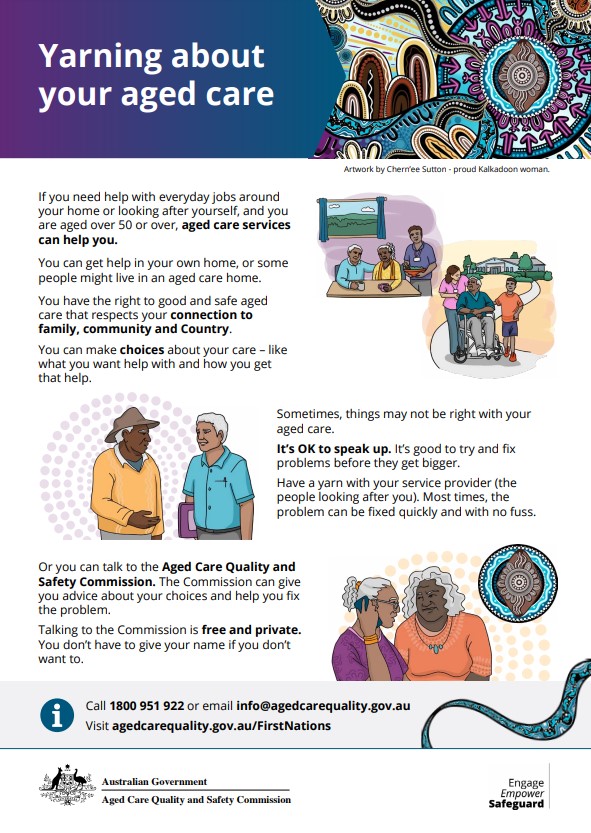
Yarning about your aged care (PDF 645.07 KB)
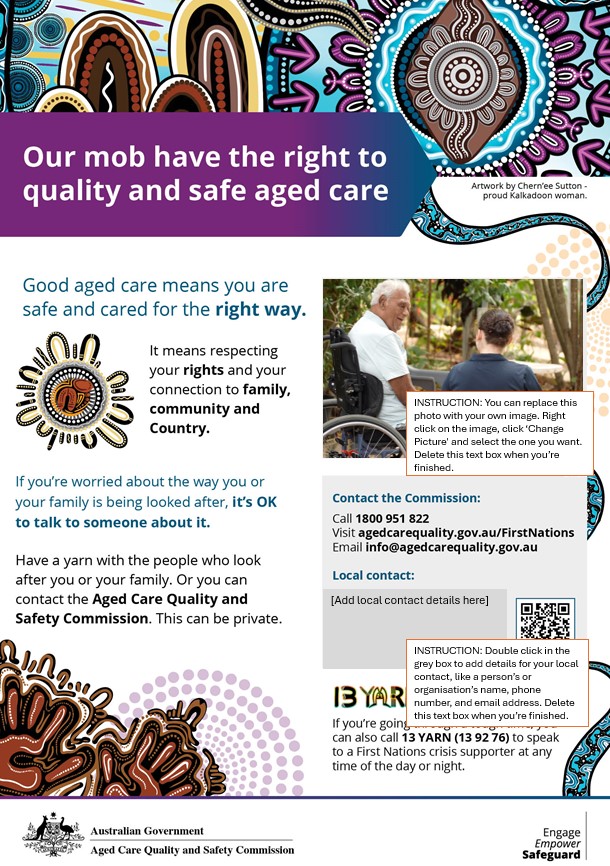
Explaining aged care and your rights – locally tailorable poster - First Nations resources
We’ve developed a tailorable poster for you to edit with your own local details, and print and display at community notice boards or waiting areas.

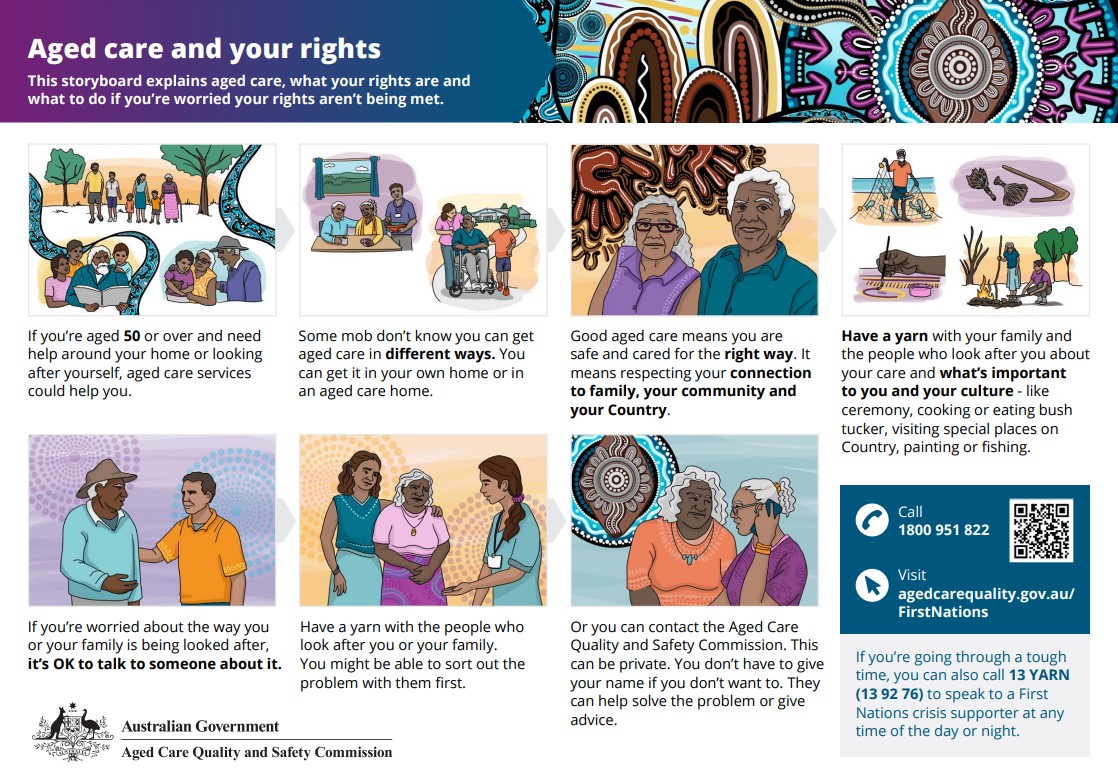
First Nations - Visual Storyboard - Aged care and your rights
The storyboards use pictures to explain aged care, your rights and what to do if your rights aren’t being met.
Aged care and your rights – visual storyboard (PDF 803.63 KB)