The Quality Standards Resource Centre helps extend understanding of the strengthened Aged Care Quality Standards, which take effect from 1 November 2025. The Resource Centre will be updated to reflect key changes made to the draft strengthened Standards. You can search for resources by using keywords, or filtering by standard, outcome, audience and theme. Before using the Resource Centre, please read the terms of use.
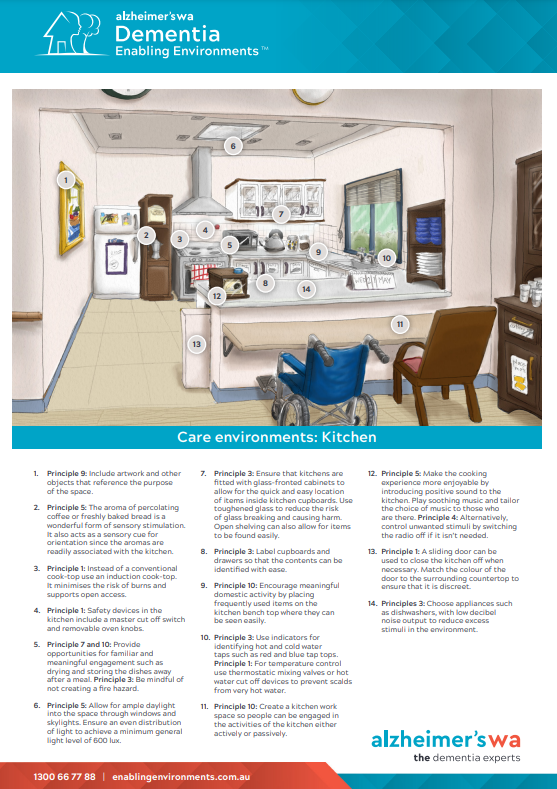
Dementia enabling environments - Care environments: Kitchen
This resource, developed by Alzheimer's WA, is a Dementia Enabling Environments illustration information sheet about kitchens in care environments. It includes principles to create enabling spaces and information about how to design the physical environment to maximise enablement and wellbeing for people living with dementia.
This resource was developed by a state/territory government or organisation and therefore its applicability and usefulness may be limited.
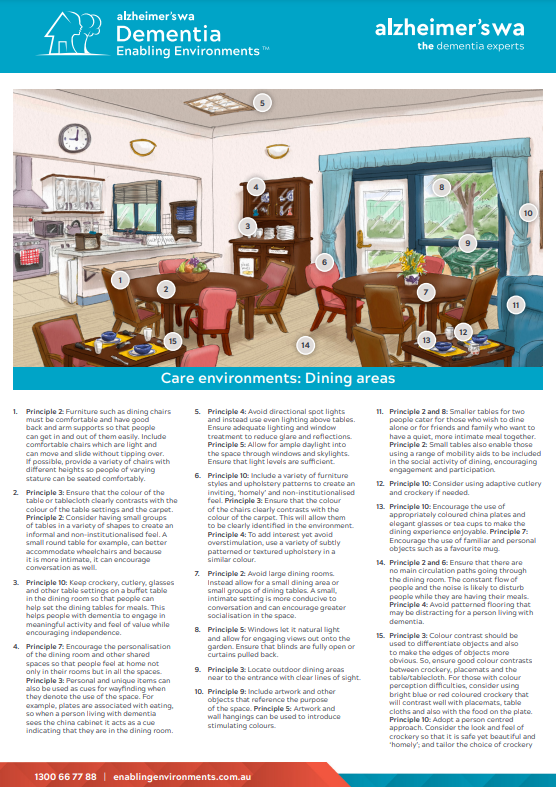
Dementia enabling environments - Care environments: Dining areas
This resource, developed by Alzheimer's WA, is a Dementia Enabling Environments illustration information sheet about dining areas in care environments. It includes principles to create enabling spaces and information about how to design the physical environment to maximise enablement and wellbeing for people living with dementia.
This resource was developed by a state/territory government or organisation and therefore its applicability and usefulness may be limited.
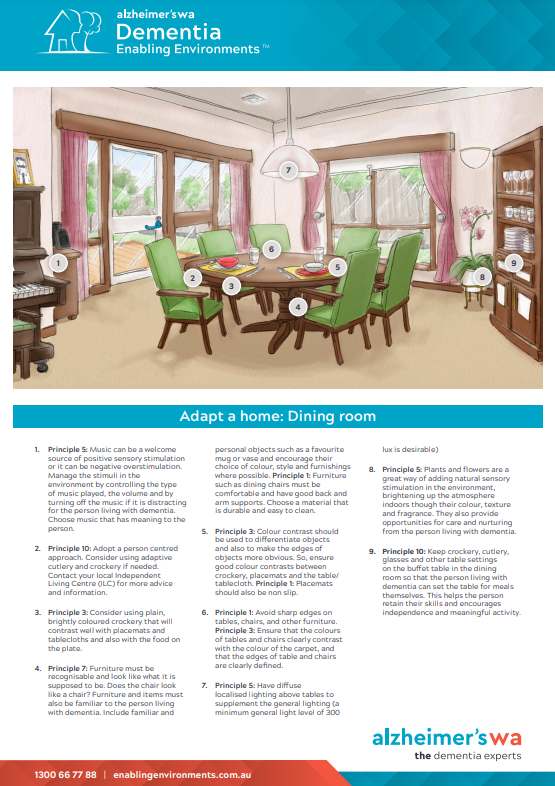
Dementia enabling environments - Adapt a home: Dining room
This resource, developed by Alzheimer's WA, is a Dementia Enabling Environments illustration information sheet about adapting a home, focusing on the dining room. It includes principles to integrate enabling design and make changes within the physical environment to maximise enablement and wellbeing for people living with dementia.
This resource was developed by a state/territory government or organisation and therefore its applicability and usefulness may be limited.
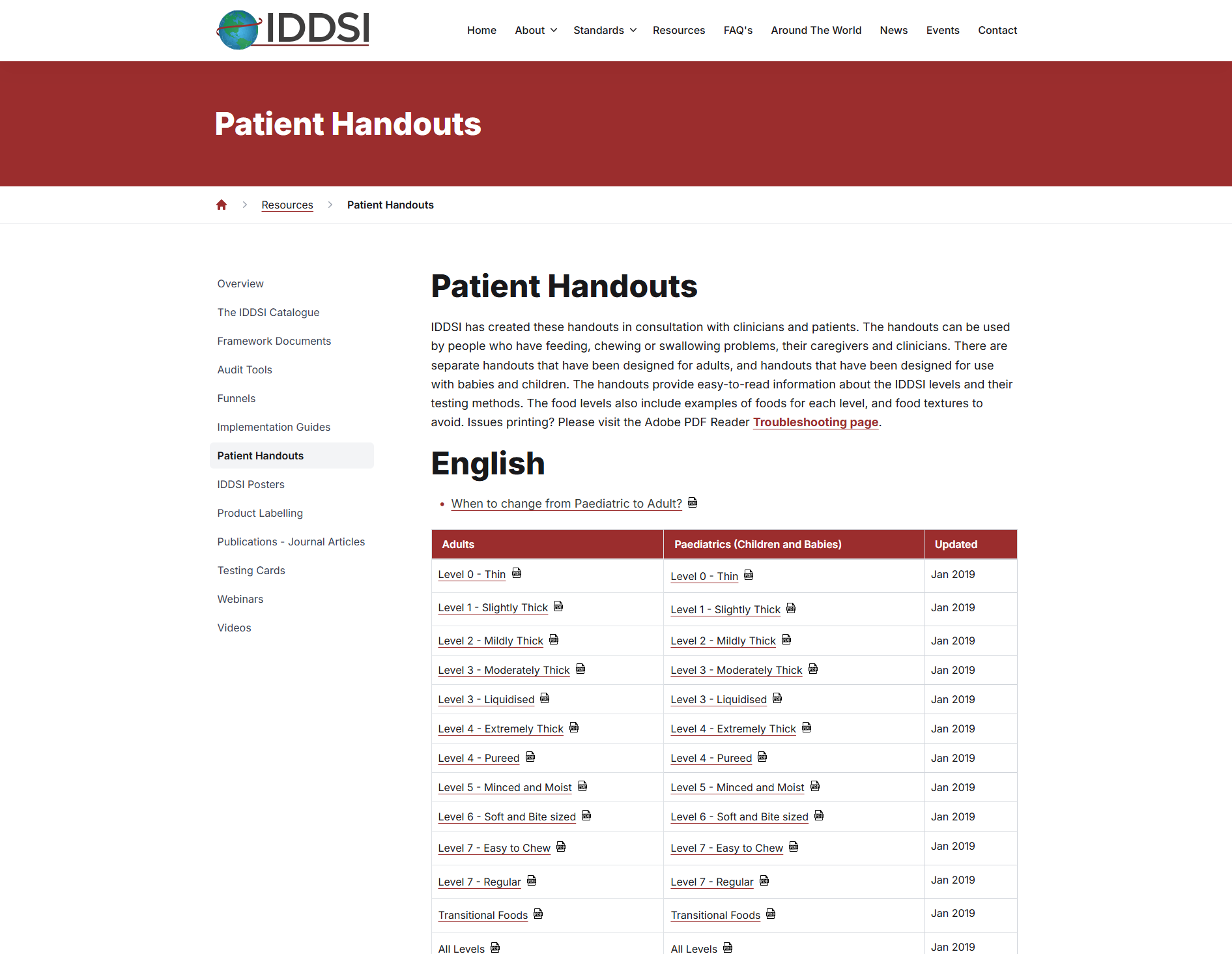
International Dysphagia Diet Initiative - Patient Handouts
This resource provides handouts tailored for people with feeding, chewing, or swallowing difficulties and their carers. It explains the IDDSI framework, describing food texture levels and appropriate testing methods. Separate versions are available for adults and children, each detailing recommended food textures to support safe swallowing practices.
This resource was developed internationally and therefore its applicability and usefulness may be limited.
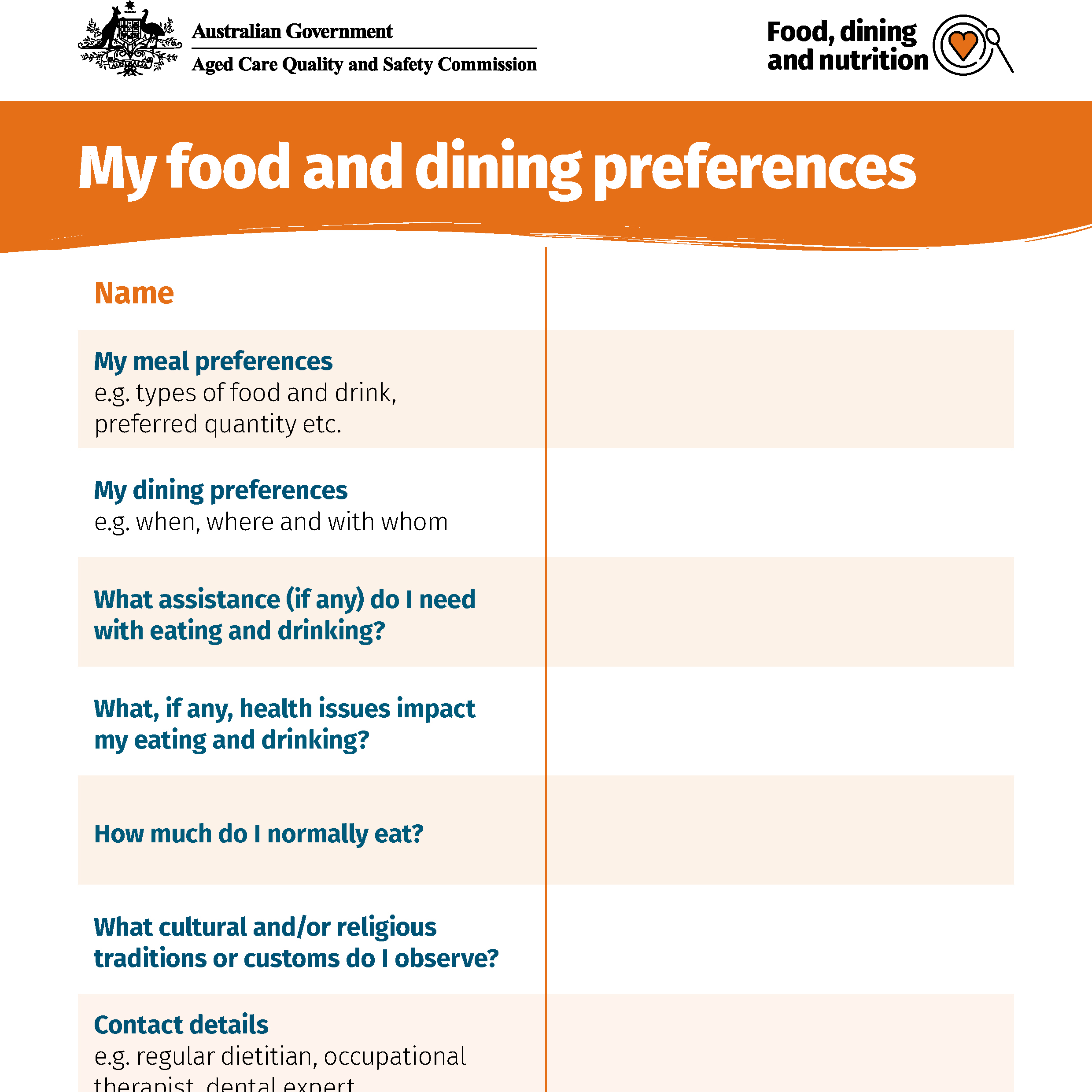
My food and dining preferences - form
This fact sheet helps aged care residents communicate their food and dining preferences. It includes sections for meal choices, dining preferences, assistance needs, health considerations, cultural or religious customs, and contact information for allied health professionals. It also advises staff to monitor changes in weight and contact a dietitian if needed.
This resource may refer to information that will be updated from 1 November 2025 to align with the new Aged Care Act and Quality Standards.
 My food and dining preferences form (PDF 378.98 KB)
Arabic - تفضيلاتي في الطعام وعادات الأكل (PDF 426.01 KB)
French - Mes préférences alimentaires et de repas (PDF 365.82 KB)
German - Meine Essens- und Speisevorlieben (PDF 358.86 KB)
Greek - Οι προτιμήσεις μου για το φαγητό και τα γεύματα (PDF 359.43 KB)
Hungarian - Étel- és étkezési preferenciák (PDF 369.35 KB)
Macedonian - Моите желби во врска со храната и јадењето (PDF 358.79 KB)
Maltese - Il-preferenzi tiegħi tal-ikel u l-ikliet (PDF 364.67 KB)
Portuguese - Minhas preferências alimentares e gastronômicas (PDF 373.26 KB)
Russian - Мои предпочтения в еде и приеме пищи (PDF 353.14 KB)
Serbian - Моје жеље које се тичу хране и обедовања (PDF 353.84 KB)
Simplified Chinese - 我的饮食及用餐偏好 (PDF 420.97 KB)
Traditional Chinese - 我的飲食及用餐偏好 (PDF 422.91 KB)
Spanish - Mis preferencias de alimentos y comidas (PDF 365.1 KB)
Vietnamese - Sở thích ăn uống và thực phẩm của tôi (PDF 340.54 KB)
My food and dining preferences form (PDF 378.98 KB)
Arabic - تفضيلاتي في الطعام وعادات الأكل (PDF 426.01 KB)
French - Mes préférences alimentaires et de repas (PDF 365.82 KB)
German - Meine Essens- und Speisevorlieben (PDF 358.86 KB)
Greek - Οι προτιμήσεις μου για το φαγητό και τα γεύματα (PDF 359.43 KB)
Hungarian - Étel- és étkezési preferenciák (PDF 369.35 KB)
Macedonian - Моите желби во врска со храната и јадењето (PDF 358.79 KB)
Maltese - Il-preferenzi tiegħi tal-ikel u l-ikliet (PDF 364.67 KB)
Portuguese - Minhas preferências alimentares e gastronômicas (PDF 373.26 KB)
Russian - Мои предпочтения в еде и приеме пищи (PDF 353.14 KB)
Serbian - Моје жеље које се тичу хране и обедовања (PDF 353.84 KB)
Simplified Chinese - 我的饮食及用餐偏好 (PDF 420.97 KB)
Traditional Chinese - 我的飲食及用餐偏好 (PDF 422.91 KB)
Spanish - Mis preferencias de alimentos y comidas (PDF 365.1 KB)
Vietnamese - Sở thích ăn uống và thực phẩm của tôi (PDF 340.54 KB)
Dining in residential aged care - tips and tricks fact sheet
This fact sheet provides practical tips for enhancing dining experiences in residential aged care settings. It offers guidance on food presentation, meal assistance, creating a respectful and enjoyable atmosphere, supporting independence, and providing culturally appropriate dining options. The aim is to improve mealtime satisfaction while maintaining older peoples' dignity and people's preferences.
This resource may refer to information that will be updated from 1 November 2025 to align with the new Aged Care Act and Quality Standards.
Dining in residential aged care – tips, tricks and what to avoid (PDF 484.37 KB)
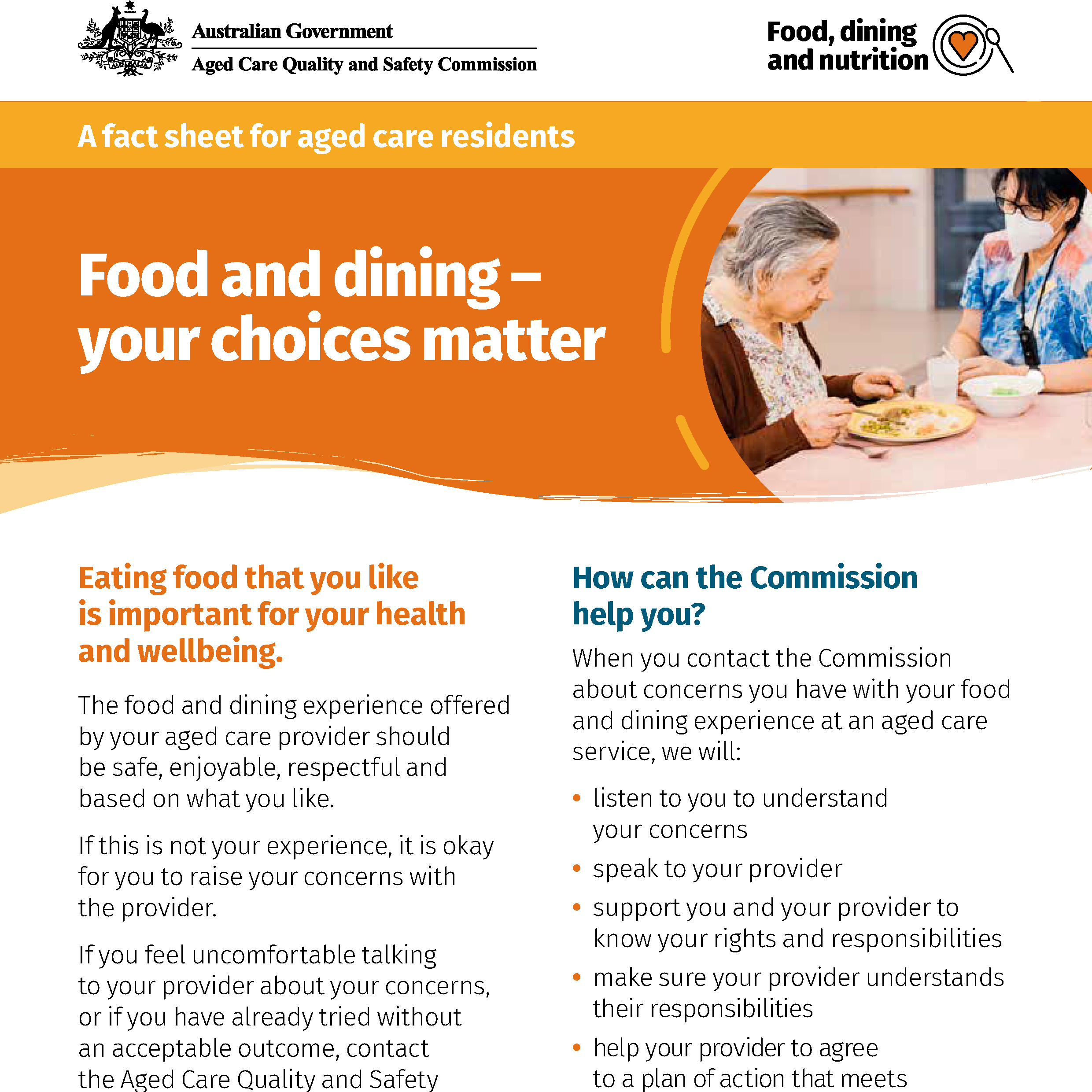
Food and dining - your choices matter
This fact sheet informs aged care residents of their rights to safe, enjoyable, and respectful dining experiences. It outlines steps for raising concerns with providers about food and dining, offers a preference form for residents to communicate their dietary needs, and provides contact information for support services if issues remain unresolved. This resource may refer to information that will be updated from 1 November 2025 to align with the new Aged Care Act and Quality Standards.
English - Food and dining – your choices matter (PDF 484.79 KB)
Arabic - تهمّّنا تفضيلاتكم في الطعام وعادات الأكل (PDF 767.17 KB)
Chinese Simplified - 食品和餐饮—— 您的选择很重要 (PDF 785.39 KB)
Chinese Traditional - 食品和餐飲—— 您的選擇很重要 (PDF 788.7 KB)
French - Alimentation et repas – vos choix sont importants (PDF 684.4 KB)
German - Essen und Speisen – Ihre Wahl zählt (PDF 686.18 KB)
Greek - Φαγητό και γεύματα – οι επιλογές σας έχουν σημασία (PDF 690.89 KB)
Hungarian - Ételek és étkezés – az Ön döntése számít (PDF 684.42 KB)
Macedonian - Храна и јадење - вашиот избор е важен (PDF 683.21 KB)
Maltese - L-ikel u l-ikliet - l-għażliet tiegħek huma importanti (PDF 685.65 KB)
Russian - Питание и прием пищи: ваш выбор имеет значение (PDF 682.53 KB)
Serbian - Храна и обедовање – ваш избор је важан (PDF 681.46 KB)
Spanish - Alimentos y comidas: sus preferencias importan (PDF 679.42 KB)
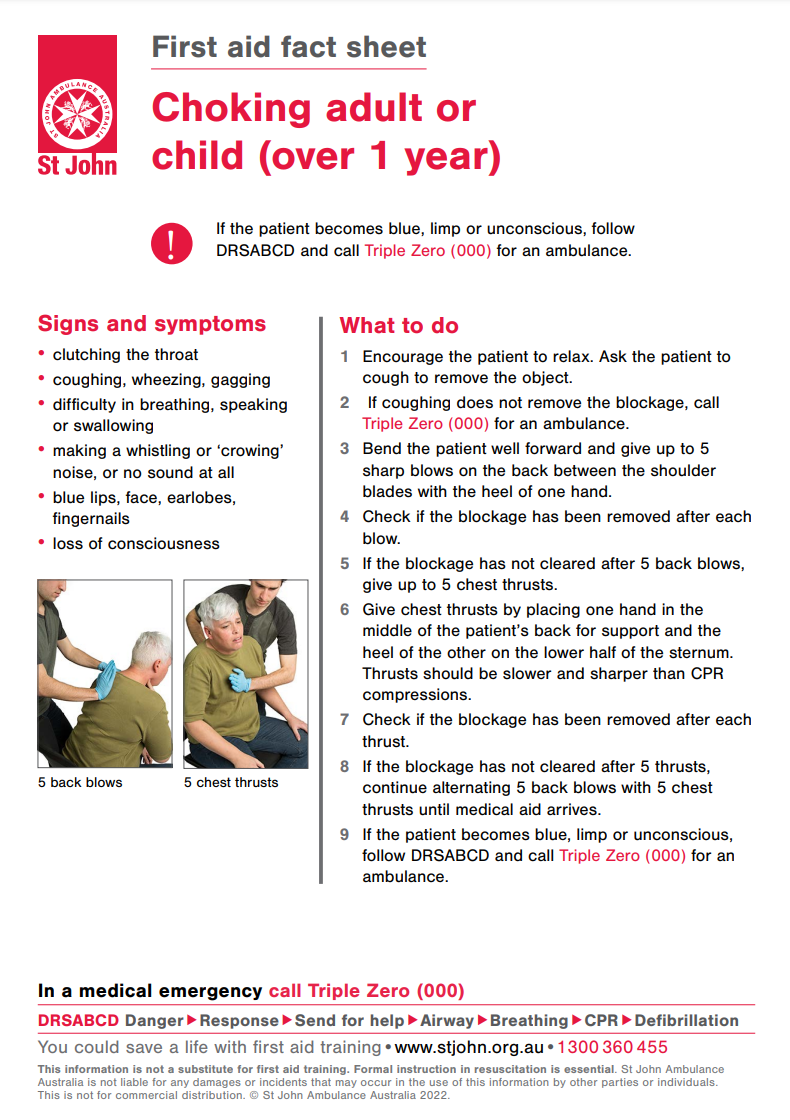
First aid fact sheet - Choking adult or child (over 1 year)
This fact sheet provides first aid instructions for choking in adults or children over one year. It details recognising choking symptoms and steps for emergency care and guidance to call emergency services if necessary.
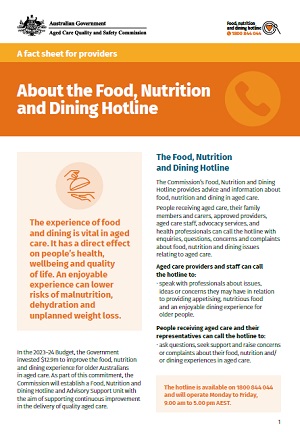
About the Food, Nutrition and Dining Hotline – provider and worker fact sheet
This resource provides information about the Food, Nutrition, and Dining Hotline, which offers advice and addresses concerns regarding food and dining in aged care. It allows aged care providers, staff, residents, families, and carers to raise issues about nutrition, menu planning, and dining experiences to improve quality and care outcomes. This resource may refer to information that will be updated from 1 November 2025 to align with the new Aged Care Act and Quality Standards.