Low-value urine dipstick testing practice in aged care is a common, yet modifiable, driver of antibiotic overuse for conditions such as asymptomatic bacteriuria.
The Commission undertook a project to evaluate the feasibility and useability of To Dip Or Not To Dip (TDONTD) in Australian aged care services.
 To Dip or Not To Dip project summary (PDF 412.34 KB)

This Regulatory Bulletin provides information on the information that the Commission publishes on aged care providers’ performance in relation to their responsibilities as providers. The Commission also publishes information on the Commission’s website and My Aged Care about outcomes of regulatory decisions, including the Service Compliance Rating for Star Ratings.
 RB 2023-18 – Publication of provider performance information (DOCX 172.12 KB)
This Regulatory Bulletin provides guidance on banning orders, the circumstances in which the Commission will make a banning order and the approach that will be taken when deciding whether or not to do so. It includes information on the consequences of breaching a banning order, variation and revocation of banning orders and publication of information on banning orders.
RB 2023–17 Regulatory Bulletin - Banning orders (PDF 408.74 KB)
This paper presents a high-level overview of contemporary evidence regarding food services in residential aged care settings.
Residential aged care food services discussion paper (PDF 536.47 KB)

Download a PDF of the slides that were used in the 15 December 2022 webinar, Aged care sector reforms – current status and what’s next?
Aged care sector reforms – current status and what’s next? (PDF 25.49 MB)

This document contains a summary of all available resources for Provider Governance as at 15 December 2022
Provider governance Resources (PDF 537.34 KB)
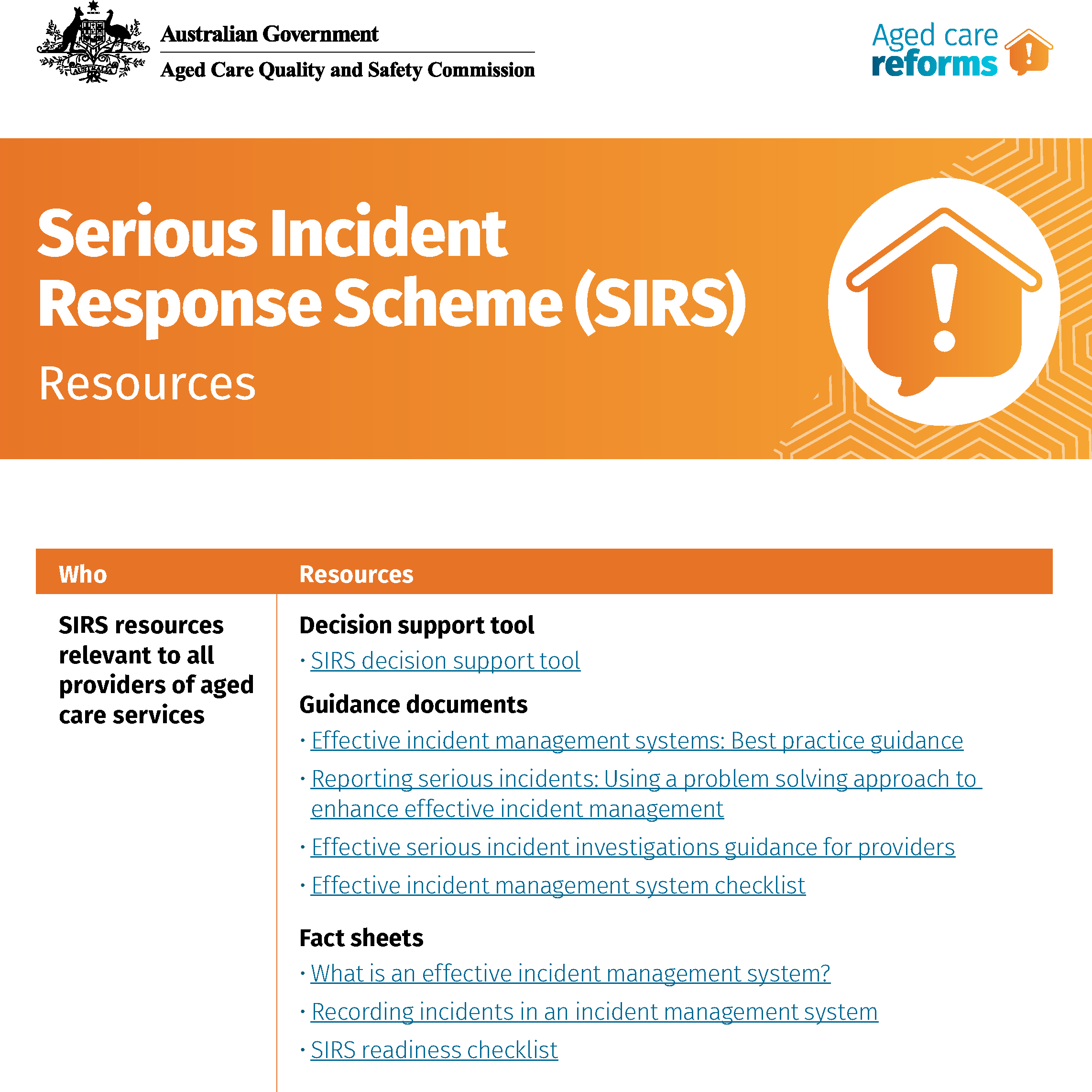
This document contains a summary of all available resources for SIRS as at 15 December 2022
SIRS resources (PDF 876.92 KB)
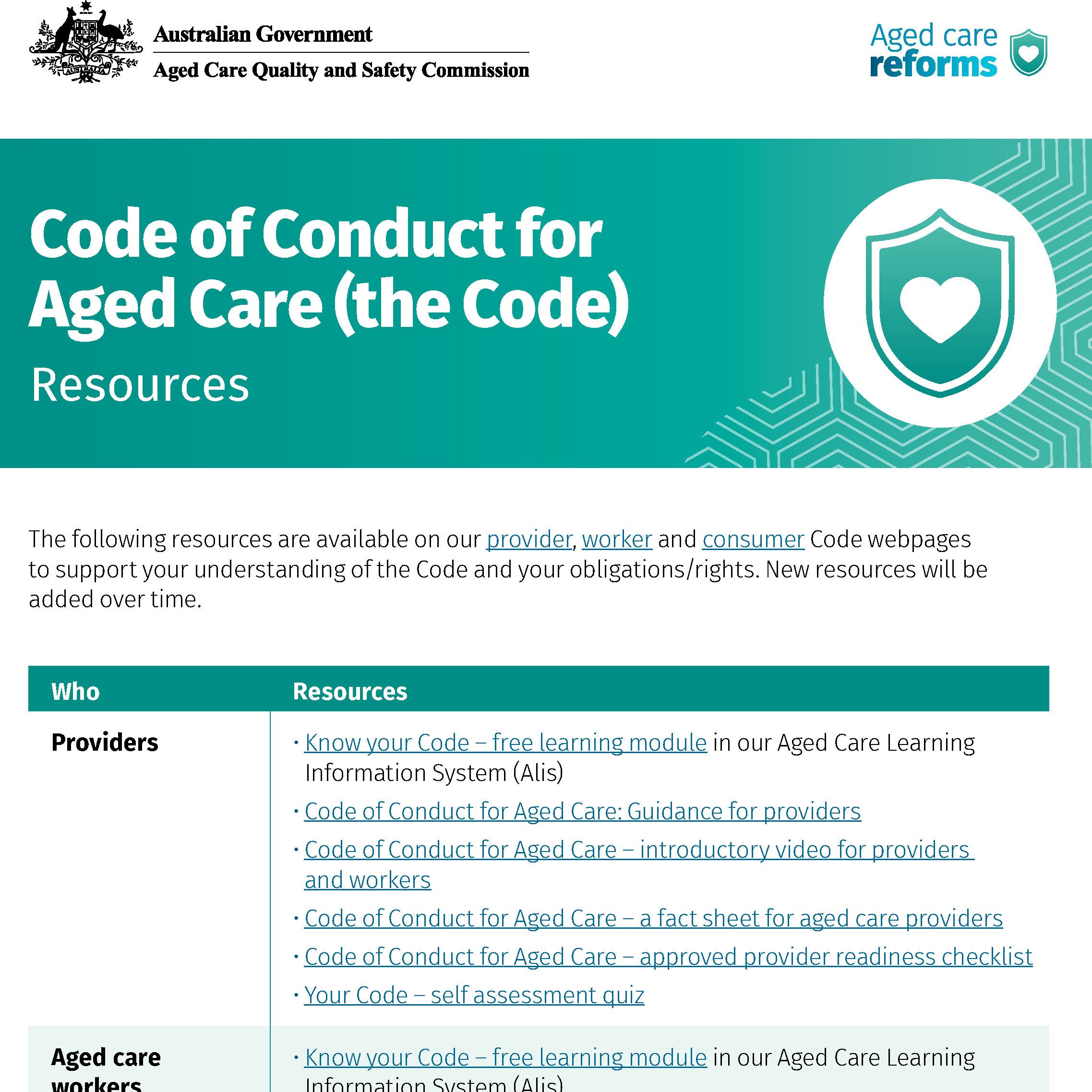
This document contains a summary of all available resources for the Aged Care Code of Conduct.
Aged Care Code of Conduct resources (PDF 504.04 KB)
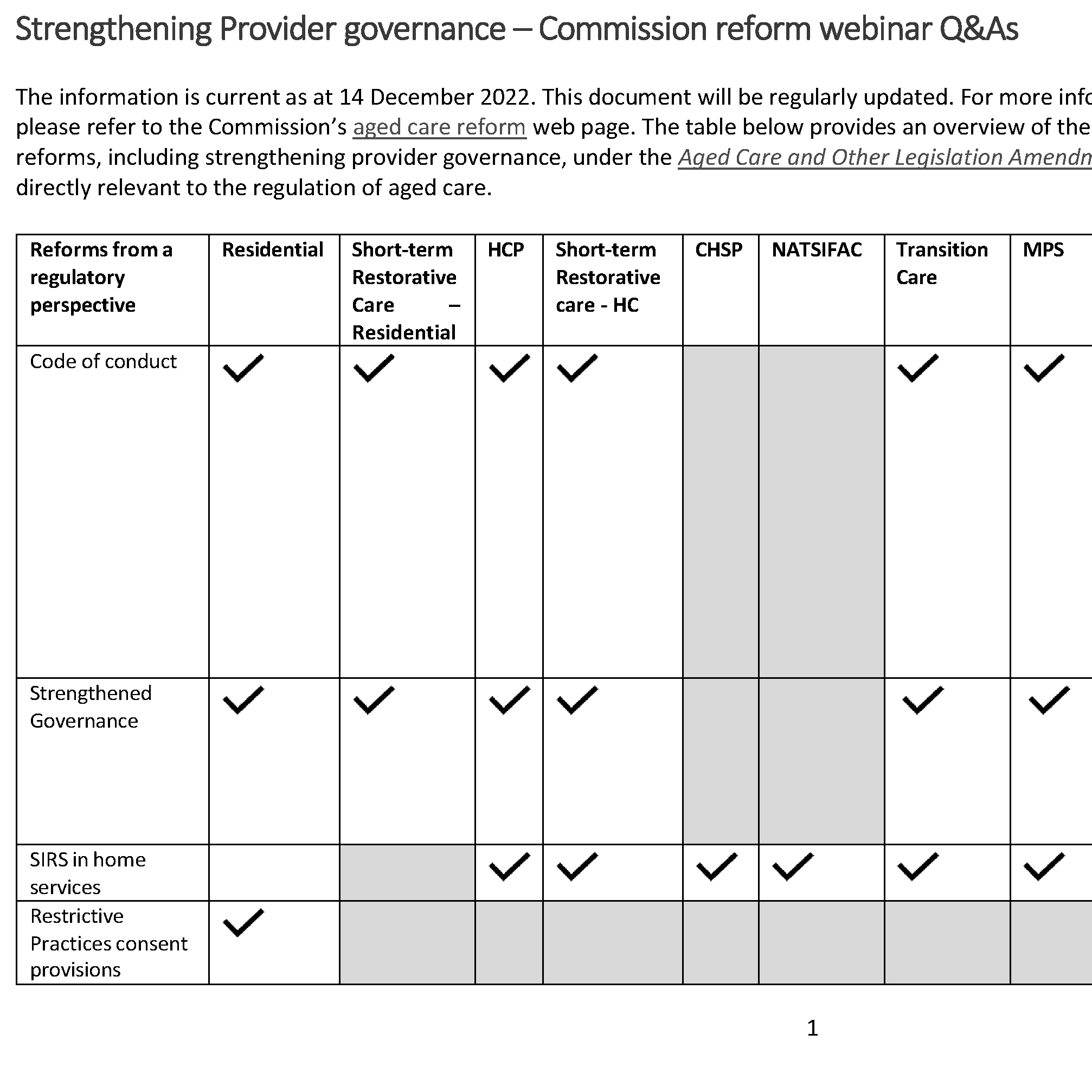
This document contains responses to questions asked during our webinar series on strengthening provider governance reforms.
This video introduces the provider governance obligations introduced on 1 December 2022
Transcript for 'Provider governance - provider responsibilities 1 December 2022'

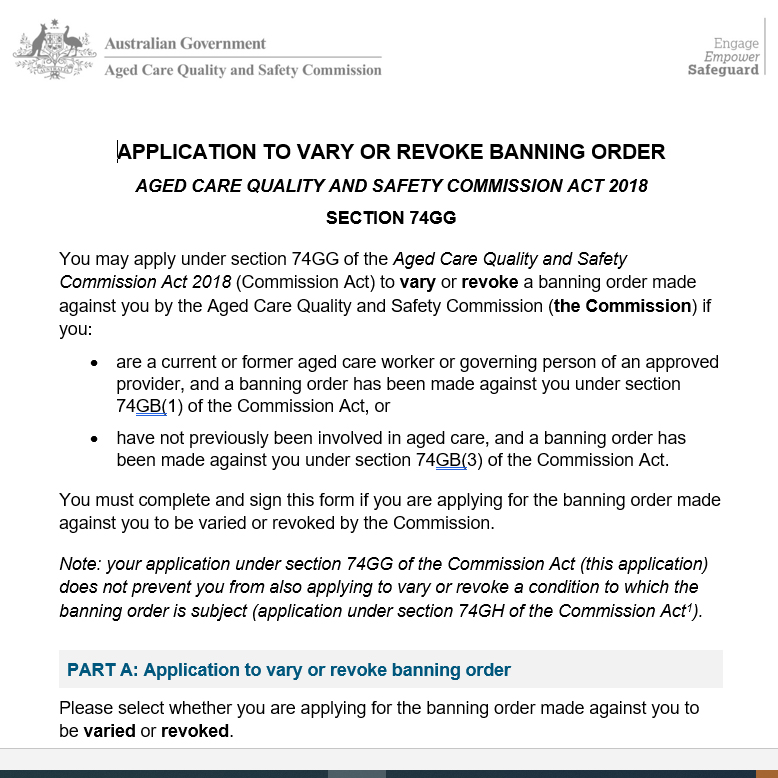
A form for a person or entity to apply to vary or revoke a banning order, or a condition of a banning order, made against them.
This video is to give older people, their representatives, families and registered supporters an overview of the Aged Care Code of Conduct. It describes the behaviour expected of registered providers, their responsible persons (e.g. board members and Chief Executive Officers) and aged care workers. It describes how providers and the people who provide your care must behave and treat you.
This video introduces the Aged Care Code of Conduct to aged care workers, responsible persons and registered providers.

On 1 December 2022, the Serious Incident Response Scheme (SIRS) was extended from residential aged care to include home care and flexible aged care depvered in a home or community setting.
This fact sheet for home services care recipients explains what the SIRS is, what is expected of providers, what a SIRS reportable incident is and how to seek help if needed.
This document contains responses to questions asked during our SIRS for home services webinar series.
SIRS for home services - Webinar QAs as at 30 November 2022 (PDF 731.8 KB)
This guidance document is intended to assist approved providers in the correct completion of a Notification Form.
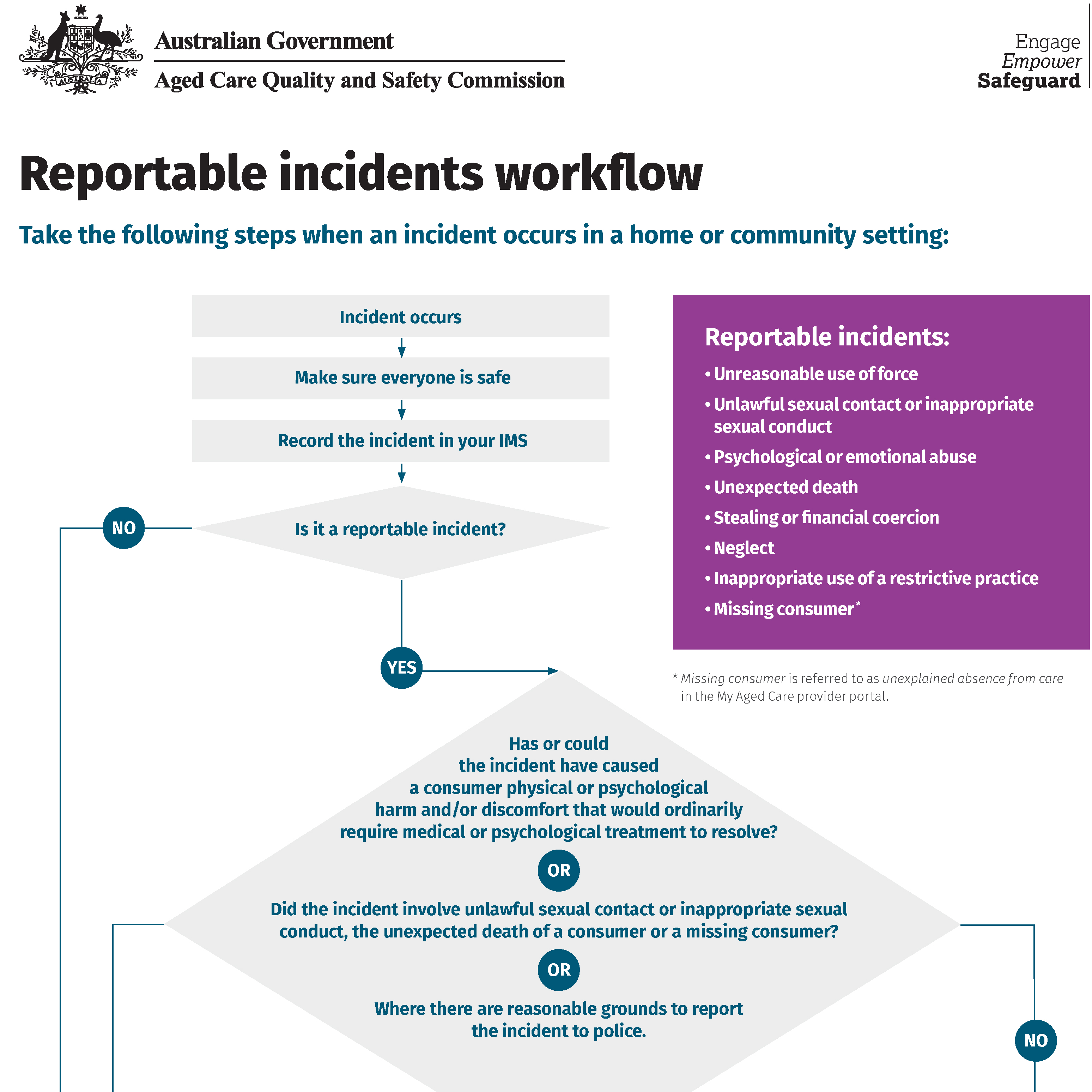
The steps to take when an incident occurs in a home or community setting.
Reportable incidents workflow SIRS in Home services (PDF 209.77 KB)
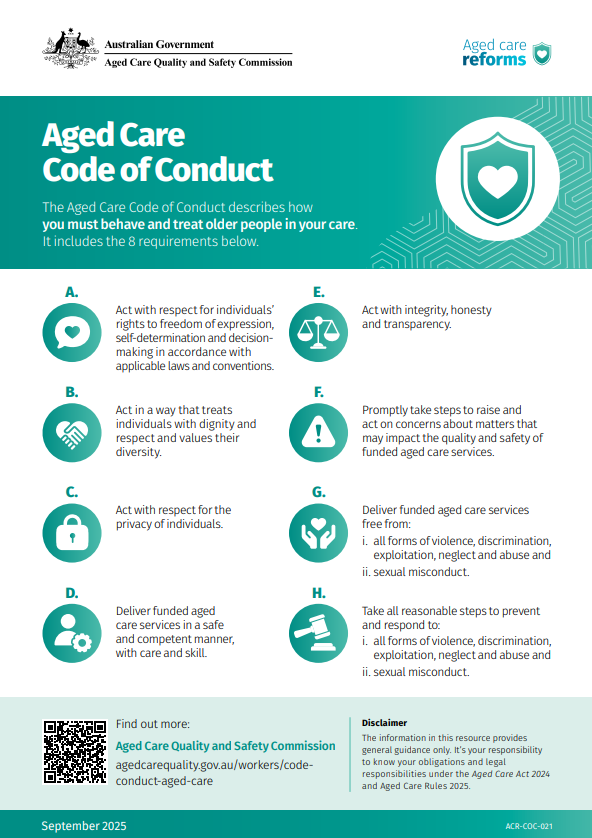
This guide for aged care workers and responsible persons provides a quick introduction to the Aged Care Code of Conduct. It includes a weblink and QR code to find out more on the Aged Care Quality and Safety Commission’s website.
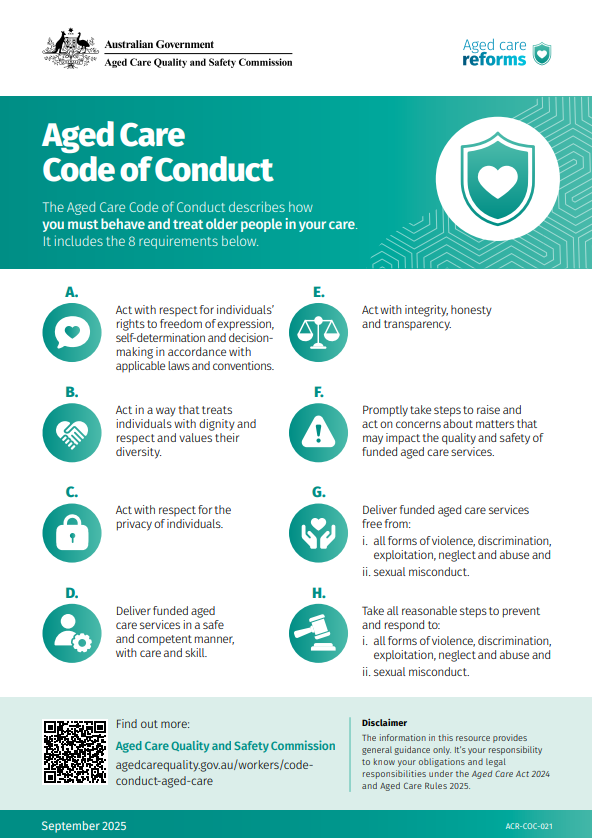
This poster provides a quick introduction to the Aged Care Code of Conduct for aged care workers and responsible persons. It includes a weblink and QR code to find out more on the Aged Care Quality and Safety Commission’s website.
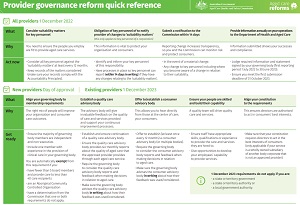
A quick reference A3 poster informing providers about their new provider governance responsibilities.
Provider Governance quick reference poster (PDF 559.11 KB)