This fact sheet outlines the steps that aged care staff should take to:
- consult with residents
- assess the need for texture modified food and drink
- correctly prepare texture modified food and drink that looks, smells and tastes great.
 For workers - Nutrition and texture modified food and drink (PDF 738.33 KB)

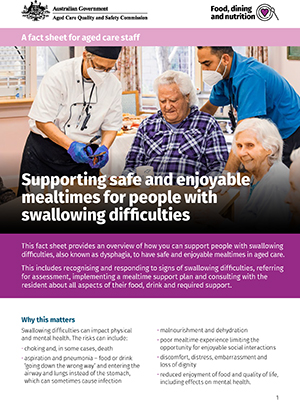
This fact sheet provides an overview of how you can support people with swallowing difficulties, also known as dysphagia, to have safe and enjoyable mealtimes in aged care.
This includes recognising and responding to signs of swallowing difficulties, referring for assessment, implementing a mealtime support plan and consulting with the resident about all aspects of their food, drink and required support.
This report provides a comprehensive picture gained through our 2022 Enriching life through care national roundtable series on the sector’s challenges and experiences in improving the aged care experience for consumers. It also reflects valuable feedback we heard from the sector on their experience of engaging with the Commission and how we are responding to the issues raised.
This report showcases innovative and creative examples shared by providers through the 2022 Enriching life through care national roundtable program on how they are improving aged care across the country.
Enriching life through care provider case studies (PDF 1.26 MB)
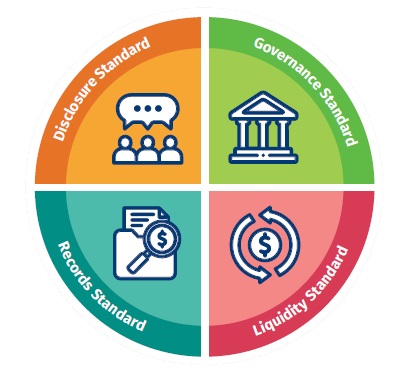
This video explains the purpose and importance of the Prudential Standards. It outlines the responsibilities of aged care providers in managing refundable deposits and what they need to do to comply. It also discusses the consequences of not complying plus additional resources that can help.
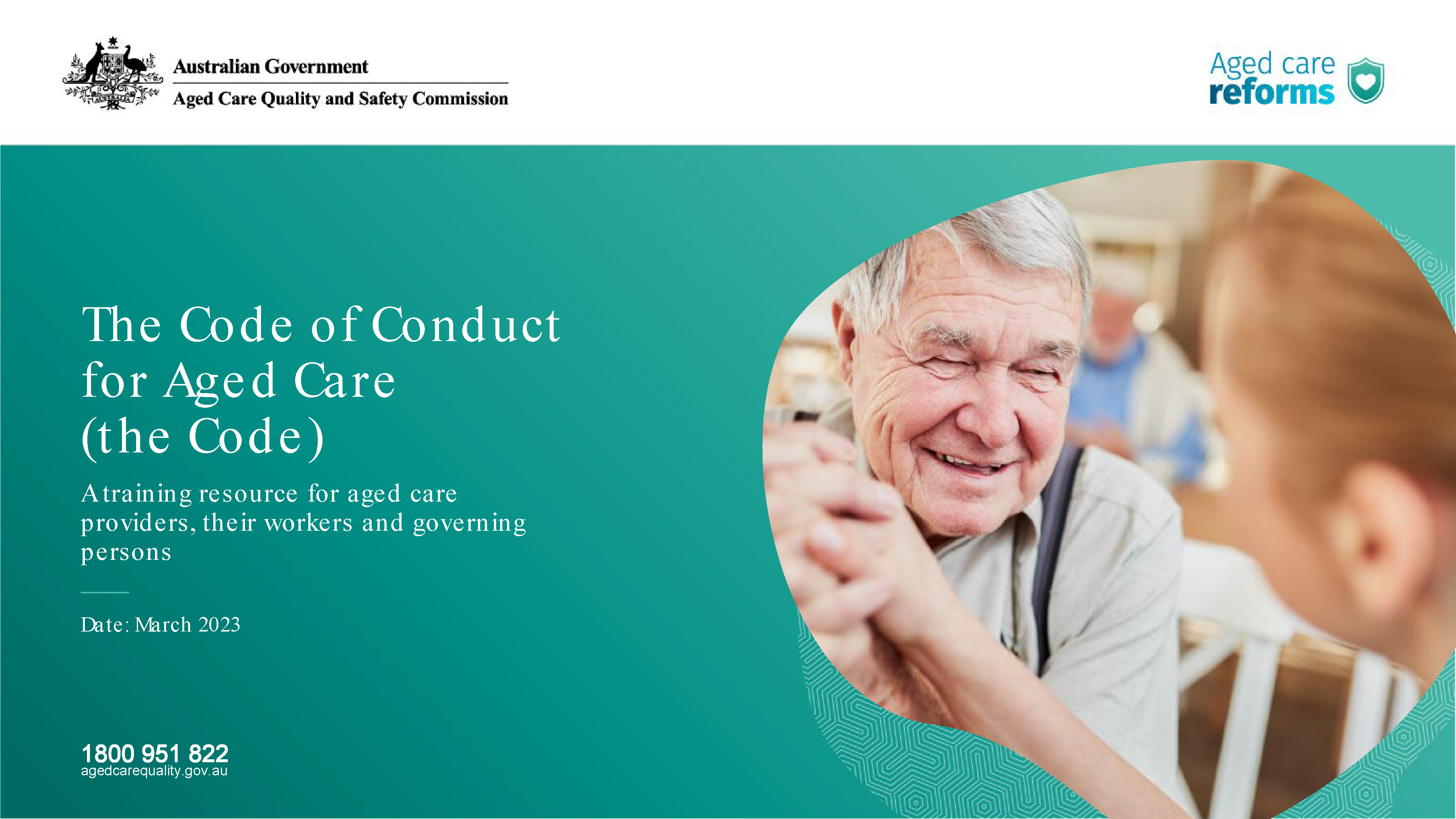
The Aged Care Code of Conduct – training PowerPoint is a presentation that trainers can download, customise and use to teach their aged care workers and responsible persons about the Aged Care Code of Conduct (Code).
The training resource:
- offers an overview of the Code
- supports an exploration of the requirements of the Code
- is designed to support reflective discussions about the Code and how it applies in practice.
Note:
Letter to general practitioners and nurse practitioners to seek support in a quality improvement intervention being undertaken in Australian residential aged care services (RACS), to address overprescribing of antibiotics for aged care residents for urinary tract conditions including asymptomatic bacteriuria.
The Commission has developed the ‘Home Services Pricing and Agreements – Navigating changes the right way’ guidance for home service providers delivering care and service supports through the Home Care Packages (HCP) Program and Commonwealth Home Support Programme (CHSP).
Provider Guidance - Home Services Pricing and Agreements (PDF 531.4 KB)
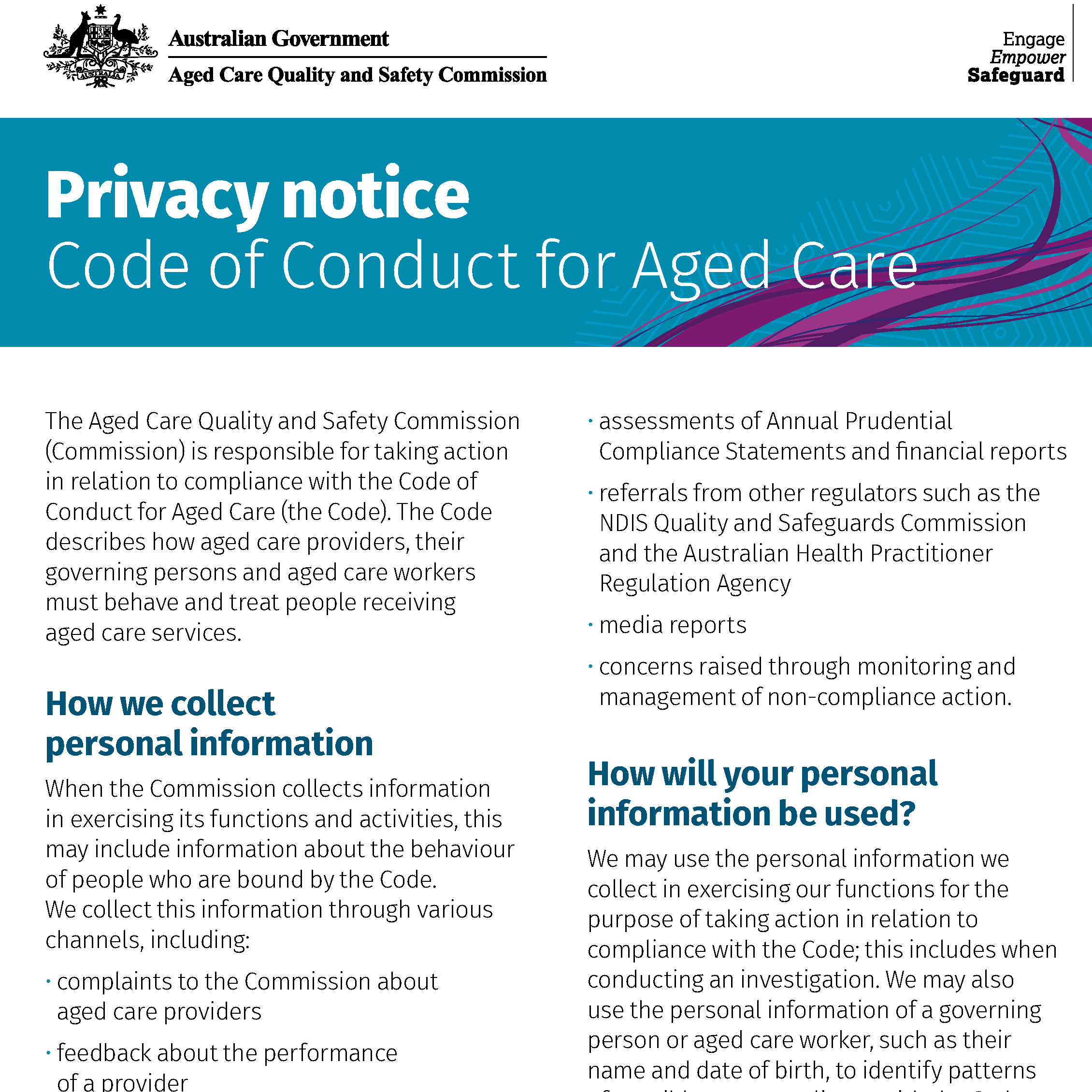
 Notice of collection form (PDF 190.3 KB)
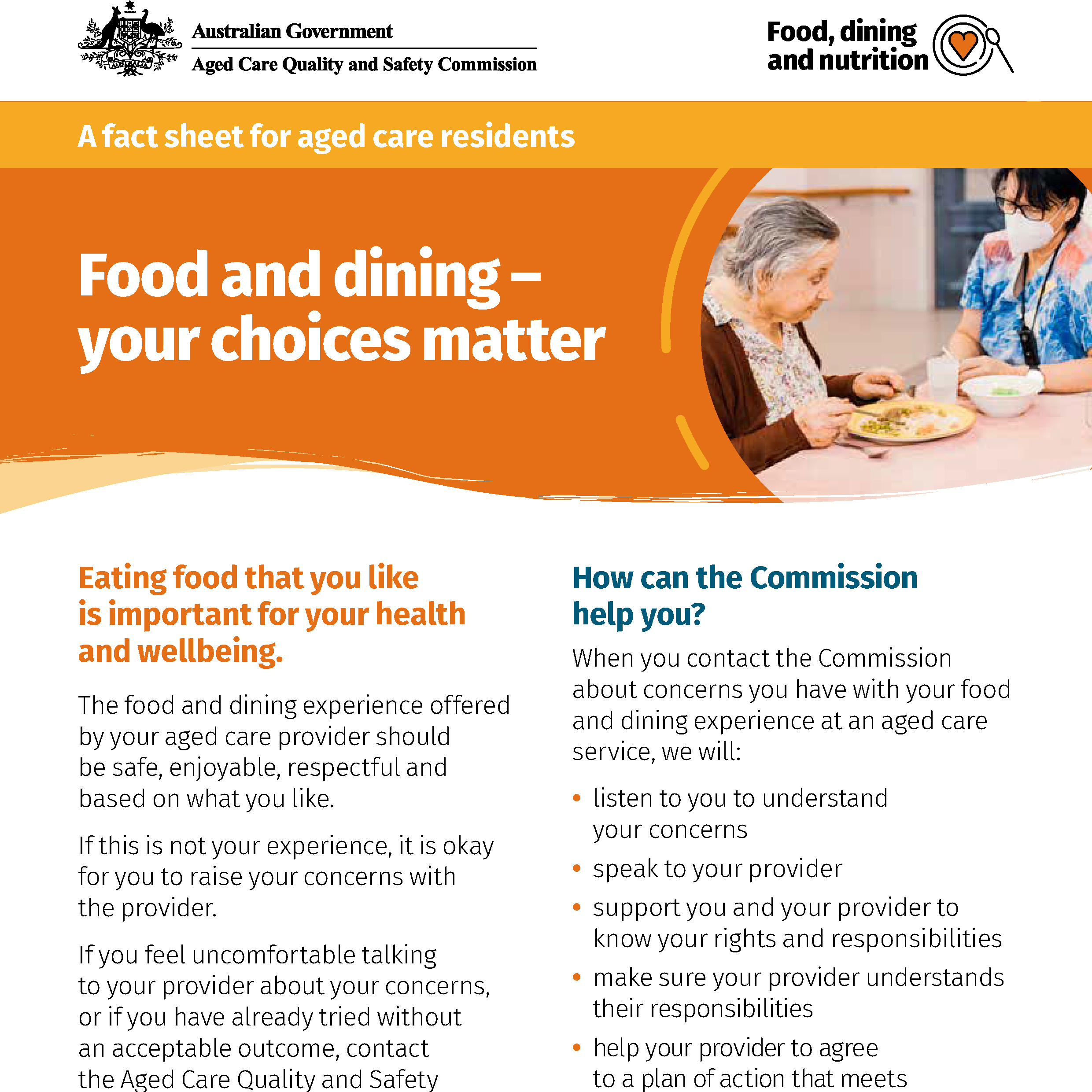
This fact sheet informs aged care residents of their rights to safe, enjoyable, and respectful dining experiences. It outlines steps for raising concerns with providers about food and dining, offers a preference form for residents to communicate their dietary needs, and provides contact information for support services if issues remain unresolved. This resource may refer to information that will be updated from 1 November 2025 to align with the new Aged Care Act and Quality Standards.
English - Food and dining – your choices matter (PDF 484.79 KB)
Arabic - تهمّّنا تفضيلاتكم في الطعام وعادات الأكل (PDF 767.17 KB)
Chinese Simplified - 食品和餐饮—— 您的选择很重要 (PDF 785.39 KB)
Chinese Traditional - 食品和餐飲—— 您的選擇很重要 (PDF 788.7 KB)
French - Alimentation et repas – vos choix sont importants (PDF 684.4 KB)
German - Essen und Speisen – Ihre Wahl zählt (PDF 686.18 KB)
Greek - Φαγητό και γεύματα – οι επιλογές σας έχουν σημασία (PDF 690.89 KB)
Hungarian - Ételek és étkezés – az Ön döntése számít (PDF 684.42 KB)
Macedonian - Храна и јадење - вашиот избор е важен (PDF 683.21 KB)
Maltese - L-ikel u l-ikliet - l-għażliet tiegħek huma importanti (PDF 685.65 KB)
Russian - Питание и прием пищи: ваш выбор имеет значение (PDF 682.53 KB)
Serbian - Храна и обедовање – ваш избор је важан (PDF 681.46 KB)
Spanish - Alimentos y comidas: sus preferencias importan (PDF 679.42 KB)
Low-value urine dipstick testing practice in aged care is a common, yet modifiable, driver of antibiotic overuse for conditions such as asymptomatic bacteriuria.
The Commission undertook a project to evaluate the feasibility and useability of To Dip Or Not To Dip (TDONTD) in Australian aged care services.
To Dip or Not To Dip project summary (PDF 412.34 KB)

This Regulatory Bulletin provides information on the information that the Commission publishes on aged care providers’ performance in relation to their responsibilities as providers. The Commission also publishes information on the Commission’s website and My Aged Care about outcomes of regulatory decisions, including the Service Compliance Rating for Star Ratings.
 RB 2023-18 – Publication of provider performance information (DOCX 172.12 KB)
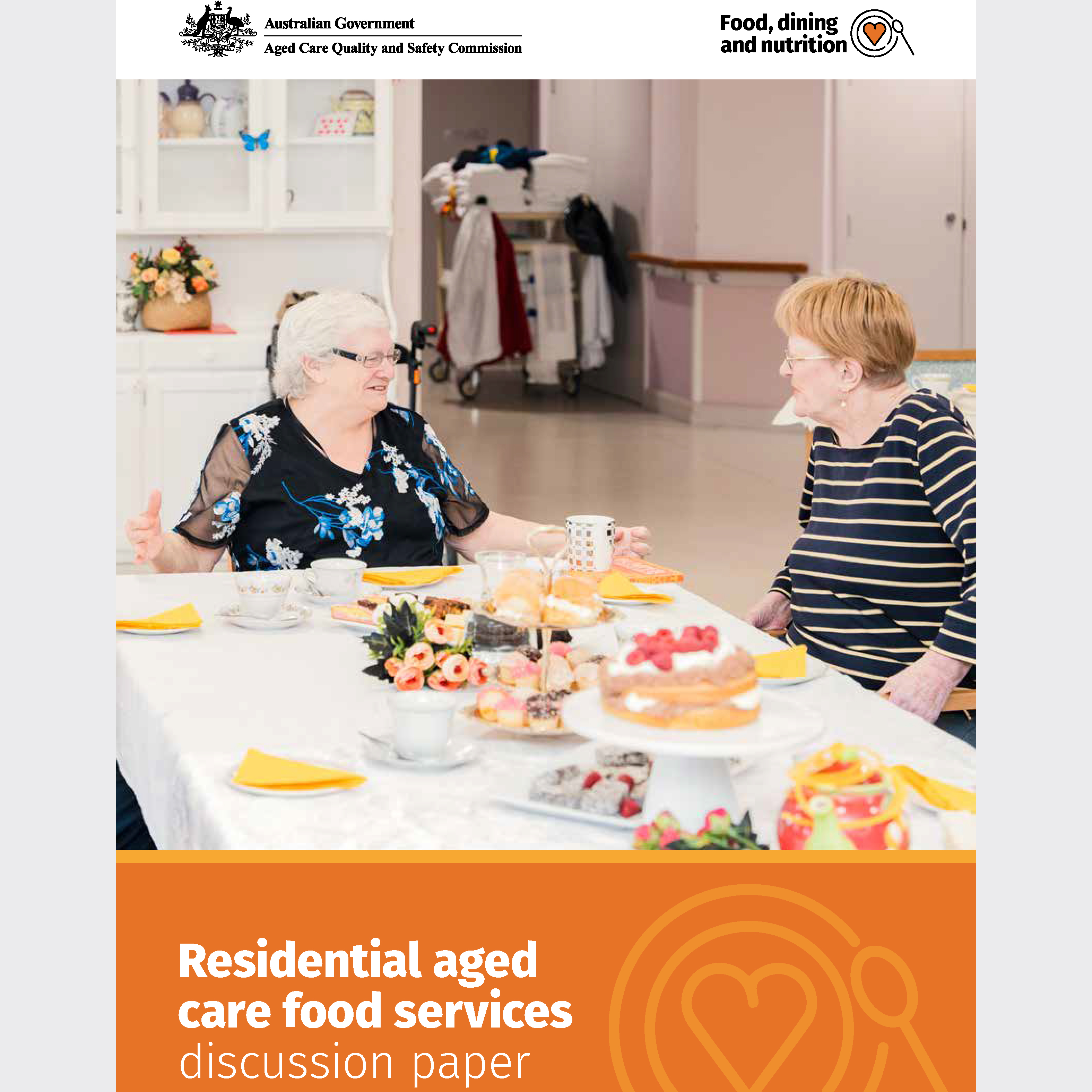
This paper presents a high-level overview of contemporary evidence regarding food services in residential aged care settings.
Residential aged care food services discussion paper (PDF 536.47 KB)
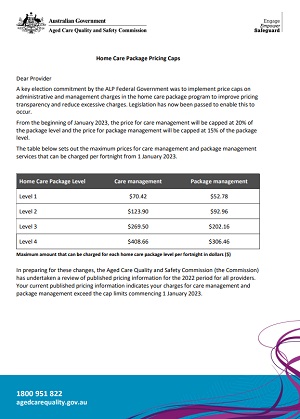
A key election commitment by the ALP Federal Government was to implement price caps on administrative and management charges in the home care package program to improve pricing transparency and reduce excessive charges. Legislation has now been passed to enable this to occur.
Download a PDF of the slides that were used in the 15 December 2022 webinar, Aged care sector reforms – current status and what’s next?
Aged care sector reforms – current status and what’s next? (PDF 25.49 MB)

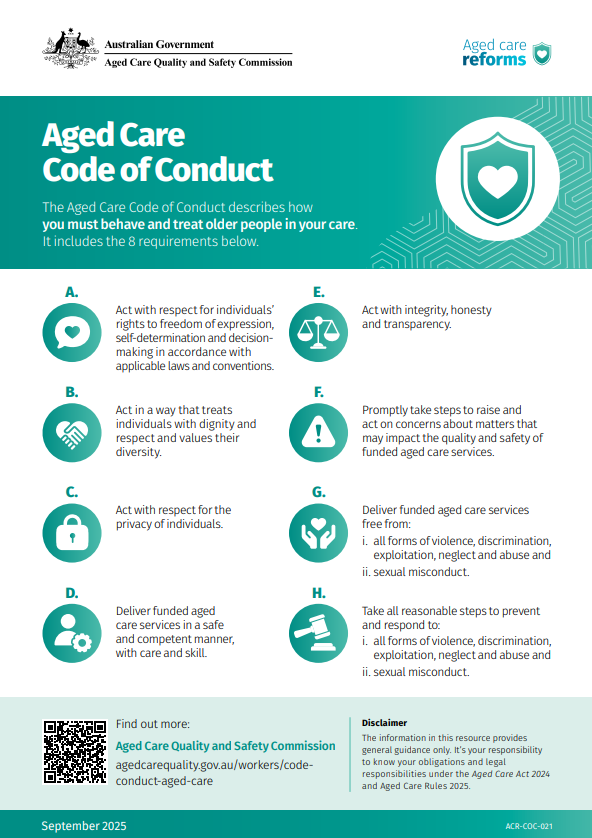
This document contains a summary of all available resources for the Aged Care Code of Conduct.
Aged Care Code of Conduct resources (PDF 504.04 KB)
This video is to give older people, their representatives, families and registered supporters an overview of the Aged Care Code of Conduct. It describes the behaviour expected of registered providers, their responsible persons (e.g. board members and Chief Executive Officers) and aged care workers. It describes how providers and the people who provide your care must behave and treat you.
This video introduces the Aged Care Code of Conduct to aged care workers, responsible persons and registered providers.

On 1 December 2022, the Serious Incident Response Scheme (SIRS) was extended from residential aged care to include home care and flexible aged care depvered in a home or community setting.
This fact sheet for home services care recipients explains what the SIRS is, what is expected of providers, what a SIRS reportable incident is and how to seek help if needed.
This guide for aged care workers and responsible persons provides a quick introduction to the Aged Care Code of Conduct. It includes a weblink and QR code to find out more on the Aged Care Quality and Safety Commission’s website.