The Quality Standards Resource Centre helps extend understanding of the strengthened Aged Care Quality Standards, which take effect from 1 November 2025. The Resource Centre will be updated to reflect key changes made to the draft strengthened Standards. You can search for resources by using keywords, or filtering by standard, outcome, audience and theme. Before using the Resource Centre, please read the terms of use.
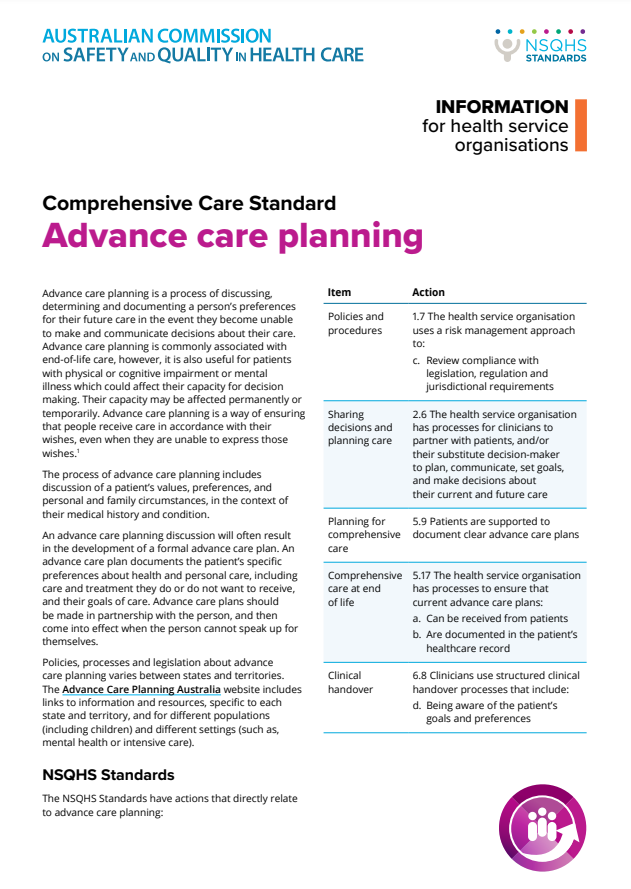
Advance care planning - Information for health service organisations
This resource outlines how health service organisations can support advance care planning within the Comprehensive Care Standard (National Safety and Quality Health Service Standards). It highlights the importance of documenting a patient’s preferences for future care and ensuring systems are in place to act on these plans. It also provides actions related to policies, sharing decisions, comprehensive care, and clinical handover.
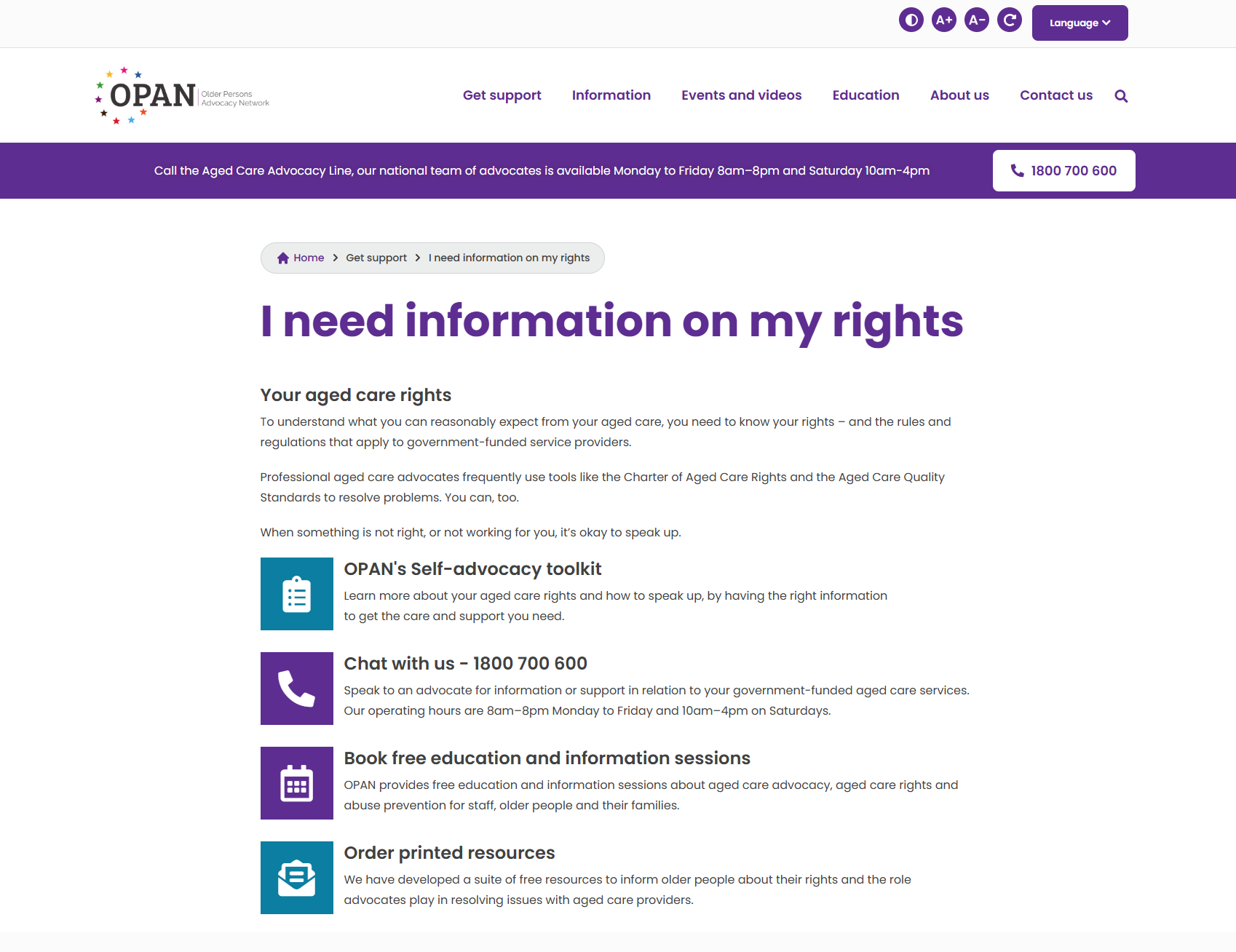
I need information on my rights
This resource provides information on aged care rights, including guidance on self-advocacy and accessing support. It offers resources, free educational sessions, and access to advocates for assistance with government-funded aged care services, empowering people to address concerns and understand their entitlements.
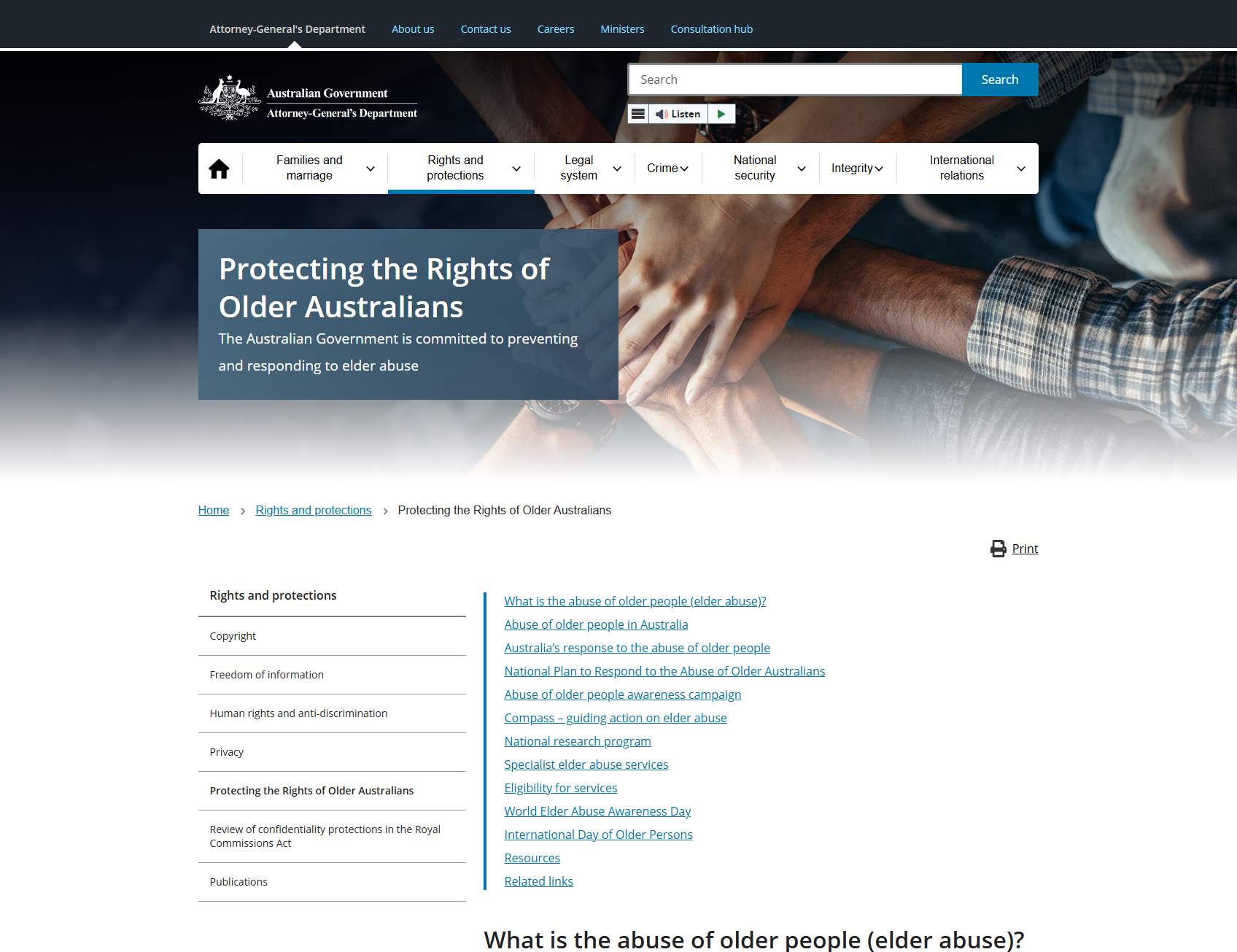
Protecting the Rights of Older Australians
This resource provides an overview of Australia’s approach to addressing the abuse of older people, including the National Plan, specialist services, awareness campaigns, and legal reforms. It aims to increase awareness, support prevention efforts, and offer accessible resources for those experiencing or at risk of abuse.
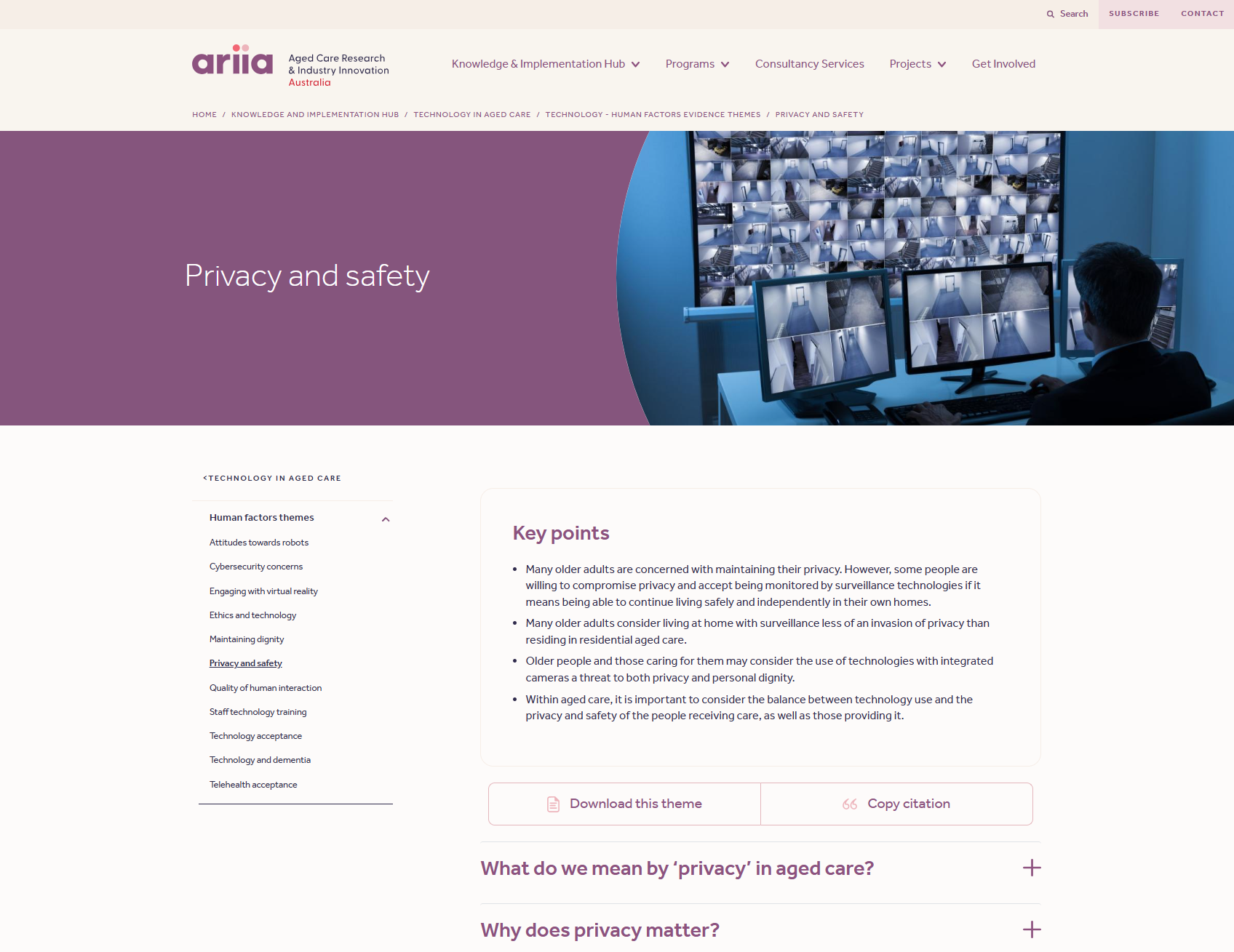
Privacy and safety
This resource addresses balancing privacy and safety for older people using technology in aged care. It highlights the importance of making sure surveillance technology supports independent living while respecting personal dignity, and it explores considerations for safety and privacy in care settings.
National Palliative Care Standards for All Health Professionals and Aged Care Services
The National Palliative Care Standards provide guidance for all health professionals and aged care services to deliver high-quality generalist palliative care. They support improved experiences and outcomes for people receiving care, and are intended for use across diverse care settings. Resources like audit tools and fact sheets are available to aid self-assessment and adherence to these standards.
Gwandalan – Supporting Palliative Care for Aboriginal and Torres Strait Islander Communities
This resource provides culturally appropriate palliative care education and support for Aboriginal and Torres Strait Islander communities. It includes resources, videos, and training materials aimed at improving understanding, communication, and care practices in end-of-life care, integrating cultural beliefs and values to enhance quality care for Indigenous Australians.
Palliative care knowledge network
This resource provides evidence-based information and resources on palliative care for health professionals, patients and carers. It covers clinical practice, education, research, and service delivery. The platform aims to improve understanding, decision-making, and quality of care for people with life-limiting illnesses and their families.
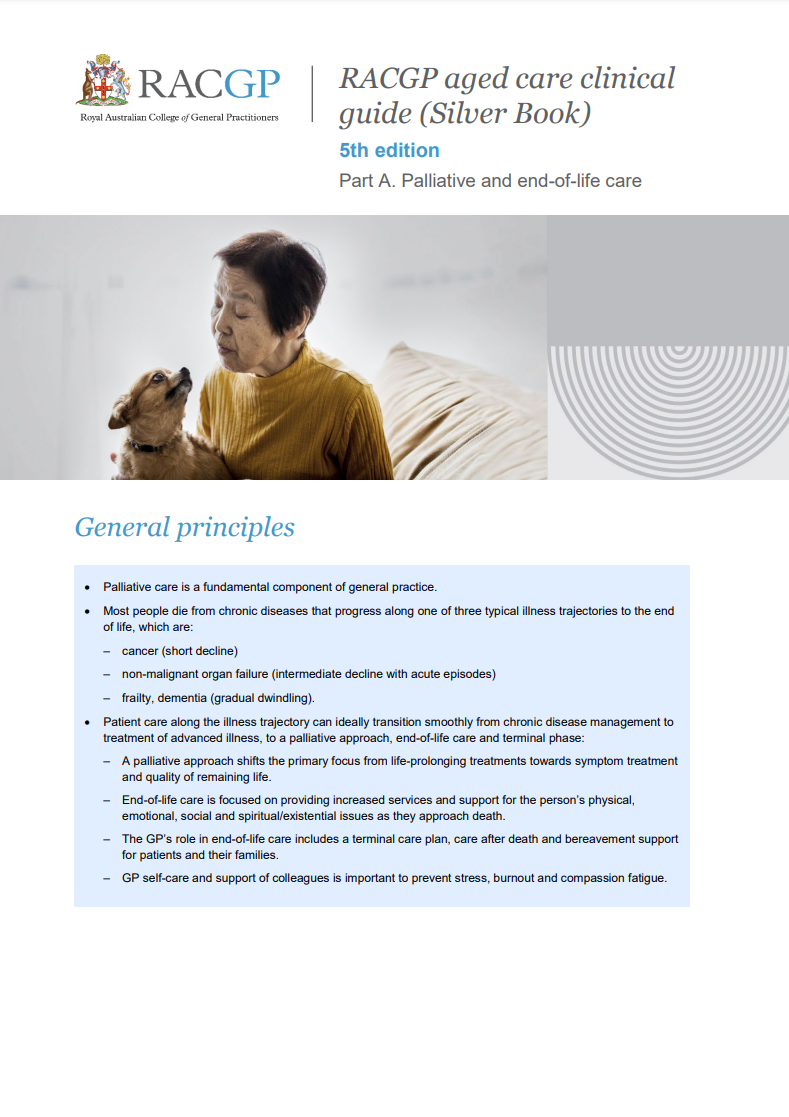
RACGP aged care clinical guide (Silver Book) - Part A - Palliative and end-of-life care
This guide focuses on palliative and end-of-life care, detailing general principles, illness trajectories, the role of general practitioners, and practical recommendations for patient-cantered care. It provides consensus-based guidelines for initiating advance care planning, symptom management, team-based end-of-life care, medication use, and supporting both patients and their families. It includes information on the transition from chronic disease treatment to a palliative approach and includes tools for clinical decision-making.
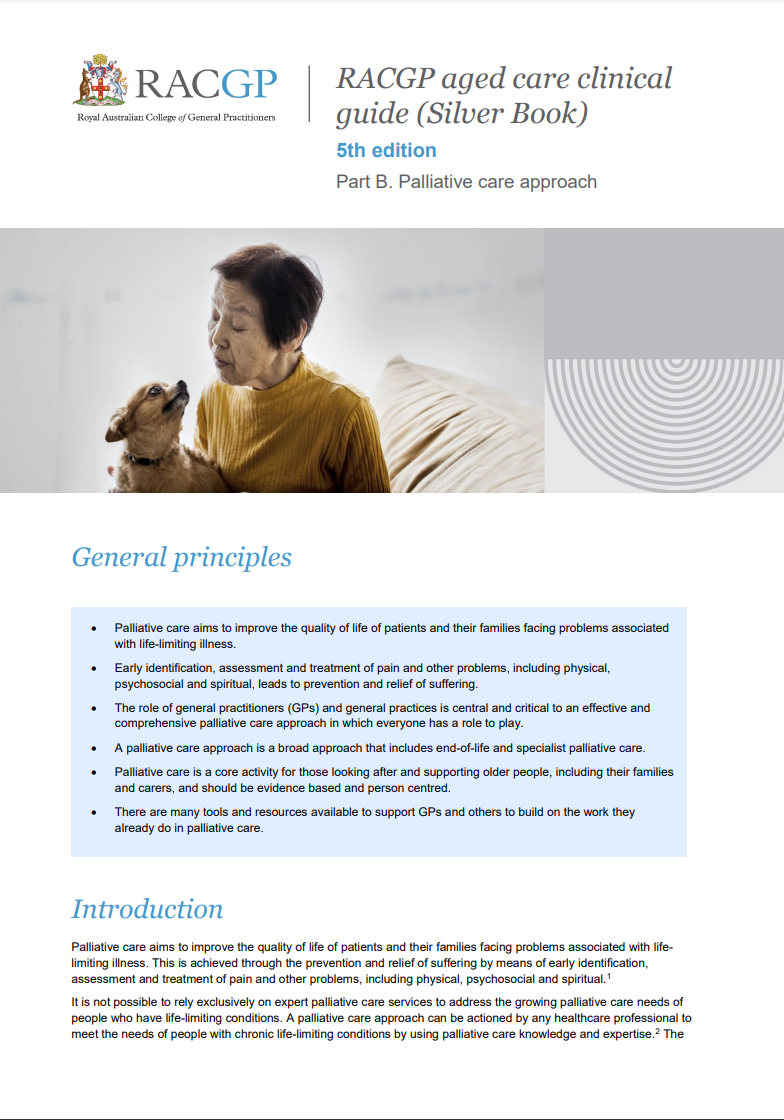
RACGP aged care clinical guide (Silver Book) - Part B - Palliative care approach
This guide outlines a palliative care approach for patients with life-limiting conditions, focusing on improving quality of life through early assessment, pain relief, and addressing psychosocial and spiritual needs. It describes the role of general practitioners in delivering person-centred care, engaging families, and ensuring collaborative, holistic support in both residential aged care and community settings.
Partnerships in care – Partner information package
The partner information pack presents information for all people visiting and volunteering in residential aged care services. The resource includes information on the importance of infection prevention and control (IPC), the use of personal protective equipment (PPE), and changes in what you need to do if you visit during an outbreak.
 Arabic - الشراكة في الرعاية الرعاية المشتركة (PDF 4.87 MB)
Chinese Simplified - 护理合作伙伴 携手护理 (PDF 4.81 MB)
Chinese Traditional - 護理合作夥伴 攜手護理 (PDF 4.73 MB)
Dutch - Samenwerking in de zorg Samen zorgdragen (PDF 4.34 MB)
German - Pflegepartnerschaften Gemeinsam pflegen (PDF 4.38 MB)
Hungarian - Gondozási partnerség Gondozás közösen (PDF 4.38 MB)
Korean - 돌봄 파트너십 함께하는 돌봄 (PDF 4.87 MB)
Latvian - Aprūpes partnerība Kopīgas rūpes (PDF 4.33 MB)
Macedonian - Партнерства во грижа Да се грижиме заедно (PDF 4.31 MB)
Maltese - Sħubija fil-kura Nieħdu ħsieb flimkien (PDF 4.35 MB)
Polish - Partnerstwo w opiece Wspólna opieka (PDF 4.37 MB)
Portuguese - Parceiros nos cuidados Cuidando juntos (PDF 4.37 MB)
Russian - Партнеры по уходу Заботимся вместе (PDF 4.33 MB)
Spanish - Atención en colaboración Cuidamos juntos (PDF 4.35 MB)
Turkish - Bakım ortaklıkları Birlikte dikkat etmek (PDF 4.32 MB)
Ukrainian - Партнерство у сфері догляду Піклуємося разом (PDF 4.33 MB)
Vietnamese - Quan hệ đối tác chăm sóc Cùng nhau chăm sóc (PDF 4.33 MB)
Arabic - الشراكة في الرعاية الرعاية المشتركة (PDF 4.87 MB)
Chinese Simplified - 护理合作伙伴 携手护理 (PDF 4.81 MB)
Chinese Traditional - 護理合作夥伴 攜手護理 (PDF 4.73 MB)
Dutch - Samenwerking in de zorg Samen zorgdragen (PDF 4.34 MB)
German - Pflegepartnerschaften Gemeinsam pflegen (PDF 4.38 MB)
Hungarian - Gondozási partnerség Gondozás közösen (PDF 4.38 MB)
Korean - 돌봄 파트너십 함께하는 돌봄 (PDF 4.87 MB)
Latvian - Aprūpes partnerība Kopīgas rūpes (PDF 4.33 MB)
Macedonian - Партнерства во грижа Да се грижиме заедно (PDF 4.31 MB)
Maltese - Sħubija fil-kura Nieħdu ħsieb flimkien (PDF 4.35 MB)
Polish - Partnerstwo w opiece Wspólna opieka (PDF 4.37 MB)
Portuguese - Parceiros nos cuidados Cuidando juntos (PDF 4.37 MB)
Russian - Партнеры по уходу Заботимся вместе (PDF 4.33 MB)
Spanish - Atención en colaboración Cuidamos juntos (PDF 4.35 MB)
Turkish - Bakım ortaklıkları Birlikte dikkat etmek (PDF 4.32 MB)
Ukrainian - Партнерство у сфері догляду Піклуємося разом (PDF 4.33 MB)
Vietnamese - Quan hệ đối tác chăm sóc Cùng nhau chăm sóc (PDF 4.33 MB)

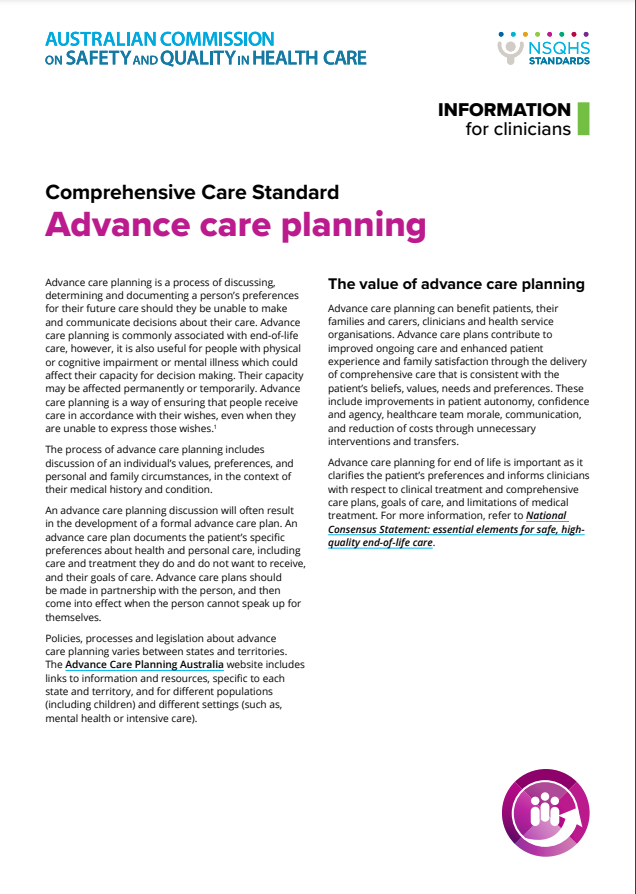
Advance care planning - Information for clinicians
This resource guides clinicians on the importance of advance care planning, particularly for those with life-limiting illnesses, chronic conditions, or cognitive impairment. It outlines the need for early conversations about patient preferences and comprehensive care, ensuring decisions are documented, shared, and align with clinical handover processes to respect patient autonomy and improve care outcomes.
This resource may refer to information that will be updated from 1 November 2025 to align with the new Aged Care Act and Quality Standards.
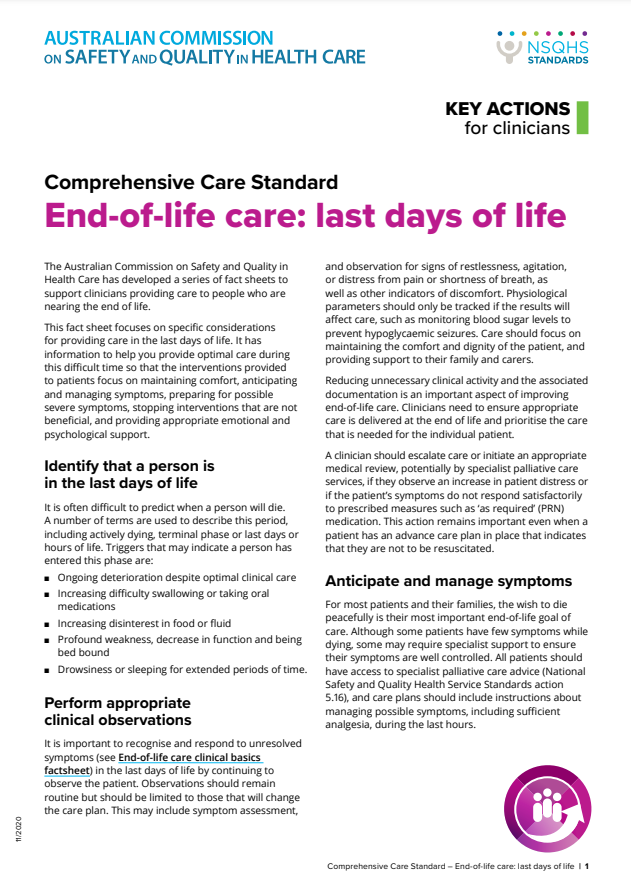
End-of-life care - Last days of life
This resource provides guidance on end-of-life care during the last days of life, relevant for aged care settings. It focuses on maintaining comfort, managing symptoms, and reducing unnecessary interventions. Clinicians are supported in offering compassionate care, addressing potential emergencies, and involving family members while ensuring that older people are treated with dignity during their final days.
This resource may refer to information that will be updated from 1 November 2025 to align with the new Aged Care Act and Quality Standards.
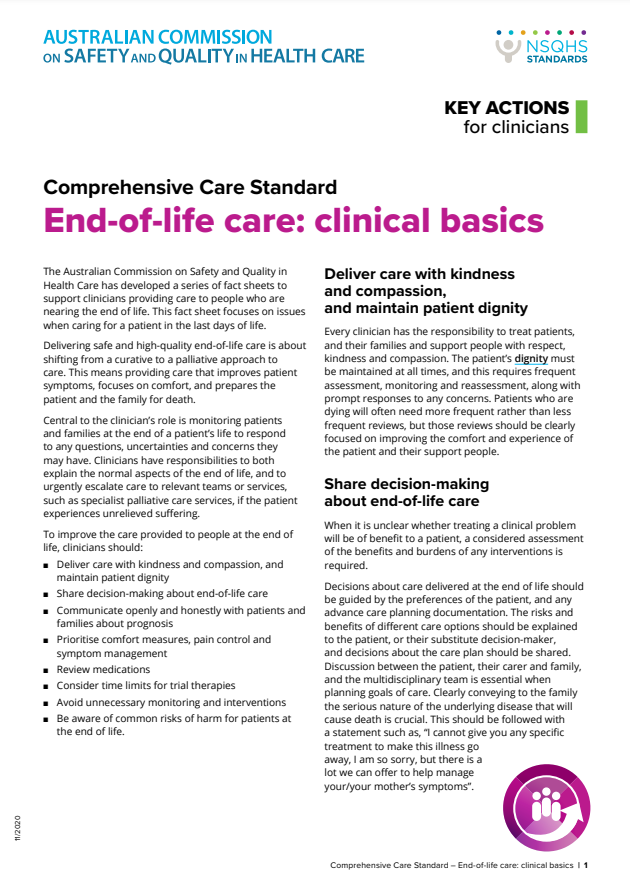
End-of-life care - clinical basics
This resource provides key actions for clinicians delivering end-of-life care. It highlights the shift from curative to palliative approaches, emphasising communication, patient dignity, symptom management, medication review, and decision-making. It includes strategies for managing common symptoms and minimising risks to ensure safe, high-quality care in the last days of life.
This resource may refer to information that will be updated from 1 November 2025 to align with the new Aged Care Act and Quality Standards.
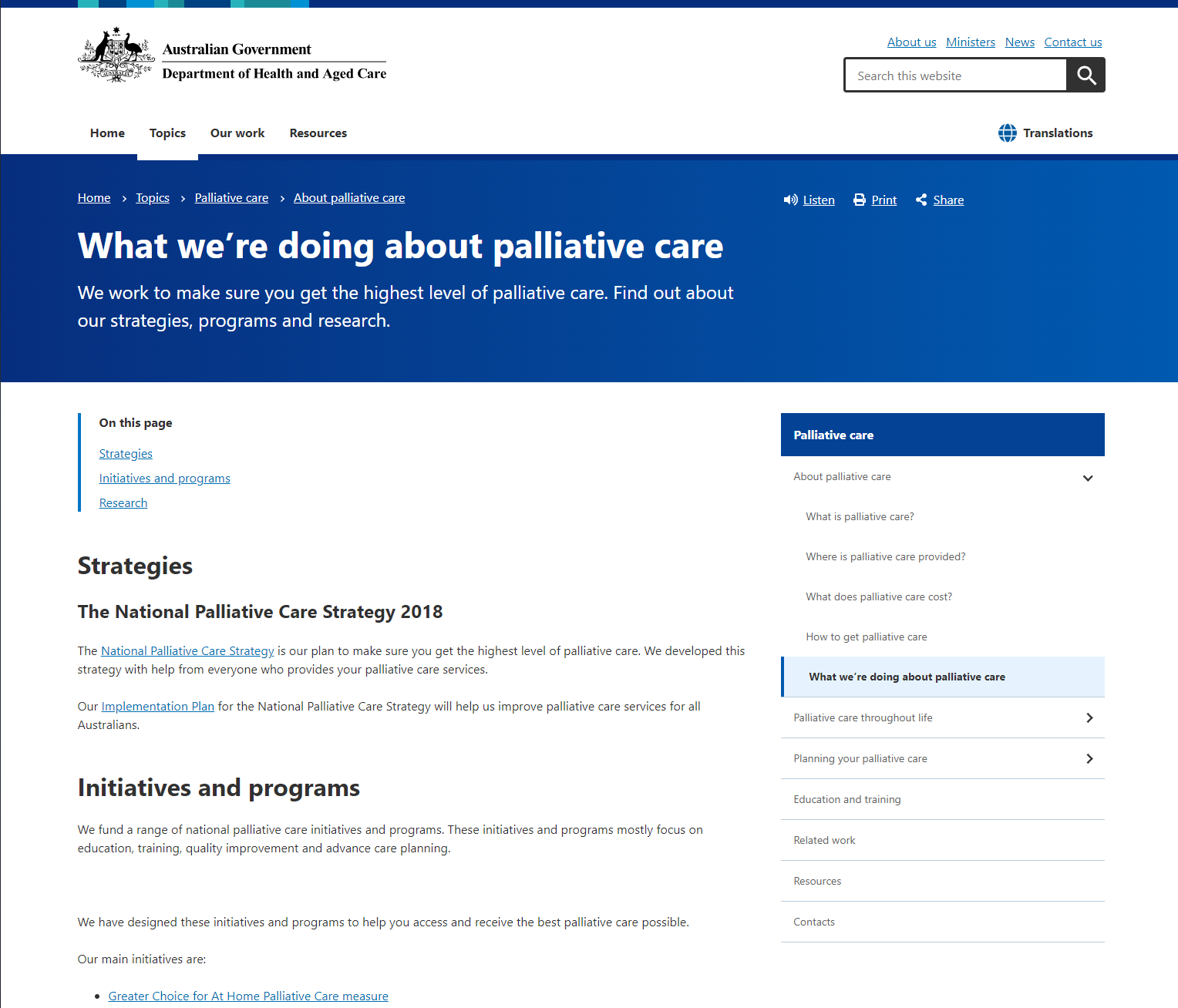
What we’re doing about palliative care
This resource outlines the Australian Government’s strategies, initiatives, and research for improving palliative care. It details the National Palliative Care Strategy, workforce training, and key programs such as at-home and aged care measures. It also highlights the National Framework for Advance Care Planning, ensuring access to quality palliative care across Australia.
This resource may refer to information that will be updated from 1 November 2025 to align with the new Aged Care Act and Quality Standards.
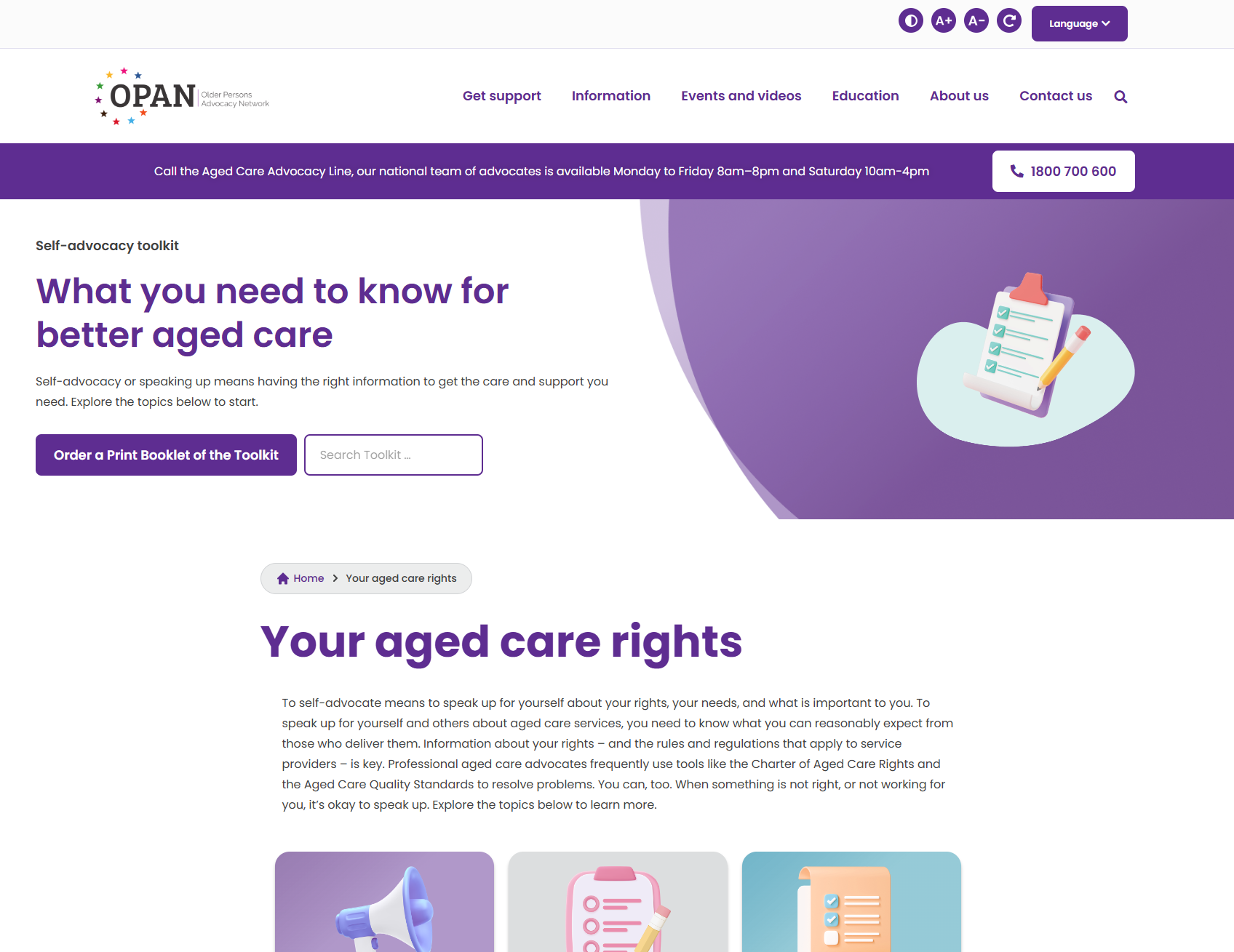
Your aged care rights
This resource offers tools for self-advocacy in aged care, helping people understand their rights and what to expect from providers. It includes resources on the Charter of Aged Care Rights, care planning, and maintaining connections, supporting people in navigating and maximising their aged care experience.
This resource may refer to information that will be updated from 1 November 2025 to align with the new Aged Care Act and Quality Standards.
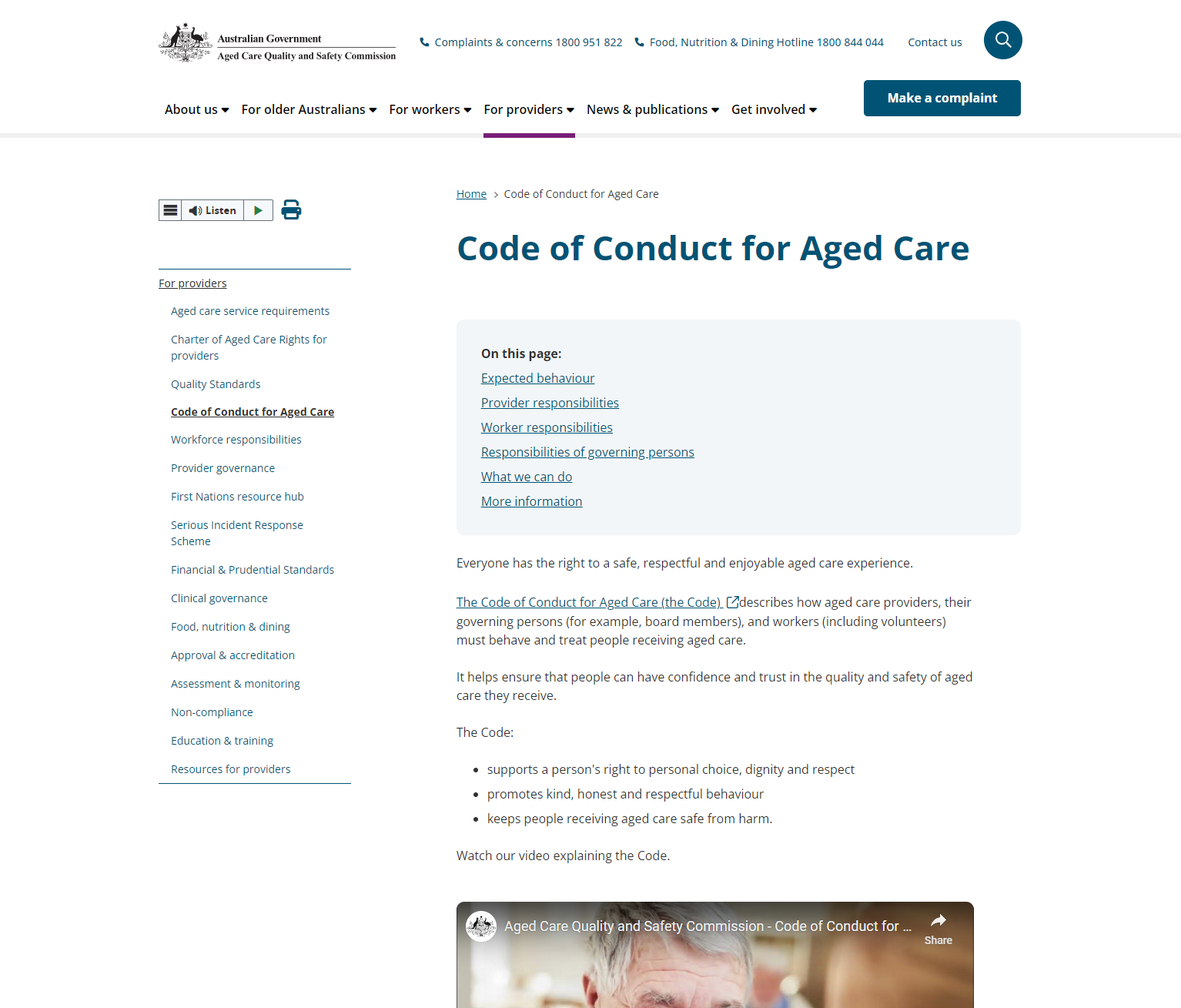
Code of Conduct for Aged Care
This resource outlines the Code of Conduct for Aged Care, which sets expectations for the behaviour of providers, governing persons, and workers. It promotes respect, safety, and quality in aged care services, ensuring people’s rights are protected. The Code includes guidance on handling concerns and preventing abuse or neglect.
This resource may refer to information that will be updated from 1 November 2025 to align with the new Aged Care Act and Quality Standards.
Code of Conduct for workers
This resource outlines the Code of Conduct for Aged Care workers, detailing expected behaviours such as respect, honesty, and integrity. It ensures people receiving care are treated with dignity, kept safe from harm, and supported. The Code applies to all aged care workers, including volunteers.
This resource may refer to information that will be updated from 1 November 2025 to align with the new Aged Care Act and Quality Standards.
Delivering and supporting comprehensive end-of-life care user guide
This guide provides practical strategies for health service organisations and clinicians to deliver comprehensive end-of-life care. It aligns with the National Safety and Quality Health Service Standards, focusing on patient-centred communication, care components, triggers for recognising end-of-life, and organisational support through leadership, education, and evaluation.
This resource may refer to information that will be updated from 1 November 2025 to align with the new Aged Care Act and Quality Standards.
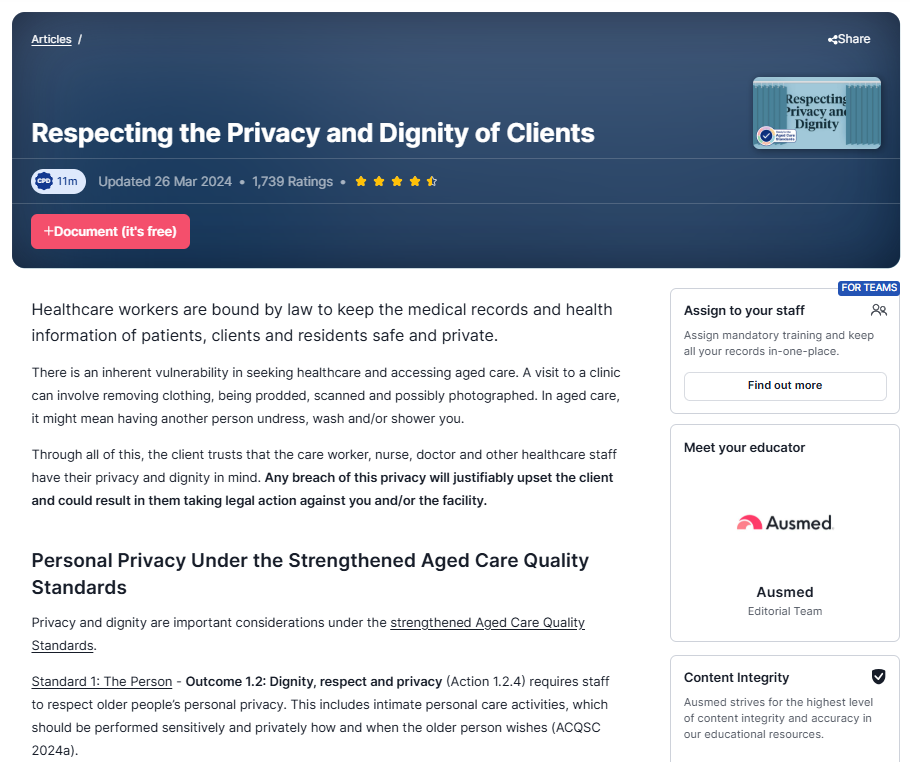
Respecting the privacy and dignity of clients
This resource provides guidance about respecting the privacy and dignity of clients. It includes information about personal privacy, the Privacy Act, what classifies as health information, consent and privacy of information. It also includes information about person-centred care and client dignity.
This resource may refer to information that will be updated from 1 November 2025 to align with the new Aged Care Act and Quality Standards.
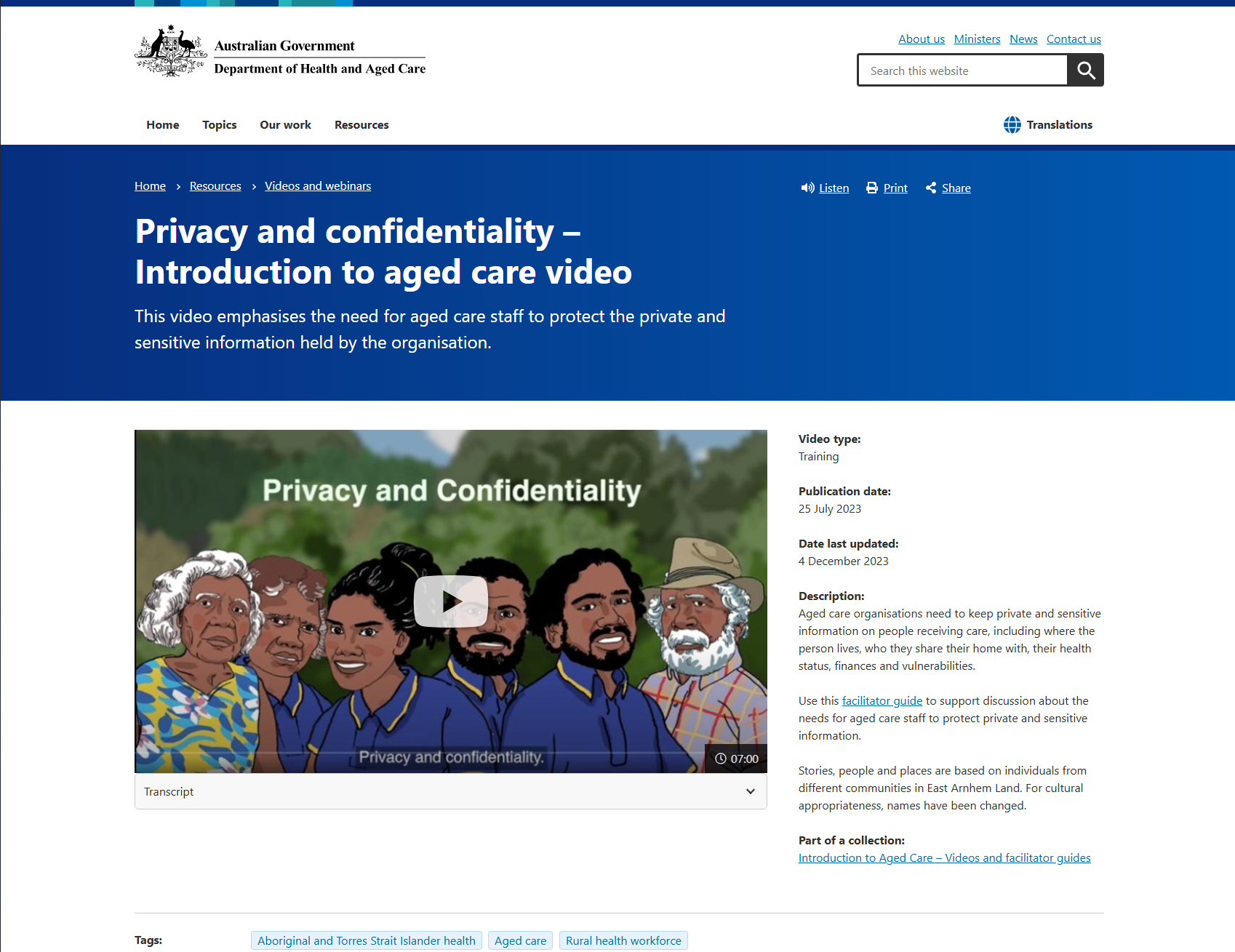
Privacy and confidentiality – Introduction to aged care video
This resource is a training video guiding aged care staff on the importance of maintaining privacy and confidentiality for people receiving care. It covers protecting personal information, proper handling of sensitive data, and safe sharing practices, aiming to make sure clients feel secure in sharing information.
This resource may refer to information that will be updated from 1 November 2025 to align with the new Aged Care Act and Quality Standards.