The Quality Standards Resource Centre helps extend understanding of the strengthened Aged Care Quality Standards, which take effect from 1 November 2025. The Resource Centre will be updated to reflect key changes made to the draft strengthened Standards. You can search for resources by using keywords, or filtering by standard, outcome, audience and theme. Before using the Resource Centre, please read the terms of use.
Partnerships in care – Partner information package
The partner information pack presents information for all people visiting and volunteering in residential aged care services. The resource includes information on the importance of infection prevention and control (IPC), the use of personal protective equipment (PPE), and changes in what you need to do if you visit during an outbreak.
 Arabic - الشراكة في الرعاية الرعاية المشتركة (PDF 4.87 MB)
Chinese Simplified - 护理合作伙伴 携手护理 (PDF 4.81 MB)
Chinese Traditional - 護理合作夥伴 攜手護理 (PDF 4.73 MB)
Dutch - Samenwerking in de zorg Samen zorgdragen (PDF 4.34 MB)
German - Pflegepartnerschaften Gemeinsam pflegen (PDF 4.38 MB)
Hungarian - Gondozási partnerség Gondozás közösen (PDF 4.38 MB)
Korean - 돌봄 파트너십 함께하는 돌봄 (PDF 4.87 MB)
Latvian - Aprūpes partnerība Kopīgas rūpes (PDF 4.33 MB)
Macedonian - Партнерства во грижа Да се грижиме заедно (PDF 4.31 MB)
Maltese - Sħubija fil-kura Nieħdu ħsieb flimkien (PDF 4.35 MB)
Polish - Partnerstwo w opiece Wspólna opieka (PDF 4.37 MB)
Portuguese - Parceiros nos cuidados Cuidando juntos (PDF 4.37 MB)
Russian - Партнеры по уходу Заботимся вместе (PDF 4.33 MB)
Spanish - Atención en colaboración Cuidamos juntos (PDF 4.35 MB)
Turkish - Bakım ortaklıkları Birlikte dikkat etmek (PDF 4.32 MB)
Ukrainian - Партнерство у сфері догляду Піклуємося разом (PDF 4.33 MB)
Vietnamese - Quan hệ đối tác chăm sóc Cùng nhau chăm sóc (PDF 4.33 MB)
Arabic - الشراكة في الرعاية الرعاية المشتركة (PDF 4.87 MB)
Chinese Simplified - 护理合作伙伴 携手护理 (PDF 4.81 MB)
Chinese Traditional - 護理合作夥伴 攜手護理 (PDF 4.73 MB)
Dutch - Samenwerking in de zorg Samen zorgdragen (PDF 4.34 MB)
German - Pflegepartnerschaften Gemeinsam pflegen (PDF 4.38 MB)
Hungarian - Gondozási partnerség Gondozás közösen (PDF 4.38 MB)
Korean - 돌봄 파트너십 함께하는 돌봄 (PDF 4.87 MB)
Latvian - Aprūpes partnerība Kopīgas rūpes (PDF 4.33 MB)
Macedonian - Партнерства во грижа Да се грижиме заедно (PDF 4.31 MB)
Maltese - Sħubija fil-kura Nieħdu ħsieb flimkien (PDF 4.35 MB)
Polish - Partnerstwo w opiece Wspólna opieka (PDF 4.37 MB)
Portuguese - Parceiros nos cuidados Cuidando juntos (PDF 4.37 MB)
Russian - Партнеры по уходу Заботимся вместе (PDF 4.33 MB)
Spanish - Atención en colaboración Cuidamos juntos (PDF 4.35 MB)
Turkish - Bakım ortaklıkları Birlikte dikkat etmek (PDF 4.32 MB)
Ukrainian - Партнерство у сфері догляду Піклуємося разом (PDF 4.33 MB)
Vietnamese - Quan hệ đối tác chăm sóc Cùng nhau chăm sóc (PDF 4.33 MB)

Different languages, same aged care
This resource provides information on a free translation service for government-subsidised aged care providers, enabling communication in languages other than English. It helps aged care providers reach diverse communities, including culturally and linguistically diverse individuals, First Nations people, and those who are Deaf or hard of hearing, supporting culturally inclusive care.
This resource may refer to information that will be updated from 1 November 2025 to align with the new Aged Care Act and Quality Standards.
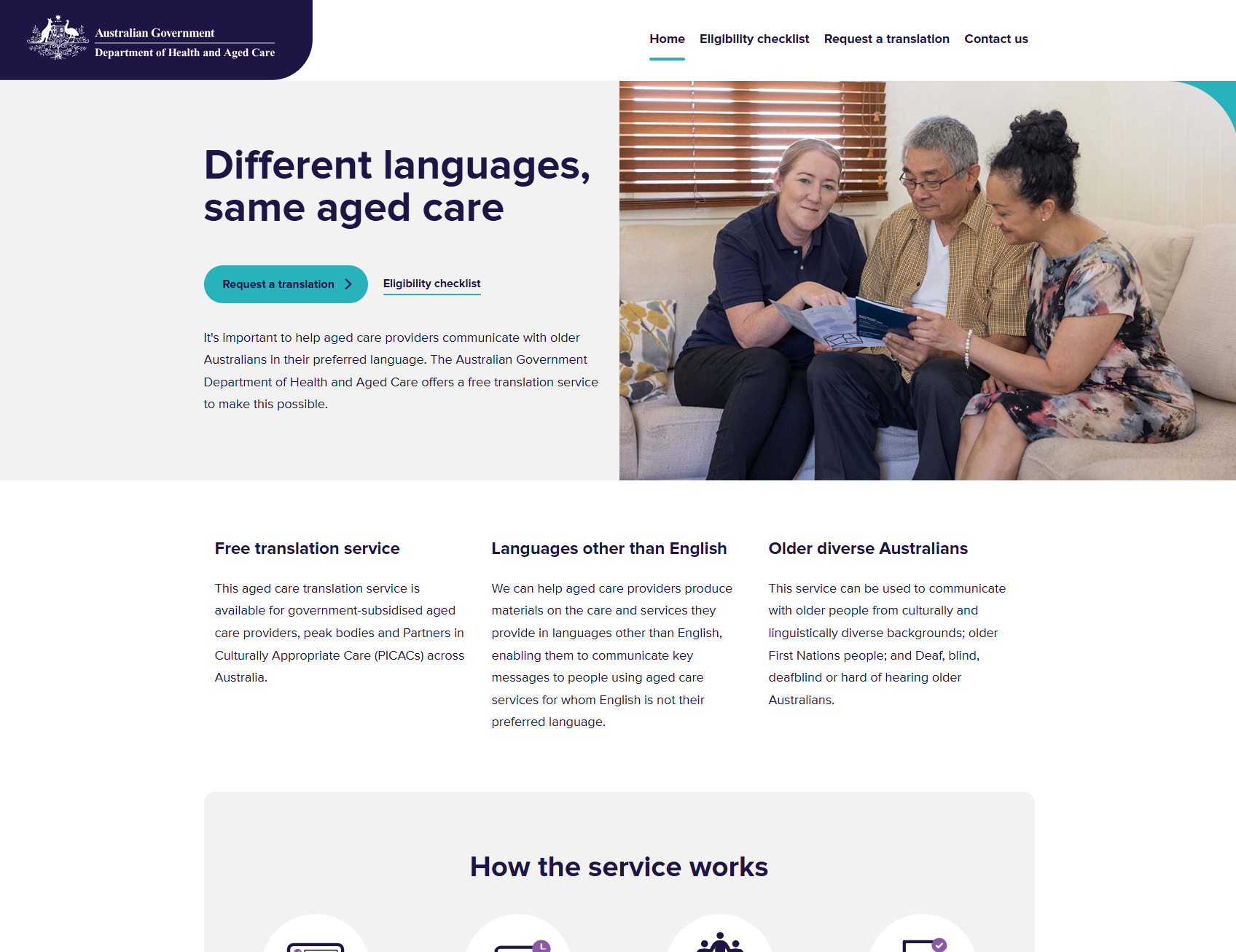
Cultural considerations in Food, Nutrition and Dining
This resource provides guidance on incorporating cultural considerations into food, nutrition, and dining in aged care settings. It highlights the importance of understanding diverse dietary preferences, religious practices, and family dynamics to support person-centred care, improve wellbeing, and promote inclusivity within the aged care environment.
This resource may refer to information that will be updated from 1 November 2025 to align with the new Aged Care Act and Quality Standards.
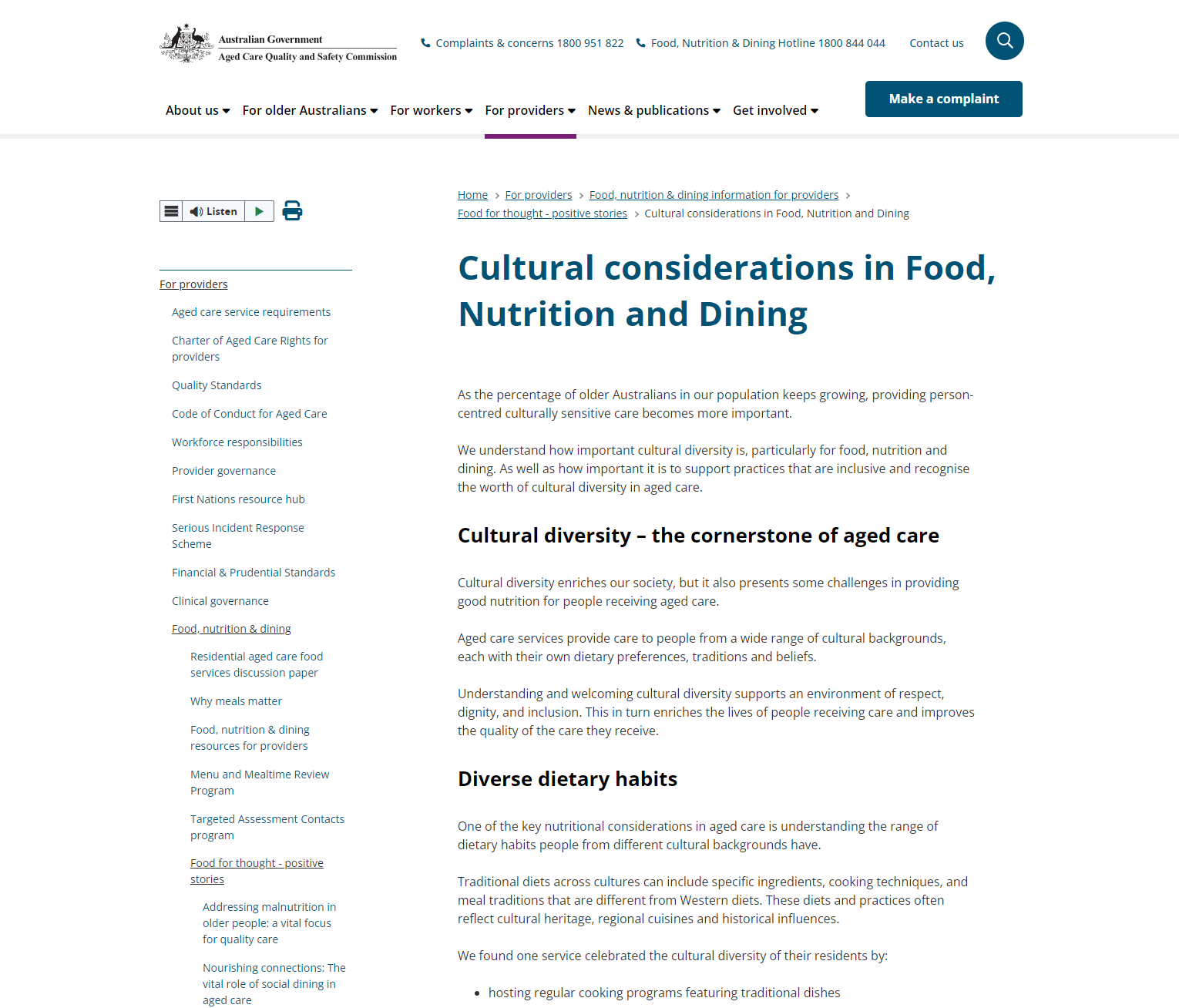
Financial & Prudential Standards
This resource provides guidance on the Financial and Prudential Standards for aged care providers. It outlines requirements for managing refundable deposits, ensuring financial viability, maintaining liquidity, and implementing governance and recordkeeping processes. It helps providers comply with financial obligations, supporting transparency and accountability in aged care services.
This resource may refer to information that will be updated from 1 November 2025 to align with the new Aged Care Act and Quality Standards.
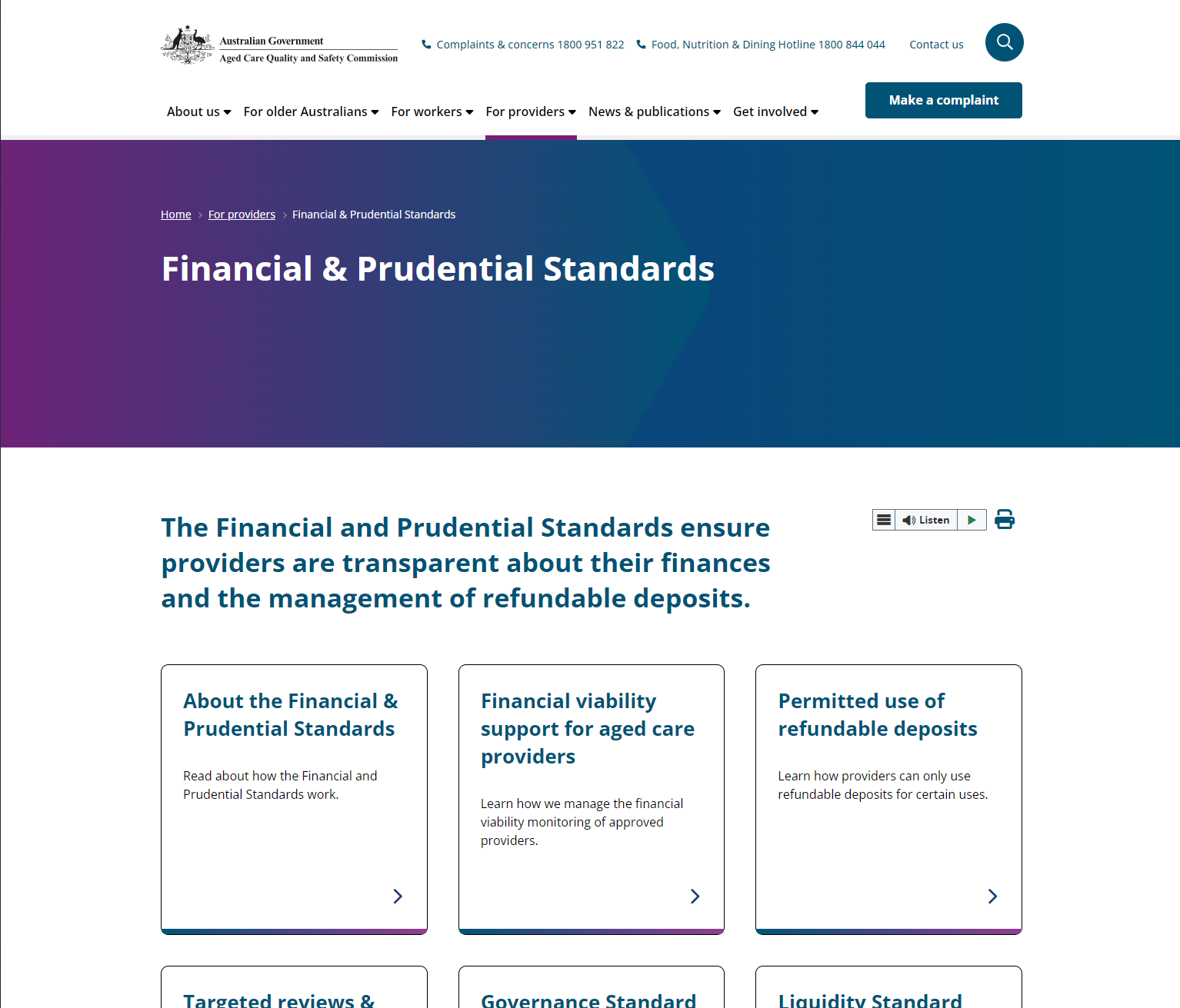
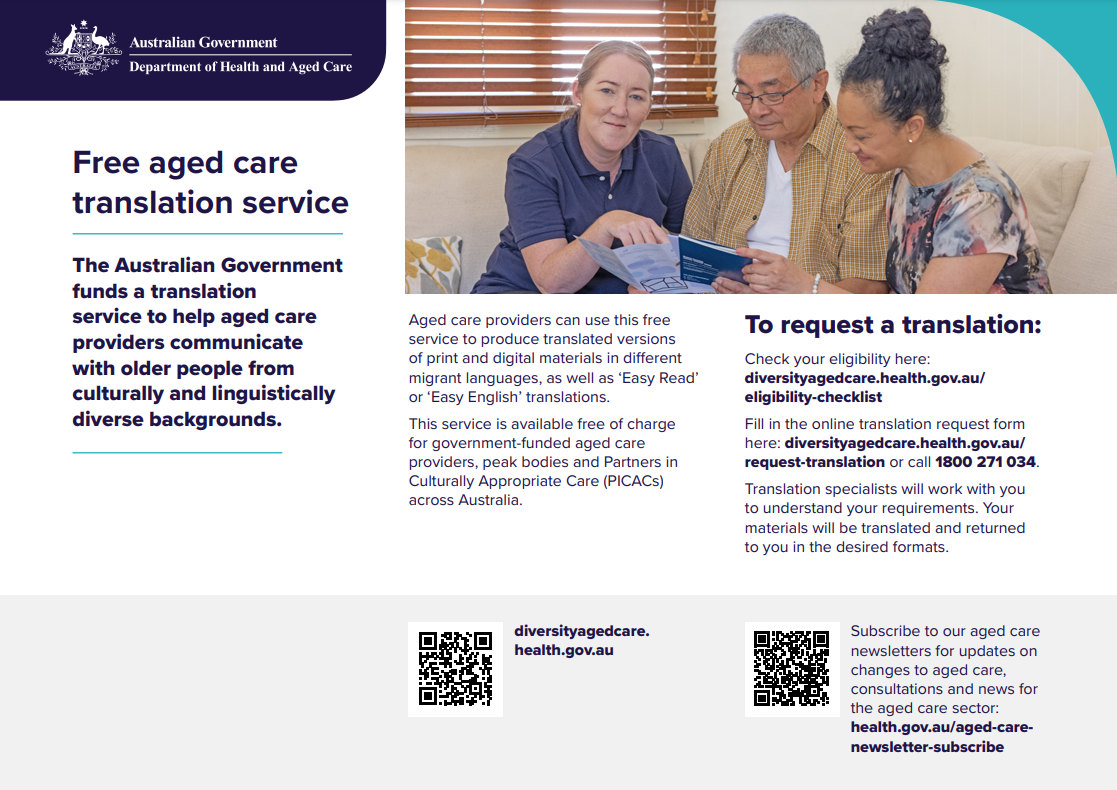
Free aged care translation service
This resource provides information on a free translation and interpreting service funded by the government for aged care providers. It supports effective communication with older people from diverse backgrounds, offering language translation, sign language, and captioning services to enhance accessibility and inclusivity in aged care.
This resource may refer to information that will be updated from 1 November 2025 to align with the new Aged Care Act and Quality Standards.
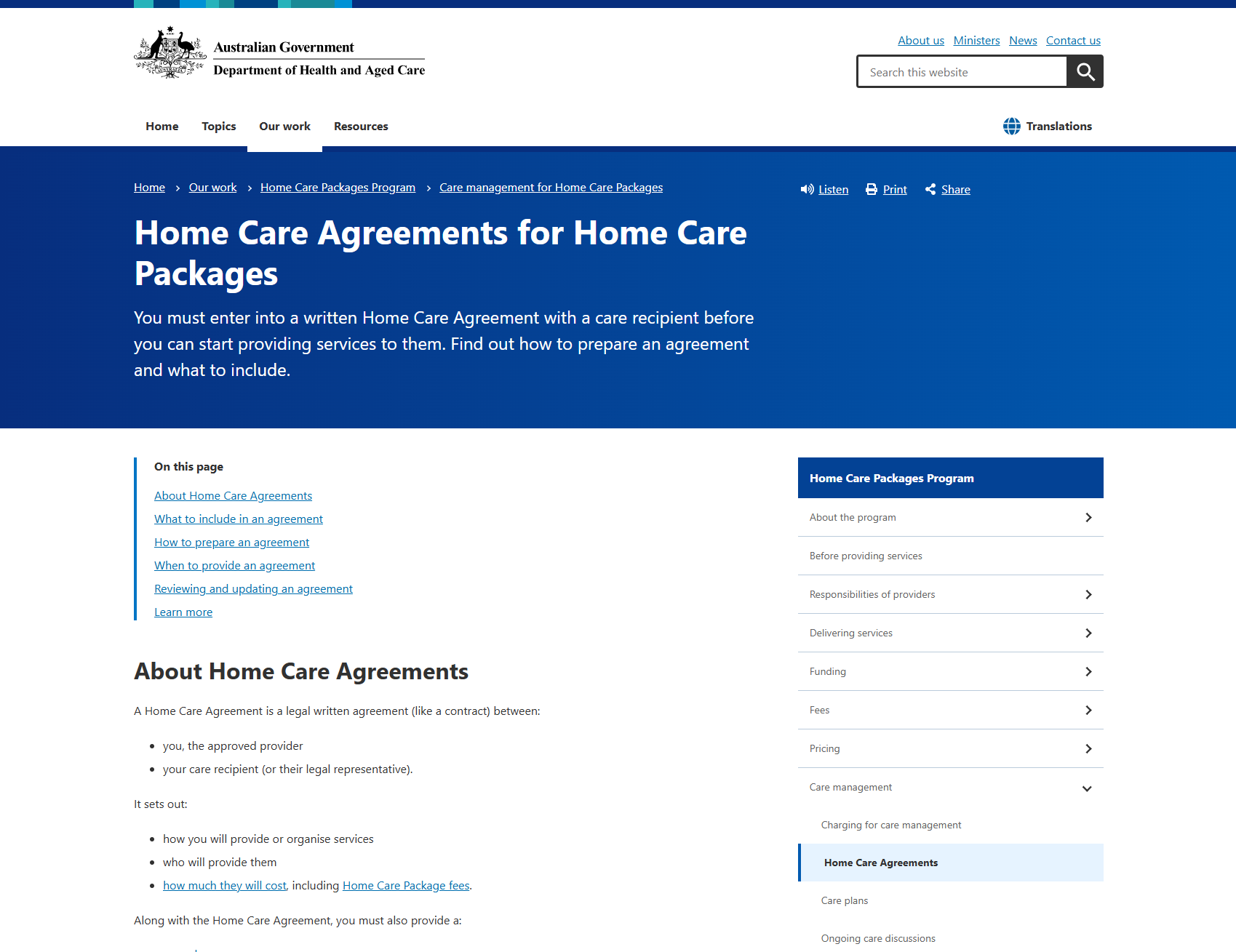
Home Care Agreements for Home Care Packages
This resource explains requirements for Home Care Agreements in the Home Care Packages Program, detailing the roles of providers and care recipients, fees, and service terms. It emphasises collaboration to make sure agreements are clear, fair, and reviewed regularly, supporting person-centred care in home settings.
This resource may refer to information that will be updated from 1 November 2025 to align with the new Aged Care Act and Quality Standards.
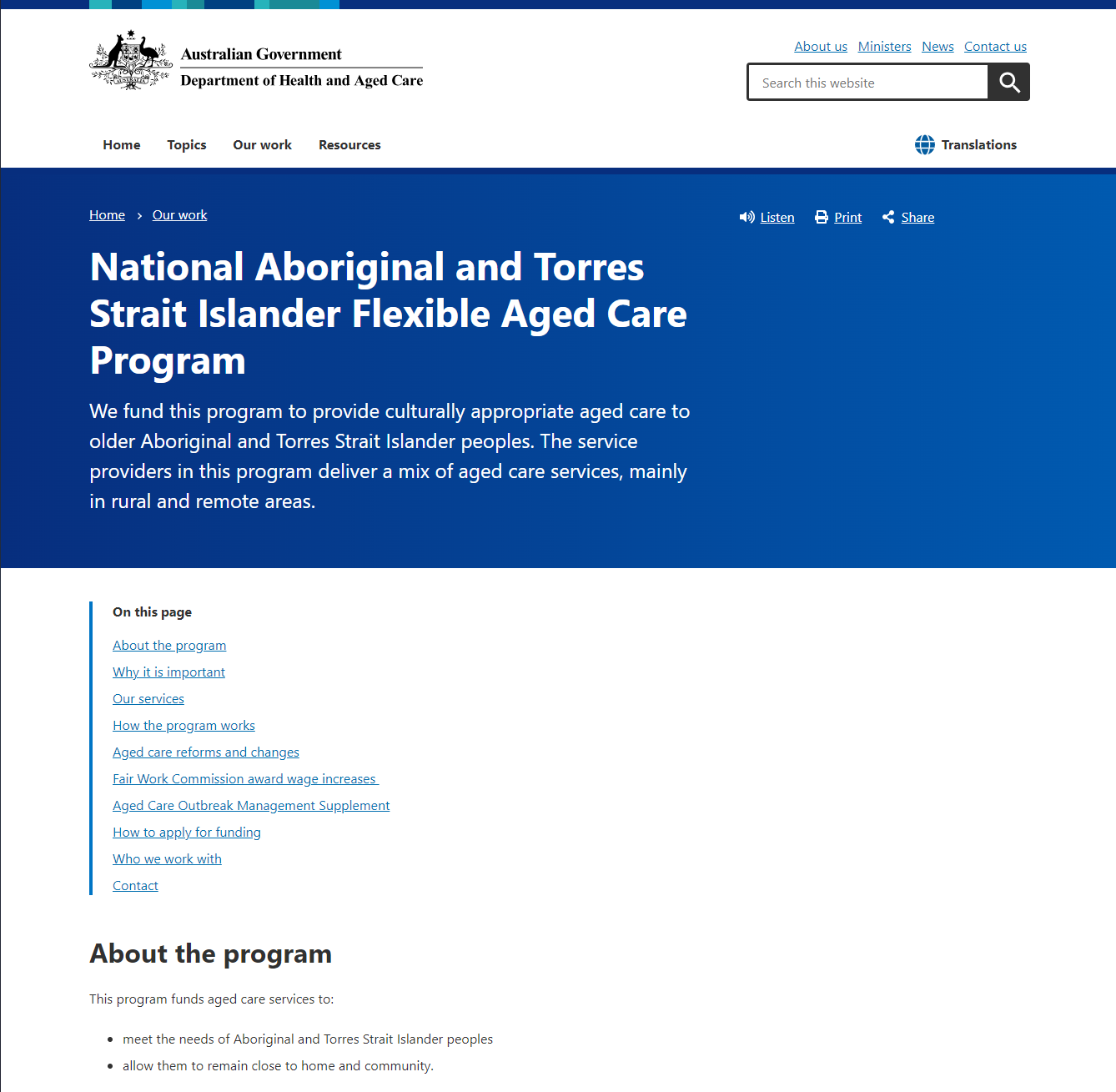
National Aboriginal and Torres Strait Islander Flexible Aged Care Program
This resource provides information on the National Aboriginal and Torres Strait Islander Flexible Aged Care Program. The program funds flexible and culturally appropriate aged care services for Aboriginal and Torres Strait Islander communities, mainly in rural and remote areas. It covers service provider requirements, funding processes, and adaptations to ongoing aged care reforms.
This resource may refer to information that will be updated from 1 November 2025 to align with the new Aged Care Act and Quality Standards.
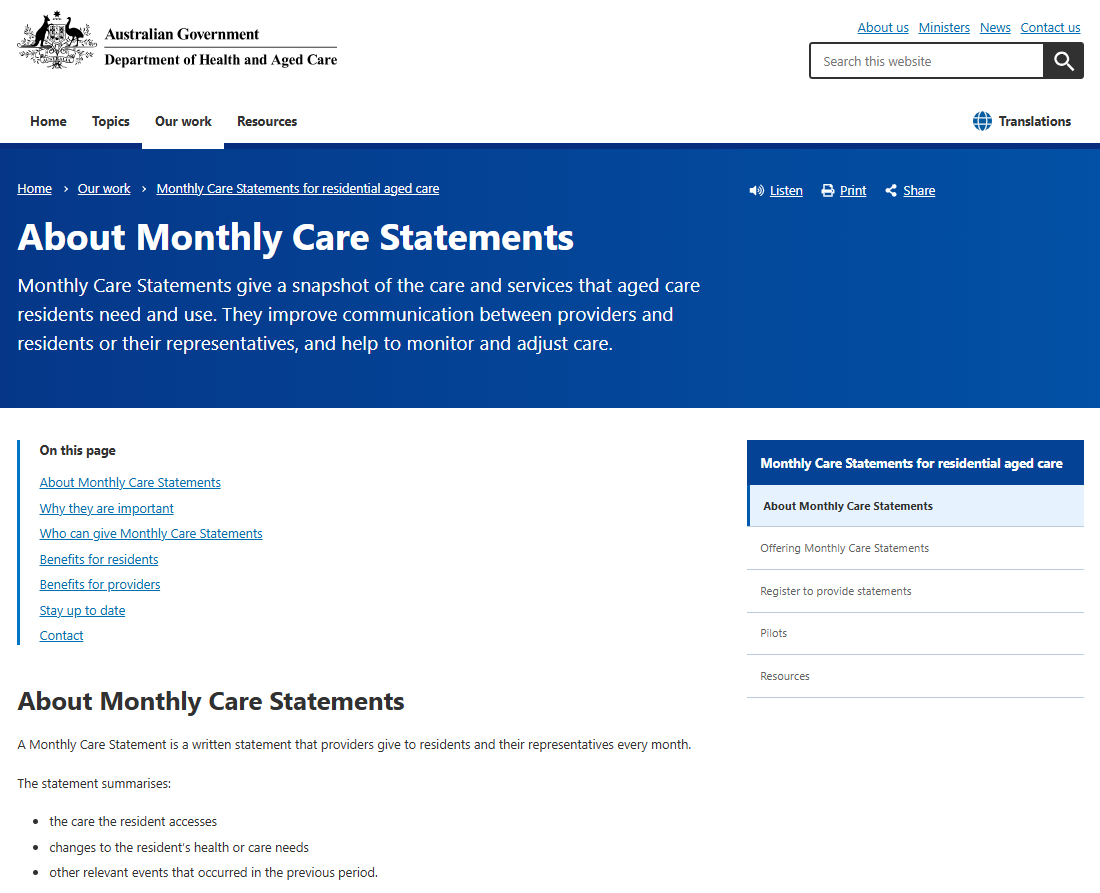
Monthly Care Statements for residential aged care
This resource provides information about Monthly Care Statements, including why they are important, who can give them, and the benefits for residents and providers.
This resource may refer to information that will be updated from 1 November 2025 to align with the new Aged Care Act and Quality Standards.
Person-centred care in practice webinar series
This resource offers a series of webinars on person-centred care, providing practical examples from Australian healthcare settings. It is designed for health service managers, clinicians, and consumer engagement staff, promoting strategies and tools to enhance person-centred practices. This resource may apply to healthcare contexts outside of aged care. Please consider the applicability of this resource to your care setting.
This resource may refer to information that will be updated from 1 November 2025 to align with the new Aged Care Act and Quality Standards.
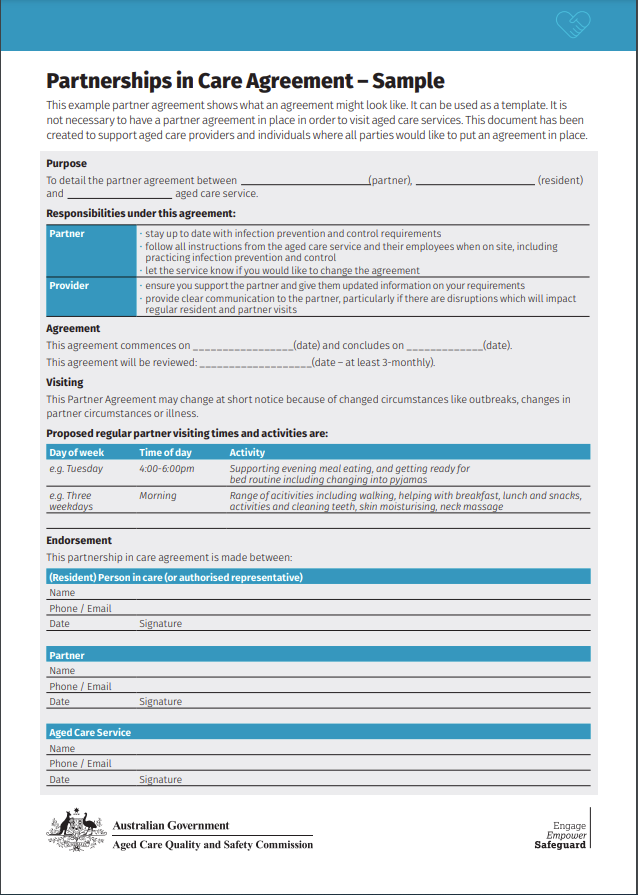
Partnerships in Care Agreement – Sample
This resource is a sample of what a partner agreement might look like. It can be used as a template. This document has been created to support aged care providers and individuals where all parties would like to put an agreement in place.
This resource may refer to information that will be updated from 1 November 2025 to align with the new Aged Care Act and Quality Standards.
Partnerships in Care Agreement – Sample (PDF 108.45 KB)
Partners in Culturally Appropriate Care (PICAC)
This resource supports aged care providers in delivering culturally appropriate care for people from culturally and linguistically diverse (CALD) backgrounds. It offers free training, workshops, and resources, helping providers understand and respect diverse needs, ensuring safe, inclusive, and culturally responsive care across all settings.
This resource may refer to information that will be updated from 1 November 2025 to align with the new Aged Care Act and Quality Standards.
NSQHS Standards User Guide for the Health Care of People with Intellectual Disability
This resource provides guidance for the health care of people with intellectual disability. The user guide is part of the Australian Commission on Safety and Quality in Health Care's National Safety and Quality Health Service (NSQHS) Standards. The resource was developed in response to significant evidence of poor health outcomes for people with intellectual disability in Australia’s health system.
This resource may refer to information that will be updated from 1 November 2025 to align with the new Aged Care Act and Quality Standards.
A little yarn goes a long way - Fact sheet
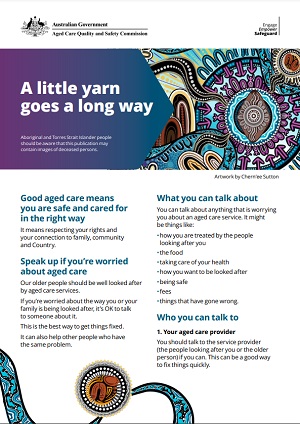
The ‘A little yarn goes a long way’ fact sheet has been developed to inform older Aboriginal and Torres Strait Islander people, and their friends and family, about the support available to help them resolve concerns about aged care services, and why it’s important to raise these concerns.
Information is also available in 7 different languages including: English, Alyawarra, Arrernte, Luritja, Pitjantjatjarra, Torres Strait Creole and Warlpiri.
English - A little yarn goes a long way (PDF 769.91 KB)
Alyawarra - A little yarn goes a long way (PDF 3.74 MB)
Arrernte - A little yarn goes a long way (PDF 3.73 MB)
Luritja - A little yarn goes a long way (PDF 3.73 MB)
Pitjantjatjarra - A little yarn goes a long way (PDF 3.73 MB)
Torres Strait Creole - A little yarn goes a long way (PDF 3.74 MB)
Warlpiri - A little yarn goes a long way (PDF 3.73 MB)
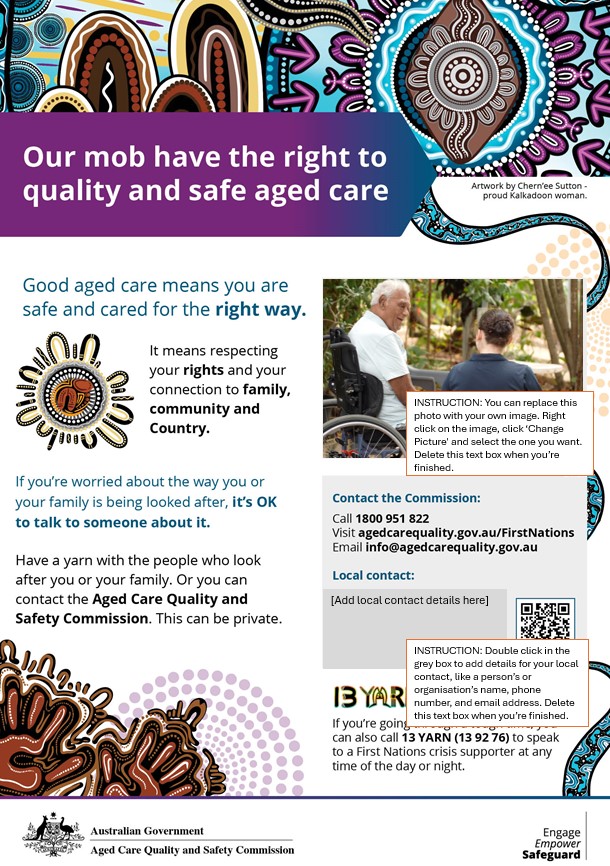
Explaining aged care and your rights – locally tailorable poster - First Nations resources
We’ve developed a tailorable poster for you to edit with your own local details, and print and display at community notice boards or waiting areas.

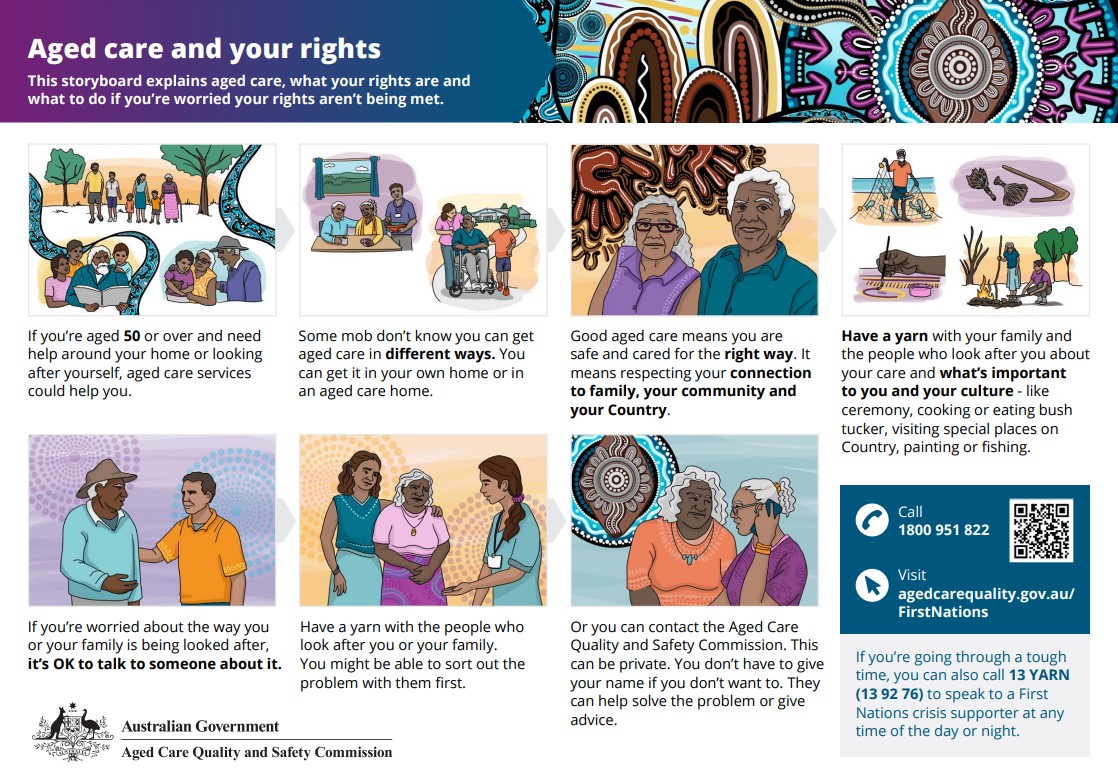
First Nations - Visual Storyboard - Aged care and your rights
The storyboards use pictures to explain aged care, your rights and what to do if your rights aren’t being met.
Aged care and your rights – visual storyboard (PDF 803.63 KB)
Consumer advisory bodies
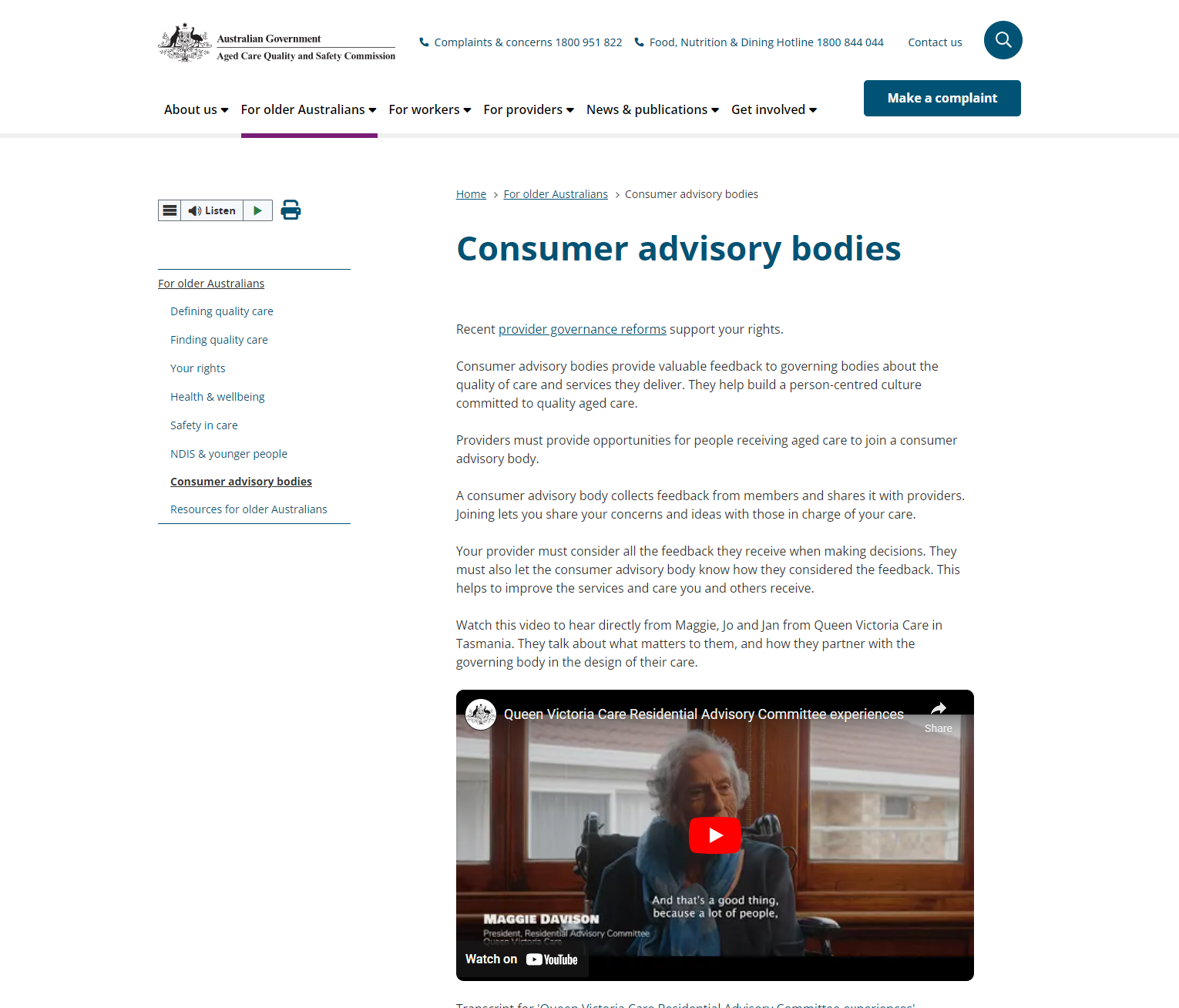
This resource explains the role of consumer advisory bodies in aged care, which provide feedback to governing bodies on care and services. It outlines the process for joining, the importance of feedback in decision-making, and the responsibility of providers to offer participation opportunities annually.
This resource may refer to information that will be updated from 1 November 2025 to align with the new Aged Care Act and Quality Standards.
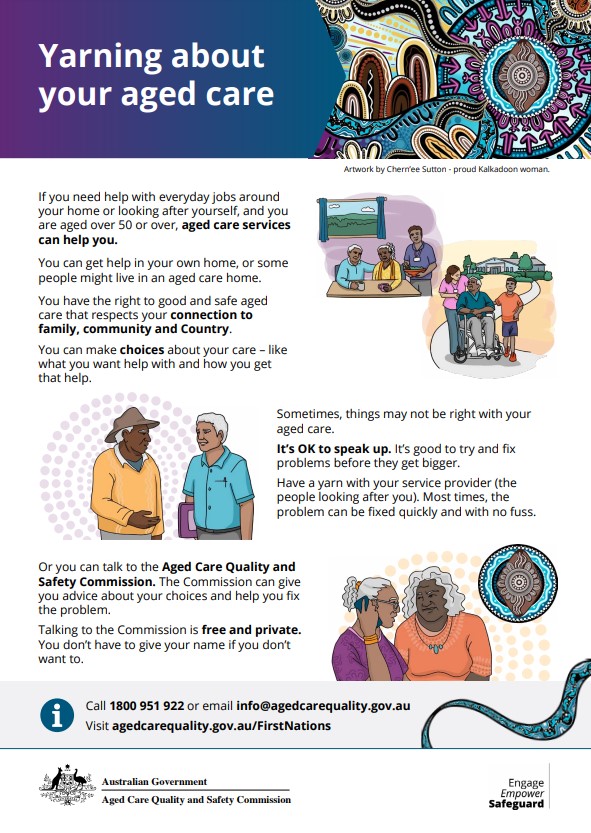
First Nations - Visual information sheet - Your rights when accessing aged care
Yarning about your aged care (PDF 645.07 KB)
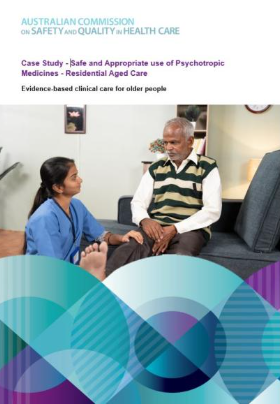
Case study - Safe and Appropriate use of Psychotropic Medicines - Residential Aged Care
This resource is a fictional scenario that follows an older person’s care pathway with a residential aged care provider. The resource focuses on the systems and processes to support high-quality care of older people living with cognitive impairment. It includes 4 key priority areas: person-centred care, medication management, managing changed behaviours and transitions of care.
This resource may refer to information that will be updated from 1 November 2025 to align with the new Aged Care Act and Quality Standards.
Case study - Safe and Appropriate use of Psychotropic Medicines - In-home Aged Care
This resource is a fictional scenario that follows an older person’s care pathway with an in-home aged care provider. The resource focuses on the systems and processes to support high-quality care of older people living with dementia. It includes 4 key priority areas: person-centred care, medication management, managing changed behaviours and transitions of care.
This resource may refer to information that will be updated from 1 November 2025 to align with the new Aged Care Act and Quality Standards.

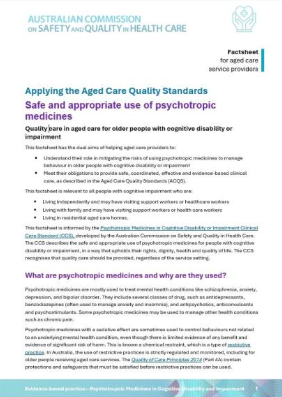
Safe and appropriate use of psychotropic medicines for aged care - Fact sheet
This fact sheet is informed by the Psychotropic Medicines in Cognitive Disability or Impairment Clinical Care Standard (CCS), developed by the Australian Commission on Safety and Quality in Health Care. The CCS describes the safe and appropriate use of psychotropic medicines for people with cognitive disability or impairment, in a way that upholds their rights, dignity, health and quality of life.
This resource may refer to information that will be updated from 1 November 2025 to align with the new Aged Care Act and Quality Standards.