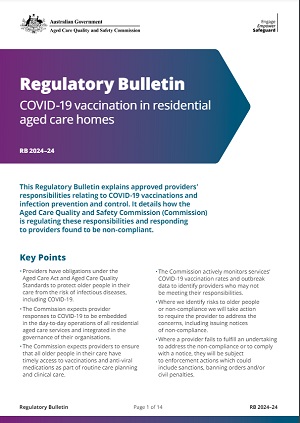
This Regulatory Bulletin explains approved providers’ responsibilities relating to COVID-19 vaccinations and infection prevention and control. It details how the Aged Care Quality and Safety Commission (Commission) is regulating these responsibilities and responding to providers found to be non-compliant.
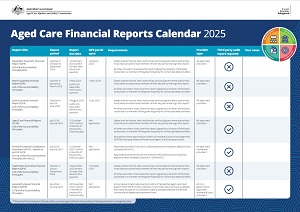
This aged care financial reports calendar details due dates and auditing requirements for reports.
 Aged care financial reports calendar 2025 - A3 poster (PDF 582.08 KB)
In this kit you will find a range of promotional resources, including social media posts and tiles, and a newsletter article to help you promote our latest complaints report, 'Complaints about aged care home services – Insights for people receiving care (July-December 2023)'.

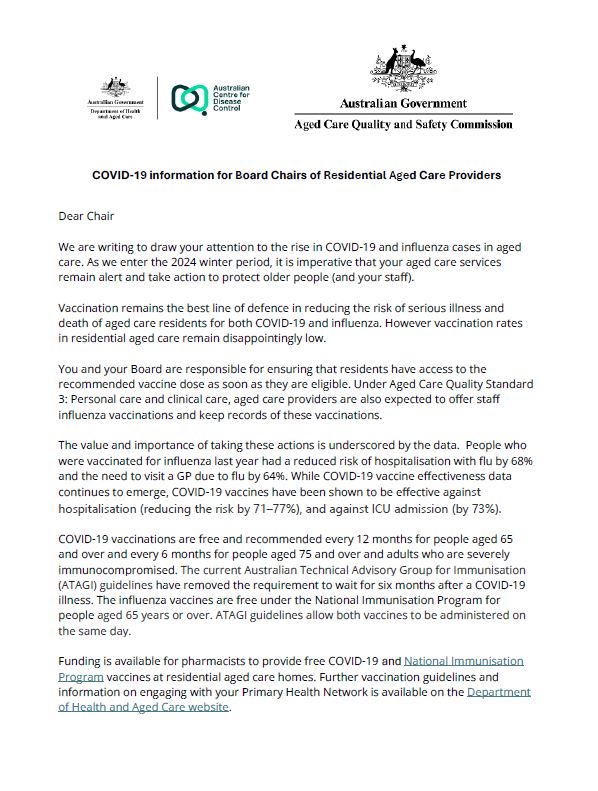
Joint letter on Winter outbreaks to Board Chairs, Residential Aged Care Providers from the Chief Medical Officer, Professor Paul Kelly and Commissioner Janet Anderson PSM.
The partner information pack presents information for all people visiting and volunteering in residential aged care services. The resource includes information on the importance of infection prevention and control (IPC), the use of personal protective equipment (PPE), and changes in what you need to do if you visit during an outbreak.
Arabic - الشراكة في الرعاية الرعاية المشتركة (PDF 4.87 MB)
Chinese Simplified - 护理合作伙伴 携手护理 (PDF 4.81 MB)
Chinese Traditional - 護理合作夥伴 攜手護理 (PDF 4.73 MB)
Dutch - Samenwerking in de zorg Samen zorgdragen (PDF 4.34 MB)
German - Pflegepartnerschaften Gemeinsam pflegen (PDF 4.38 MB)
Hungarian - Gondozási partnerség Gondozás közösen (PDF 4.38 MB)
Korean - 돌봄 파트너십 함께하는 돌봄 (PDF 4.87 MB)
Latvian - Aprūpes partnerība Kopīgas rūpes (PDF 4.33 MB)
Macedonian - Партнерства во грижа Да се грижиме заедно (PDF 4.31 MB)
Maltese - Sħubija fil-kura Nieħdu ħsieb flimkien (PDF 4.35 MB)
Polish - Partnerstwo w opiece Wspólna opieka (PDF 4.37 MB)
Portuguese - Parceiros nos cuidados Cuidando juntos (PDF 4.37 MB)
Russian - Партнеры по уходу Заботимся вместе (PDF 4.33 MB)
Spanish - Atención en colaboración Cuidamos juntos (PDF 4.35 MB)
Turkish - Bakım ortaklıkları Birlikte dikkat etmek (PDF 4.32 MB)
Ukrainian - Партнерство у сфері догляду Піклуємося разом (PDF 4.33 MB)
Vietnamese - Quan hệ đối tác chăm sóc Cùng nhau chăm sóc (PDF 4.33 MB)

This report is specifically for people receiving aged care and focuses on the experience of those using home services through Home Care Packages or through the Commonwealth Home Support Programme.
The report aims to help people to understand what to expect from their home services provider and sets out what to do if things are not going the way they want. The report includes information about aged care standards, data collected from thousands of complaints and useful tips for people receiving care.
 National Aged Care Provider Conference 2024 Placemat (PDF 2.92 MB)
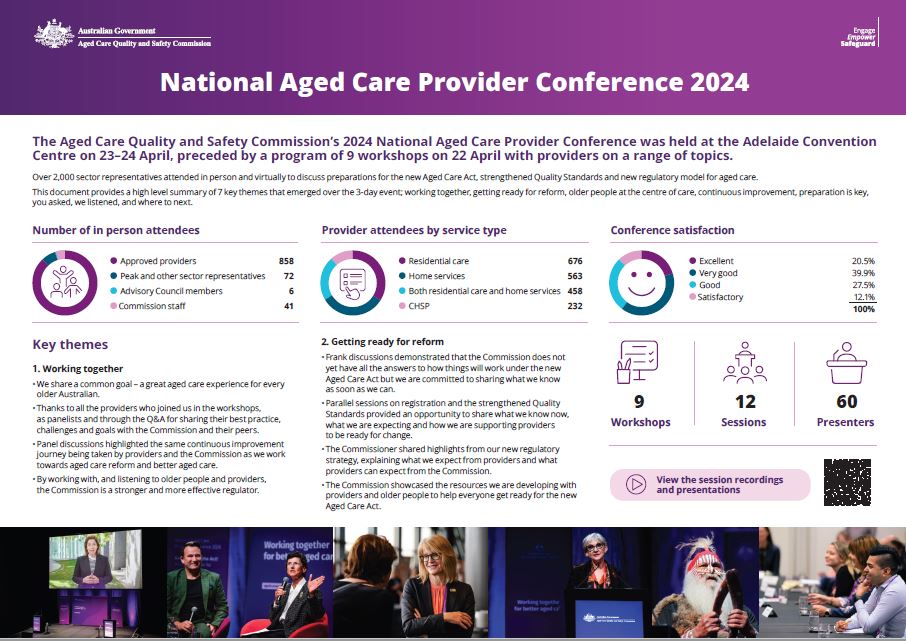
National Aged Care Provider Conference 2024. Towards excellence - aged care on the move, address and open forum by Janet Anderson, PSM Commissioner.

National Aged Care Provider Conference 2024. Parallel session 1: Provider registration unpacked - registration and renewal (Residential services). Presentation by Louise Macleod, Complaints Commissioner, ACQSC
National Aged Care Provider Conference 2024. Parallel session 1: Provider registration unpacked - registration and renewal (Home services). Presentation by Anthony Speed, Executive Director, Quality Assessment and Monitoring, ACQSC.
National Aged Care Provider Conference 2024. Parallel session 2: Strengthened Standards – what to expect and how to be ready (Residential Services). Presentation by Deputy Commissioner, Sector Capability and Regulatory Strategy Lisa Peterson PSM, ACQSC.
National Aged Care Provider Conference 2024. Parallel session 3: Governing bodies working with older people in the design of their care (Residential services). Presentation by Louise Macleod, Aged Care Complaints Commissioner, ACQSC.

National Aged Care Provider Conference 2024. Parallel session 3: Governing bodies working with older people in the design of their care (Home services). Presentation by Executive Director, Approvals and Serious Incident Notifications Ann Wunsch, ACQSC.

National Aged Care Provider Conference 2024. Parallel session 3: Governing bodies working with older people in the design of their care (CHSP). Presentation by Janet Anderson, PSM Commissioner.

National Aged Care Provider Conference 2024. Closing Plenary: Bringing it all together – closing plenary with Commissioner Janet Anderson PSM, First Assistant Secretary, Quality Assurance, Department of Health and Aged Care Amy Laffan and pre-conference workshop representatives

The strengthened Quality Standards pilot project final report outlines key insights, findings and lessons learnt from the pilot audits. The report will direct future work to be undertaken by the Commission in preparation for implementation of the strengthened Quality Standards and new audit methodology.

To Dip or Not to Dip (TDONTD) is a quality improvement intervention successfully implemented in UK and Australian aged care homes to improve UTI assessment and antibiotic prescribing appropriateness.
This implementation guide has been drawn from the experiences of homes and champions who have implemented TDONTD, along with feedback from aged care nurses and personal care assistants who have used TDONTD resources.

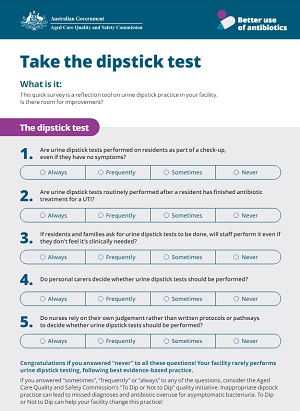
This quick survey is a reflection tool on urine dipstick practice in your facility.
Is there room for improvement?
take-the-dipstick-test.pdf (PDF 290.31 KB)
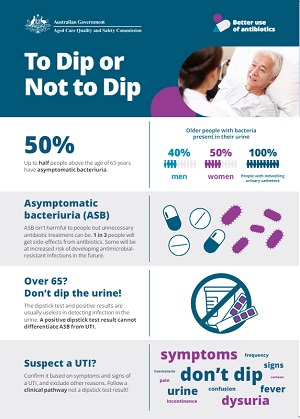
This huddle tool poster provides guidance on appropriate use of urine dipstick tests in older adults. It explains that asymptomatic bacteriuria (ASB) is common and not harmful, but that unnecessary antibiotic treatment can be. It suggests confirming urinary tract infections (UTIs) through clinical symptoms rather than dipstick results.
This resource may refer to information that will be updated from 1 November 2025 to align with the new Aged Care Act and Quality Standards.
To Dip or Not to Dip - huddle tool A3 poster (PDF 393.96 KB)