We have released a suite of fact sheets to help providers, aged care workers, and other stakeholders understand the new strengthened Quality Standards and their obligations in meeting them .
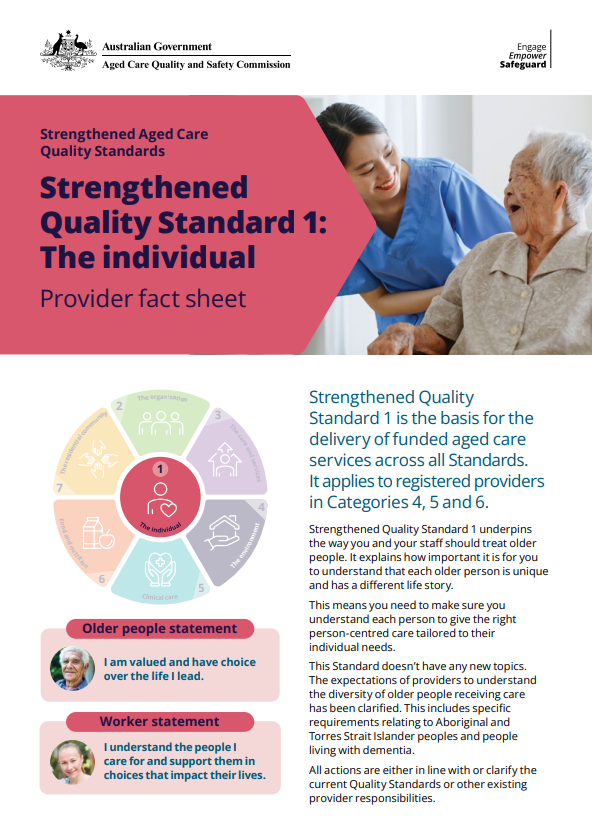
Strengthened Quality Standard 1 underpins the way providers and staff should treat older people. It explains how important it is to understand that each older person is unique and has a different life story.
 Standard 1: The individual (PDF 537.58 KB)
We have released a suite of fact sheets to help providers, aged care workers, and other stakeholders understand the new strengthened Quality Standards and their obligations in meeting them .
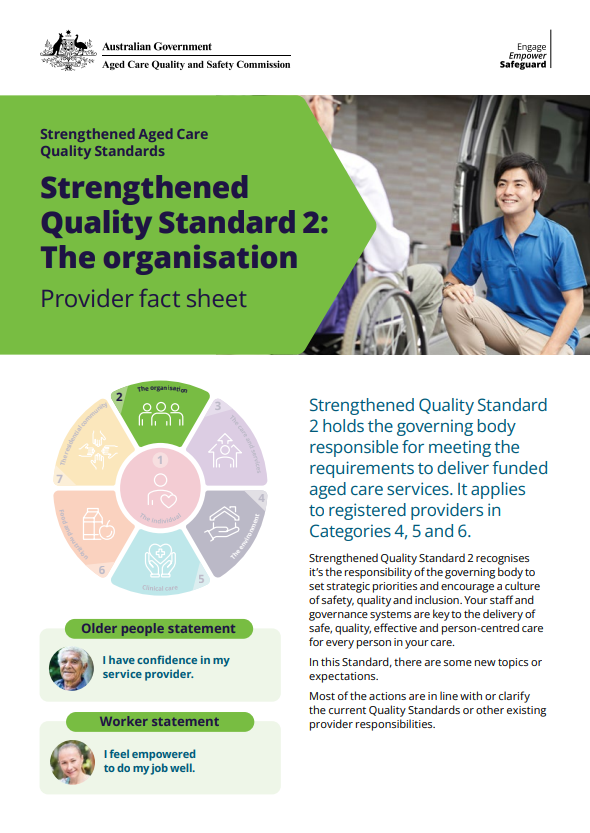
Strengthened Quality Standard 2 recognises that it’s the responsibility of the governing body to set strategic priorities and encourage a culture of safety and quality. Staff and governance systems are key to the delivery of safe, quality, effective and person-centred care for every person.
Standard 2: The organisation (PDF 548.55 KB)
We have released a suite of fact sheets to help providers, aged care workers, and other stakeholders understand the new strengthened Quality Standards and their obligations in meeting them .
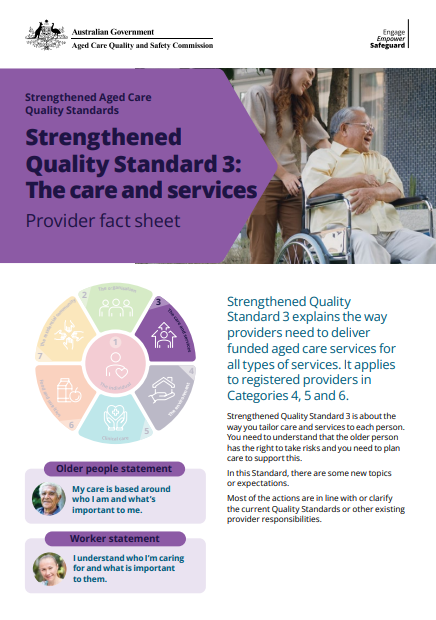
Strengthened Quality Standard 3 is about the way providers tailor care and services to each person. It's important to understand that the older person has the right to take risks and you need to plan care to support this.
Standard 3: The care and services (PDF 571.62 KB)
We have released a suite of fact sheets to help providers, aged care workers, and other stakeholders understand the new strengthened Quality Standards and their obligations in meeting them .
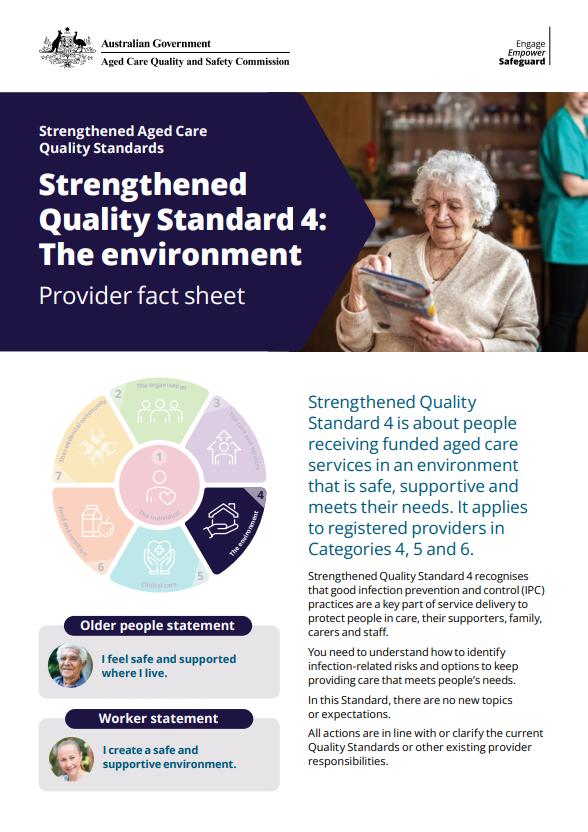
Strengthened Quality Standard 4 is about people receiving care and services in an environment that is safe, supportive and meets their needs. Good infection prevention and control (IPC) practices are a key part of service delivery to protect people in care, their family, carers and staff.
Standard 4: The environment (PDF 481.93 KB)
We have released a suite of fact sheets to help providers, aged care workers, and other stakeholders understand the new strengthened Quality Standards and their obligations in meeting them .
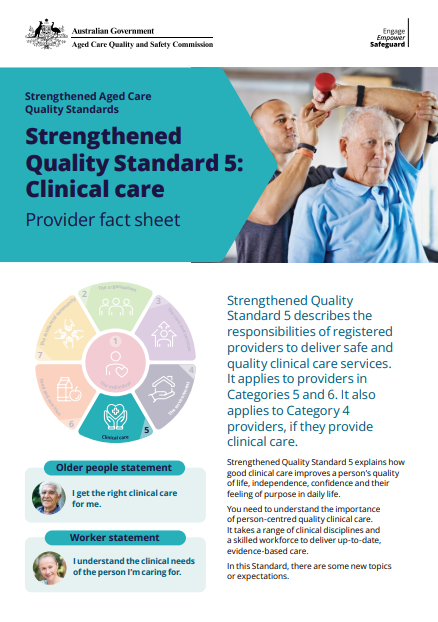
Strengthened Quality Standard 5 describes the responsibilities of providers to deliver safe and quality clinical care. Good clinical care improves a person’s quality of life, independence, confidence and their feeling of purpose in daily life.
Standard 5: Clinical care (PDF 482.49 KB)
We have released a suite of fact sheets to help providers, aged care workers, and other stakeholders understand the new strengthened Quality Standards and their obligations in meeting them .
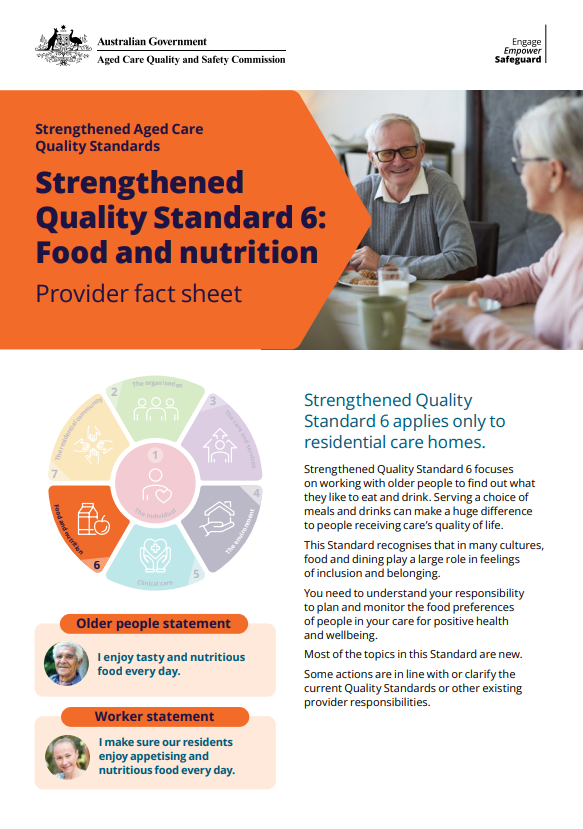
Strengthened Quality Standard 6 is about working with older people to find out what they like to eat and drink. Serving a choice of meals and drinks can make a huge difference to people receiving care’s quality of life. This Standard only applies to residential aged care services.
Standard 6: Food and nutrition (PDF 478.4 KB)
We have released a suite of fact sheets to help providers, aged care workers, and other stakeholders understand the new strengthened Quality Standards and their obligations in meeting them .
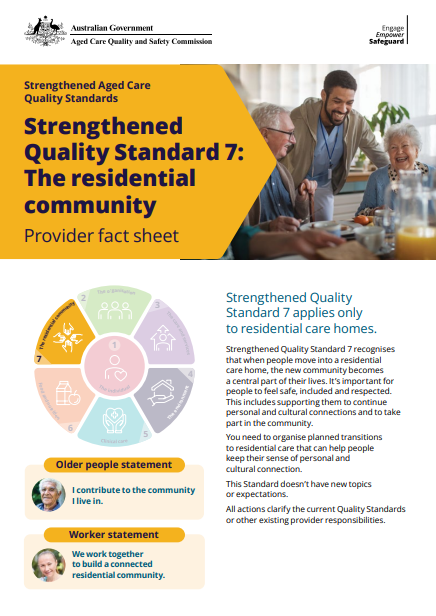
Strengthened Quality Standard 7 acknowledges that when people move into a residential service, the new community becomes a central part of their lives. It’s important for people to feel safe, included and respected. This Standard only applies to residential aged care services.
Standard 7: The residential community (PDF 482.81 KB)
Infection prevention and control, also known as IPC, are the steps and processes that people can use to reduce the spread of harmful germs and bacteria. People who visit aged care services can help support IPC processes.
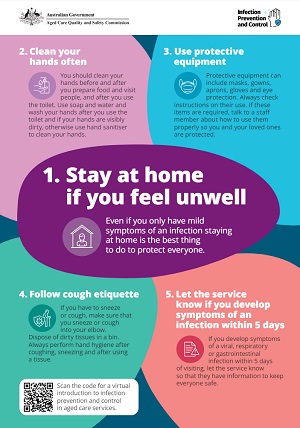
Infection prevention and control, also known as IPC, are the steps and processes that people can use to reduce the spread of harmful germs and bacteria.
People who visit aged care services can help support IPC processes.
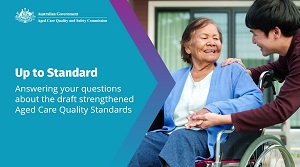
Watch our video series answering the most common questions we have received about the strengthened Aged Care Quality Standards.
In this third episode, Lisa Peterson PSM, Assistant Commissioner for Sector Capability and Regulatory Strategy, discusses the main changes from the current Standards to the strengthened Quality Standards, and gives insight as to how providers will be assessed against them.
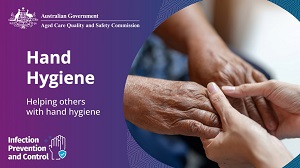
Infection prevention and control helps to stop the spread of germs like bacteria and viruses that cause respiratory infections and gastroenteritis. Hand hygiene is a very important part of this.
In this video you will learn how to clean another person's hands.
How to create an environment with strong infection prevention and control practices while continuing to provide a positive experience for people with cognitive decline and dementia.
This resource may refer to information that will be updated from 1 November 2025 to align with the new Aged Care Act and Quality Standards
This Cost Recovery Implementation Statement (CRIS) provides information on how we implemented cost recovery charging arrangements for the accreditation and re-accreditation of residential aged care services for the period 1 July to 31 October 2025.
A new Cost Recovery Implementation Statement is available and sets out the new charging arrangements under the new Aged Care Act (from 1 November 2025).
This tool and user guide supports residential aged care services in self-assessing their antimicrobial stewardship (AMS) practices. It covers AMS governance, policies, education, monitoring, and feedback, aiming to improve antibiotic use and reduce risks associated with antimicrobial resistance. The resources helps identify gaps and develop action plans to enhance AMS activities and patient care. This resource may refer to information that will be updated from 1 July 2025 to align with the new Aged Care Act and Quality Standards.
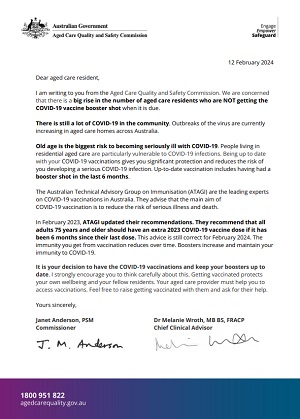
Letter from Commissioner Janet Anderson PSM and Chief Clinical Advisory Dr Melanie Wroth to residential aged care providers and people living in residential aged care homes on the importance of being up to date with COVID-19 vaccine boosters.
English — COVID-19 vaccination booster letter (PDF 86.14 KB)
Arabic — COVID-19 vaccination booster letter (PDF 524.5 KB)
Chinese Simplified — COVID-19 vaccination booster letter (PDF 100.71 KB)
Chinese Traditional — COVID-19 vaccination booster letter (PDF 139.73 KB)
Croatian — COVID-19 vaccination booster letter (PDF 159.29 KB)
Greek — COVID-19 vaccination booster letter (PDF 283.89 KB)
Hindi — COVID-19 vaccination booster letter (PDF 265.65 KB)
Italian — COVID-19 vaccination booster letter (PDF 156.62 KB)
Khmer — COVID-19 vaccination booster letter (PDF 266.14 KB)
Korean — COVID-19 vaccination booster letter (PDF 135.11 KB)
Macedonian — COVID-19 vaccination booster letter (PDF 164.34 KB)
Polish — COVID-19 vaccination booster letter (PDF 164.34 KB)
Punjabi — COVID-19 vaccination booster letter (PDF 144.48 KB)
Russian — COVID-19 vaccination booster letter (PDF 172.44 KB)
Serbian — COVID-19 vaccination booster letter (PDF 323.71 KB)
Spanish — COVID-19 vaccination booster letter (PDF 47.59 KB)
Vietnamese — COVID-19 vaccination booster letter (PDF 171.81 KB)
The Aged Care Quality Standards (Quality Standards) have been strengthened as part of broader aged care reforms in response to the Royal Commission into Aged Care Quality and Safety. The purpose of this framework analysis is to show providers how the Quality Standards are strengthened. This version of the framework analysis is based on the final Strengthened Quality Standards published in August 2025.
Strengthened Quality Standards framework analysis (PDF 4.6 MB)
Letter from Ann Wunsch to home services providers who have not reported a serious incident in the first 12 months of the Scheme. This is a follow-up communication to our letter sent to all home services providers on 27 June 2023.
People who enter residential care can pay for their accommodation costs with:
- a refundable deposit
- a daily payment
- a combination of a refundable deposit and a daily payment.
When a person transfers to another service, permanently leaves care or passes away, you need to refund their refundable deposit.
Refunding refundable deposits (PDF 854.62 KB)
This fact sheet explains what you can do if you have been overcharged a refundable accommodation deposit (RAD) or daily accommodation payment (DAP) by your provider.
Overcharged accommodation payments - Your rights (PDF 743.94 KB)
Watch our video series answering the most common questions we have received about the strengthened Aged Care Quality Standards.
In this second episode, Lisa Peterson PSM, Assistant Commissioner for the Sector Capability and Regulatory Strategy, discusses Strengthened Standards Pilot Project, what it involved and what the aged care sector can expect once it's completed.