
Infection prevention and control, also known as IPC, are the steps and processes that people can use to reduce the spread of harmful germs and bacteria.
People who visit aged care services can help support IPC processes.
Watch our video series answering the most common questions we have received about the strengthened Aged Care Quality Standards.
In this third episode, Lisa Peterson PSM, Assistant Commissioner for Sector Capability and Regulatory Strategy, discusses the main changes from the current Standards to the strengthened Quality Standards, and gives insight as to how providers will be assessed against them.

Infection prevention and control helps to stop the spread of germs like bacteria and viruses that cause respiratory infections and gastroenteritis. Hand hygiene is a very important part of this.
In this video you will learn how to clean another person's hands.

How to create an environment with strong infection prevention and control practices while continuing to provide a positive experience for people with cognitive decline and dementia.
This resource may refer to information that will be updated from 1 November 2025 to align with the new Aged Care Act and Quality Standards
This Cost Recovery Implementation Statement (CRIS) provides information on how we implemented cost recovery charging arrangements for the accreditation and re-accreditation of residential aged care services for the period 1 July to 31 October 2025.
A new Cost Recovery Implementation Statement is available and sets out the new charging arrangements under the new Aged Care Act (from 1 November 2025).
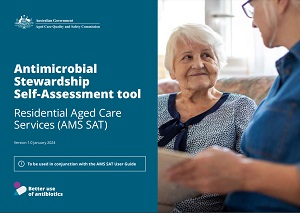
This tool and user guide supports residential aged care services in self-assessing their antimicrobial stewardship (AMS) practices. It covers AMS governance, policies, education, monitoring, and feedback, aiming to improve antibiotic use and reduce risks associated with antimicrobial resistance. The resources helps identify gaps and develop action plans to enhance AMS activities and patient care. This resource may refer to information that will be updated from 1 July 2025 to align with the new Aged Care Act and Quality Standards.
Letter from Commissioner Janet Anderson PSM and Chief Clinical Advisory Dr Melanie Wroth to residential aged care providers and people living in residential aged care homes on the importance of being up to date with COVID-19 vaccine boosters.
 English — COVID-19 vaccination booster letter (PDF 86.14 KB)
Arabic — COVID-19 vaccination booster letter (PDF 524.5 KB)
Chinese Simplified — COVID-19 vaccination booster letter (PDF 100.71 KB)
Chinese Traditional — COVID-19 vaccination booster letter (PDF 139.73 KB)
Croatian — COVID-19 vaccination booster letter (PDF 159.29 KB)
Greek — COVID-19 vaccination booster letter (PDF 283.89 KB)
Hindi — COVID-19 vaccination booster letter (PDF 265.65 KB)
Italian — COVID-19 vaccination booster letter (PDF 156.62 KB)
Khmer — COVID-19 vaccination booster letter (PDF 266.14 KB)
Korean — COVID-19 vaccination booster letter (PDF 135.11 KB)
Macedonian — COVID-19 vaccination booster letter (PDF 164.34 KB)
Polish — COVID-19 vaccination booster letter (PDF 164.34 KB)
Punjabi — COVID-19 vaccination booster letter (PDF 144.48 KB)
Russian — COVID-19 vaccination booster letter (PDF 172.44 KB)
Serbian — COVID-19 vaccination booster letter (PDF 323.71 KB)
Spanish — COVID-19 vaccination booster letter (PDF 47.59 KB)
Vietnamese — COVID-19 vaccination booster letter (PDF 171.81 KB)
The Aged Care Quality Standards (Quality Standards) have been strengthened as part of broader aged care reforms in response to the Royal Commission into Aged Care Quality and Safety. The purpose of this framework analysis is to show providers how the Quality Standards are strengthened. This version of the framework analysis is based on the final Strengthened Quality Standards published in August 2025.
Strengthened Quality Standards framework analysis (PDF 4.6 MB)

Letter from Ann Wunsch to home services providers who have not reported a serious incident in the first 12 months of the Scheme. This is a follow-up communication to our letter sent to all home services providers on 27 June 2023.
People who enter residential care can pay for their accommodation costs with:
- a refundable deposit
- a daily payment
- a combination of a refundable deposit and a daily payment.
When a person transfers to another service, permanently leaves care or passes away, you need to refund their refundable deposit.
Refunding refundable deposits (PDF 854.62 KB)
This fact sheet explains what you can do if you have been overcharged a refundable accommodation deposit (RAD) or daily accommodation payment (DAP) by your provider.
Overcharged accommodation payments - Your rights (PDF 743.94 KB)
Watch our video series answering the most common questions we have received about the strengthened Aged Care Quality Standards.
In this second episode, Lisa Peterson PSM, Assistant Commissioner for the Sector Capability and Regulatory Strategy, discusses Strengthened Standards Pilot Project, what it involved and what the aged care sector can expect once it's completed.

This poster summarises the permitted and non-permitted uses of refundable deposits. Your main purpose of using refundable deposits must be to provide residential and flexible aged care.
Permitted and non-permitted uses of refundable deposits (PDF 1.03 MB)

This fact sheet explains how the Aged Care Quality and Safety Commission (the Commission) works with and supports aged care workers.
English – Aged care workers fact sheet (PDF 245.67 KB)
عربي (Arabic) – Aged care workers fact sheet (PDF 301.74 KB)
简体中文 (Chinese Simplified) – Aged care workers fact sheet (PDF 498.16 KB)
繁體中文 (Chinese Traditional) – Aged care workers fact sheet (PDF 487.49 KB)
Hrvatski (Croatian) – Aged care workers fact sheet (PDF 270.03 KB)
Français (French) – Aged care workers fact sheet (PDF 273.55 KB)
Eλληνικά (Greek) – Aged care workers fact sheet (PDF 281.54 KB)
हिं दी (Hindi) – Aged care workers fact sheet (PDF 300.97 KB)
Italiano (Italian) – Aged care workers fact sheet (PDF 272.96 KB)
ខ្មែរ (Khmer) – Aged care workers fact sheet (PDF 309.94 KB)
한국어 (Korean) – Aged care workers fact sheet (PDF 353.22 KB)
ਪੰਜਾਬੀ (Punjabi) – Aged care workers fact sheet (PDF 287.47 KB)
Cрпски (Serbian) – Aged care workers fact sheet (PDF 261.57 KB)
Español (Spanish) – Aged care workers fact sheet (PDF 277.49 KB)
Tagalog – Aged care workers fact sheet (PDF 267.01 KB)
Türkçe (Turkish) – Aged care workers fact sheet (PDF 258.67 KB)
Tiếng Việt (Vietnamese) – Aged care workers fact sheet (PDF 239.38 KB)

The Aged Care Act 2024, the Aged Care Rules 2025 and the Aged Care Financial and Prudential Standards 2025 detail your responsibilities for the use and management of your residents' refundable deposits. This fact sheet outlines what you need to do if you intend to charge above the maximum room price, including the approval and governance requirements, and what you need to do if you have overcharged any residents.
Overcharged accommodation payments (PDF 767.09 KB)
This fact sheet includes suggested questions you can ask your provider about how prepared they are for an infectious disease outbreak (including COVID-19). It also includes links to a range of resources to help you feel safe, informed and connected.
resident-covid-outbreak-fact-sheet.pdf (PDF 619.54 KB)

This regulatory bulletin explains the governance obligations that registered providers and their governing bodies must comply with under the new Aged Care Act 2024 and the Aged Care Rules 2025.
Regulatory Bulletin RB 2023-23 Provider governance obligations (PDF 359.05 KB)

In this short video, Tara Pamula, Acting Assistant Commissioner for the Sector Capability and Regulatory Strategy Division, discusses when the strengthened Aged Care Standards will be implemented and the role of the Commission.

The Good Spirit Good Life (GSGL) assessment package is a resource available to support aged care providers in the delivery of culturally safe aged care for First Nations Peoples. Developed by the University of Western Australia, the resource has been developed and validated for use with older Aboriginal Australians, aged 45 years and over, who live in urban or regional areas.
The GSGL package is a resource that providers might want to consider. It comprises an assessment tool, framework, training guide, and recommendations informed by Aboriginal Elders.

Letter from Commissioner Janet Anderson PSM and Complaints Commissioner Louise Macleod to approved providers of residential and home services on the Commission’s new report on Complaints about Aged Care Services – Insights for providers released on 20 November 2023.
