These translated guides will help you understand what to expect if someone has COVID-19 in your residential aged care service, including that a number of changes will take place. These changes will be made very quickly. You might be anxious when these changes take place but the aim is to keep you safe.
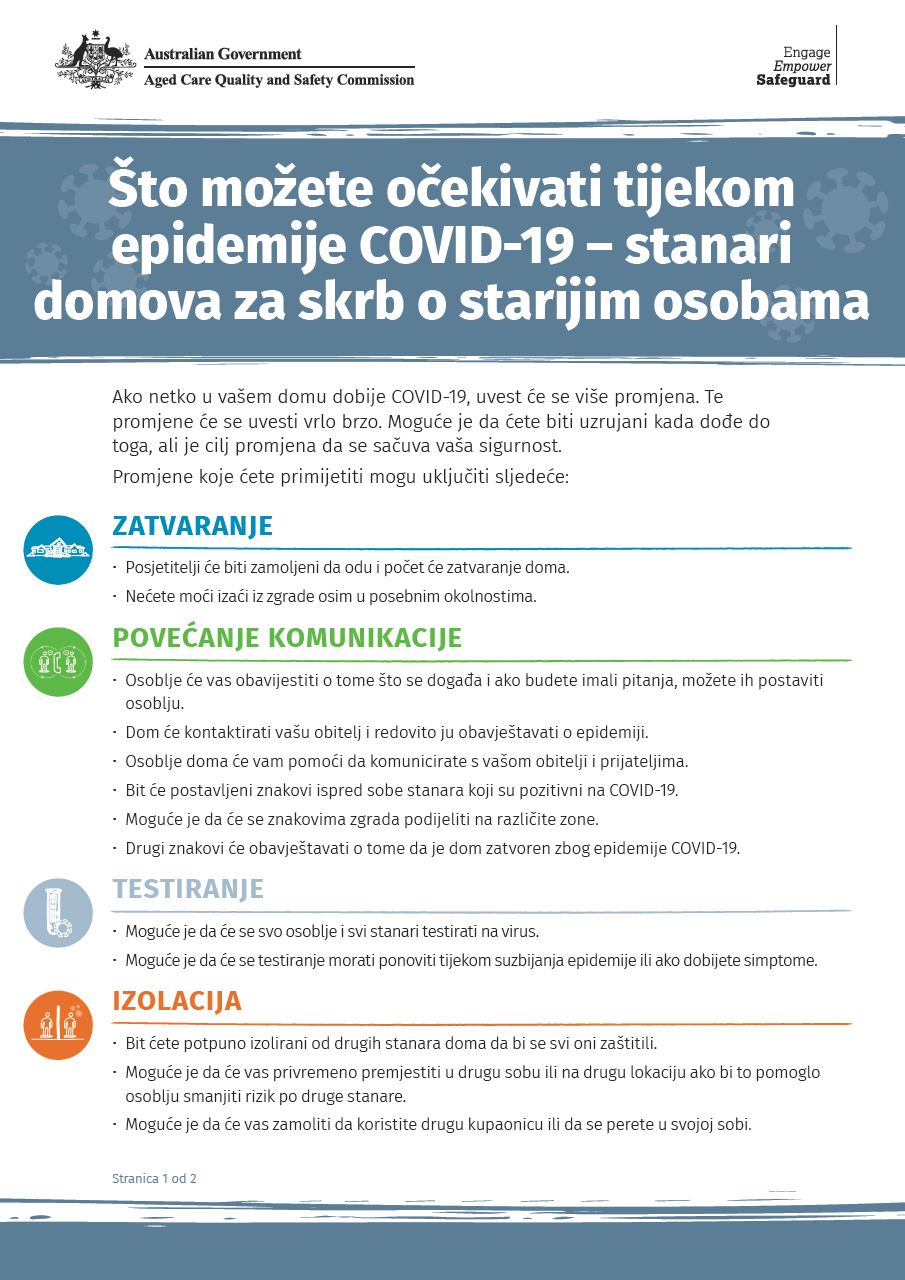
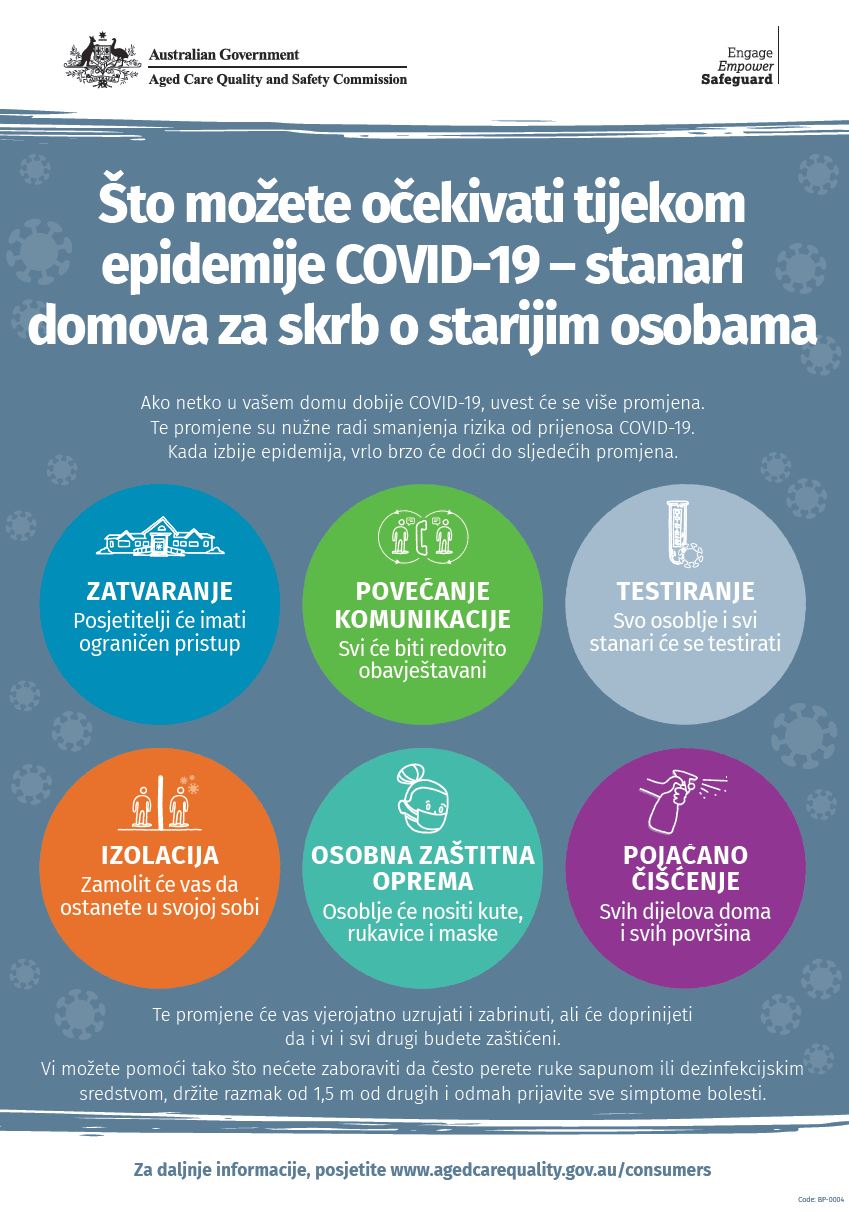
If someone has COVID-19 in your residential aged care service, a number of changes will take place. These changes will be made very quickly. You might be anxious when these changes take place but the aim is to keep you safe.
This poster has been translated into 15 languages to help residents understand what to expect in the time of COIVD-19.
This discussion paper explores strategies to improve medication management in aged care, including reducing inappropriate prescriptions and promoting non-pharmacological interventions. It reviews current interventions' effectiveness, highlights the use of psychotropic medications, and identifies areas for improving practices through multifaceted and multidisciplinary approaches for better resident outcomes and healthcare quality.
This resource may refer to information that will be updated from 1 November 2025 to align with the new Aged Care Act and Quality Standards.
On Thursday 6 August 2020, the Commission held a webinar for NSW/QLD-based providers of residential aged care services to share insights from the Commission’s work in monitoring and supporting services to prepare for and respond to an outbreak.

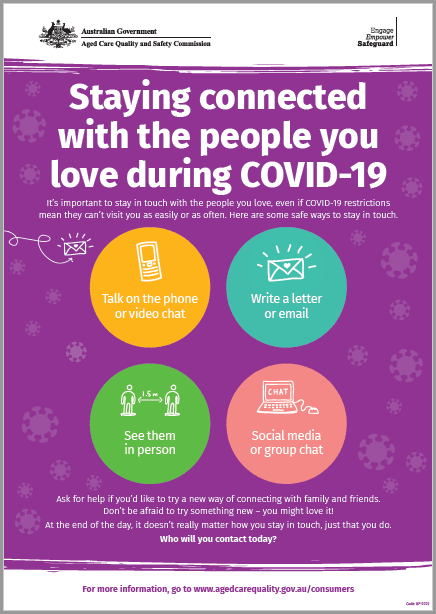
It’s important to stay in touch with the people you love, even if COVID-19 restrictions mean they can’t visit you as easily or as often.
Regulatory Bulletin RB 2020-11 Publication of provider performance information (PDF) (540.5 KB)
RB 2020-11 This Regulatory Bulletin details the information the Commission publishes about aged care service providers' performance in relation to their responsibilities under the Aged Care Quality and Safety Commission Act 2018 (Commission Act) and the Aged Care Act 1997, or the Commonwealth funding agreement that relates to a service.
States and Territories have established directions giving effect to the Australian Health Protection Principal Committee’s recommendation that visitors and staff (including visiting workers) should not be permitted to enter a residential aged care facility, if they have not been vaccinated against influenza (after 1st May 2020).
Residential aged care facilities may wish to display the attached poster at entrances, to alert anyone entering the facility of these flu vaccination requirements.
 Flu vaccination poster (PDF 122.41 KB)

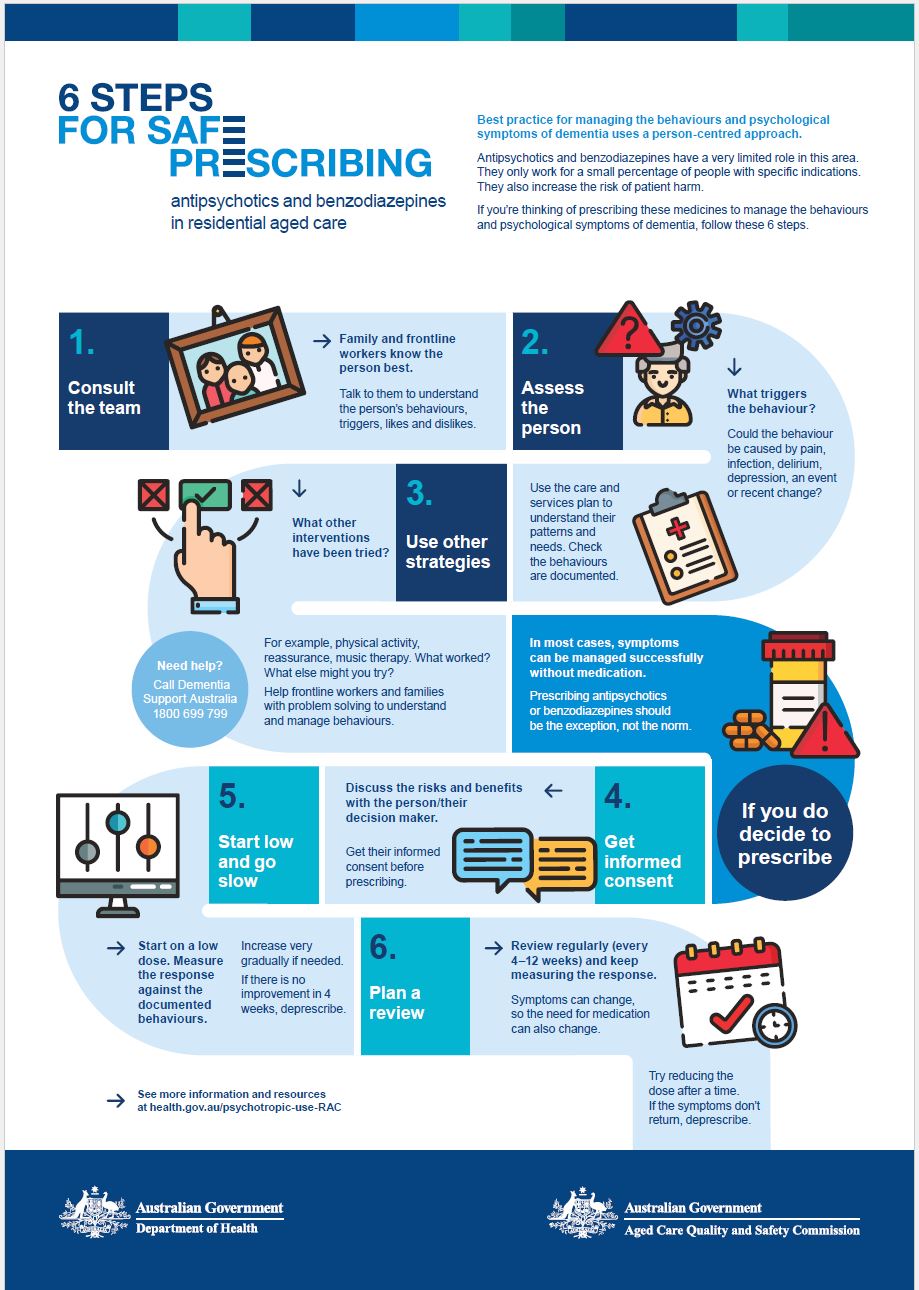
Six steps for safe prescribing antipsychotics and benzodiazepines in residential aged care.
If you’re thinking of prescribing these medicines to manage the behaviours and psychological symptoms of dementia, follow these 6 steps.
What are psychotropic medications?
Psychotropic medications are ‘any drug capable of affecting the mind, emotions and behaviour'
The three main classes of psychotropics prescribed are antidepressants, anxiolytic/hypnotics (mostly benzodiazepines to manage anxiety and insomnia) and antipsychotics. Other psychotropic classes include anticonvulsants and stimulants.

This resource was designed to support aged care providers to partner and engage with consumers to drive the delivery of consumer-centred care.
Working with aged care consumers - Resource (PDF 2.29 MB)

This literature review examines published peer-reviewed articles and a broader set of literature to gain an understanding of existing models of co-design that have been successfully applied in a range of sectors both in Australia and internationally, which could be applied in the Australian aged care sector.
To inform this piece of work, we have undertaken a literature review of co-design and consumer engagement.
ACQSC Consumer engagement in aged care - Literature review (PDF 984.98 KB)
This report describes the key themes and findings from online surveys of aged care consumers and aged care providers, regarding best practice models for engagement between consumers and providers.
ACQSC Consumer engagement in aged care - Survey report (PDF 459.97 KB)
The rights of consumers are protected by a Charter of Aged Care Rights. Download this helpful booklet for aged care service providers and their consumers.
This resource is not available to order on the Commission's website. Hard copies of the English version of the booklet are available at no cost from National Mailing and Marketing.
Charter of Aged Care Rights (English) (PDF 708.18 KB)
 Accessible – Charter of Aged Care Rights (English) (DOCX 237.15 KB)
Arabic – ميثاق حقوق رعاية المسنين (PDF 1.65 MB)
Chinese, Simplified – 老年护理权益章程 (PDF 1.67 MB)
Chinese, Traditional – 老年護理權益章程 (PDF 1.7 MB)
Dutch – Handvest voor Rechten in Ouderenzorg (PDF 1.54 MB)
German – Charta über Rechte in der Altenpflege (PDF 1.54 MB)
Greek – Χάρτα Δικαιωμάτων Φροντίδας Ηλικιωμένων (PDF 1.56 MB)
Hindi – वृद्ध लोगों के अधिकारों का घोषणा-पत (PDF 1.62 MB)
Hungarian – Idősgondozási jogok chartája (PDF 1.58 MB)
Korean – 노인 케어 권리 헌장 (PDF 1.58 MB)
Macedonian – Повелба за правата за старосна нега (PDF 1.57 MB)
Maltese – Ċarter tad-Drittijiet tal-Kura tal-Anzjani (PDF 1.55 MB)
Polish – Karta Praw w Opiece nad Osobami Starszymi (PDF 2.15 MB)
Russian – Хартия прав по уходу за престарелыми (PDF 1.57 MB)
Serbian – Повеља о правима старијих лица на негу (PDF 1.57 MB)
Accessible – Charter of Aged Care Rights (English) (DOCX 237.15 KB)
Arabic – ميثاق حقوق رعاية المسنين (PDF 1.65 MB)
Chinese, Simplified – 老年护理权益章程 (PDF 1.67 MB)
Chinese, Traditional – 老年護理權益章程 (PDF 1.7 MB)
Dutch – Handvest voor Rechten in Ouderenzorg (PDF 1.54 MB)
German – Charta über Rechte in der Altenpflege (PDF 1.54 MB)
Greek – Χάρτα Δικαιωμάτων Φροντίδας Ηλικιωμένων (PDF 1.56 MB)
Hindi – वृद्ध लोगों के अधिकारों का घोषणा-पत (PDF 1.62 MB)
Hungarian – Idősgondozási jogok chartája (PDF 1.58 MB)
Korean – 노인 케어 권리 헌장 (PDF 1.58 MB)
Macedonian – Повелба за правата за старосна нега (PDF 1.57 MB)
Maltese – Ċarter tad-Drittijiet tal-Kura tal-Anzjani (PDF 1.55 MB)
Polish – Karta Praw w Opiece nad Osobami Starszymi (PDF 2.15 MB)
Russian – Хартия прав по уходу за престарелыми (PDF 1.57 MB)
Serbian – Повеља о правима старијих лица на негу (PDF 1.57 MB)

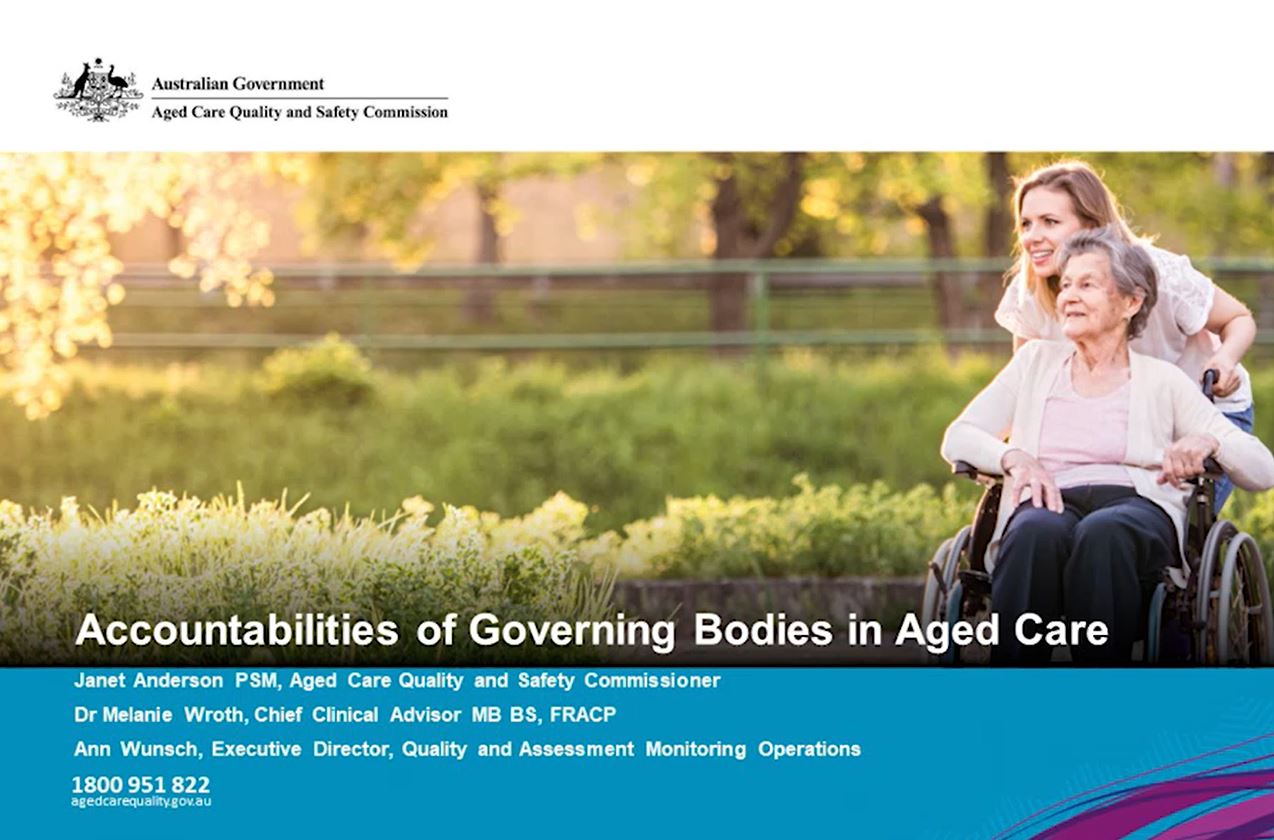
Under the Aged Care Quality Standards, the organisation’s governing body is accountable for the delivery of safe and quality care and services. This includes consideration of leadership, organisational culture, consumer engagement, organisation wide governance, risk management and clinical governance.
This webinar will help you to understand your regulatory and legislative obligations.
This resource provides guidance for creating safe, inclusive aged care for Forgotten Australians and Care Leavers, focusing on trauma-informed practices. It supports providers in recognising unique needs, avoiding re-traumatisation, and promoting respect and sensitivity in care environments.
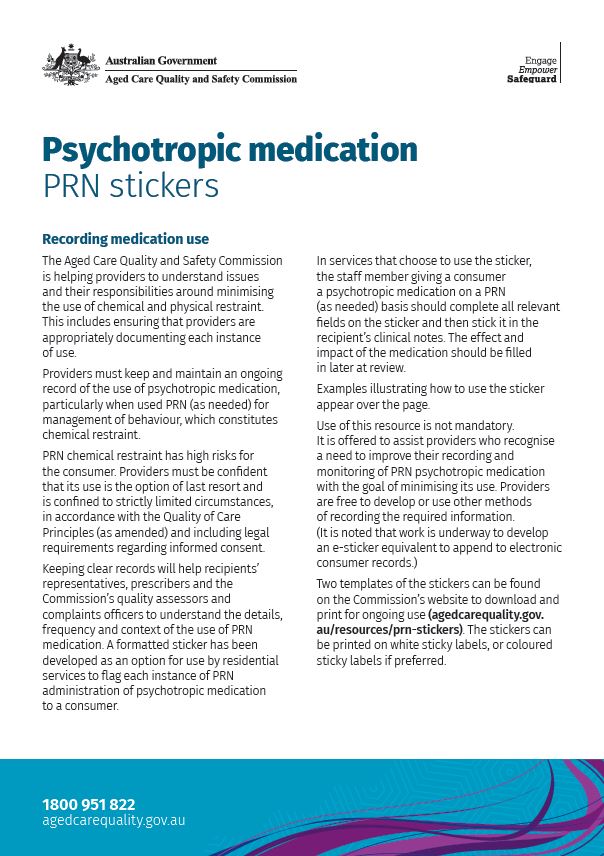
The Aged Care Quality and Safety Commission is helping providers to understand issues and their responsibilities around minimising the use of chemical and physical restraint. This includes ensuring that providers are appropriately documenting each instance of use.
ACQSC Psychotropic medication PRN stickers guide (PDF 692.76 KB)
ACQSC Psychotropic medication PRN stickers - colour template (PDF 85.93 KB)
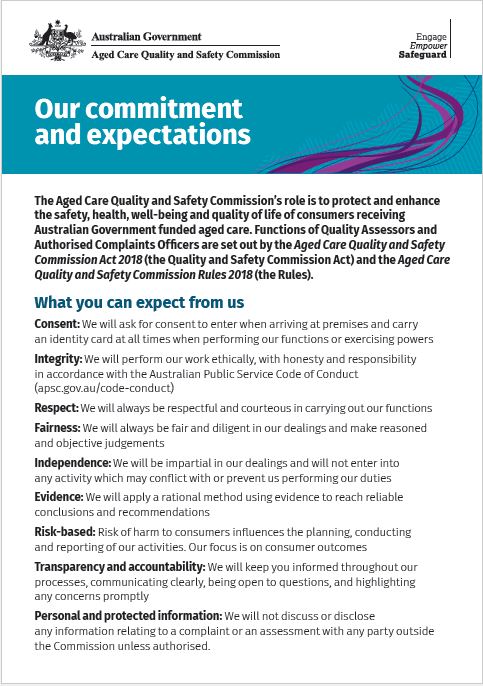
The Aged Care Quality and Safety Commission’s role is to protect and enhance the safety, health, well-being and quality of life of consumers receiving Australian Government funded aged care. Functions of Quality Assessors and Authorised Complaints Officers are set out by the Aged Care Quality and Safety Commission Act 2018 (the Quality and Safety Commission Act) and the Aged Care Quality and Safety Commission Rules 2018 (the Rules).
Our commitment and expectations - site visit information sheet (PDF 264.13 KB)
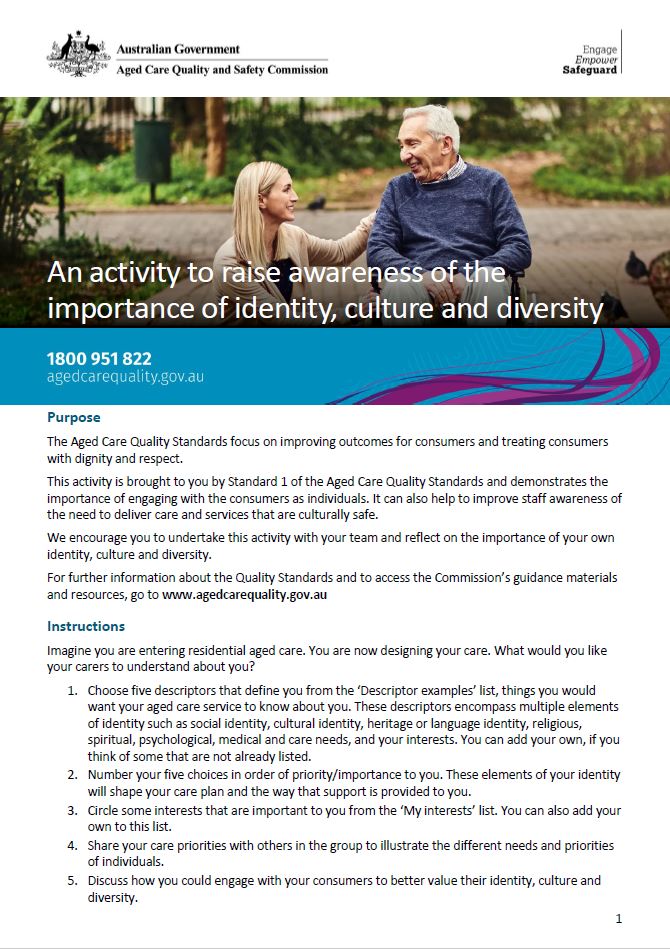
An activity to raise awareness of the importance of identity culture and diversity
Design your care activity - accessible version (DOCX 1.77 MB)
Design your care activity PDF (PDF 331.14 KB)
A new educational video for service providers has been produced providing information about open disclosure for aged care providers. The resource is a collaboration between the Commission and online training services provider, Altura Learning.

These scenarios cover a range of examples to help providers understand issues around the use of restrictive practices. They are intended to be illustrative only, and should not be relied upon as authority.
Restrictive practices scenarios (August 2021) (PDF 481.04 KB)