Our Managing Worker Risk Policy explains our approach in detecting, assessing and responding to risks arising from the actions, inactions and behaviours of workers.
This policy includes information about:
 Managing worker risk policy (PDF 386.18 KB)
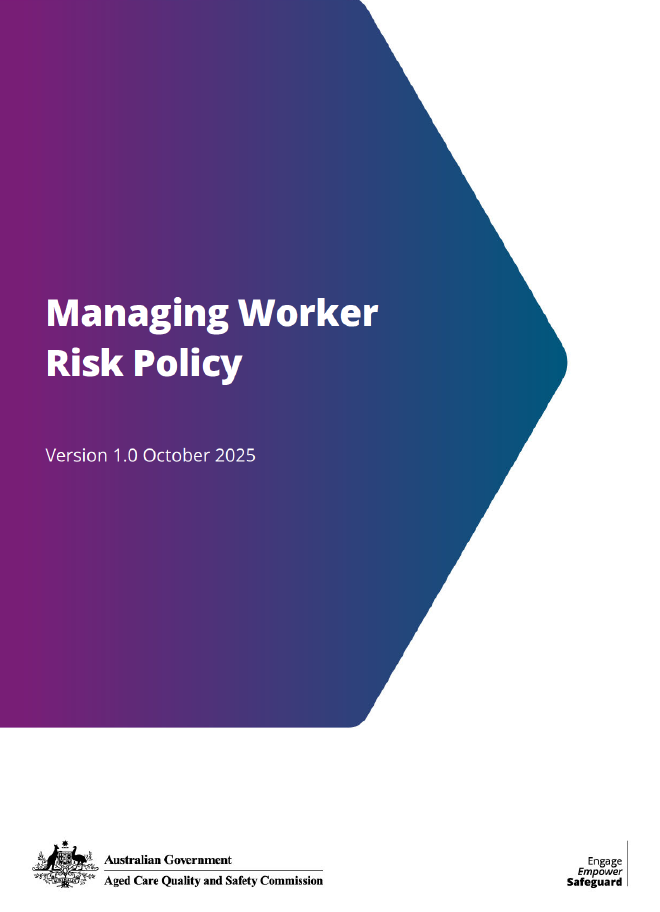
Providers must determine your evaluated minimum liquidity amount each quarter.
Use this approved form to notify the Commission that you are:
- electing to maintain,
- revoking an election to maintain, or
- re-determining
an evaluated minimum liquidity amount (evaluated MLA) under the Aged Care Financial and Prudential Standards 2025.
Evaluated MLA notification form (PDF 865.93 KB)
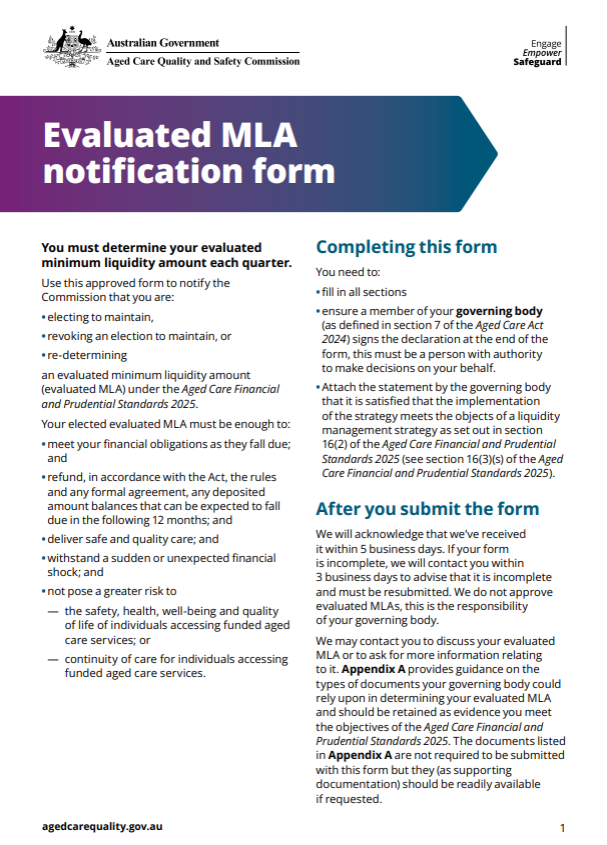
This document provides an overview of resources and learning opportunities to help aged care workers understand changes in the new Aged Care Act, and how they affect them, including :
- Aged Care Quality Standards
- Statement of Rights
- Aged Care Code of Conduct
- worker screening
- whistle blower protections
- complaints.
Resources for aged care workers – New Aged Care Act (PDF 581.94 KB)
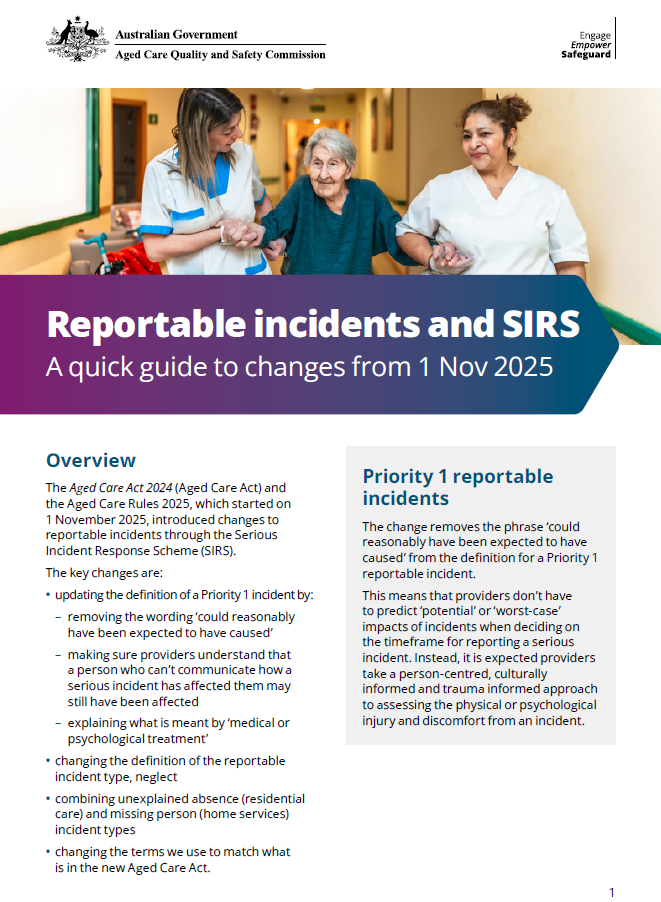
Joint letter from the Deputy Secretary, Ageing and Aged Care Group, Department of Health, Disability and Ageing and the Commissioner to Board Chairs and CEOs of Residential Aged Care Providers on Star Ratings Compliance rating.
The Commission released the draft Regulatory Strategy 2025–26 for feedback in August 2025. This consultation report summarises what we heard during the consultation process, and what we did in response.
public_consultation_report_-_2025-26_regulatory_strategy.pdf (PDF 315.59 KB)
2025-26 Regulatory Strategy
Our Regulatory Strategy sets out how the Commission will deliver on our goals and commitments.
Consultation Report – draft Regulatory Strategy 2025-26
The Commission released the draft Regulatory Strategy 2025–26 for feedback in August 2025. This consultation report summarises what we heard during the consultation process, and what we did in response.
2025-26 Regulatory Strategy (PDF 1.83 MB)
Draft Regulatory Strategy 2025–26 Public Consultation Report (PDF 315.6 KB)
2025-26 Regulatory Strategy Easy Read Version (PDF 2.68 MB)
The Aged Care Act 2024 (the Act) and the Aged Care Rules 2025, which started on 1 November 2025, introduced changes to reportable incidents through the Serious Incident Response Scheme (SIRS). This quick guide provides an overview of these changes.
The information in this fact sheet provides general guidance only. It’s your responsibility to know your obligations and legal responsibilities under the Act and the Aged Care Rules.
Our Compliance and Enforcement Policy applies from 1 November 2025.
The Policy explains the compliance and enforcement actions we can take to:
Compliance and Enforcement Policy (September 2026) (PDF 602.61 KB)
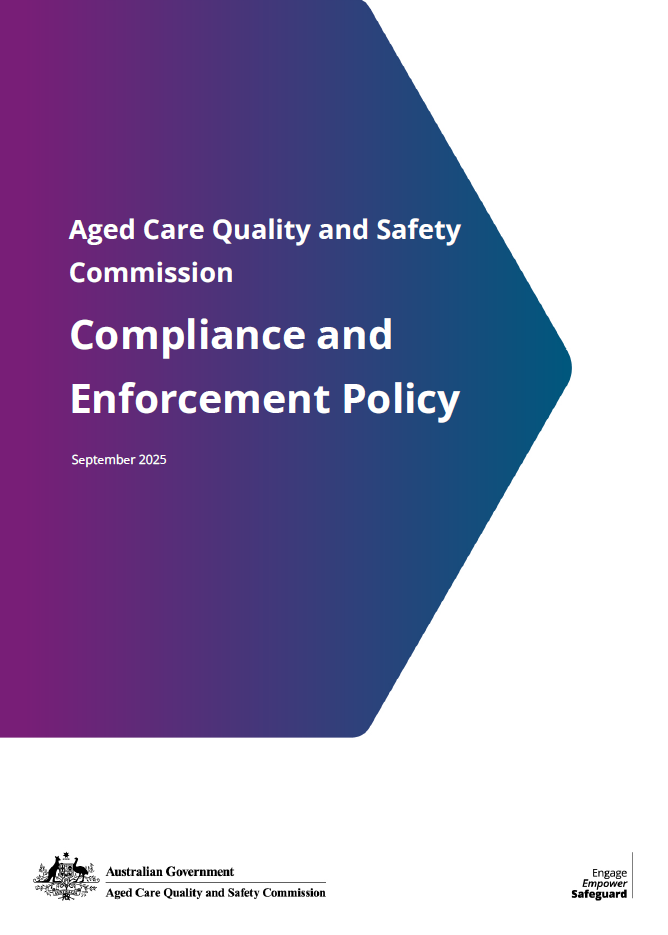
The Financial and Prudential Standards: Guidance for providers explains the new Financial and Prudential Standards, your obligations, and our regulatory approach. It also includes:
- an expanded Liquidity Standard section which sets out how providers must work out two minimum liquidity amounts (MLAs) each quarter
- clearer definitions of cash expenses, cash, and cash equivalents
- checklists for each Standard.
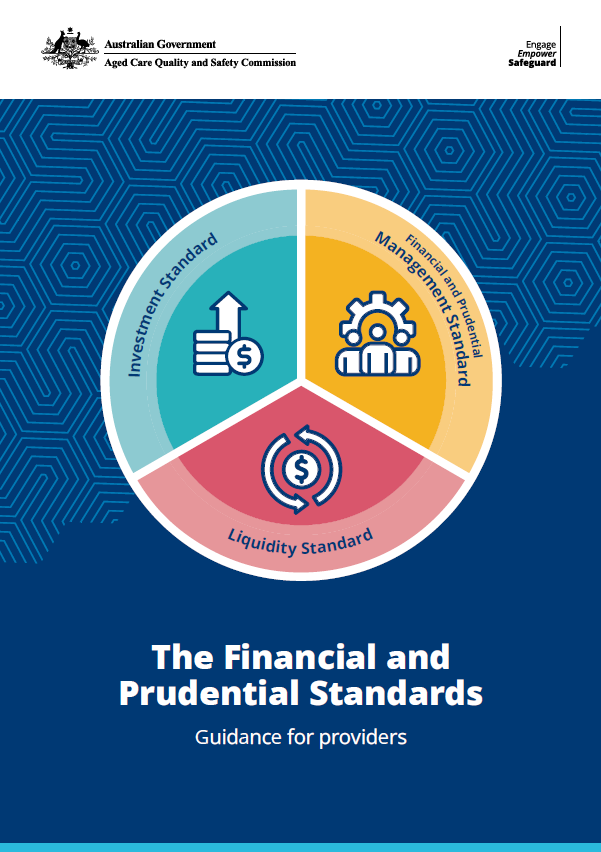
The Aged Care Quality Standards (Quality Standards) are a set of requirements that define what good care looks like.
They describe the standard of care you can expect from your aged care provider, whether you live in an aged care home or in your own home.
The Quality Standards have been strengthened to deliver better aged care for older people and took effect with the new Aged Care Act 2024 from 1 November 2025.
We have released a suite of overview fact sheets to help older people understand the new strengthened Quality Standards.
The strengthened Quality Standards come into effect in line with the commencement of the new Aged Care Act.
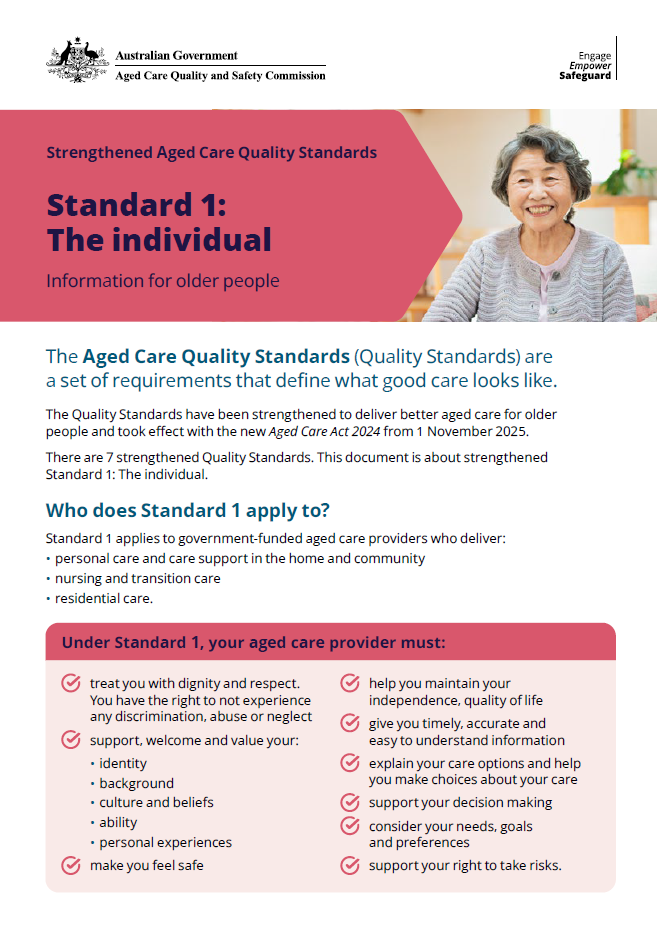
Strengthened Quality Standard 1: The individual means you have the right to be treated with dignity and respect, and to make your own choices about your life, care and services.
Standard 1: The individual - Information for older people (PDF 271.4 KB)
We have released a suite of overview fact sheets to help older people understand the new strengthened Quality Standards.
The strengthened Quality Standards come into effect in line with the commencement of the new Aged Care Act.
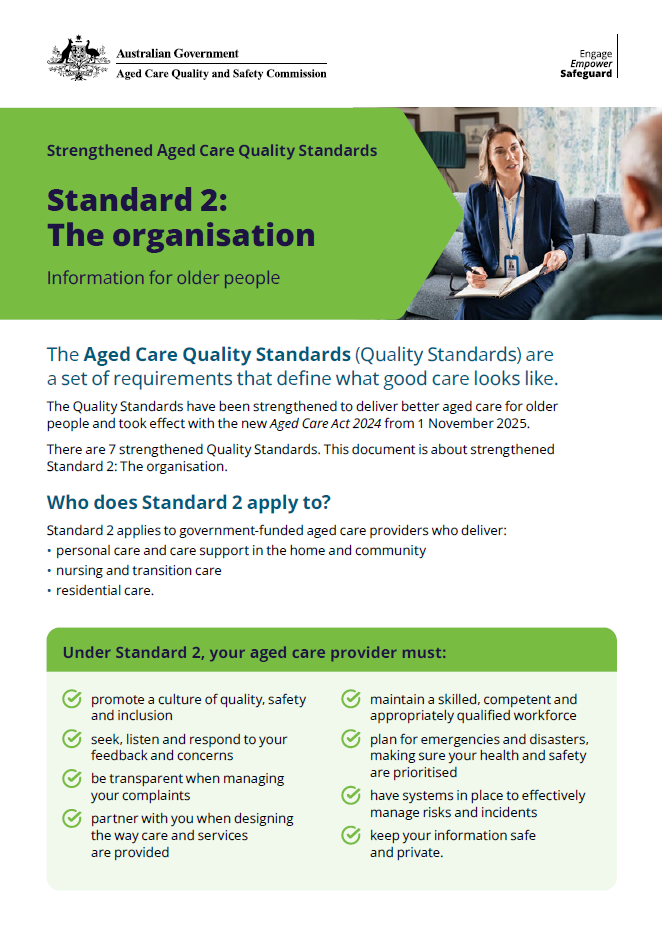
Strengthened Quality Standard 2: The organisation means that the organisation that provides your care should be well run, and your providers and workers listen when you give feedback.
We have released a suite of overview fact sheets to help older people understand the new strengthened Quality Standards.
The strengthened Quality Standards come into effect in line with the commencement of the new Aged Care Act.
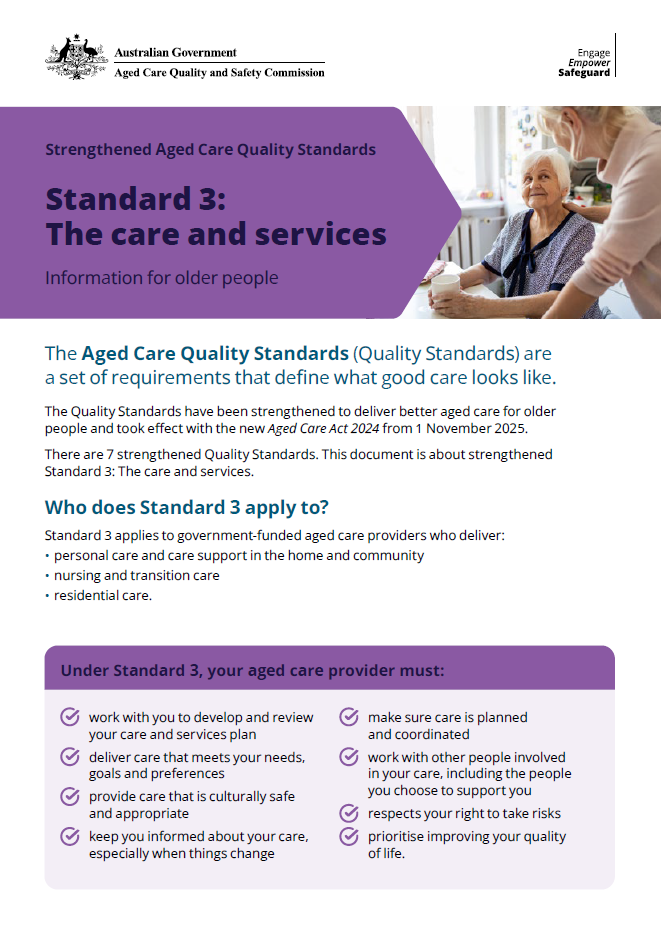
Strengthened Quality Standard 3: The care and services means the care you get is safe and effective, and meets your needs.
Standard 3: The care and services - Information for older people (PDF 291.91 KB)
We have released a suite of overview fact sheets to help older people understand the new strengthened Quality Standards.
The strengthened Quality Standards come into effect in line with the commencement of the new Aged Care Act.
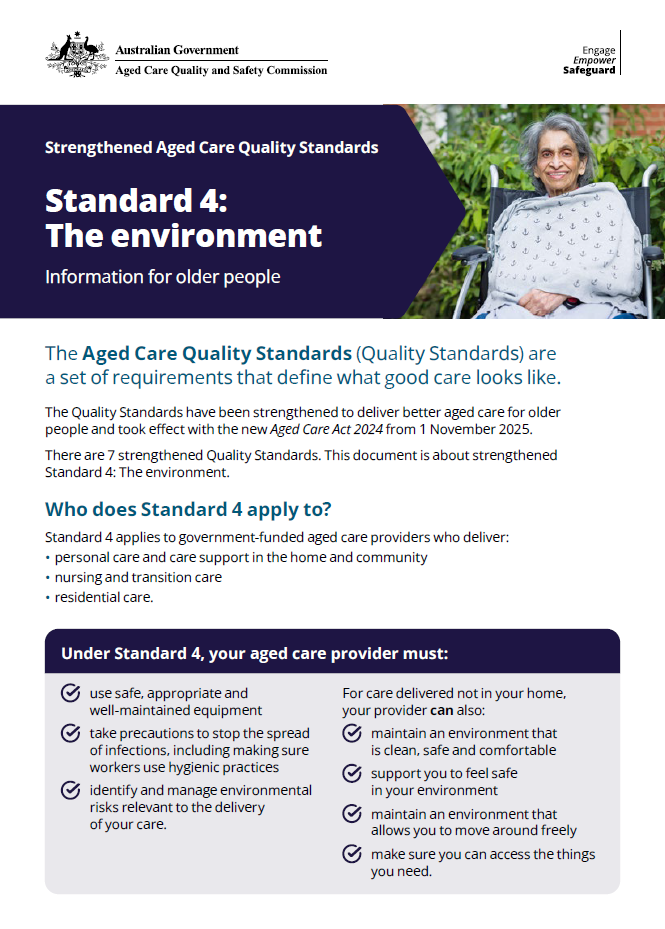
Strengthened Quality Standard 4: The environment means the care you get is delivered in a clean, safe, comfortable environment. You feel safe when using aged care services.
Standard 4: The environment - Information for older people (PDF 279.68 KB)
We have released a suite of overview fact sheets to help older people understand the new strengthened Quality Standards.
The strengthened Quality Standards come into effect in line with the commencement of the new Aged Care Act.
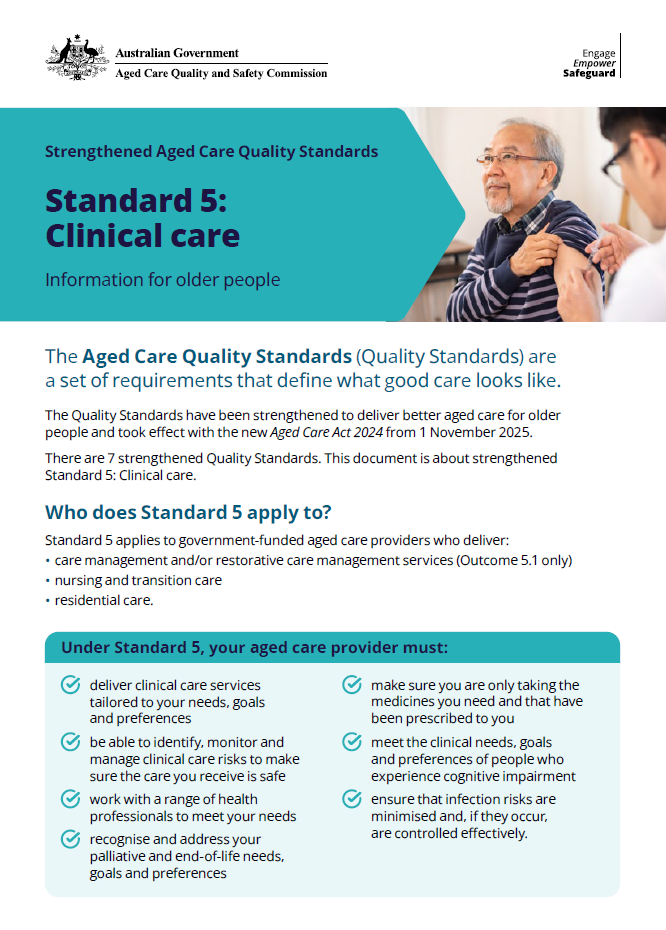
Strengthened Quality Standard 5: Clinical care means you get safe and quality clinical care services that are effective, coordinated, and continuously improved.
Standard 5: Clinical care - Information for older people (PDF 271.27 KB)
We have released a suite of overview fact sheets to help older people understand the new strengthened Quality Standards.
The strengthened Quality Standards come into effect in line with the commencement of the new Aged Care Act.
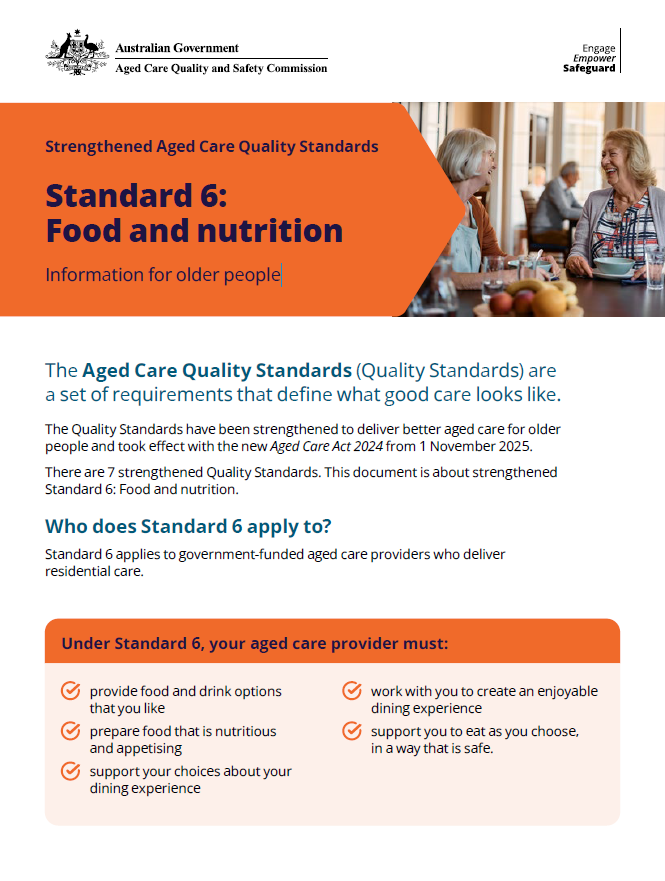
Strengthened Quality Standard 6: Food and nutrition means that you get plenty of food and drink that you enjoy.
Standard 6: Food and nutrition - Information for older people (PDF 264.89 KB)
We have released a suite of overview fact sheets to help older people understand the new strengthened Quality Standards.
The strengthened Quality Standards come into effect in line with the commencement of the new Aged Care Act.
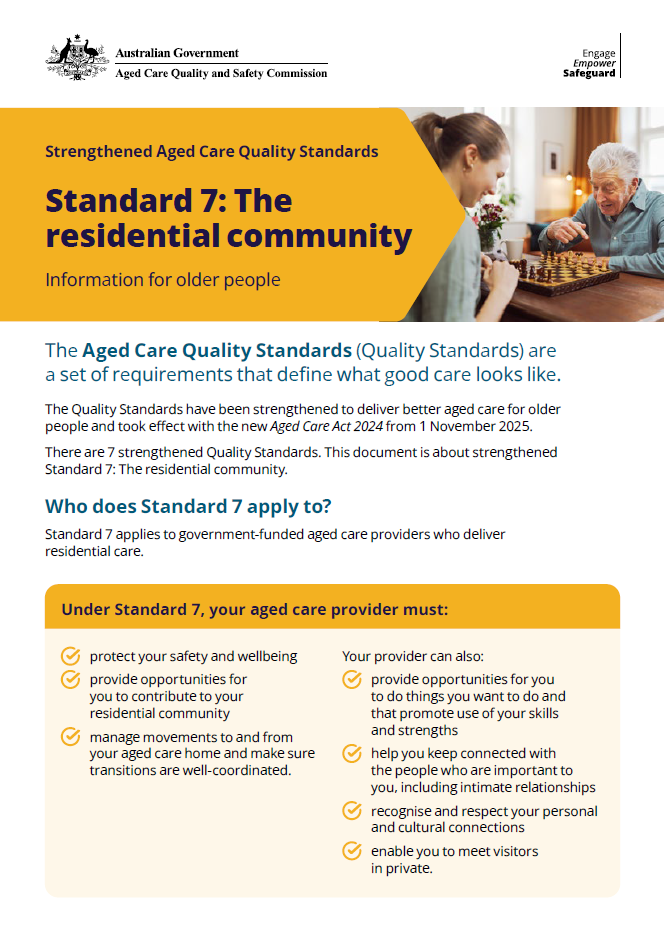
Strengthened Quality Standard 7: The residential community means you are supported to do things you want and enjoy, and you are helped to maintain connections and relationships.
The Aged Care Act 2024 (the Act) provides people with rights and protections from retaliation when they share information and make disclosures that qualify for protection under the Aged Care Act, about registered providers, responsible persons and aged care workers.
Our Managing Whistleblower Disclosures Policy explains how we receive, manage and use information shared with us that qualifies for whistleblower protections under the Act.
Managing Whistleblower Disclosures Policy (PDF 366.91 KB)
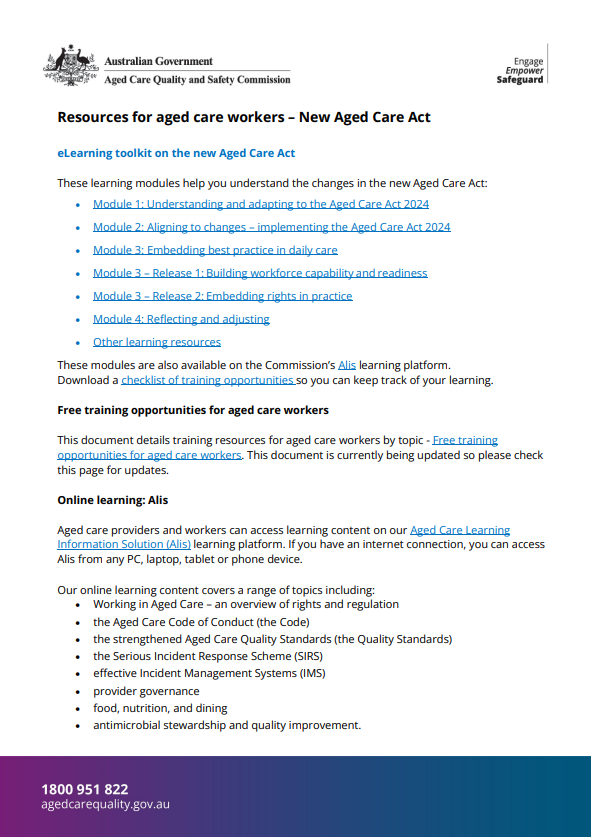
The Aged Care Act 2024 (Act) introduces ‘associated providers’. They are organisations that deliver aged care services on behalf of a registered provider.
This regulatory bulletin explains the types of entities (organisations and people) that are considered associated providers and the requirements that apply to them. We also explain the requirements of registered providers who use associated providers in the delivery of their aged care services.
Regulatory Bulletin RB 2025-1 Associated providers (PDF 368.03 KB)