The Quality Standards Resource Centre helps extend understanding of the strengthened Aged Care Quality Standards, which took effect from 1 November 2025. You can search for resources by using keywords, or filtering by standard, outcome and audience. Before using the Resource Centre, please read the terms of use.
To Dip or Not to Dip - Implementation Guide for Nurse and Pharmacist Champions
To Dip or Not to Dip (TDONTD) is a quality improvement intervention successfully implemented in UK and Australian aged care homes to improve UTI assessment and antibiotic prescribing appropriateness.
This implementation guide has been drawn from the experiences of homes and champions who have implemented TDONTD, along with feedback from aged care nurses and personal care assistants who have used TDONTD resources.

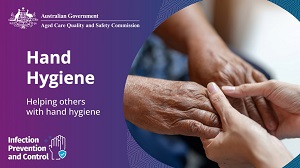
Hand Hygiene - Helping others with hand hygiene
Infection prevention and control helps to stop the spread of germs like bacteria and viruses that cause respiratory infections and gastroenteritis. Hand hygiene is a very important part of this.
In this video you will learn how to clean another person's hands.
Your role in infection prevention and control when visiting an aged care service
Infection prevention and control, also known as IPC, are the steps and processes that people can use to reduce the spread of harmful germs and bacteria.
People who visit aged care services can help support IPC processes.
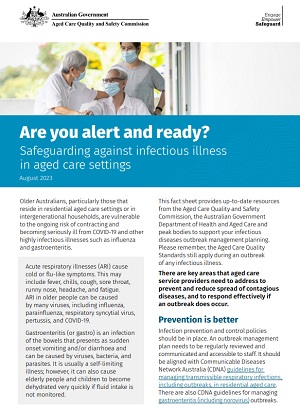
Are you alert and ready? Safeguarding against infectious illness in aged care settings
Older Australians, particularly those that reside in residential aged care settings or in multigenerational households, are vulnerable to the ongoing risk of contracting and becoming seriously ill from COVID-19 and other highly infectious illnesses such as influenza and gastroenteritis.
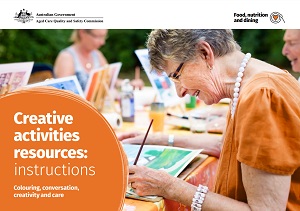
Colouring, conversation, creativity and care
These colouring resources have been designed specifically for the Aged Care Quality and Safety Commission with the intention of providing a multifaceted creative experience for older Australians living in residential or home aged care settings, and for the people who care for them.
 fnd-colouring-resources-engagement-pages.pdf (PDF 1.72 MB)
fnd-colouring-resources-instructions.pdf (PDF 3.86 MB)
fnd-colouring-resources-engagement-pages.pdf (PDF 1.72 MB)
fnd-colouring-resources-instructions.pdf (PDF 3.86 MB)
Partnerships in care – Partner information package
The partner information pack presents information for all people visiting and volunteering in residential aged care services. The resource includes information on the importance of infection prevention and control (IPC), the use of personal protective equipment (PPE), and changes in what you need to do if you visit during an outbreak.
Arabic - الشراكة في الرعاية الرعاية المشتركة (PDF 4.87 MB)
Chinese Simplified - 护理合作伙伴 携手护理 (PDF 4.81 MB)
Chinese Traditional - 護理合作夥伴 攜手護理 (PDF 4.73 MB)
Dutch - Samenwerking in de zorg Samen zorgdragen (PDF 4.34 MB)
German - Pflegepartnerschaften Gemeinsam pflegen (PDF 4.38 MB)
Hungarian - Gondozási partnerség Gondozás közösen (PDF 4.38 MB)
Korean - 돌봄 파트너십 함께하는 돌봄 (PDF 4.87 MB)
Latvian - Aprūpes partnerība Kopīgas rūpes (PDF 4.33 MB)
Macedonian - Партнерства во грижа Да се грижиме заедно (PDF 4.31 MB)
Maltese - Sħubija fil-kura Nieħdu ħsieb flimkien (PDF 4.35 MB)
Polish - Partnerstwo w opiece Wspólna opieka (PDF 4.37 MB)
Portuguese - Parceiros nos cuidados Cuidando juntos (PDF 4.37 MB)
Russian - Партнеры по уходу Заботимся вместе (PDF 4.33 MB)
Spanish - Atención en colaboración Cuidamos juntos (PDF 4.35 MB)
Turkish - Bakım ortaklıkları Birlikte dikkat etmek (PDF 4.32 MB)
Ukrainian - Партнерство у сфері догляду Піклуємося разом (PDF 4.33 MB)
Vietnamese - Quan hệ đối tác chăm sóc Cùng nhau chăm sóc (PDF 4.33 MB)

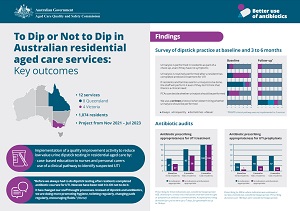
To Dip or Not to Dip in Australian residential aged care services - project findings
This visual abstract presents outcomes from a quality improvement project aimed at reducing low-value urine dipstick testing in aged care services. It included nurse education, implementing clinical pathways for UTI identification, and evaluating urinalysis practices and antibiotic prescribing. The findings demonstrate improved antibiotic prescribing appropriateness for UTIs over a 6-month follow-up period.
This resource may refer to information that will be updated from 1 November 2025 to align with the new Aged Care Act and Quality Standards.
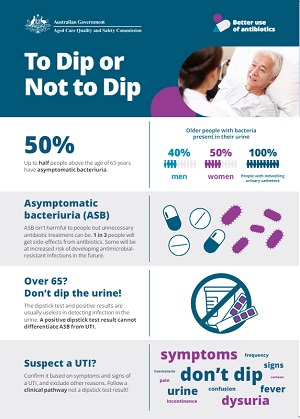
To Dip or Not to Dip - huddle tool A3 poster
This huddle tool poster provides guidance on appropriate use of urine dipstick tests in older adults. It explains that asymptomatic bacteriuria (ASB) is common and not harmful, but that unnecessary antibiotic treatment can be. It suggests confirming urinary tract infections (UTIs) through clinical symptoms rather than dipstick results.
This resource may refer to information that will be updated from 1 November 2025 to align with the new Aged Care Act and Quality Standards.
To Dip or Not to Dip - huddle tool A3 poster (PDF 393.96 KB)
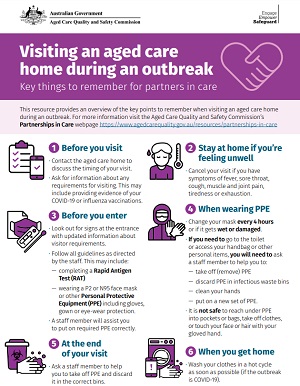
Visiting an aged care home during an outbreak - A3 poster
This A3 poster can be used by aged care facilities during an outbreak. It explains the key things for partners in care to remember when visiting an aged care home during an outbreak.
This resource may refer to information that will be updated from 1 November 2025 to align with the new Aged Care Act and Quality Standards.
Visiting an aged care home during an outbreak poster (PDF 323.5 KB)
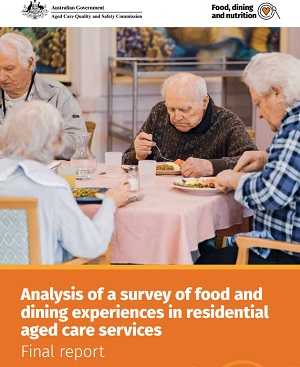
Analysis of a survey of food and dining experiences in residential aged care services - Final report
This resource provides insights into food, dining, and nutrition in residential aged care services. It is based on a survey conducted to understand residents’ dining experiences, preferences, and the quality of food and service provided. The findings highlight the importance of fresh, familiar meals, flexible mealtimes, and a homelike dining environment to enhance the quality of life for older people. This resource may refer to information that will be updated from 1 November 2025 to align with the new Aged Care Act and Quality Standards.
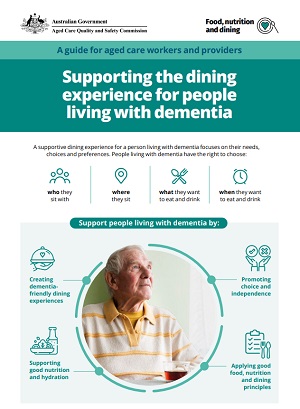
Supporting the dining experience for people living with dementia – Providers and workers guide
This guide is about how to support people living with dementia to maintain good nutrition and enjoy positive dining experiences.
This resource may refer to information that will be updated from 1 November 2025 to align with the new Aged Care Act and Quality Standards.
Regulatory Strategy 2024–25
Our Regulatory Strategy sets out how the Commission will deliver on our goals and commitments. This resource may refer to information that will be updated from 1 November 2025 to align with the new Aged Care Act and Quality Standards.
Regulatory Strategy 2024–25 (PDF 1.08 MB)
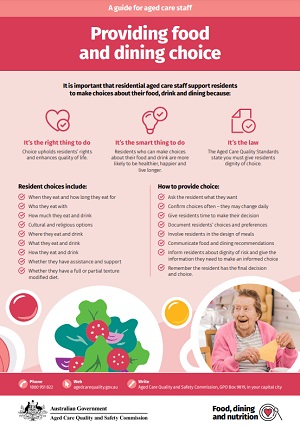
Providing food and dining choice - aged care staff poster
This guide supports aged care staff in providing food and dining choices for residents. It outlines the importance of upholding residents' rights to choose, enhancing their health and quality of life. The guide recommends confirming preferences regularly, involving residents in meal planning, and respecting individual choices regarding when, where, and what they eat or drink. This resource may refer to information that will be updated from 1 November 2025 to align with the new Aged Care Act and Quality Standards.
Providing food and dining choice - aged care staff poster (PDF 445.57 KB)
Food and dining - your choices matter
This fact sheet informs aged care residents of their rights to safe, enjoyable, and respectful dining experiences. It outlines steps for raising concerns with providers about food and dining, offers a preference form for residents to communicate their dietary needs, and provides contact information for support services if issues remain unresolved. This resource may refer to information that will be updated from 1 November 2025 to align with the new Aged Care Act and Quality Standards.
English - Food and dining – your choices matter (PDF 484.79 KB)
Arabic - تهمّّنا تفضيلاتكم في الطعام وعادات الأكل (PDF 767.17 KB)
Chinese Simplified - 食品和餐饮—— 您的选择很重要 (PDF 785.39 KB)
Chinese Traditional - 食品和餐飲—— 您的選擇很重要 (PDF 788.7 KB)
French - Alimentation et repas – vos choix sont importants (PDF 684.4 KB)
German - Essen und Speisen – Ihre Wahl zählt (PDF 686.18 KB)
Greek - Φαγητό και γεύματα – οι επιλογές σας έχουν σημασία (PDF 690.89 KB)
Hungarian - Ételek és étkezés – az Ön döntése számít (PDF 684.42 KB)
Macedonian - Храна и јадење - вашиот избор е важен (PDF 683.21 KB)
Maltese - L-ikel u l-ikliet - l-għażliet tiegħek huma importanti (PDF 685.65 KB)
Russian - Питание и прием пищи: ваш выбор имеет значение (PDF 682.53 KB)
Serbian - Храна и обедовање – ваш избор је важан (PDF 681.46 KB)
Spanish - Alimentos y comidas: sus preferencias importan (PDF 679.42 KB)
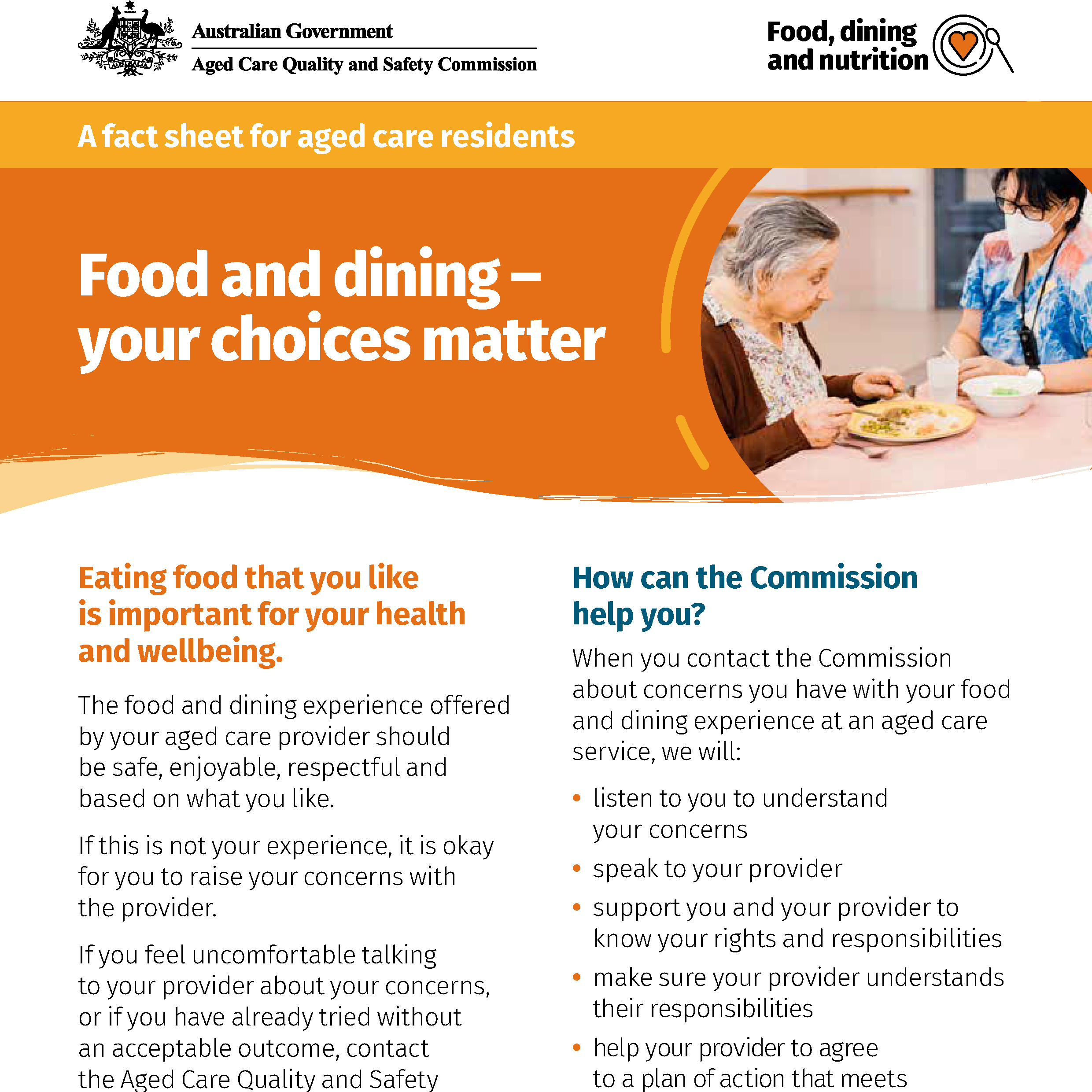
A little yarn goes a long way - Fact sheet
The ‘A little yarn goes a long way’ fact sheet has been developed to inform older Aboriginal and Torres Strait Islander people, and their friends and family, about the support available to help them resolve concerns about aged care services, and why it’s important to raise these concerns.
Information is also available in 7 different languages including: English, Alyawarra, Arrernte, Luritja, Pitjantjatjarra, Torres Strait Creole and Warlpiri.
English - A little yarn goes a long way (PDF 769.91 KB)
Alyawarra - A little yarn goes a long way (PDF 3.74 MB)
Arrernte - A little yarn goes a long way (PDF 3.73 MB)
Luritja - A little yarn goes a long way (PDF 3.73 MB)
Pitjantjatjarra - A little yarn goes a long way (PDF 3.73 MB)
Torres Strait Creole - A little yarn goes a long way (PDF 3.74 MB)
Warlpiri - A little yarn goes a long way (PDF 3.73 MB)
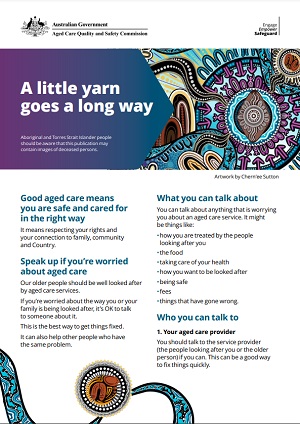
Food and drink in your aged care - supporting informed choice and risk - staff poster
This resource provides guidance for aged care staff on supporting older people's informed choices regarding food and drink, even when those choices involve personal risks. It encourages staff to respect resident autonomy, provide information on risks, document decisions, and ensure access to professional advice, promoting dignity and quality of life in care settings. This resource may refer to information that will be updated from 1 November 2025 to align with the new Aged Care Act and Quality Standards.
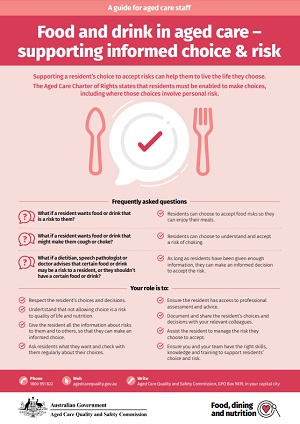
About the Food, Nutrition and Dining Hotline – provider and worker fact sheet
This resource provides information about the Food, Nutrition, and Dining Hotline, which offers advice and addresses concerns regarding food and dining in aged care. It allows aged care providers, staff, residents, families, and carers to raise issues about nutrition, menu planning, and dining experiences to improve quality and care outcomes. This resource may refer to information that will be updated from 1 November 2025 to align with the new Aged Care Act and Quality Standards.
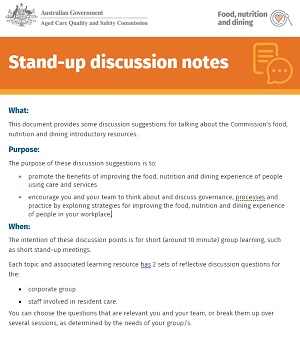
Food, nutrition and dining stand-up discussion notes
This resource provides discussion notes to improve the food, nutrition, and dining experience in aged care settings. It includes reflective questions for corporate teams and care staff, focusing on governance, resident choice, oral health, and support for those with swallowing difficulties. The resource promotes continuous improvement and quality care through group discussions. This resource may refer to information that will be updated from 1 November 2025 to align with the new Aged Care Act and Quality Standards.
 Stand-up discussion notes (DOCX 6.68 MB)
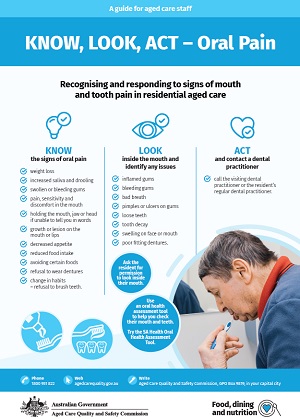
KNOW, LOOK, ACT - Oral Pain aged care staff poster
This poster serves as a resource for aged care staff to recognise and respond to signs of oral pain in residents. It provides guidance on identifying mouth and tooth pain and taking appropriate action to address these issues. The poster is available for download and use in residential aged care settings. This resource may refer to information that will be updated from 1 November 2025 to align with the new Aged Care Act and Quality Standards.
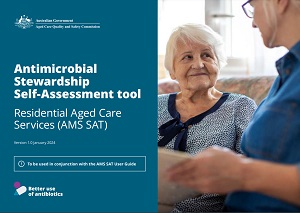
Antimicrobial Stewardship Self-Assessment Tool and User Guide
This tool and user guide supports residential aged care services in self-assessing their antimicrobial stewardship (AMS) practices. It covers AMS governance, policies, education, monitoring, and feedback, aiming to improve antibiotic use and reduce risks associated with antimicrobial resistance. The resources helps identify gaps and develop action plans to enhance AMS activities and patient care. This resource may refer to information that will be updated from 1 July 2025 to align with the new Aged Care Act and Quality Standards.