The ‘A little yarn goes a long way’ fact sheet has been developed to inform older Aboriginal and Torres Strait Islander people, and their friends and family, about the support available to help them resolve concerns about aged care services, and why it’s important to raise these concerns.
Information is also available in 7 different languages including: English, Alyawarra, Arrernte, Luritja, Pitjantjatjarra, Torres Strait Creole and Warlpiri.
 English - A little yarn goes a long way (PDF 769.91 KB)
Alyawarra - A little yarn goes a long way (PDF 3.74 MB)
Arrernte - A little yarn goes a long way (PDF 3.73 MB)
Luritja - A little yarn goes a long way (PDF 3.73 MB)
Pitjantjatjarra - A little yarn goes a long way (PDF 3.73 MB)
Torres Strait Creole - A little yarn goes a long way (PDF 3.74 MB)
Warlpiri - A little yarn goes a long way (PDF 3.73 MB)
English - A little yarn goes a long way (PDF 769.91 KB)
Alyawarra - A little yarn goes a long way (PDF 3.74 MB)
Arrernte - A little yarn goes a long way (PDF 3.73 MB)
Luritja - A little yarn goes a long way (PDF 3.73 MB)
Pitjantjatjarra - A little yarn goes a long way (PDF 3.73 MB)
Torres Strait Creole - A little yarn goes a long way (PDF 3.74 MB)
Warlpiri - A little yarn goes a long way (PDF 3.73 MB)
RB 2019-06 This Regulatory Bulletin outlines the principles and practices that form the Commission’s framework for making decisions relating to its regulatory functions. It outlines how the Commission will ensure high quality and consistent decision-making under the Aged Care Quality and Safety Commission Act 2018 and Aged Care Quality and Safety Commission Rules 2018.
RB 2019-06 Regulatory decision-making (PDF) (PDF 1.38 MB)
 RB 2019-06 Regulatory decision-making (accessible Word doc) (DOCX 153.07 KB)
The Aged Care Quality and Safety Commission has worked with a range of stakeholders to develop resources that help aged care providers understand the key concepts of clinical governance and how they can be applied in their service.

A practical guide developed by the Working Group on Influenza Outbreaks in Residential Care Facilities on behalf of the Communicable Diseases Network of Australia. The purpose of the document is to assist residential care services and carers by providing best practice information for the prevention and management of influenza outbreaks in residential care facilities.
rcf_guidelines.pdf (PDF 2.25 MB)
To assist aged care providers, the Commission has identified some of the very useful information and resources produced by Commonwealth and State Departments of Health.

Open disclosure is the open discussion that an aged care provider has with people receiving aged care services when something goes wrong that has harmed or had the potential to cause harm to a person receiving aged care service. With more than 1.3 million people receiving care in Australia, this is a crucial activity for providers to support continuous improvement within their service.
ACQSC_Open_Disclosure.pdf (PDF 874.11 KB)

This provider template is for recording information for consumers receiving psychotropic medications.
Psychotropic medications self-assessment tool template (DOCX 687.53 KB)
RB 2019-04 (Rescinded)- This Regulatory Bulletin outlines how the Commission will respond to and manage non-compliance with the Aged Care Quality Standards.
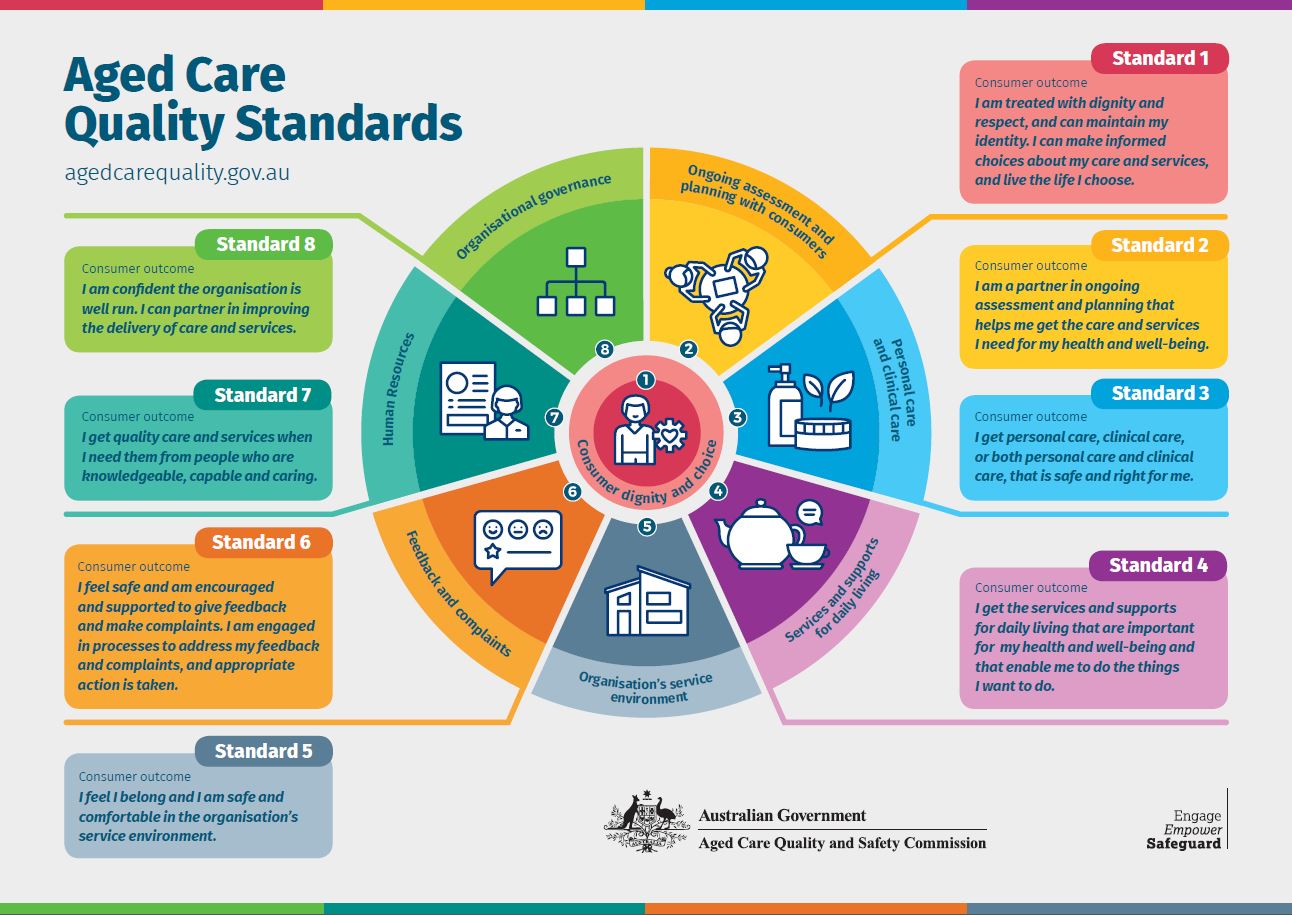
Download the English Aged Care Quality Standards Consumer Outcomes A2 poster. This resource is not available to order.
Aged Care Quality Standards Consumer Outcomes A2 poster (PDF) (PDF 260.38 KB)
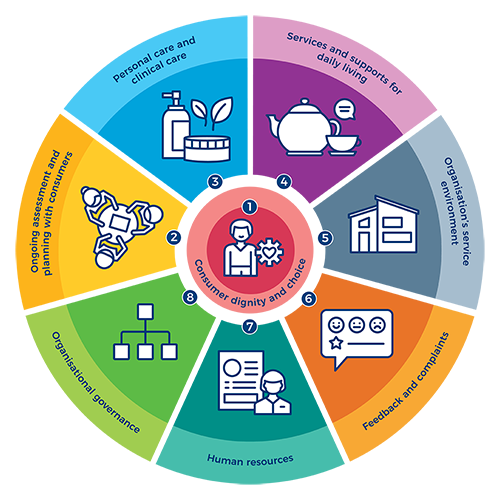
Download the Commission's Aged Care Quality Standards imagery, including the Standards wheel and individual Standards icons. Includes terms of use.
A short video for aged care consumers, their families and representatives explaining the new Aged Care Quality Standards (Quality Standards) that began on 1 July 2019. Watch the video to see what the new Quality Standards mean in practice for you.
Note: This resource is not available for hard copy order.

A 30-minute Aged Care Quality Standards educational video for service providers.
This resource is not available to order.

The Aged Care Quality and Safety Commission's Corporate Plan January to June 2019
Corporate Plan – January to June 2019 (PDF 4.5 MB)

Aged Care Quality and Safety Commission Statement of Intent 2019.
Commission Statement of Intent 2019.pdf (PDF 200.47 KB)
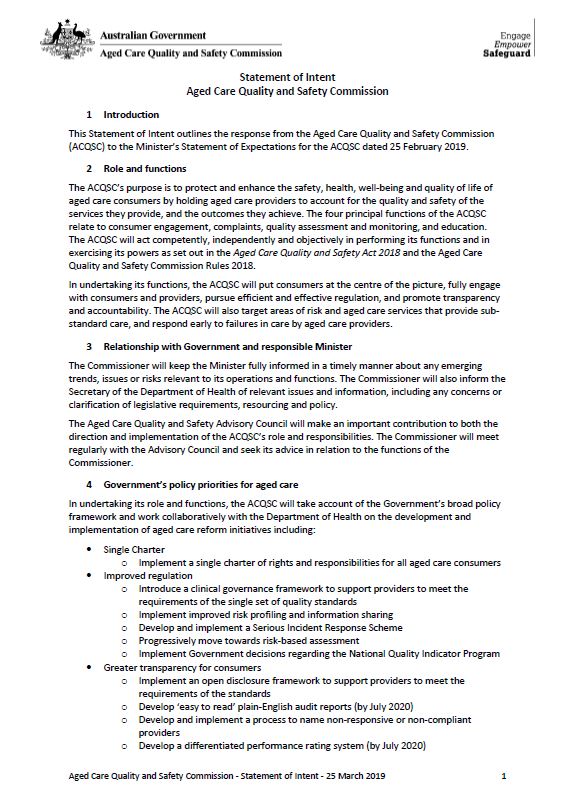
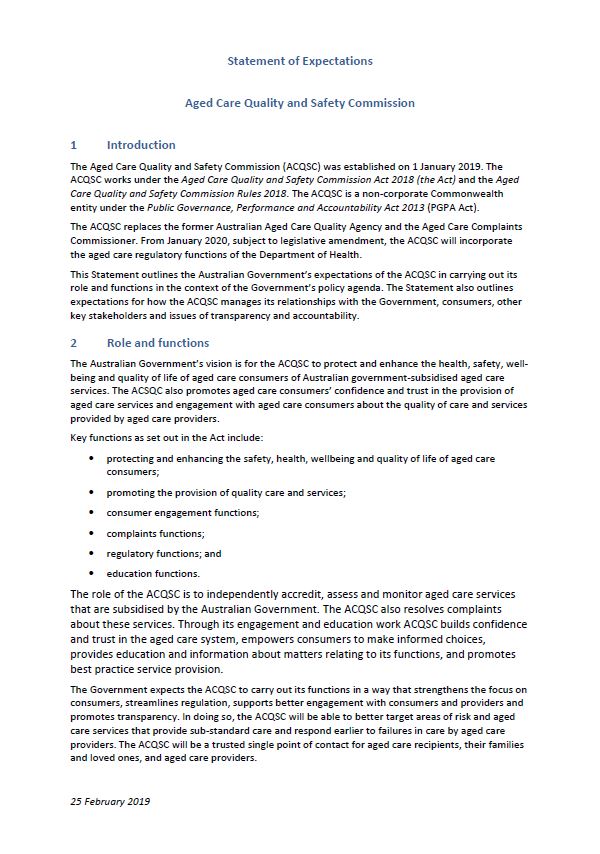
The Aged Care Quality and Safety Commission Statement of Expectations 2019.
Commission Statement of Expectations - 25 February 2019.pdf (PDF 563.53 KB)
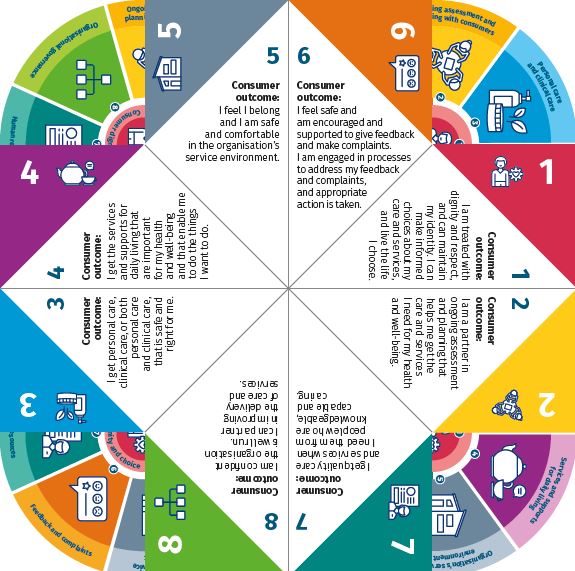
A downloadable chatterbox template to support aged care service providers and their consumers engage with the new Aged Care Quality Standards.
This resource is not available to order.
chatterbox_web.pdf (PDF 804.94 KB)

A short video aimed at aged care providers to support them to prepare and take action to meet the new Aged Care Quality Standards.
This resource is not available to order.

Key changes to accreditation and re-accreditation under the new Aged Care Quality and Safety Commission Act 2018 and Rules.
Accreditation and re-accreditation key changes fact sheet (DOCX 199.45 KB)
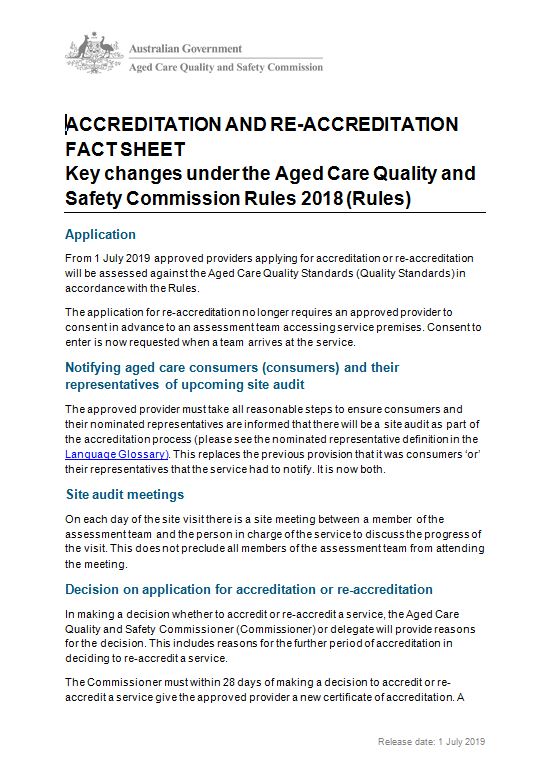
Part of a fact sheet series related to Key changes under the new Commission Act and Rules
As part of the application for accreditation and re-accreditation, applicants must include ‘any other information or documents specified by the Commissioner’. This replaces the previous requirement for submission of self-assessment information. The new requirement covers self-assessment material as well as any other information or documents specified by the Commissioner.
Request for specified information key changes fact sheet (DOCX 198.44 KB)